Category: Features

  • Remembering Lord David Young: Tributes from David Cameron, Theresa May, and More

    Former prime ministers and business royalty pay tribute to the remarkable businessman, politician, and philanthropist who sadly died in 2022 at the age of 90

    There are successful business people, successful politicians, marvellous philanthropists and then there’s David Young. He is one of those very few who seemed equally at home in all three worlds. He was also, of course, at the start of his career, a lawyer, and to the many people who came forward to contribute to this special Finito World tribute, a loyal and valued friend, mentor and confidante. His death in December 2022 was met with the dismay and remembered affection which always accompanies the passing of an unusually productive life.

    Young was born in 1932 to an orthodox Jewish family near Minsk in what was now Belarus; his family fled a pogrom there and Young’s father prospered in business, as his son would do. Naturally, he never forgot these circumstances; in her moving tribute Wendy Levene remembers his profound commitment to the Jewish Museum later in life.

    David Young was admitted to be a solicitor in 1955, but it was business – or enterprise, as he would later refer to it – which was his real passion. Even in his early 20s, he was an executive at Universal General Stores. Not all successful executives can successfully found businesses but Young found he could, creating a series of companies in property, construction and plant hire, eventually selling his interest in June 1970 to Town & City Properties plc. The rest of that decade followed on a similar track; it was a tale of considerable success in business.

    When Margaret Thatcher said that other Cabinet ministers came to her with problems and that Young came to her with his achievements, she didn’t add that these were numerous. But then she didn’t have to; Young, who served in her Cabinet for most of the second half of her Downing Street tenure, was always a favourite of Britain’s first female Prime Minister.

    Young served successively in Thatcher’s Cabinets as Minister Without Portfolio, Secretary of State for Employment, and  Secretary of State for Trade and Industry, and President of the Board of Trade. In the latter role he found his metier, racking up air miles on behalf of UK plc. His passion for business was just as relevant to that role as it was in the business world itself.

    Though he would return to government to advise David Cameron on enterprise (perhaps the happiest period of his life), he also had a superb final chapter outside of government in business with Simon Alberga (who writes movingly about his friendship in these pages), and in philanthropy. By this point in life, he was a sage. People continually sought his advice; and he continually found time to offer it. His death was a sadness to all of us at Finito World. We have done our best to preserve, the example of his remarkable life is preserved in this pages.


    Former Prime Minister David Cameron
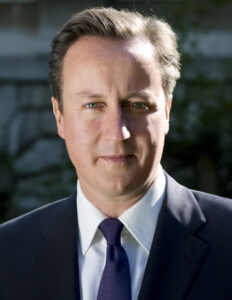


    I first met David in 1988 when I worked in the Conservative Research Department covering trade, industry and energy. This meant following his department, the Department for Trade and Industry. David was famously one of Thatcher’s favourite Ministers, and you could see why. I was a 20-something researcher; he was a Secretary of State with many years’ experience. Yet he treated me with great warmth and kindness, inviting me to his weekly ‘Ministerial prayers’ meeting, where his top team discussed the challenges of the day.

    Fast forward to 2010 when I became Prime Minister and one of my biggest challenges was bringing down the barriers to business that were preventing our economy from growing. I knew exactly who I wanted to help me in this endeavour. I called up David Young and invited him back into government as my Enterprise Adviser. Fortunately, he agreed. From his office in 10 Downing Street he produced report after report which led to concrete reforms, such as start-up loans, that truly helped to kickstart growth in our country.

    David was my oldest adviser, but he was one of the most dynamic. It was wonderful having him around No10 and being able to call on his advice and wisdom. His legacy lives on in all those businesses he helped to get off the ground, all the policies he helped to drive forward, and all the people – like me – who he inspired during his four decades in public service. He will be much missed but very fondly remembered.


    Former Prime Minister Lady May

     

    Image ©Licensed to i-Images Picture Agency. 01/08/2016. London, United Kingdom. Prime Ministers Official Portrait. Picture by Andrew Parsons / i-Images


    David Young was a remarkable man, constantly enthusiastic and brimming with ideas. Crucially these were ideas that led to action which improved the lives of people here in the UK. He was a consistent champion of enterprise and an invaluable adviser to a number of Conservative governments and Prime Ministers. I never met David without him coming up with a new proposal for boosting the economy, encouraging new business or helping young people. His energy and interest in others, together with his passion for enterprise, were infectious and have left a lasting legacy for so many. It was a privilege to have known him.


    Lord Cruddas, businessman and philanthropist

    I met Lord Young when he was Chairman of the Trustees for the Prince’s Trust; it was around 2006. I had created the Peter Cruddas Foundation and I wanted to donate to good causes. At that point, I met Lord Young and instantly took a great liking to him – partly because of his political background. I’m a big Margaret Thatcher fan, because of the way in which she transformed the country. As I knew David had been in her Cabinet, I was awe-struck to meet him.

    But he turned out to be charming – a lovely man, and very down-to-earth. I donated to the Prince’s Trust. Here was a man who was willing to sit down, talk to me, help me, guide me, and mentor me. We became great friends. I invited him to be the Chairman of my Foundation and he introduced me to the lawyer Martin Paisner who helped also.

    Over time, our friendship developed. I went to his house in Graffham and became friends also with his lovely wife Lita, Lady Young. At his house in Graffham, there was a Spitting Image puppet of David himself in his study which his family had managed to get hold of, and which I thought was very funny.

    David also introduced me to opera. When you come off a Hackney council estate, you don’t often go to the Royal Opera House in Covent Garden; he took time to explain the music to me, and today, whenever I go to the opera, I think of him.

    He was very smart on technology. I remember at his 80th birthday party, one of his grandchildren gave a speech saying that he was one of the few grandchildren who go to their grandfather for technological advice: David could fix anything. Imagine being in your eighties and embracing all this new technology – mobile phones and computers and so on. You always learned about technology from Lord Young.

    I’m very sad that he has passed away. But I take comfort in the thought that he had a good and rewarding life. I’m proud to say he was one of my dear friends. But really it was more than that: he was like the father I never had.


    Ronel Lehmann, Chief Executive of Finito Education

    Lord Young was a legend. David was often to be seen at high-profile business, political, charitable and other community events. He was the one person that every entrepreneur queued up to meet, either to seek his opinion, share news about a deal or development or just to shake his hand. He had time and always made time for you. He always reached out to those who need a helping hand, the old-fashioned way.

    I remember when I was thinking of setting up Finito in 2016, I made an appointment to see him at his offices overlooking Regent’s Park. He liked the purpose that we had set ourselves to help young people find their meaningful career before reminding me of his own passion for the Enterprise Passport, a digital record of activities which he championed for young people to help underpin their own career prospects.

    It was a genius idea never adopted by Government to record pupils through school and beyond about their career development for prospective employers seeking proven employability skills. Earlier this year, we remembered his contribution and paid tribute to his vision at the launch meeting of the AAPG on The Future of Employability.

    We first met many years before when Lord Young was appointed Chair of the British Israel Chamber of Commerce (now UK Israel Business). He penned a letter to his fellow long-standing Board of Directors thanking us all for our service and then asking us for our immediate resignations. I replied, “Dear David, No, Yours, Ronel,” and then continued to serve under his stewardship for many more years. David retorted that he liked to sort the wheat from the chaff. We laughed about it every time we met, and I took pleasure reminding him.

    He had an office at 10 Downing Street under David Cameron’s Premiership and relished holding meetings there to discuss the latest business topics. On one occasion, we sat there drinking the worst coffee ever, but he was so engaged about the issues, it never mattered.

    In his last email exchange with me, I shared with David a letter I had submitted to The Times, praising his idea of the Enterprise Passport. Sadly, it had been rejected, but I wanted to share the letter, and so wrote to him copying in his niece Imogen Aaronson, to whom David had recently introduced me.

    His response was characteristically funny and kind.  “Thank you very much for the thought, pity the Letters Editor did not have your taste and judgment! I am not sure what you two are plotting together but you both are in good hands. Take care and stay safe.” I will miss his smile and bow tie.


    Sir Lloyd Dorfman CVO CBE

     

    One of David’s catchphrases was “Life’s a bicycle – stop peddling, and you fall off!” It was a phrase I often quoted and it encapsulated the man. Well after the point most people have retired, he continued to combine a dizzying mixture of commercial, public service and charity commitments.

    My relationship with David straddled social, charity and business worlds. It reflected the diversity and depth of his life and work. Over time, he became a mentor and a friend, and I always valued his advice and opinions on any subject.

    Whilst I knew David a little from the 1970s, it was really through my involvement in Jewish Care starting in the 1990s that I came to know him better. The charity is the Jewish community’s largest welfare organisation. David was its President and I joined the Board in 1997.

    It was through the Prince’s Trust, however, that I became much closer to him. I was invited to join the charity’s Development Board in 2002, which he chaired. I soon learnt what a pivotal figure David was in the Trust’s evolution. Whilst the charity had been founded by the then Prince of Wales in 1976, David had helped accelerate its growth.

    He was supportive of the charity enabling young people from underprivileged backgrounds find jobs and also start businesses. As Secretary of State for Employment and then for Trade and Industry in the 1980s, he famously devised a matched fund-raising scheme to support the Trust’s enterprise work. The government ended up committing millions of pounds, much more than had been imagined, to the surprise even of his Prime Minister Margaret Thatcher.

    When David stepped down from the Board in 2007, he recommended I should take his place. I went on to become Chairman of Prince’s Trust and Prince’s Trust International. Overall he played a pivotal role in the growth of the Trust to become, what is today, the King’s oldest and largest charity.

    The charity links did not stop there. I served alongside David on the Board of Community Security Trust, which protects British Jews from antisemitism. David and I also ended up in business together. He brought me an opportunity to invest in an oil technology business. His enthusiasm for dynamic businesses with growth potential never dimmed.

    Over the years, Lita and David became cherished friends. They joined us on one particularly memorable group holiday to the Galápagos Islands. It was the first trip there for all of us. David was an especially keen photographer and took great pride in presenting everyone with a fabulous photo album at the end of the trip. Another lovely social memory was joining him and the family for his 80th birthday weekend at his family home in Sussex.

    This coincided with the end of his time as Chairman of the Chichester Theatre, yet another cause David had poured his energies and talents into, originally rescuing it from closure. David enjoyed the arts and particularly loved coming to the Royal Opera House. When I became Chairman last year, he was characteristically very supportive.

    On social occasions, you saw the side of David as a devoted family man. It was clear how much Lita was a rock for him, and how much he adored her. He would not have had the impact he had, without her constant support.

    David was a loyal friend and an exceptional man, with so many dimensions. His legacy is his family and friends, and the many causes and charities he supported with his leadership, charisma and passion. The world will be a lesser place without him.


    Simon Alberga
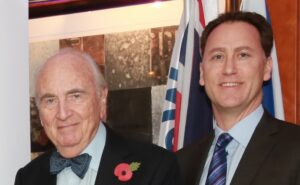
    David Young lived an extraordinary life. Through my close association with him in business and communal matters over the course of 26 years, the word I would most closely associate with David is positive. Whether in the realm of business, community affairs or politics, David always approached life with a can-do attitude. In my view, this is a hallmark of successful people and a significant part of the reason David achieved so much in his life. Rather than dwelling on potential impediments to success, David always focused on the art of the possible, and invariably he was a driving force behind making things happen. David believed in the power of one’s actions to effect positive change in the world.

    In the world of business, David was a committed risk-taker, and he always believed success would come through a positive approach to working with good and talented people, despite the inevitable risks associated with business ventures. He was often – though not always – right, though he was right often enough to achieve great things in business. It was, however, in areas which were particularly important to David, such as education and skills development, that he understood the need to think and act positively.

    David was passionately determined to help less fortunate people advance in life. David was a big part of the reason I became involved in the Jewish charity ORT, which helps people across the world with education and skills training to gain employment and provide for themselves, their families and communities. David was also a great communicator with extraordinary interpersonal skills. He was affable, generous, good-humoured and cultured. People loved to be in a room with David, chat with him and, if they were lucky, work with him.

    I will always cherish the 26 years of friendship, mentorship and support I received from David Young. He has left a great void in many of our lives, though if we can take forward his legacy of positivity, then we may also be fortunate enough to achieve some of the great things he achieved during the course of his extraordinary life.


    Wendy Levene

    Both Peter and I knew David and Lita over a number of years, meeting at charity events, mutual friends’ occasions and occasional dinners. We have regularly enjoyed each other’s company and have mutual respect for one another.

    I really got to know David well when I invited him to become Chairman of the Jewish Museum London. Admittedly, it took some persuasion but I won him over and he agreed. That was in 2010.

    We were in desperate need of leadership, integrity and funding. David had all of those qualities. He brought in amazing contacts and raised large amounts of funding to keep the Museum afloat. He had also been involved in other very worthy charities, Coram Trust, Chai Cancer Care and Chairman of the Chichester Festival Theatre – all remarkable institutions to which David devoted much of his time.

    What was so apparent to me was that David loved the Museum and the role it played in the community. He was so proud of his Jewish roots and was determined to acknowledge the role that the Jewish people had played in this country. In his ten years as Chairman of the Museum he and I formed a great working relationship. He teased me mercilessly and always claimed it was all my fault that he was Chairman of the Museum! He loved the Museum and took the Museum out of a difficult period into much better times. David didn’t tolerate fools but admired hard work, dedication and integrity.

    David is very much missed by me and many many people – he left an indelible mark on our lives. Rest in peace.


    Lord Leigh of Hurley

    Lord Young of Graffham was a role model and mentor for me having known him for literally all of my life: he was a friend of my late father –and my grandparents. I remember clearly when he first entered Government how unusual it was in those days for a businessman to be catapulted in to high office.

    His first day in the House of Lords he spoke on training for young people, a passion for him along with tech. Then, shortly afterwards, he had to answer four questions and their supplementaries in a row: that would have been longer than PMQ’s.

    I was always struck by his great humility. Despite rising to great distinction under a number of Prime Ministers, he never needed or sought praise. He knew what he was doing and he knew where he came from, always remembering and respecting his background and his community with enormous acts of philanthropy. He will be deeply missed


    Chelsey Baker, Chief Executive & Founder, National Mentoring Day
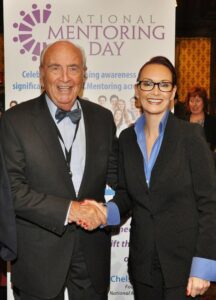
    I first met Lord Young back in 2012 when I was a lead mentor for the government backed Start Up Loans scheme, which Lord Young conceived to boost entrepreneurial spirit in the UK. Entrepreneurs were given a mentor alongside a start-up loan to launch their business. Lord Young firmly believed in the value of mentoring citing, ‘The mentor is far more important than the money! That’s what made all the difference to me when I was starting out.’

    I saw the impact that mentoring had on the lives of these young entrepreneurs and came up with the idea to launch National Mentoring Day to increase mentoring for all ages. Lord Young was my first choice to become our Patron. We shared a similar passion for supporting entrepreneurship and a vision for mentoring to be at the forefront of business and education.

    During the inauguration of National Mentoring Day at the House of Lords in 2016, Lord Young gave the opening speech declaring, “I had a mentor when I started my first business, and he saved me more than once. I hope that National Mentoring Day will encourage more people to act as a mentor.” His words certainly left an indelible mark on everyone.

    Last year saw our biggest National Mentoring Day on record. Lord Young believed in my vision to elevate all forms of mentoring and championed our mission to ensure everyone has an opportunity to reach their fullest potential with access to mentoring. For this I will be forever grateful.

    Lord Young loved his bow ties and loved mentoring. The world has lost a truly great mentor, but his legacy will live on not only as our founding patron but in all the lives he touched.


    Michael Hayman MBE

    As he did for a great many, David Young brought solutions to my life and never problems.

    What a privilege to have a friend who lived life to the full and made such an immense contribution to public and business life. He was one of the greats and for all of the right reasons.

    We worked together on the start-up agenda during his time as enterprise advisor to the then Prime Minister David Cameron. He encouraged me and others to have a go at making a difference. The result was the national campaign for early stage firms, StartUp Britain.

    As well as its contribution to UK start-ups, it would, on a personal level, usher in a great and defining friendship between us.

    We had many adventures and for me it was also an opportunity to watch a master at work. I self-styled myself as his ‘bag carrier’, an incredible apprenticeship working with someone with the skill, judgement and attitude to bring people together and get things done.

    He had the greatest of hearts and its pulse pumped with enthusiasm, fun and energy. It brought out the best in you. He was like instant sunshine.

    That attitude I think made all the difference and was key to his incredible track record. If you look at the list of achievements in enterprise policy since 2010 you will see the hand of David Young in all over them.

    He told me that those years in the run up to his retirement from government were among his happiest. Given his career roll call it was a quite a thing to say. But the reason was that it allowed him to focus on small firms, his life passion and mission to see succeed.

    He would often compare and contrast with the recommendations of the Bolton report in the 1970’s that predicted a corporatist future of very large companies with little room for entrepreneurs. It was a view he did not share.

    Fast forward to today and the UK is a small firms economy – five million of them and some 800,000 business registrations every year. That this is so, says much about David’s gift of prediction but also his proactive contribution to making change happen.

    I interviewed him on his last day in Downing Street and remember his words: “We’ve got a good thing going unless we mess it up.” They are words that this generation of politicians would do well to heed in their appreciation of entrepreneurs when it comes to the growth of the economy.

    I often find myself asking: “What would David do?” He’d probably tell me to get on with it. As he told me: “My definition of wisdom is the accumulated memory of past mistakes! “

    And he also said this: “If we all focused our efforts on the journey rather than the destination the world would be a far better place.”

    It was why he believed in action and lived a life vested in the defeat of problems and the pursuit of solutions. I miss my friend immensely.


    Michael Hayman MBE co-founded the national campaign for early stage enterprise, StartUp Britain and chairs the Small Business Charter.

  • The Rise of Portfolio Careers: Could this be the era of the new Renaissance Man?

    Christopher Jackson


    I’ve been lucky enough to go often to Florence, more than any other the city of the Renaissance man. Each summer the crowds gather outside the copy of the Michelangelo David beside the Palazzo Vecchio, and I wonder how many people there know that its creator also wrote poetry, and designed the stairs to the Laurentian Library about half a mile away. They queue around the block for the Ufizzi galleries, and when they’re inside they long to see Leonardo’s Annunciation. But it isn’t widely known that Leonardo was also a fine musician and for his time, a mean palaeontologist. People often feel they are dreaming when they come to Italy, because the past has such a strong pull. But we must also ask ourselves why they have that pull. It’s because these figures have a reach and potential that, however clever we might think we are, demonstrably exceeds our own: they were the Renaissance Men.

    For myself, sometimes I’ve taken a moment to sit on the benches in the square Santa Maria Novella, the façade of which was produced by the man who is sometimes said to have started it all Leon Battista Alberti (1404-1472). Alberti might be better known if one were better able to pinpoint who he was – but that’s just the point, he was the original owner of what today we call the portfolio career. However he seems to have gone out of his way to make his identity as difficult to define as possible. He was by turns an author, artist, architect, poet, priest, linguist, philosopher, and cryptographer. Alberti is probably now a little in the shadow of Leonardo Da Vinci and Michelangelo, both of whom could do almost anything, and perhaps you might say, could do all those things a little better than Alberti. But there is a daring about Alberti which is part of the Florentine spirit. Perhaps he is more fitting emblem of the Renaissance that Michelangelo and Leonardo, those superb outliers. Alberti embodies the opportunities of doing lots of little things, but perhaps in a way some of the drawbacks.

    It is sometimes said that Goethe, who died in 1832, was the last person alive to know the entire state of human knowledge as it was at that time. Nobody who has studied him can ignore that for Germany’s most famous poet he knew an awful lot about physics – and architecture, art, plants, geology and everything else. Others have observed that Joyce’s Ulysses, that massive work published in 1922, showed that its author had arrived at something close to a complete knowledge of the world as he found it at the start of the 21st century.

    Received wisdom is that this is no longer possible. The story goes like this. In the 21st century it became quite impossible to arrive at any overall view of things, because everything from poetry to mathematics became almost outrageously specialised. You might just about get your head around Nils Bohr’s physics, but it would come at the cost of not being able to understand The Wasteland. I must admit that I have rather tended to dislike this reductive and unambitious way of living. It was Saul Bellow who in The Adventures of Augie March (1953) had its hero say: “This is an age of specialisation and I am not a specialist.” In my own life, I’ve found myself writing books about figures as disparate as Theresa May and Roger Federer – and also had a stab at a long book on American democracy, and fiction and poetry too. I’ve also wanted to mentor, start magazines, edit, paint, and play piano. It is a moot point as to whether I have ever done these things well: but I know this tendency within myself to lie so deep as to amount to a fact of my life.

    This restlessness, you might say, or perhaps inquisitiveness, can be punished by the world. It doesn’t make one easily categorizable. It was something which the late Clive James, who insisted on his write to appear on television, while also translating Dante and learning the tango (and speaking about ten languages), used to complain about. Today it can still look rather peculiar on CVs to have wheeled about continually: he speaks of lack of staying power, and can raise doubts (often justified ones) about the extent of one’s commitment to any one thing.

    One such person is Anushka Sharma, the founder of the London Space Network, who tells me of her own portfolio career. “I worked in politics but then left in 2012 to work in the Olympics,” she recalls. “I then went into self-employment and began working in the start-up ecosystem, before realising my passion was space. I was building up a network, doing a lot in the space sector, and people would say: ‘You’re doing so much in space but not telling anyone.”

    Life for Anushka was somewhat unpredictable. She recalls: “I was straddling one six-month contract with one and then another, getting a break in between, getting access to the space community. I was network mapping and looking at the opportunities. I’ve definitely had a portfolio background.”

    But this, she says, has brought both huge benefits and certain costs. “I’ve followed what I love and what I’m passionate about. My CV was rejected by so many jobs. Prospective employers would assume I’d get bored, or they’d say they didn’t understand my story. It’s only now in retrospect that all this makes sense.”

    Finito mentor Sophia Petrides has seen this regularly with her candidates: “I see this a lot in my work as a coach. Clients who are feeling burned out and stuck often come to me for help in navigating this difficult time and figuring out their next career move. In many cases, a portfolio career can be a good solution. It allows them to leverage their skills and experience in a way that is more fulfilling and sustainable.”

    She attributes the trend to a range of factors. The first is a desire for flexibility. “Many individuals seek greater flexibility in their work lives to pursue multiple interests and accommodate personal commitments,” Petrides explains. “A portfolio career allows them to design a work schedule that fits their lifestyle.” This, she continues, carries with it possible financial benefits, in particular diversification of income: “With the rise of the gig economy and freelance opportunities, individuals may choose a portfolio career to diversify their sources of income. This can provide greater financial stability and resilience against economic downturns or job loss.”

    Of course there’s risk attached too in that one’s roots across different sectors may somehow be shallower than is the case with somebody who becomes highly expert in a single, durable career. People with portfolio careers are best advised to make sure that they are following their passion – or passions – otherwise the risks of this path may not seem worth it. Petrides continues: “A portfolio career allows individuals to pursue multiple interests and passions simultaneously, leading to a more fulfilling and varied work life. This can lead to greater job satisfaction and a sense of purpose. Furthermore, some people have a diverse set of skills and interests that may not be fully utilized in a traditional career path. A portfolio career allows them to leverage all their talents and expertise across different roles or industries.” We’re also, she points out, at a point in time where all this is possible and so why not give it a try? “The nature of work is evolving rapidly with technological advancements and globalization,” she explains. “A portfolio career offers individuals the opportunity to adapt to these changes by continuously learning new skills and exploring different opportunities.”

    However, while these benefits are real, they will likely fit a particular sort of person – and even that sort of person might want to be aware of certain potential drawbacks. “On the downside of a portfolio career, juggling multiple roles or projects can be challenging and may lead to income variability as you constantly chase the next job,” Petrides adds. “Balancing different commitments can also be overwhelming, potentially leading to stress and burnout if not managed effectively. Additionally, you may lack benefits such as health insurance or retirement plans.” All in all, like everything in life, it’s a choice: “In today’s uncertain times, having a portfolio career can offer advantages by making individuals more agile, resilient, and adaptable to change. It allows them to find joy in life by pursuing diverse interests and maintaining a flexible work-life balance.”

    But how to know whether this path is for you? Petrides outlines certain personality types who might be particularly suited to a portfolio career. Her first category are those who are curious and creative, adding that “those who enjoy finding new solutions and exploring different ideas are likely to thrive in a portfolio career. The variety of work can help them stay engaged and motivated.” But she’s also keen to point out that this is no walk in the park. She adds that you’ve got to be self-disciplined (“managing multiple projects and clients requires strong time management and organisational skill” as well as adaptable (“the ability to learn new skills and adjust to changing markets demands is essential for success in a portfolio career”). It’s also important to work on your networking skills.

    So are we perhaps evolving in this direction? Dr Paul Hokemeyer, an admired psychologist who has built up an impressive practice and client base, thinks that’s possible.  “Human beings are born to evolve,” he tells me. “In 1859, Darwin noted that it wasn’t the strongest species that survived, but rather the ones who could adapt to changing circumstances. Over a half a century later, Sartre wrote eloquently about how existence precedes essence. In our modern world, this applies to one’s professional successes and fulfilment in life as well. In my experience in working with young adults and nascent professionals, I’ve found in our rapidly changing world, people are best served by developing a well-diversified set of professional credentials that change over time.”

    So are we therefore in the era of Renaissance Man 2.0?  Hokemeyer is enthused by the idea. “I love the promise of Renaissance Man 2.0. In it, we recognize that life is meant to be lived, relationships nurtured and our earth, honoured.  One of the central features of the original Renaissance Man was that it was grounded in an ethos of abundance, a recognition that the world contains more than enough resources to provide a safe and equitable place for everyone. Given that today science has turned its attention to issues relating to longevity and reversing the aging process, I welcome a renewed focus on issues relating to an embrace of all knowledge and an intentional focus on developing one’s capacity to their full potential.”

    However, as exciting as all this is, I’ve also sometimes wondered whether my own tendency to do lots of different kinds of things might perhaps open up onto fear of failure. It was Sir John Mortimer who was amusingly open about this. As both a barrister and a writer – and a writer across many genres – he only have jokily observed that having lots of projects on the go was a useful wager against failure. Hokemeyer finds this plausible: “There is of course the potential that adopting a scatter shot approach to life is grounded in unhealthy personality and mental health issues. Typically, these include things like imposter syndrome, commitment issues related to poor self-concept and low self-esteem, and issues such as ADHD, bipolar disorder, depression, anxiety and addiction issues. For people who suffer from these aforementioned conditions, their ability to attain success in or mastery over a professional area will be compromised due to their reactive rather than intentional nature.”

    So perhaps it can really be a sort of ‘covert laziness’? “I think there is something to it for sure but I don’t really see the archetypical ‘layabout’ trying different things. They tend more towards the victim mentality. They lay about bemoaning the ills of the world rather than doing anything to change them.”

    Sophia Petrides is not so sure that the motivations for the portfolio career are usually bad. “While restlessness might play a part for some, the core of a portfolio career lies is taking control of your work and shaping it to fit your goals and aspirations.” However, she does concede that there is ‘a danger in not specialising.” Why is this? Petrides explains: “Specialisation allows you to develop a deep understanding and expertise in a particular area. This can make you more valuable to employers and can help you to advance your career. However, there is also a danger of overspecialising. The world is constantly changing, and the skills that are in demand today may not be in demand tomorrow. If you are too specialised, you may find it difficult to adapt to these changes.”

    All of which means there’s a necessary balance to be struck. We no longer expect to spend our lives at the same firm or even in the same profession for our entire working lives. We now have the ability to move about and try different things, and as curious creatures, we are naturally inclined to explore these now opportunities [1]. However, as the world develops swiftly in this new direction, we must also be aware of the need to pursue a portfolio career with a certain measured caution, and be sure above all that we’ve embarked upon it for the right reasons.


  • Lessons from the Olympic Spirit: Insights into Competition and Humanity

    Lessons from the Olympic Spirit, Christopher Jackson


    It is always a boost to look up from whatever one’s doing to see that the Olympics are just around the corner. That’s the case this year with Paris Olympics – the 131st incarnation of the Games – which begin on 26th July and finish on 11th August. One sees them in the calendar with that same delight with which one sees other rare occasions such as the Football World Cup, or the Ashes.

    Their regularity is sufficient to generate familiar feelings of affection, but the gap between Olympiads is never too narrow as to lead to weariness. The Olympics get to anybody who can be gotten to. In being able to do that, they have a way of joining us together.

    It is worth noting that most sporting events are of more interest to some countries than others. While there has been a noticeable increase in American interest in soccer these past years, it still isn’t the sport which the country’s premier athletes tend to opt for, preferring the dizzying financial prospects of baseball, basketball and American football. China, perennially second in the medals table at recent Olympiads, has only appeared in one FIFA World Cup in 2002, losing all matches and scoring no goals. Similarly the Cricket World Cups are of interest predominantly to nations of the Commonwealth who were taught under Britain’s transient dominion the undoubted virtues of the sport – but it doesn’t travel much beyond that.

    But alongside the sense of international carnival, each Olympiad is also an opportunity to focus in on the host country. We became honorary Brazilians when the Olympics were held in Rio in 2016, and will be honorary Frenchmen this year when the greatest show on earth reaches Paris. Everybody in this country remembers Danny Boyle’s marvellously mad opening ceremony, which celebrated everything from James Bond to the NHS. France, too, has a vast amount to celebrate.

    A brief list might include: l’escargots, steak bavette, Claude Monet, the first cathedrals, Les Miserables, the Napoleonic Code, wine and champagne (the latter invented by Benedictine monks), as well as Joan of Arc, Descartes, Pascal, the Tour de France and, if one were inclined to see past that famous headbutt, Zinedine Zidane. That’s quite a lot to be going of as a first draft of an opening ceremony.

    Nevertheless, the global excitement is one of many differentiators between our Olympiad and the ancient games held at Athens. The political situation in Ancient Greece was inevitably provincial compared to ours, but before we feel superior to them, we might remember that sport in those days was part of an integrated vision of life which can shine a light on our somewhat atomised approach. For instance, the Greeks tended to announce political alliances during their games, and one of the greatest poets Pindar wrote predominantly around sporting themes. I know of relatively few good poems about sport – certainly compared to its apparent importance in our lives.

    Even so, there is still something marvellous about the way in which the Olympics provides one of our links to the deep past. The Olympics open up onto history and complicated questions about meaning and why we deem tasks to be worth doing at all. Today, sport too often seems to be about more than just who wins and who loses; we have made it limited and reductive when it is actually capable of opening up onto exciting realms of meaning.

    But before we broach all that, what makes the Olympics so interesting is that winning and losing seems to mean more at the Olympics than it does anywhere else. There are two reasons for this. One is the occasional nature of the Games, meaning that even a great athlete may only compete in several Olympiads. It is quite possible to be the best athlete in the world at your discipline, and somehow, either due to nerves, injury or bad luck, not get that CV-defining gold medal.

    Colin Jackson was perhaps a bit like this – a great hurdler who fell just short. Conversely, it’s possible to be a rank underdog and by some mix of cunning, gumption and adrenalin-fuelled raising of one’s game, win through. Our Olympic long-jumping champion Chris Rutherford is an example of this: I remember vividly in 2012, his own surprise that he had seized a moment which nobody had especially expected to be his.

    When it comes to the Olympics, such narratives feel enlarged and cannot be replicated in, say, our weekly football matches, where this week’s defeat can be remedied by the following week’s improvement, and even a disappointing season at least cedes, after a brief lag, to the next set of opportunities in a new calendar year.

    But the other reason for it all mattering so much is that many of these sports are weird and wonderful and hardly watched at all by the general public in the period between Olympics. It is a rare delight to find one’s interest in, say, equestrian activities, peculiarly re-emerge every four years, and how swiftly one reacquaints oneself with a connoisseur’s eye for dressage.

    Every four years I am always interested to mentally re-enter the swimming pool, consider again the plight of the lonely Olympic archer, wonder at the dedication of the weightlifter, feel exhausted as I watched the muscled striving of the rower, and look on with amazement at the life decisions of the top table tennis players. I am therefore thoroughly delighted to see that breakdancing makes its debut at the upcoming Games, and shall be tuning in with particular interest to that.

    What makes these quixotic heroes so remarkable is that they have found purpose in activities from which they are unlikely to make much money: this lends a certain purity to their endeavour which feels admirable. It’s incidentally a reason why one never quite buys into the idea of golf or tennis as Olympic sports: we can’t quite believe in Novak Djokovic or Rory McIlroy as feasible visitors to the Olympic village, since they are no doubt en route to their five star hotels.

    They may have suffered once for their art, but they have been too amply rewarded since really to qualify in my mind as Olympians. Most athletes partake in the Games strive in the almost certain knowledge that they will never be rewarded. It is the loneliness of the endeavour which gives it its heroism.

    Besides, it’s the stories you don’t see which really form the essence of the Olympic experience. I remember sitting in the track and field stadium in East London when the Olympics came to London in 2012. I was watching the heats for the women’s 100 metres. I noticed one athlete – I have never been able to discover her name – who was defeated in her heat, and I found myself reflecting that her entire Olympic experience had lasted just over 10 seconds.

    I watched her long walk back to the changing room, already in some way manoeuvred into her post-Olympics life, head bowed and thoughtful. The cameras do not take us there – they need minute by minute drama. A dramatic defeat might make their highlights reel, but not the prosaic ones. Yet to me she had a kind of dignity and decency which made my heart go out to her. She had done what she had to do.

    One wonders sometimes about the voices which prompt these athletes to follow these paths. We can only imagine that there is an authentic need here, a wish to take part and belong to something larger than oneself – to strain, to go on a journey of discovery, to compete and to learn to live with defeat or acquire the taste of victory.

    I hope that that athlete who lost in qualification may over time have come to reflect that she had much more than that ten second sprint by which to remember her Olympic experience: she could think back with pride on her time of training and the camaraderie that would have entailed; on the excitement of arriving at the Olympic village and the great spirit of mutual joy which pervades it; of the wonder of partaking in the Opening Ceremony; and then, in the experience of defeat, a certain humility and self-knowledge which couldn’t have been arrived at by any other set of experiences.

    If we consider that every single one of the athletes at the forthcoming games is embarked on such a journey then perhaps we can enter vicariously into the spirit of the Games with even greater delight.

    Even so, the Olympics have down the years bequeathed their particularly memorable dramas, and these all seem to correspond to lessons which we can learn from. Everybody knows that Jesse Owens in 1936 thwarted the racialist ideology of Adolf Hitler when the Games were staged in Berlin. That win reminds us that of the point of competition: our bodies, in their measurable capacities, open up onto reality in a way in which the dark fantasies of dictators do not. This is the health of sport: each discipline is calculable, and the fact of an agreed upon set of rules makes us pay attention and leads us onto truth.

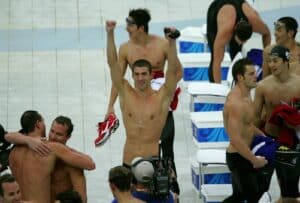
    Those who win all teach us something about how we might find something extra in our own lives, no matter what it is we have been called upon to do in our work. I remember the extraordinary career of Michael Phelps who in 2008 broke Mark Spitz’s record by winning 8 gold medals at one Games.

    In his seventh win he seemed to be losing in the 100 metre butterfly to Serbia’s Milorad Čavić and somehow in the last stroke made a great lunge forward to win the race by one hundredth of a second. It was a lesson on the very fine margins between success and its antithesis, but also opens up onto the possibility that we may all have something more within ourselves: it is a question of searching – and in this case, having the ability somehow to summon up precisely what you need when you most need it.

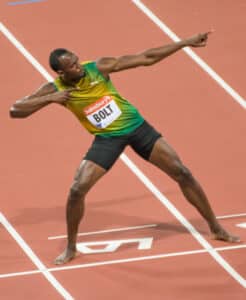
    Usain Bolt was a different sort of athlete altogether. He made his element pure showmanship, and I doubt any Olympian ever bestowed so much joy per minute. I expect if you totted up all his races across his career, you’d arrive at about five minutes of entertainment. Yet he changed the world because he showed us how to compete without arrogance, yet in celebration at what we’re capable of.  There was nothing self-effacing whatsoever about Bolt, but everybody could see his good nature – his delight was never aimed at his rivals in any negative way. Instead, it went outwards with the honest intention of delighting the crowds.

    Everybody who comes before us in the Olympics can feel transparent in that way – under the microscope of our collective observation. We feel we know this procession of athletes: Simone Biles with her agility and her occasional lapses into mental fragility; Daley Thompson’s slightly embittered determination; Steven Redgrave’s nearly humourless bloody-mindedness.

    Each of these, and so many others, present themselves for our inspection and we can admire their strengths, consider their foibles. Here is success to be reached for with a certain inner uncertainty (Biles), to be grimly and sometimes glumly striven for (Redgrave) or loftily assigned to oneself (Thompson). Personally, I can never get over the straightforward delight of Dame Kelly Holmes as she realises what she’s done in winning the 800 metres in Athens in 2004.

    I have written several drafts of this article, and each time when I get to this paragraph I have paused to watch that race, and felt the same tingle when the bell for the last lap rings. Each time, I find myself muttering, “Go on, Kelly” on the final stretch even though I know the result of the race. So much that is precious about the Olympics and humanity is contained in her expression when she sees she’s won: she can’t believe what she’s done as she didn’t know what she was capable of – until she gave it a try.

    Despite this, defeat can sometimes be more vivid than victory. Consider, for instance, the story of Derek Redmond who was running in the semi-final of the 400 metres, with a very good chance of a medal should he reach the final. Sadly, he tore his hamstring, but decided to finish the race, evidently in extreme agony. His father came down from the stands to assist him and help him finish.

    Nobody who has seen this very moving footage can doubt that there is something here in our own lives which we might emulate. We all go through our lives, vaguely aware that it is in our gift to help each other. But this is an illustration of what help often looks like. I imagine Redmond’s father may briefly have wondered if he was allowed to cross over the stands and help his son, and yet chose to overcome that impediment. It is a reminder that there are always reasons we create for ourselves not to help.

    Whenever I watch any montage of Olympic highlights, I start to wonder what it’s about. What is it that makes human being create these disciplines and perfect them? Does it matter if we ever run 100 metres in under 9 seconds? Did it matter that Roger Bannister ran the four minute mile? From one standpoint, it can seem oddly futile – the balls going back and forth; the bodies in their postures; the weights being lifted; the heights being hurdled or vaulted.

    And yet there is something good for us about learning to do things well: at our best, it seems that by determined efforts we reach some kind of higher freedom, where we are in some better relationship with natural law. Besides, it is unthinkable to permit a world without play.

    It was the great scientist and theologian Emmanuel Swedenborg who said that when the angels play in heaven, they play far harder than we do here. The only right response to the advent of the Paris Olympics is to emulate that.


  • Friday art essay: Impressionism at 150

    Christopher Jackson


    If you go to the National Gallery in London and visit, say, Room 32, where Mannerism is represented, there’s a good chance you’ll have it more or less to yourself. The same will likely be true if you walk past all those Renis and Guercinos and into Room 33, where Chardin’s Card-Players typically hangs. Things will likely get a little more crowded as you swing by the great British landscape painters in Room 34 – JMW Turner and John Constable.

    But something will happen as you enter Room 35: that’s because you’ve entered a room full of Impressionism. Come rain or shine, this will be the busiest part of the gallery. You probably won’t have Cézanne’s views of Mont Sainte-Victoire or any of the many Monets to yourself for very long, and you won’t have Vincent Van Gogh’s Sunflowers to yourself at all. Something has happened: you have crossed over.

    Why is Impressionism, which loosely speaking turns 150 this year, such a big deal? None of the painters, with the possible exception of Vincent, had a natural talent to equal Rembrandt. I don’t think any of them create awe in the viewer as Turner does. If you want the oddities of daily life, you’ve got other Dutch painters like Hendrick Avercamp and Johannes Vermeer. For spiritual power, nothing beats Piero Della Francesca. But if the numbers tell the truth, something about these pictures makes us need them more than all of them put together.

    One possible explanation is that they’re closer to us in time. The Impressionist movement was a response to the great essay ‘The Painter of Modern Life’ written by Charles Baudelaire in 1860, and which created a huge impact at a time when reading was the primary mode of entertainment. In this, the poet pleaded with artists to show the distinctive beauty of the modern world. The paintings in the Louvre, he says:


    …represent the past; it is to the painting of modern manners that I wish to address myself today. The past is interesting not only for the beauty extracted from it by those artists for whom it was their present, but also, being past, for its historical value. It is the same with the present. The pleasure we derive from the representation of the present is due not merely to the beauty with which it can be invested but also to its essential quality of being present.


    It is this ‘essential quality of being present’ which I think makes the crowds in the National Gallery flock in such numbers to these pictures.

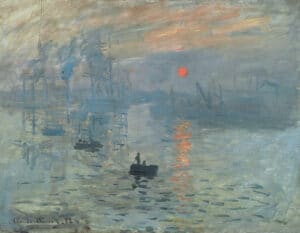
    Admittedly the modern world meant something rather different in 1874 to what it means today, but still there is a sense in which these essentially secular images of pleasure and leisure chime. Though they might be low on depicting things like computer modems or airports, nevertheless they feel psychologically similar in some way to our own lives: they somehow have a legacy in us. It was the critic Louis Leroy who said after the first Impressionist exhibition in a somewhat derogatory way that the artists in the exhibition seemed intent on creating an ‘impression’ – by which he really meant a sketch:


    Impression I was certain of it. I was just telling myself that, since I was impressed, there had to be some impression in it — and what freedom, what ease of workmanship! A preliminary drawing for a wallpaper pattern is more finished than this seascape.


    This is the authentic note of the misfiring critic, who doesn’t even know that they have missed the main point, and so must satirise in a self-admiring vacuum. What Leroy failed to understand was that the world was now in a state of permanent psychological revolution, and that it would from now on move inexorably in the direction of hurry. We still live like this – dimly aware, even as we dash to the next meeting, that we have not enough time.

    The eye too is in a hurry, never still, blinking continually, and alert to the latest shift. It too makes impressions. It was the Australian critic Clive James who towards the end of his life recalled his early time in Florence and the sight of the Bardi spire rising up over the medieval streets: “Glimpses are all you ever get,” he wrote. Leroy misunderstood that when it came to Impressionism, glimpses were being elevated to the realm of permanent art.

    In doing all this, as Leroy also missed, a new attitude towards light was established and I think this is what really makes these pictures so exciting, and which gives them their addictive charge. Of course, all paintings have something to do with light: whenever you’re painting anything at all, you’re painting that – otherwise you wouldn’t be in the privileged position of being able to see.

    But Impressionism – and this is especially true of Claude Monet (1840-1926) – seems to mark a new kind of interest in light. Monet looks on water in a way different to the way in which, say, Leonardo da Vinci gave it his intention: in his Water Lilies, he wants to break it down, and consider what constitutes reflection and what amounts to water – and crucially, what that elusive entity light has to do with that relationship.

    It is often said that Impressionism was the natural offshoot of photography. And so it was. But people rarely say how that relationship worked: the invention of the camera made people realise that the act of seeing was a more complicated business than had been supposed. The photographic image felt too clinical. Really, it was a kind of abstraction and this sent artists back to themselves.

    If this amounted to a sort of crisis, it was a very exciting one. The sense of juxtaposition between a photograph’s verdict and the human eye’s experience meant that artists were suddenly compelled to consider the constituents of the world. They were helped in this by the way in which science had developed, especially with John Dalton’s discovery of the electron, and its secret and peculiar mystical vibrations.

    But we tend to view Impressionism through a particular lens: we know that it would lead in time to the further fragmentation of Cubism and Abstraction. This in turn reminds us that Impressionism could easily have been a boring philosophical development – as did in fact happen to its successors. We do not flock to the work of Georges Braque – in fact, if it comes to that, I don’t think we really flock to Picasso. It’s all too intellectual and young artists should note how it is no coincidence that in avoiding this, the Impressionists have endured in a way the others haven’t.

    But critics of the time did notice, with considerable prescience, the philosophical radicalism of Impressionism, if they usually failed to note the extent to which this was an underpinning and never intended to distract from the pleasure given to the viewer. The critic Theodore Duret wrote of Monet that he was “no longer painting merely the immobile and permanent aspect of a landscape but its fleeting appearances which the accidents of atmosphere present”.

    This might have been true but it was a merely incidental truth. A sheer love of looking is what makes Impressionism so popular: it is full of an infectious enthusiasm for the visible world. The Impressionists knew that what they saw, faithfully interacted with, was enough. As Monet put it, with his legendary cantankerousness: “Everyone discusses my art and pretends to understand, as if it were necessary to understand, when it is simply necessary to love.”


    Given all this, what contemporaries noted was that new aspects of life had been incorporated as subject matter by this new movement. Most of the references to classical mythology which had characterised the Impressionists’ great predecessor Jean-Auguste-Dominique Ingres (1780-1867) were gone (though they recur occasionally in canvases like Manet’s ‘Olympia’), so were the grand battles and historical scenes preferred by Eugène Delacroix (1798-1863).

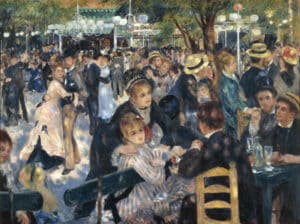
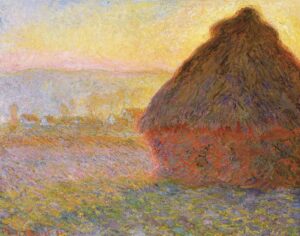
    Instead, the Impressionists depicted life’s intimate unfolding: in time they would give us the look of a haystack (Monet), an afternoon lazing by the Seine (Seurat), women bathing (Dégas), ballet-dancers practising their moves (Dégas again), a pair of boots (Vincent), and of course, a vase of sunflowers (Vincent). The gaze had been shifted temporarily away from the reconstruction of events theological and historical. Viewed in that way, and given what happened next, Impressionism is so valuable as a period in art history as it is a brief interregnum of actually looking at the world, rather than thinking about it in paint. This journey towards intellectual painting is already at its starting point in Cézanne’s cerebral canvases.

    We tend to encounter Impressionism in grand art galleries with the best gilt picture frames round the pictures, and so we forget that these painters had a certain humility about their relationship to nature – though Monet certainly cannot have been called humble towards other people. In the way in which they faithfully set down what they saw, they were everymen – though in many cases everymen who happened to be geniuses. The artist beginning today could do a lot worse than look not towards the next fad but to what really lies outside their window for the inspiration that really counts.

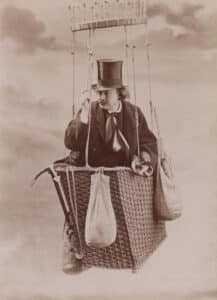
    The other thing we miss – and again it’s because reputation can sometimes intervene between us and what a painter’s real intentions are – is the wonderful oddity of some of the people knocking around Paris in the 1860s and 70s. For instance, the first Impressionists exhibition took place in the studio of a magnificent photographer called Nadar, who deserves an article in his own right.

    He was not just a magnificent and original photographer but also an early enthusiast for ballooning; I think he was probably a fairly peculiar character in the best sense. But all the Impressionists had their unusualness from Monet’s ill temper to Renoir’s flightiness and indecision – not to mention Van Gogh’s occasional tendency, attributable today to bipolar disorder, to hug random people in the street.


    We think of success as somehow preordained once it has happened, but it rarely looks like that at the time: actually it looks improbable for the reason that it’s usually unlikely to happen. Next time you see someone tinkering away at a picture or an invention with a look of concentration on their face, you may not be looking at someone slightly bonkers, but at a historical figure.

    When it comes to Impressionism, the plight of women is another interesting one. The National Gallery of Ireland is this summer celebrating the 150th anniversary of the first Impressionist exhibition with Women Impressionists, a show which lasers in on four women artists integral to Impressionism – Berthe Morisot (1841-1895), Eva Gonzalès (1849-1883), Marie Bracquemond (1860-1914), and Mary Cassatt (1844-1926). All but Eva Gonzalès exhibited at Impressionist exhibitions, of which there were eight over the following 12 years.

    It’s worth going to Dublin for – here are the women who broke free from being painted to doing the actual art. Morisot is easily the best known today – and in fact that was also the case in 1874, in that she was the only female artist to be featured in that first show at Nadar’s studio.

    Throughout the Dublin exhibition we find images of maternal intimacy and gentleness. In Morisot’s work we are shown domesticity as it hasn’t been shown since Vermeer. But while Vermeer’s paintings sometimes point a lesson, or suggest an allegory, these are completely shorn of any morality: here we see, as in Cottage Interior, the quiet of the typical household shorn of explanation. This is just a girl in a beautifully lit interior, with a garden outside, some food on the table: life is like this, it seems to give such few directives. We live amid quiet mystery and many of Morisot’s paintings testify to this.

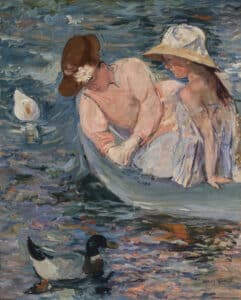
    This sense of a welcoming simplicity repeats in the other female impressionists in the show. In Mary Cassatt’s drawings we can see that the love of Japanese prints wasn’t confined to Vincent Van Gogh – it was as much a fad of that time as primitivism would be at the start of the 20th century. My favourite picture of hers is Summertime where the water seems thicker, gloopier even, than it does in a Monet where we can hardly tell what is water and what is light. And yet on certain summer days, when it’s really hot, we find ourselves more conscious of the shade and the shadows, since we seek them out.

    Summertime, 1894. Oil on canvas, 39 5/8 x 32 in. Daniel J. Terra Collection, 1988.25.


    The Dublin exhibition confirms that Impressionism is still very much alive: it’s not really an aspect of art history at all, but part of our living reality. Today we find young artists falling over themselves to create gimmicks, and sustain an Instagram-driven brand: perhaps there are ways to build a brief career in that line, but it is impossible to create true art without reference to what is before our eyes in the universe itself. Impressionism is so valuable because it provides us with this encouragement. It sometimes seems behind us; really, it’s the way forward.


  • Discovering the Charm Budapest: Tom Pauk’s Letter from the Heart of Hungary

    Tom Pauk


    I’m writing at our table in the New York Café, Budapest, although to call this ridiculously ornate former insurance hall a café seems at best irreverent. I’ve just polished off a bowl of somloi galuska, Hungarian trifle made with walnuts, chocolate and cream, soaked in apricot brandy.

    I’m here with my wife Rachel in Hungary’s capital visiting friends and relatives. My parents fled the country during the 1956 Uprising, so it’s another opportunity for me to practice my rusty Hungarian, a dauntingly opaque language linked only to Finnish and Estonian.

    Budapest is above all a city of bridges, connecting the commercial side, Pest, with the leafy hills of Buda, dominated by Castle Hill with its steep, cobbled alleys, atop which the imposing Castle, Fisherman’s Bastion and magnificent Matthias Church.

    During your visit you’ll find yourself crossing the Danube often in order to take in this stunningly beautiful city and walk off the calories. The most famous crossing is the “picture postcard” Széchenyi Chain Bridge; designed by an Englishman, constructed by a Scot.


    Pest is home also to Hungary’s 286 metre-long neo-Gothic Parliament (or Országház) in Kossuth Square. It’s well worth the visit and the No. 2 tram and Line 2 metro stop right outside. If you’ve been to Vienna you’ll be reminded of its architectural doppelganger, Vienna’s gothic City Hall.

    Prior to WW2, Budapest was home to one of Europe’s largest Jewish communities. The first anti-Jewish laws had been passed in 1938; Jews were banned from working in government and from editing newspapers, and only six per cent. of lawyers, doctors and engineers were permitted to be Jewish. The events that followed Nazi Germany’s invasion of Hungary in March 1944 need no retelling here, suffice to say that my own family (both maternal and paternal sides) was severely impacted.

    The Dohány Street (or Great) Synagogue (closest metro stop Astoria), built in an Arabic-Moorish style (check out those Alhambra-like domed towers), remains Europe’s largest with a capacity of 3,000 worshippers. A visit (guided and private tours can be booked on-line, or just buy a ticket and wander around) takes in the synagogue itself, memorial gardens and the Hungarian Jewish museum on the site of the house where Theodor Herzl was born. Especially poignant, the dramatic Emanuel Tree (or Weeping Willow) Memorial, which has the names of thirty thousand Holocaust victims inscribed on its metal leaves.

    Dohány Street marks the border of the former Budapest Ghetto within Budapest’s District 7, an area now popular for its specialist coffee shops, falafel bars, craft beers and quirky shops. While there, admire the fusion of Judeo-Art Nouveau of the orthodox synagogue, and stop off for a superb flat white at Stika.

    Do also visit the Cipők a Duna-parton (or Shoes Memorial) roughly half-way between Parliament and Széchenyi Chain Bridge on the Pest embankment. The sixty pairs of iron shoes, boots and sandals commemorate the hundreds of Budapest Jews lined up and shot into the river by the Hungarian Fascist Militia in December 1944. My father, then only eight, was one of those rounded up for execution. Mercifully, he was able to run away and avoid recapture.

    Budapest is famous for the wellbeing properties of its waters. The city sits on a geological fault line with hundreds of natural springs jetting skywards. Following their conquest of Hungary in 1526 the Turks built a number of Hamman-style thermal baths, three of which, Rudas, Király and Veli Bej, operate today. However, for the full spa experience, head over to either of Gellért Baths (in the fabulous Art Nouveau Hotel Gellert on the Buda side), and Széchenyi Baths (the largest spa complex in Europe, and especially wonderful in winter) for a full range of spa treatments, and for mineral-rich indoor and outdoor swimming.

    A quick mention of Hungarian politics. Hmm. Hungary continues to struggle with … let’s politely say idiosyncratic views, likely a result of being subjugated over the centuries by successive invaders (Ottoman, Austro-Hungarian, Soviet) and now struggling to assert its own identity. Happily, as a visitor you’ll be oblivious to the country’s growing political radicalisation on the global stage, and unless you’ve a good grasp of Hungarian you’ll miss the inflammatory political messaging on posters and billboards.

    Where to stay? You could check in to one of the global 5* brands (Four Seasons, Kempinski, Ritz Carlton and others) but Budapest also has an abundance of boutique hotels and Airbnb properties. On one memorable visit Rachel and I stayed at Brody House,  a former artists’ salon, now quirky boutique hotel, in which each of the ten rooms has been decorated by a different artist.

    If you’re staying for more than a long weekend, a half-day in the small baroque town of Szentendre along the banks of the Danube (40 minutes on the HÉV H5 local train from Margit Bridge) provides a wonderful escape from the bustle of the city on a hot summer’s day. With its narrow cobblestoned streets, art galleries, coffee shops and churches, Szentendre is home also to the Szamos Csokoládé Múzeum (Museum of Chocolate).

    Your waistline won’t thank me but trust me, you will!

    On the subject of food (I keep coming back to that, don’t I), traditional Hungarian restaurants abound, and with the forint weak against Sterling and US$ you’ll find prices generally low by say London standards. I’d suggest avoiding the glitzy eateries along the Pest embankment and up on Castle Hill in favour of more authentic dinning venues like Café Kor, Két Szerecsen and, for a modern take on Hungarian classic cuisine, Szaletly. Reservations are always wise; Budapest is busy all year round.

    More Budapest top tips:


    ABSOLUTELY take the number 2 tram (Pest side) on its stunningly scenic 20-minute meander from Közvágóhíd to Jászai Mari Square at the Margit Bridge. For 450 forint (under a quid!) you’ll take in many of the major Budapest landmarks. When you get off, walk half-way across the bridge to Margit Island, a one-kilometre green oasis equivalent to say Hyde or Central Park. It will take you a pleasant hour or so to circumnavigate.

    Download the BudapestGo app to purchase e-tickets for bus, tube and tram. Alternatively, buy books of ten from ticket machines (4,000 forint or roughly £8.50). A word of caution: ticket inspectors are ruthless and abundant, and all tickets (paper and digital) must be validated in a designated machine to avoid incurring a hefty penalty fare.

    Download the Főtaxi taxi app,  Budapest’s cheap and reliable equivalent to Uber.  Főtaxi is the official provider of taxi services to and from Budapest Airport. Fares are transparent and reasonable. Bolt also operates in the city.


    Budapest is a walker’s paradise (wear comfortable shoes) and is perhaps even more beautiful after dark!


    ***


    Back at the New York Café our waitress has returned. Would we like the bill, she enquires, her eye on the growing queue of impatient faces that now snakes all the way back to the main entrance. Not just yet. Could we see the menu again? That raspberry and pistachio tart looks rather tempting.

  • Promoting Community Relations to Advance Net-Zero: An Interview with Marjorie Neasham Glasgow

    Marjorie Neasham, Promoting Community Relations to advance Net Zero, Glasgow


    Sir Keir Starmer swept to power and is proposing a ‘mission driven government.’ He is making clean energy one of Labour’s top missions. Vowing to make the UK a ‘clean energy superpower,’ Labour have set bold targets to double onshore wind, treble solar and quadruple offshore wind by 2030.


    Their dedication to decarbonising society is welcome. Labour has also made welcome signals they are committed to translating ambitious targets into action through necessary planning reform.


    To attract the level of investment required for us to achieve net zero – especially in the timeframe Labour have suggested – and for renewables to meet their economic potential, we need a more efficient planning process. In her first major speech as Chancellor, Rachel Reeves lifted the de-facto ban on onshore wind. This overturns planning rules that have made it almost impossible to secure planning consent for onshore wind in England in the last decade.


    The UK can yet become a global leader in renewables innovation, enabling a rollout of onshore projects that make environmental and financial sense amid a world without consensus on climate change. In fact, the UK is making more progress than many think in the transition to a more renewables-based energy sector.


    For the first time ever, renewables accounted for more than 40% total UK electricity demand in the second half of 2023. Analyses by Drax Electric Insights showed that in the 12 months leading into October 2023, coal supplied less than 1% of the UK’s electricity use for the first time.


    The UK is also the first major economy to cut its emissions by half since 1990, compared to the EU, who have cut emissions by 30%, the US not at all, while China’s emissions are up by 300% according to the UK Department for Energy Security and Net Zero in a 12 March 2024 statement on reinforcing energy supply.


    Further, a growing proportion of new jobs in the UK are ‘green jobs’, defined by the Office for National Statistics as ‘employment in an activity that contributes to protecting or restoring the environment, including those that mitigate or adapt to climate change’. Recent PwC data indicates that 2.2% of new UK jobs are classified as ‘green,’ green jobs growing four times faster than jobs in the wider UK market. And research by the UCL Institute for Sustainable Resources indicates UK green jobs could increased by 150,000 by 2030.


    Yet, while the data shows we are making progress, we are still some way off bringing local communities on board with the transition. To deliver on decarbonisation, we don’t just need political will and investment.


    Many people see the value and importance of transitioning to renewable energy. For instance, they are aware that producing and burning fossil fuels creates air pollution that harms our health and generates toxic emissions that drive climate change. Imperial College research finds that air pollution is the largest single environmental risk factor in the UK, associated with the premature deaths of 28,000-36,000 people each year and affecting the poorest in society the most. The transition to renewable energy will help address these health concerns.


    However, people understandably also want to know what tangible economic, cultural and social benefits the transition will bring to their daily lives and their communities. Right now, the renewables industry is struggling to convince people that we can genuinely deliver a green energy transition with respect for landscapes, livelihoods and heritage.


    Sir Keir Starmer vowed to make public trust a central theme of his government. That must be the foundation of all our work across the renewables sector too. In my 30 years in this sector, I have learned that trust is the cornerstone for driving meaningful change in the renewable industry.


    Without communities onboard, in a way that engages them based on their local needs, concerns and aspirations, it is difficult to develop the trust that is so vital to seizing the opportunities in front of the UK.


    Trust fosters collaboration, ensuring that local needs, concerns, and aspirations are addressed. This engagement not only facilitates smoother project implementation but also enhances public support and acceptance.


    Trust can only be developed gradually through relationships between real people, not corporate language or platitudes. This process takes time – there are no shortcuts. A recent King’s College London study found that 98% of the UK population say they trust people they know personally – joint top out of 24 countries with Sweden and Norway – showing that trust can only be built through relationships between real people rather than conglomerates and brands.


    For responsible developers, months if not years of investment in community relations are necessary to understand who they are and what they care about. Consultation processes must not be tick-box exercises. They must be proactive and truly collaborative, with developers actively approaching community members at the onset of every project.


    Developers need to demonstrate to local communities that a green energy transition is worthwhile for them socially, culturally and economically as well as being sustainable.


    Communities must be consulted and allowed to shape projects from the start, considering the potential impacts on their lives. That includes listening and learning about their specific needs as well as generating local jobs and creating cleaner, more sustainable energy sources.


    Developers have so many assets and areas of expertise they can offer communities, should both sides be open to a genuine, real relationship.


    At Ridge Clean Energy we look beyond our renewable energy projects when partnering with local communities, and use our resources and expertise to advance community initiatives that are important to them. In some cases, communities may seek investment for local initiatives that are not at all directly related to energy. That doesn’t preclude a developer from helping, they just need to think creatively.


    For example, we recently lent our fundraising and development expertise to one community in Scotland that wanted help to restore its much-loved local pier, an important point of cultural pride. We worked with community leaders and groups in the town of Inveraray near one of our development sites.


    Our team helped the community to apply for and secure £244,000 in funding to take ownership of the pier and restore it, finally seeing it open to the public for the first time in a decade. We supported local community negotiations with the previous pier owner, helping to provide the confidence that a repurchasing was possible. This was all undertaken years before we submitted a planning permission application for our site.


    We are also in the process of establishing a Climate Care Awards scheme for primary schools in the vicinity of our projects, to help contribute to their academic growth and foster a sense of ownership and responsibility towards their community and the planet.


    As part of the Awards, children will be encouraged first to work together with their classmates and their families to calculate their carbon footprint, and second to take small steps to reduce it, by, for example, turning off lights, shopping second-hand and planting their own vegetables.


    We are excited about the project’s potential, and would like to share the programme with other renewables companies who could take it to the schools in the communities they serve.


    American investor and philanthropist Warren Buffett once said ‘trust is like the air we breathe. When it’s present nobody really notices. But when it’s absent, everyone notices.’ As we navigate the complexities of the green energy transition, trust cannot simply be a buzzword.


    There is a profound importance to fostering genuine long-term trust among communities. Developers and politicians alike must acknowledge that will only happen through real actions, not just words, one genuine relationship at a time.


    Marjorie Neasham Glasgow is CEO of Ridge Clean Energy

  • Enhancing Effective Communication in the Workplace: Insights from Sophia Petrides

    Finito World sat down with Sophia Petrides to talk about how we communicate effectively in workplace settings


    FW: I am fascinated by communication and the workplace – how it works and how is sometimes misfires. What are the factors which sometimes lead to unclear communication?


    SP: Communication is the currency of connection, serving as the essential tool for building and maintaining relationships in all areas of life. It allows for the sharing of ideas, navigating problems, and building trust, all of which are crucial for success in work and personal relationships. Without effective communication, misunderstandings and conflicts become inevitable. By mastering this skill, you unlock the potential for stronger bonds and smoother interactions in everything you do.

    Factors that lead to unclear communication include:

    Cultural Differences: Varying cultural backgrounds can result in different interpretations of the same message. Tailor your message to your audience to ensure clarity.

    Language Barriers: Misunderstandings can occur if the sender and receiver do not share a common language or have different levels of proficiency.

    Assumptions and Biases: Preconceived notions can affect how messages are sent, received, and interpreted.

    Emotional Interference: Emotions like anger and frustration can cloud the clarity of communication. It’s best to respond thoughtfully and review your message to ensure the right tone.

    Complexity of the Message: Overly complex messages can be difficult to understand without proper context. State your message clearly and concisely, avoiding unnecessary technical terms.

    Poor Listening Skills: Ineffective listening can lead to misunderstandings. Confirm your understanding by restating the message in your own words.

    Environmental Factors: Distractions or physical barriers can interfere with message transmission and reception.

    When you’re mentoring, presumably the most important thing is to establish the most effective communication methods with your mentee. I imagine that must vary from one mentee to the next – can you talk a bit about how this plays out?


    When mentoring, it is crucial to establish the most effective ways of conveying information tailored to each mentee’s unique needs and learning styles. This approach requires understanding that each individual processes and retains information differently. Here are some ways to ensure effective communication in mentoring:

    1.     Assess Learning Styles: Determine whether your mentee is a visual, auditory, reading/writing, or kinesthetic learner. Visual learners benefit from diagrams and visual aids, auditory learners from discussions, reading/writing learners from written materials, and kinesthetic learners from hands-on activities.

    2.     Set Clear Goals and Expectations: Establish mutual goals and expectations at the beginning of the mentoring relationship. This clarity helps both parties stay focused and aligned on the desired outcomes. It also teaches mentees to set boundaries in their lives.

    3.     Personalize Communication: Adapt your communication style to match your mentee’s preferences. Some mentees may prefer detailed explanations, while others might benefit from concise, to-the-point information.

    4.     Active Listening: Practice active listening to understand your mentee’s concerns, questions, and feedback. This shows respect and ensures you address their specific needs.

    5.     Provide Constructive Feedback: Offer feedback that is specific, actionable, and encouraging. Focus on areas of improvement while also acknowledging strengths.

    6.     Encourage Questions and Dialogue: Create an open and psychologically safe environment where mentees feel comfortable asking questions and engaging in discussions without judgement. This interactive approach promotes better understanding and retention of information.

    7.     Use Real-Life Examples: Relate concepts to real-life situations or past experiences to make the information more relatable and easier to grasp. Storytelling keeps mentees captivated and focused and helps them see things from a different perspective.

    8.     Regular Check-Ins: Schedule regular check-ins to review progress, address any issues, and adjust the mentoring approach as needed. This ongoing support helps maintain momentum and motivation.

    9.     Empower Self-Directed Learning: Encourage mentees to take initiative and seek out additional resources. This fosters autonomous thinking, taking ownership and accountability, independence, and continuous learning.

    10.  Be Patient and Supportive: Recognise that learning is a process and be patient with your mentee’s pace. Offer support and encouragement throughout the journey.

    By taking these steps, you can effectively convey information and support your mentees in a way that aligns with their individual learning styles and needs, ultimately fostering a productive and positive mentoring relationship.


    One thing I am aware of in bad managers is verbosity, which may perhaps be allied to nerves on the part of the person doing the communicating? Similarly, is an excess of terseness to do with shyness?

    While a manager’s communication style can offer clues about their personality, it can also create challenges. A manager who relies on excessive talking might come across as nervous or lacking confidence, while one who is overly terse could be perceived as cold or dismissive. Both extremes can hinder clear communication and team morale. The key is for managers to find a balance, adapting their style to the situation and their team members.

    In addition to this we have the method of communication – the written word which might be conveyed now by email or WhatsApp; and speech which might be in person, down the phone or over Zoom? I know we have discussed these things a little in the past, but it seems that we are faced all the time with such a variety of options to communicate that we may either choose the wrong one in some fundamental way – or perhaps choose the wrong one for the occasion?

    While a multitude of communication channels can bring versatility to the workplace, it can also create a labyrinth of confusion. Employees can get bogged down by information overload from emails, instant messaging, project management tools, and video conferencing. Without clear guidelines on which channel to use for what purpose, chaos ensues, wasting time and hindering productivity. Conversations scattered across various platforms make it difficult to track discussions and ensure everyone is on the same page.

    Security concerns also surface when sensitive information is inadvertently shared on unsecured platforms. The constant barrage of notifications from different channels can further disrupt focus, making it difficult to delve into tasks requiring deep concentration. In essence, while options are valuable, clear communication strategies and intentional use of channels are essential to avoid getting lost in a maze of information.


    One thing we need to be aware of is mechanical speech – in short, it’s very difficult really to be conscious of what one is saying at any one time. For much of the time we are on autopilot – we babble. Assuming that it is undesirable, what can we do to combat it?

    Mechanical speech, where we speak on autopilot, often leads to ineffective communication and misunderstandings. To address this, practice mindfulness to stay present during conversations and pause to reflect before responding. Focus on active listening and slow down your speech to choose your words more carefully. Practice empathy by considering the listener’s perspective and prepare key points in advance for important discussions. Seek feedback from colleagues to improve, monitor your speech patterns, encourage interactive dialogue, and continually enhance your communication skills through learning. These strategies will help you communicate more intentionally and effectively.


  • Labour’s Ambitious Green Policies

    Labour’s Ambitious Green Policies: Navigating Challenges for a Sustainable Future, Dinesh Dhamija


    When Sir Keir Starmer took office as Britain’s new Prime Minister on 5 July, there was a sense of relief among many people in the renewable energy sector that the Conservative government, which had begun to make a virtue of its opposition to green measures, was gone.

    Instead of delaying the deadline for the phase out of petrol and diesel cars, Labour is keen to re-establish it. Rather than pandering to the oil and gas lobby, Labour will allow more onshore wind energy development. Overall, the incoming government aims to double onshore wind, triple solar power and quadruple offshore wind energy as it pursues its goal of net zero carbon power generation by 2030.

    The trouble is that the undercurrent of opposition to many green policies, which the Tories identified and tried to harness, has not gone away. Reform, which won 14 per cent of the popular vote (4 million votes), promised to do away with subsidies for renewables and instead ‘drill down’ to harness Britain’s remaining reserves of coal, oil, gas and shale. This appeals to the same instincts that Reform appeals to more generally, opposing immigration, reducing imports and fostering nationalism.


    Labour’s task is to foster nationalism of a different kind, persuading the nation that its future prosperity lies in clean energy rather than in the extractive industries of the past. There is a deeply regressive feel to this debate: in the 1980s, it was the right wing of British politics under Margaret Thatcher that sought to move the country on from its dependence on coal mining, while Labour fought to maintain it. Today, the right-wing Reform party is trying to re-introduce this dirty, polluting, climate-change-inducing (but still cheap) energy source, against the flow of history.

    Labour will face other obstacles to its green agenda, including from green activists themselves, who decry the miles of pylons that must be erected to transmit clean power around the country and from anti-immigration parties like Reform, who oppose bringing in overseas labour to help build the necessary infrastructure. Then there is the cost of the plans, which Labour kept quiet about during the campaign, fearing that any specifics would be held against them by the Conservatives, accusing them of planning tax rises.

    This is all the business of politics, making unpopular choices for the long term good of the economy and the nation. It remains to be seen whether this government has the courage to act on these instincts and face down its detractors, knowing that with every year the potential for climate catastrophe comes ever closer.

    Dinesh Dhamija founded, built and sold online travel agency ebookers.com, before serving as a Member of the European Parliament. Since then, he has created the largest solar PV and hydrogen businesses in Romania. Dinesh’s latest book is The Indian Century – buy it from Amazon at https://www.amazon.co.uk/dp/1738441407/


  • Understanding the Future of the Apprenticeship Levy under the New Government

    Finito World


    Initially it sounds a good idea to expand the apprenticeship levy and reform it into the “growth and skills levy”. This would mean that other forms of training were now possible under the scheme, with businesses allowed to use 50 per cent of their apprenticeship funding. This is all part of a general offer to young people between the age of 18 and 21 called the ‘youth guarantee’.

    It is difficult to gauge the cost of such a move. Under the previous government, Labour’s proposals were estimated to cost £1.5 billion – and it’s not clear how it would be paid for.  At that time, the then skills minister Rob Halfon argued that it is ‘important that the apprenticeships budget remains ring-fenced for apprenticeships to ensure continued affordability of the programme”.

    The real problem is in what firms will do with the money. Some analysis points to the likelihood that firms will use the money from the new levy to cover their costs for training programmes which they would probably have paid for already. Labour stated before coming to power that it would issue a list of approved courses, but already it looks less simple to administer than the levy was before.

    The inevitable result of the new levy would be fewer apprenticeships – probably down to under 150,000 per year, a huge decrease in the number of young people having apprenticeships – but that’s only if the figure is right, since it essentially charts a situation where large employers use all their levy and use up the 50 per cent allowed for non-apprenticeship training.

    Obviously the situation would be more complex than that – and so the question comes down to the detail of how the policy will be be designed and what incentives will be built into the system. Watch this space.


  • Steve Brill’s The Death of Truth: Unveiling the Web of Lies

    Book Review of The Death of Truth by Steve Brill, Finito World


    Dustin Thompson was living in Columbus, Ohio and getting along more or less fine in the pests control industry when the pandemic came along. As Covid took hold, he lost his job which led to a notable increase in time spent online. Eventually, he would be among those who perpetrated the 6th January Capitol Riots. His weapon? A coatrack.

    It’s a weird image – and perhaps it fits somehow with the sorts of weird states we can get ourselves into when we try to twist reality. Steve Brill’s book is an examination of how we got here, and it’s no surprise at all to find that the Internet is to blame. Specifically he notes that Section 230 – a 1995 law in the US allowing internet providers to police their own platforms and granting them immunity over content, no matter how far-fetched – was a landmark moment which nobody much noticed at the time.

    So what can be done? Brill suggests that Section 230 – and presumably similar provisions globally – be amended to take into account dangerous algorithms. He also argues for the scrapping of online anonymity, as well as an end to partisan primaries, which he argues create an atmosphere of resentment, which itself leads to misinformation. Of course, the title is a bit misleading in that truth itself, if it is true, can’t actually die: what happens is that individuals become severed from it en masse. Perhaps there’s hope there – and also in this authoritative and well-written book.