Category: Culture

  • Class Dismissed: Jimmy Choo

    World-renowned fashion designer Jimmy Choo came to London in the late eighties from his home in Malaysia. From his first workshop in the East End, Choo created a shoe brand which would be worn by countless celebrities including Princess Diana. Now, he has shifted focus to the next generation of fashion designers through his JCA London Fashion Academy in Hackney. There, students learn the ins and outs of the fashion world with a heavy emphasis on entrepreneurship. He now shares his journey with Finito World readers.


    How did you get your start in fashion?

    I guess it was meant to be I was born into a shoe-maker family, and that influenced my career path: I decided to follow in  Since I was young, I knew I wanted to be a designer, so I moved to London to study at the Cordwainers Technical College and three years later, in the early 80s, I opened my first shop.


    Do you have a favourite design?


    I feel especially fond of the ‘Fetto’, which is a classic sling-back style that Princess Diana wore in the 90s. She wore her first pair to a performance of Swan Lake at the Royal Albert Hall in June 1997, just a few months before her death.


    What was Diana like to work with?


    She was always very kind to me – she cared so much about other people. That’s the sign of an admirable person – when they’re good to people when you don’t have to be.

    How did your father help start your journey with shoes?


    I was immersed in the shoe-making process from a young age, and it came naturally to me to take up my father’s passion. He taught me how to make a shoe and guided me to create my first pair when I was 11, which I know seems young but I was impatient to get started well before then. You have to remember that this was before Internet and mobile phones. We did everything with our hands. I’ve been doing it one way or another ever since. Now at the JCA London Fashion Academy, I want to give back a little of what I’ve learned.

    Have you had any other mentors?


    My father was my most important mentor, although I have been able to work with some incredible designers over the years who have supported me, and back in the 80s, I was awarded a grant and mentorship from the Prince’s Trust which was very valuable to me – and that’s why I’ve decided to return now to mentoring. I know its value, because I’ve experienced it for myself.


    What advice would you give to a young person looking to enter the fashion world today?


    My biggest piece of advice would be to never give up: you’ve got to learn how to tackle adversity because that’s definitely coming to you. We all have so much potential to create something extraordinary with our talents – and it’s that knowledge which should


    So the future’s bright?


    It is if you decide to pursue your vision. If you do that, then there will always be a great future ahead: but you have to take the plunge and decide to be true to yourself, and find the ideas that really belong to you.


    For more information go to: https://www.jca.ac.uk/


  • When Tom Met Brin: The Fortnum & Mason CEO meets the 2024 winner of Masterchef


    In a special Finito World interview, the 2024 Masterchef champion Brin Pirathapan and Fortnum & Mason CEO Tom Athron are brought together on the third floor at the famous Piccadilly store 

    The real joy of networking isn’t to meet people for oneself: it’s introducing people to one another. When the opportunity came up to interview Brin Pirathapan, the brilliant Tamil Sri Lankan winner of 2024’s MasterChef, we put heads together at Finito, with help from Janine Stow at The Quorum Network, to decide what to do about it.

    The answer came in a flash of inspiration: Fortnum & Mason is being altered by its brilliant CEO Tom Athron, and the third floor, formerly the menswear floor, is now set up for food experiences. There is a gin bar, and a cooking area where the store hosts masterclasses, as well as the beautiful Fortnum & Mason culinary products.

    Once we’d decided that might be a good idea, we thought we’d go one further and interview Brin and Tom together and see whether anything came of it.


    Brin Pirathapan, Masterchef winner, and Tom Athron, CEO of Fortnum & Mason interviewed by Chris Jackson, editor of Finito World in the Food & Drink Studio, Fortnum & Mason.. 19.6.2024 Photographer Sam Pearce


    Brin is there as I arrive, looking resplendent in the sort of outfit which Federer used to wear at Wimbledon in his pomp. So I ask Brin if it was always food for him? “I have always loved food. I almost took it for granted because my parents always cooked so well. The table was always full of delicious Tamil Sri Lankan food.”

    Perhaps unknowingly a standard had been set. “When I went to university,” Pirathapan continues, “there wasn’t really a conscious decision that I was going to learn to cook: it was just a thing that happened. I wasn’t willing to eat the same bland meal plan every day. But I didn’t have the funding or the finances to be going out for food all the time or to be buying the most expensive ingredients. That situation created the chef that I am today.”

    Let’s be clear what this wasn’t: it wasn’t a decision not to have that Deliveroo. It was more financially constrained than that. “I never had to refuse to lazy route. I would cook instead of having a takeaway just because I had to: it was either that or cook boring meals. I never leant towards takeaways. I thought: ‘I can probably do it as nice or nicer myself and learn a new skill’.”

    At that time, Brin can have had no way of knowing where it would lead. “Really, I like to eat!” he says simply. “I like nice food and I wanted to do it myself. It was essentially self-reliance and learning a skill. I started cooking for friends, when they came over for dinner. And they’d compliment me. I’d want to do more because it was nice when people said I’d done a good job.”


    Brin Pirathapan, Masterchef winner, and Tom Athron, CEO of Fortnum & Mason interviewed by Chris Jackson, editor of Finito World in the Food & Drink Studio, Fortnum & Mason.. 19.6.2024 Photographer Sam Pearce

    It seems as though we all need to find that thing in life where we feel there’s no particular ceiling: that we can continue to develop across the whole course of a life. “Something about food makes me want to learn more and more about it. You’d watch people on television or online and the chef has these intricate skills. And I wanted to know how to do that: I was so invested in it. So it probably comes back to just it being a pure passion that I wanted to be good at.”

    But even here – he didn’t know how far it would take him; but he had found his passion. “I’d been a veterinary surgeon for a good few years, and I didn’t necessarily think food was ever going to give me a new career. But I think I knew that if I didn’t give MasterChef a go, I would never be able to make it a reality.”


    It’s as if you find a thread in life – and it’s not that you’re pulling it, but it pulls on you and leads you on. “It seemed a bit unsafe. I’d been planning on working in veterinary. When you do that, at least by the age of 15 you’re already committing time; you’re committing your holidays to work experience you’re committing your evenings to studying. It’s quite hard when you are within those walls of a structured education and a structured career to dream outside, because it seems really unsafe. And let’s be honest, the food industry isn’t exactly the safest industry to be in. It’s tough – but MasterChef has given me the platform now.”


    Brin Pirathapan, Masterchef winner, and Tom Athron, CEO of Fortnum & Mason interviewed by Chris Jackson, editor of Finito World in the Food & Drink Studio, Fortnum & Mason.. 19.6.2024 Photographer Sam Pearce


    Brin has long been a fan of MasterChef so it was a huge thing to apply for the show. “I’ve watched it since I was a young age, and it’s made me the chef I am today. When I started the show, I was so worried about being knocked out in the first round. But my fiancé was very firm – she’d seen me moaning about my normal job.”

    I say I find it hard to imagine being able to focus on cooking when the cameras are rolling. “It would have been impossible to play to the camera,” he says.

    “Every dish I created I pushed myself to the absolute max – so timings were incredibly tight. Obviously within each cook, you need to have an interview with the judges too – other than that, there was no room for error, and I got used to the cameras being there. I needn’t to know there was no time left over for each cook – that there was physically and mentally nothing more that I could have done.”

    Reminding myself of the formidable MasterChef judges John Torode and Gregg Wallace, I ask whether their verdict ever affected his concentration. “It’s hard – especially at the start. When they come round, all you’re thinking is: “Do they think I’m doing this wrong?” You start questioning yourself. But as you get to know them, they’re actually very good at calming you down and making sure you’re relaxed.”

    I find it hard to imagine Torode or Wallace in calming mode. What stays with Brin is the long silence when the judges give their verdict. “From the first cook to the last, that silence when they are eating, to when they say their first words – that will haunt me. It was an eternity, and it never got easier.” It all came down to the last cook, and I think the way in which Brin approached the most important moment of his life speaks volumes about his character.

    “I’d felt so proud to have just gotten to the final and I felt that no matter what, I now had a platform to make a new career in something I love. I wanted to show the judges what my journey in that competition had been – and what the competition had given me. So within every course, you could see multiple elements that reflected a certain dish or a certain opportunity we were given, or a restaurant we went into.”

    It is that humility, combined with a willingness to learn which seems to mark out Brin: these traits, when they are combined, place no limits on a person’s potential development. There is throughout our conversation a sheer fascination with cooking – the timings, the sourcing, the service – everything. When we come onto Brin’s famous octopus dish, he is fascinating about the complexities of making the dish work.

    “It’s a difficult meat to cook actually. It’s really easy to make an octopus tough and you want a good couple of hours, but in the MasterChef kitchen you only have an hour and a half. So, then you also add in the difficulty of cooking it within a pressure cooker, which can change its texture – and the thing about that is that it’s blind – you can’t see what’s going on inside.” I could listen for hours to anybody talking with passion about the detail of what makes them love it.

    Brin continues: “Five extra minutes in a pressure cooker is probably the equivalent of a half an hour of standard cooking. So there’s a lot of margin for error and the texture is one of the main aspects in an octopus. It’s a little bit like a scallop. It’s really easy to get that texture wrong.” You can see why someone who can talk like this will have a long and exciting career: because they’re interested in the task itself, independent of any reward it may bring.

    As Brin went through the competition, he kept his head down, until he found himself caught up in that iconic moment when the winner is about to be announced. “Throughout the entire process, I didn’t allow myself to look too far ahead. When I look back, I think one of the reasons [KL6] I did well was because I didn’t give myself the pressure of dreaming about winning. I was simply thinking of the need to execute everything to the best of my ability. So when they did call my name, it was more of a shock than I can ever imagine.”

    And, of course, in that moment – even longer in reality than it looks on television, according to Brin – he was crossing over from one world into another, one of considerable opportunity.

    Surveying the landscape of options now, Brin is characteristically level-headed and sensible: “I don’t think you have to win MasterChef and open a restaurant immediately. The food industry in 2024 is so much broader than what it was probably 20 years ago, which is so exciting for me because I think in my life I need variety anyway, to keep interested.

    Private dining and supper clubs are really interesting to me. They’re the areas where I can show off and kind of going back to when my friends used to come to dinner. I’ve loved all the services that I’ve done throughout the show and any private dining I’ve done afterwards. So I want private dining to be a decent portion of what I do, and I’d also love to write a book.”

    There is a sense then in which Brin is going full circle – or rather, moving forwards without forgetting where he came from. “The reason I want to write a book is because, going back to how I started cooking, you can cook amazing food without having to stretch your budget. And it can be very cost-effective. We’re at a time now where people are struggling, because ingredients are so expensive.

    I want to bring that through in a book but also, I want to give that to people online because that’s how I learned. I would see these incredible chefs doing amazing dishes – all these techniques I’ve never seen and then I’d go read about it and work it out myself. So if that’s the way I learned I’d like other people to learn that way too. So creating that content online that’s going to be really accessible for people to go and do that themselves is going to have to be a large part of what I do as well.”


    Brin Pirathapan, Masterchef winner, and Tom Athron, CEO of Fortnum & Mason interviewed by Chris Jackson, editor of Finito World in the Food & Drink Studio, Fortnum & Mason.. 19.6.2024 Photographer Sam Pearce

    By this point Tom Athron has joined, and there is a period where the pair of them are introduced, and huddle together. I have a moment to consider the pair: the latest star in the world of cooking, and the CEO of a business which began in 1707. But I find that the two of them seem to fit in some way: that’s because Brin clearly has such respect for people and is so hungry to learn – and because Athron, as I shall discover when he sits down, is bent on driving Fortnum & Mason forwards towards the future.

    Athron is immediately kind about Brin – and explains how right it is that they should be sitting next to one another. “When I joined – and my predecessor actually did the same thing – we’d been asking ourselves as a business some existential questions about what we want to be, what we want to stand for, and who we are. Over the last ten years or so, we’ve become less of a department store, and more of a business which sells extraordinary food and drink.”

    For Athron, having Brin here is a moment to reflect on that journey: “Ten years ago, no one would have thought to bring a MasterChef winner into Fortnum’s. And yet now it seems an obvious place to spend a bit of time  – whether it’s  cooking in the food and drinks studio, or having lunch in our boardroom.” He gestures at the surrounding floor, as if to gauge the extent of the change.

    “This whole floor used to be menswear,” Athron says. “But in our quest to become a food business, and to become famous for extraordinary food and drink, our thinking was that that menswear was probably a category of products as a retailer that’s too far out from that particular core. So it’s not that I want everything here to be food, but it needs to be sort of connected within concentric circles. And it just felt to me that menswear was a sort of a circle too far out.”

    Once this decision was taken, Athron had 1000 square feet to play with, and had to decide what to do with it. “We had to think not so much as a retailer, but more as a brand-owner and content producer. We needed a space that was going to allow us to showcase our talents – and the talents of chefs around the country. We have 100 chefs who work in this building – but they’re all secreted away behind the walls in the kitchens, and nobody sees the mastery and the craftmanship which goes into making the food.”

    So Athron is a MasterChef fan? “It is such a watchable, brilliant show,” he enthuses. “That’s because what you’re seeing is what used to happen behind closed doors. You never really saw the skill that goes into it. So what we wanted to do was create a space that allowed us to show off our mastery a bit and show off our craftsmanship. So again, I was just talking to Brin saying that, that this food and drink studio is glassed off, and that counter over there behind the pillar is actually a chilled top, which is brilliant for pastry work.

    The idea is that if you’re a customer walking around in the morning, you probably will see chefs from the tea salon prepping food for that day on that counter. They might be making Scotch eggs or macaroons – and just showing customers a bit of the work that goes on here. a lot of the food that they buy here is actually made in Piccadilly – it’s not just brought in.”

    The rise of online shopping, and of Amazon in particular, has taught many shops that they need to be offering experiences which sets them apart. “Our customers are looking for a bit of theatre,” Athron says. “Retailers don’t just exist to sell product. They exist to provide experiences. In here, we have our “Conversations With” series, and we’ll have 50 or so people in here in conversation about, say, Borough Market, and why that started and why tinned fish is the most incredible products that we should be all eating more of. We can do book launches, masterclasses, supper clubs, all sorts of things. It’s just brought the whole floor to life.”

    Fortnum & Mason was founded in 1707 when Queen Anne was on the throne – and I wonder what it is she’d recognise about the business if she were permitted to walk through London today? “William Fortnum was a footman to the Queen, and he asked for permission to take the candles that had been melted down in St. James’s Palace, and took the wax away to reconstitute them as new candles – and he sold them on this very spot. And so we still sell candles to this day, largely as a nod to that, even though candles are probably a step away from food although I can actually make quite a strong connection to it.”

    I ask Athron about this and he says: “One of the things that we do in the Food and Drinks studio, for example, is a masterclass on how to dress a table for Christmas. I’m interested in those concentric circles that sit around food. We want to make Fortnum’s joyous and I think food really lends itself to that. We are a luxury business, and aim to be at the pinnacle of food and drink – but I don’t think of luxury in the same way as Bond Street thinks about luxury.

    We’re not exclusive: we’re warm and welcoming and friendly and inclusive. Quite soon after I joined, we had a chef down from Cumbria whose first course was this chicken wing. And it was a Korean chicken wing, and we had 100 people on the ground floor all eating chicken with their fingers – it was the world’s best chicken wing, but it was also just a chicken wing.”

    Many customers at Fortnum & Mason love the packaging but Athron realises that what the packaging contains must make good on the promise of how the brand’s produce is presented: “We’re not a packaging business. We’re a food business and the most important thing to me is that the food justifies the label. And I would never want us to get into a situation where the label justifies the food.

    When I joined, we brought in a new commercial director who’s responsible for all our buying and merchandising. I sent him a hamper to say: ‘Welcome to the job’. I thought I was going to get a thank you letter but actually he wrote to me to say the shortbread was overbaked. I remember thinking: ‘That’s exactly why you’re coming’. The food has to stand up to scrutiny.”

    This new attitude to the business has enabled Athron to think creatively about where the brand is seen. We’ve got three shops in London in addition to the Piccadilly store: there’s one at Terminal Five at Heathrow, one of St Pancras and one at the Royal Exchange in the city. But we want to give people access to the Fortnum’s brand outside London. The online business is one way of doing that: another way of doing it is to show up in slightly unexpected places. So you might think that you know we should be at Glyndebourne or Ascot – and actually we are at Ascot. But we also like turning up at Glastonbury.”

    Last summer, Fortnum & Mason did a pop-up in Watergate Bay in Cornwall. “We had this beautiful beach house, beautifully decked out with lots of things that you can buy – picnic equipment and rugs and all sorts of accessories. But in August, there was a storm and in conjunction with the high tide, it all got washed away.

    We thought: ‘What are we going to do? Maybe we should just come back to London?’ But then we thought: ‘No. This is what a British beach holiday is like. What you do is you rebuild and then you sit there in the rain’. And we did. And actually, the weather was so good in September and October that we ended up extending the season. It was the best thing we ever did.”

    During Athron’s tenure, the business has pivoted towards 70 per cent on the domestic side – a trend which, Athron says, was already in evidence before he came into the job. “Ten years ago, it was about 70 per cent international customers and 30 per cent domestic, although it depends a bit on the time of year: in the summer we tend to be much more international because it’s a big tourist influx into London, but at Christmas we’re much more domestic.

    But we need to appeal to a domestic audience and if you do that, the international customers will come anyway. If I position to foreigners as a tourist brand, no one from Britain will ever want to come here; I want it to be the other way around.”


    Brin Pirathapan, Masterchef winner, and Tom Athron, CEO of Fortnum & Mason interviewed by Chris Jackson, editor of Finito World in the Food & Drink Studio, Fortnum & Mason.. 19.6.2024 Photographer Sam Pearce

    So what are the career paths for young people, looking to work at Fortnum’s? “You can you start in one of our restaurants or one of our shops. In fact, most people do that. My view is that the very best retailers in the country are typically those people who started stacking shelves. Providing careers to those sorts of people is hugely important. So you can start in the shop, or you can start in our cocktail bar.”

    But there are office jobs as well. “There are lots of ways into the industry: buying and merchandising is a really good way and we have a lot of young people who want to get into social media marketing and actually we tend to find young people to do that for us because they are much more savvy about what works and what doesn’t work.”

    Athron enjoys walking through the store in order to see how things are working: “We’re a small business and so we’re lucky in that respect. So you can definitely spot talent, and you can sort of move them through move them through the business. There’s a lot of what my dad used to call management by wandering about: in retailing and in restaurants you have to do that. If you do that, you spot mirrors that aren’t straight or shelves that are empty.”

    So how does Athron manage his time as CEO? “It’s a constant juggle,” he says. “This is my first role as a CEO though I’ve been on an interim basis before but previously I’ve been a finance director. I was the CFO at Waitrose for many years and, and I knew what I needed to do and what I needed to spend my time on: it was quite defined.

    Even though, as a CFO, you have a view across the whole business, my output was defined. The great thing about finance is that it works in a set rhythm, and you know what you need to be doing at any particular time of the year. With the CEO role, it’s different because you can apply yourself in any area, and so I have to make sure I’m giving equal airtime to the whole business, and not just gravitating towards the sparkly fun bits.”

    It sounds rather similar to what one sees in politics when the Chancellor of the Exchequer becomes Prime Minister. “I do find that I go from a budget meeting into a meeting about what the summer campaign is going to look like, and into an ice cream tasting. And then back to what we’re going to do with the apprenticeship levy: each day is incredibly varied.”

    Coming from the CFO side also means that Athron has to, in his own words, not to be too technocratic: “I’m married to an artist, who is creative and chaotic. So I spend quite a lot of time thinking about not trying to tidy everything up, but trying to give room for people to express themselves: that’s incredibly important in a business like this.”

    Would Athron ever participate in MasterChef? “I wouldn’t! I watch it and of course I do what everyone does, which is to become an armchair expert, and say: ‘Well that’s never going to work, is it? Ultimately what Brin does is a creative endeavour, I think. When I cook, I follow a recipe and it’s a logical endeavour. And what will the future hold for Brin? “I’m self-taught and so I’ve still got gaps in my knowledge. I just want to continue to learn in years to come.

    I need to make sure I’m I’ve learned enough and mature enough. If I start a restaurant, I want it to be the best. Now’s not the right time.” But happily, it is the right time for lunch – and I am pleased to see Tom and Brin head off for discussions which I suspect will prove fruitful for both of them. They certainly look like they have much to discuss – and more than that perhaps, work to do together.

  • Ian Botham’s unbelievable journey: Headingley 1981, Geoffrey Boycott, and transformative philanthropy

    Christopher Jackson


    In person, Ian Botham is utterly solid, calling to mind a rugby prop forward more than England’s greatest cricketing all-rounder. Botham is a famous wine enthusiast, and hunched over his lunch as if he could easily eat one’s own meal as well, it would be a lie to say one can’t see that he’s enjoyed himself from time to time.

    Botham is one of those very few sportsman whose achievements carry across the generations. Sport is really to do with the dramatic maximisation of the present moment: we are rarely quite so conscious of life as when we watch closely to see whether a ball has nicked a bat. Especially because there is so much of it, little sticks in the mind.


    1981 and All That


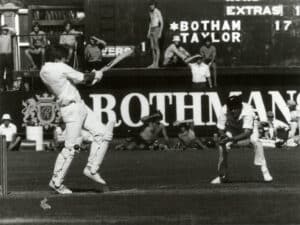
    Something about Botham did: it was to do with the fearlessness with which he played the game, allied always to a certain laddish humour which is still in evidence today. Especially Botham is known for the Ashes in 1981 now forever known as Botham’s Ashes, when Botham’s swashbuckling 149 not out at Headingley began an unlikely set of events. Not until 2005 would cricket come alive in this country to anything like the same extent.

    When we think back on that Test match, It should really be Bob Willis’ test, since it was Willis, who died of cancer in 2019, took 8-43 to bowl out the Australians. Willis hangs over lunch, since Botham is here to raising money for the Bob Willis Fund which raises money for better prostate cancer research.

    Botham tells a wonderful anecdote about that storied day in 1981: “Australia needed a 130 to win. The Australians were 50-1. Bob comes on, and turns to Briers [Mike Brearley, the then England captain] and he said: ‘Any chance I could have a go down the slope with the wind?’ He steamed in and took 8-53.”

    This led to an amusing administrative issue over the unexpected celebrations which Botham, as the world knows, enjoyed more than anyone. “We had this young lad – Ricci Roberts, a 140year-old: he was over from South Africa as a runner. I said to him: “Look we haven’t got any champagne, because obviously thought we weren’t going to win the game.” The Australians thought they would. I said to Ricci: “Go and knock on the Australians door, and be polite and just say: ‘Could the England boys have a couple of bottles of champagne, please?” He did exactly that, but added on the end: ‘Because you won’t be needing them’.”

    The Australians may not have reacted well. Botham continues: “Ricci came through the door horizontal. He had one bottle in each hand and he didn’t spill a drop. Ricky Ricci went on to be Ernie Els’ caddie in all Ernie Els’ major wins. That was down to what we taught him – and how Bob taught him to pour a pint.”


    The Two Geoffreys

    At Lord’s, alongside the extraordinarily likeable Geoff Miller, Botham gave a jovial tour through his career, joking that Geoff Miller was ‘the livelier of the two Geoffreys I played with’ referring to his long-running grudge against Geoffrey Boycott, who Botham famously ran out in Christchurch in 1978. On that famous occasion, Boycott was batting at his usual glacial pace when the situation required runs. Botham picks up the story: “I was asked by Bob, who was then the vice-captain, to run him out and I said: “I’m playing my fourth game and he’s playing his 94th.” Bob replied: “If you don’t do it, you won’t play your fifth.”

    It is impossible to not feel nostalgic about the fun of those times. Botham has come along way. In fact, when Botham recalls his upbringing, as is usually the case with the extraordinarily successful, his story comes into focus in all its glory and improbability: “My father was in the services in the Navy and was serving in Northern Ireland on active duty. When his wife Marie, my Mum, was due to give birth, they sent us over to Heswall in Cheshire.”


    Crunch Time

    The family then moved down to Yeovil and Botham, having shown exceptional sporting prowess, had a difficult decision to make by the age of 15. “I had to make a choice between soccer and cricket. Crystal Palace offered me an apprenticeship. I had just signed at 14 with Somerset – I registered with them and when it came to the decision, I sat down with my dad. He said: “You are by far a better cricketer”. I listened to him – for once.”

    Botham then transferred to Lords for a year and half, before being called back to Somerset at 18. It didn’t work out too badly, did it? Botham smiles: “Not too bad.”

    Botham recalls his first Test match. “The way they did it in those days – well, let’s just say it wouldn’t happen nowadays. You’re driving down a motorway. At three minutes to 12 you turn into a layby and switch the radio on and wait for the 12 O’Clock News. And the England team to play Australia is…And I thought: ‘Yes, I’m in’.”

    That sent Botham up to Trent Bridge, where another lovely anecdote occurs. “We lined up at the start of the game and it was the Queen’s Jubilee. The Queen went down the England line, and wished me luck on my debut. Then she went over to the Australia line, and came to DK Lillee [the great Australian fast-bowler].

    Dennis pulled out of his back-pocket an autograph book. “Ma’m, would you sign this?” She said: “I can’t do that now.” But clearly the Queen had remembered the encounter. Botham continues: “When Lillee got home from the tour six or seven weeks later, through the letterbox there came this envelope with the Royal seal and there was a picture of the Queen. It now sits on his mantelpiece.”


    Merv the Great

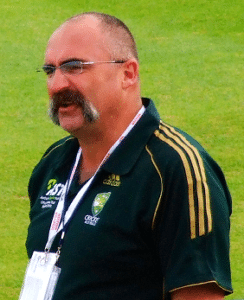
    It’s a lovely story – and the more time you spend in Botham’s spell, the more the stories keep coming. Merv Hughes also gets the Botham treatment. “In 1977-78 we toured Australia, one of my first tours. We were sponsored by a company called JVC Electronics. They decided in their infinite wisdom that on the rest day morning at about 10 o’clock – when most of us had only been in bed 10 minutes – we’d go to a shopping mall in north Melbourne to mingle. None of us were particularly excited about that prospect.”

    So what did Botham do? “I hid behind this tower. This young lad came up in a tracksuit and said: “Good day, Mr Botham. Mate, I want to be a fast bowler have you got any advice for me?” I wasn’t feeling great so I said: “Mate, don’t bother – go and play golf and tennis.”

    Fast forward to 1986: the first test at Brisbane. Botham recalls: “Merv Hughes makes his Ashes debut in that game. In Brisbane, you could see this little black line, that in about 30 minutes became a thunderstorm – hailstones the size of golf balls. Hughes bounces it in, then the gigantic hailstones. Merv wasn’t happy as I’d hit him for 22. We weren’t going to play anymore, the ground was covered with these golf balls.

    One of the lads brought me a beer. Merv comes out and I say: “Congratulations on your first Ashes.” He said: “You know we’ve met before.” I said: “No. Where?” “At the shopping centre in Melbourne.” I was that kid who came running up to you, and you told me not to be a fast-bowler but to play tennis and golf.” He said: “What do you reckon now?” I said: “I was bloody right.”


    Beneath the swagger of the public persona, there is his immense generosity as a philanthropist and his life as a family man. His grandson, James, is following in Botham’s footsteps as a sportsman. Botham speaks with evident pride: “He’s had a couple of years with injuries. His confidence is back – he played very well against South Africa at Twickenham. James was born in Cardiff and said: ‘I’m playing for Wales’. He’s got a task on his hand and we’ll see.”


    A Decisive Difference


    But it’s the philanthropy which really brings a tear to the eye. “I’m very proud of it,” says Botham. “In 1977, I was playing against the Australians and stepped on the ball and broke a couple of bones in my foot. In those days you didn’t stay with the England squad, you got sent back to your mother county. Mine was Somerset.  So I get to Musgrove Park Hospital in Taunton, the club doctor’s waiting for me. To get to the physio department you had to go past the children’s ward.”

    This turned out to be a fateful walk since it would change many peoples’ lives. “You can see children who are obviously ill – tubes sticking out, and their feet up. There were four lads sitting round the table playing on the board games. I said: “Are these guys visiting?” He said: “No, they’re seriously ill.” I said: “But they look fine.” He replied: “You’ve got eight weeks of intensive treatment to get it right for the tour. Those four lads in all probability will not be there when you finish your treatment. True enough at the end, all four of them had passed away.”

    It made a deep impact on Botham who found he couldn’t stand by and do nothing. “What the hospital used to do was give them a party, whether for one of their birthdays or for Christmas. And they were so drugged up with painkillers. As I was leaving the hospital, I said: “Is there anything we can do to help?” He said: “Well, you’ve now seen four parties. We don’t get any funding for those.” I said: “I’ll stick my hand up and pay for the parties.”


    By mid-1984, Botham wanted to do something more substantial. “I was flicking through a magazine which someone had left on the train – a colour supplement. There was an article about a certain Dr Barbara Watson, who lived on the south coast. Every summer she would get on the train and go to the most northerly part of the UK, John O’Groats and meander back. I thought: “Right, I’m going to do a sponsored walk. I’m going to do John o’Groats to Land’s End. My geography wasn’t great. 400 miles to the English border, then 600 miles to the Land’s End.”

    It was a huge learning curve for Botham who had never walked like this before, but he managed to do the walk in 33 days. “You couldn’t do PayPal: you had to physically collect. By the end of the walk we got over £1million. That was used immediately to build a research centre outside Glasgow.” Then the conglomerates came behind us. “When we started the walk, there was a 20 per cent chance of survival for kids with leukaemia – a few years ago we announced it is now 94 per cent.”

    It’s an astonishing story of how something so innocent as being good with a bat and ball and can lead with the right heart and mindset to genuinely consequential change. Botham’s is a reminder to us all to start with what we’re good at – but to keep an eye out for what we might do for others along the way.


    Lord Botham was talking at an event at Lord’s Cricket Ground in aid of https://bobwillisfund.org/


    https://www.beefysfoundation.org


    Like this? See also our other cricket articles:


    Cricket Nostalgia: Henry Blofeld on PG Wodehouse, Ian Fleming and the Remarkable Cricket of the Past

    Culture Essay: What we can all learn from cricket


  • Coldplay’s ‘Moon Music’: the virtues of “surmounted cliche”

    Christopher Jackson reviews the latest Coldplay release


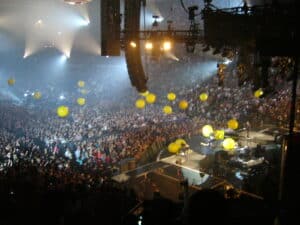
    Every now and then I find myself considering the fine margins between major and minor success. I remember, for instance, a gig I attended at the turn of the millennium at the Nottingham Arena performed by the band Travis. In those days, like their rivals Coldplay, they could easily fill a stadium of 10,000 people. We may have turned up with a certain scepticism but ended up shouting out the lyrics to ‘Sing’, our cynical side assuaged by the fun of the evening.

    Today, rotating on Apple Music, Travis’ songs have a power of nostalgia which the songs of Oasis lack. ‘Wonderwall’ has never really gone away. Travis, by contrast, have had a quiet few decades: this fact creates the gap in our experience which can make for a genuine revisiting not quite possible with the Gallagher brothers. And Travis’ songs stand up reasonably well. ‘Why Does it Always Rain on Me?’ ‘Sing’. ‘Driftwood’. ‘Flowers in the Window’. I hope they have a comeback.

    But had you asked me in the year 2000 which band, Travis or Coldplay, would in 2025 break the record for the most consecutive gigs played at Wembley Stadium, I would have probably plumped for Travis. Coldplay at that time were mainly known for ‘Yellow’, which, lovely as it was, seemed to be a melancholic dead end. Travis’ songs seemed to have more complexity: they even sounded a bit like standards. One could imagine people covering them: there was more to explore.

    I was wrong, of course. I’m not sure if Travis can still fill Nottingham Arena, but I know that it would be too small a venue for Coldplay. When A Rush of Blood to the Head came out in 2002, I was on the frontlines of the backlash, feeling that Coldplay represented not something new and lasting, but some form of decline from the greater cleverness of Blur and Pulp, those high spots of Britpop. Coldplay, I felt confident, represented the blandification of the British scene.


    Change of Heart

    I now see I was wrong in this reasoning – and wrong perhaps precisely because I would have been reasoning and not experiencing the emotion of the music.

    All this came back to me recently when Coldplay returned to my life by a series of accidents. Our family’s enjoyment of ‘Something Like This’ in the car on holiday, led me to the Coldplay Essentials playlist on Apple, and via that to a discovery of all that Coldplay had been up to in the intervening decades since I had loftily decided that they would have no future. I note also that I never bothered between the years 2002 to 2024 to check in on whether my predictions had proven false or not.

    At least I am not alone. As I read the other reviews of Moon Music, the album recently released to an almost Swiftian excitement, I realise I am not alone in having underestimated Chris Martin and all his works.

    Almost any broadsheet review of a Coldplay album will begin with some disclaimer, making it reasonably clear that though the reviewers themselves have not written ‘The Scientist’ – or indeed any song of any description – that they are obviously above the task which has befallen to them: namely to review the latest Coldplay album.

    Usually, there will be some sniping at the lyrics, and a general keening about Chris Martin’s perennial failure to be Gerard Manley Hopkins. From here, the reviewer, having restored themselves to intellectual respectability, will then go on to relate what I suspect might be their real feelings: namely, a few carefully caveated points of praise. It turns out that one or two of the songs are actually ‘not bad’ or in fact, in some cases, surprisingly good. It is then sometimes observed that this is true of most and perhaps all Coldplay albums. The eventual rating – usually three stars – seems to conceal a certain embarrassed enthusiasm.

    If we take the typical reviewer’s estimation at face value that there are, say, two good songs on each album then it must be pointed out that this still amounts at this point to around 20 songs which even the naysayer would wish to preserve.

    What is often forgotten is that this in itself is a high number. If we look at the amount of a celebrated pop act’s catalogue which we actually want to keep it usually turns out to be very small. We would probably be content with rescuing around 10 of Fleetwood Mac’s songs, and Fleetwood Mac is an excellent band. I’ve often thought the Rolling Stones really amounts to around 20 songs (they have released hundreds). It’s only when we get into the major acts, the Beatles and Paul Simon that we top 50 songs – and only in relation to Bob Dylan that we clear 100.

    All this is to say that even if we take a negative estimate of Coldplay’s output then the band’s work is to be approached with respect and not derision.


    The Ghosts of Modernism


    Of course, one shouldn’t have to say this – and one wouldn’t have to say it at all if it weren’t for the peculiar way in which the 20th century turned out in terms of art. Really, it is an inheritance of modernism where people began to feel that things must be complicated, and even incomprehensible, to be good. This view would have surprised many artists and writers who university professors like to exalt, Shakespeare among them, who always took care to have a ghost or a murder – and ideally both – in his plays.

    What appears to have happened by 2024 is that we have realised more or less unanimously that we quite dislike modernism, and wish to keep it at a safe arm’s length. We want to enjoy life, and that for most of us, means not reading The Wasteland or listening very much at all to Schoenberg.

    This is not to say that Moon Music is full of ageless poetry: if written down, the lyrics can indeed be banal. But then this album never claims to want to be experienced in that way: it claims instead to be joyful – and joy-inducing – music. This has two ramifications at the level of the lyrics which are worth examining.


    One is the propensity for simple and grand statements which at the level of language, a child could write. In the third single of this album ‘All My Love’, the lyric reads:


    You got all my love
    Whether it rains or pours, I’m all yours
    You’ve got all my love
    Whether it rains, it remains
    You’ve got all my love


    Now, we can certainly surmise that if T.S. Eliot were writing that as poetry that he might not be top of his form, and even having rather an off day. Bob Dylan, a different kind of songwriter to Martin, especially when writing in the 1960s, would if writing this song no doubt cram in additional internal rhymes around ‘pours’ and ‘yours’ with available words being ‘floors’ ‘pause’ and ‘cause’. He would glut the listener with ideas – and with every idea crammed in one can imagine it getting significantly less likely that the song would ever be sung in a stadium. The song would become more intellectual – would become another kind of song.

    Martin doesn’t do this, and I think at this stage in his career we must give him the benefit of the doubt that he does it deliberately. To firm ourselves in this concession, let me pick almost at random an interview excerpt to show the intelligence of the man. This is Martin talking to The New Yorker in an article released to promote Moon Music:

    “I’m so open it’s ridiculous,” he said. “But, if you’re not afraid of rejection, it’s the most liberating thing in the world.” Well, sure—but who’s not afraid of rejection? “Of course,” Martin said, laughing. “To tell someone you love them, or to release an album, or to write a book, or to make a cake, or to cook your wife a meal—it’s terrifying. But if I tell this person I love them and they don’t love me back, I still gave them the gift of knowing someone loves them.” Martin noticed a slightly stricken look on my face. “I’m giving this advice to myself, too,” he added. “Don’t think I’ve got it mastered.”

    Now regardless of the ins and outs of the philosophical point here, I think most will agree this is obviously an intelligent man speaking who is probably in person wise, funny and kind. Furthermore, it seems unlikely that he should become less so when doing the thing he loves to do which is songwriting. In short, there is something forgivable about the lyrics when we consider the man.

    So given the deliberate nature of his music, what is it which Martin is trying to do with a song like ‘All My Love’? With this kind of song, everything comes down to the sincerity with which it is sung. Sometimes, reviewers will accuse Martin of issuing song lyrics which are like Instagram self-help posts. This is intended to wound him, and perhaps it does.


    Chris Martin by Roger Woolman

    However, even if this is admitted to, we have to say that there are two kinds of platitude: that which is meant sincerely and genuinely designed to help people, and that which isn’t really intended to help at all but which is really a kind of show, and therefore a sort of con.


    On Sincerity

    Having listened to Moon Music for the last few days, I don’t think it is at all the latter. I think Martin is someone who genuinely cares about his fellow human beings, and that his music is, by and large – with admitted peaks and troughs which are entirely human – a fair method of conveying what he feels about life. It was Emmanuel Swedenborg who wrote of insincere feeling that it were as if ‘a liquid were, on the surface, like water, but in its depths putrid from stagnation’. A certain kind of commercialised pop music is like this: it is, in its depths, false.

    The impression one has of Coldplay is different. Probably it wouldn’t catch so many people, and cause such widespread delight, if it weren’t.

    It was his friend Nick Cave who wrote of Chris Martin’s ‘songwriting brain’. Now that we have admitted that he has one, we can see what Martin is able to do in his songs. The interesting point about this is that the correct measure of true feeling does away with artistic doubt. Moon Music is full of what we might call surmounted cliché.

    If I sing that I feel like I’m feeling falling in love, and I have – as one might in adolescence – no real sense of what that feeling means, I will sound rather silly. I will probably not convey that feeling with sufficient experience. Almost certainly, I shall sound immature and insecure, and if the girl is rejecting me, self-pitying.


    But if I sing, as Martin does on the second track here ‘feelslikeimfallinginlove’, about falling in love with full consciousness of what that means – the fear as well as the joy, the vulnerability as well as the force of it – then the words, simple as they are, come hitched to meaning. In that scenario, the music has some sort of potential which exists completely independently of what has been written down on the page.

    Similarly, if I pray for a better world as in the third track here ‘We Pray’ and with every fibre of my being, I really do wish for peace for my fellow human beings, and feel the genuinely awful corollary of war and all its disasters as I sing it, then I am able to bypass the literary concerns of even a music journalist for The Independent around a line like “Pray that I don’t give up/pray that I do my best’.

    That journalist may write at length that I am using cliché, but will be missing the fact that in pop music, if I mean what I sing, and see the glory of peace and the horror of war in my mind’s eye as I sing it, their objections simply don’t carry. In this art form, to mean what one says is a sort of de facto defeat for the naysayer because no matter what The Independent might say, peace is really a very important thing, and praying for it is a very good thing to do.

    At a certain point, Martin realised he could do this sort of thing again and again and that people hugely needed it. He is not Dylan or Cohen, and never intended to be. Musically, his chords progressions are extremely simple, and so he is also to be differentiated from the greatest player of stadiums Freddie Mercury. Mercury’s musical vocabulary was borrowed from jazz and classical. A song like ‘All My Love’ with its straightforward chord sequence from Am to D7 to G and Em shares nothing musically with Mercury’s ‘My Melancholy Blues’ with its complex diminished chords. In fact, Mercury’s songs would generally be a bit outside Martin’s ability as a piano-player.


    Don’t Panic

    But again, in a world of difference, there is no need to fret about any of this if the music can be made to convey good things honestly. It might all be summed up by the presence of an emoji of a rainbow as a track title on Moon Music. A rainbow is a cliché of course – but I know few people who don’t pause and point when they see one in nature. A rainbow then, like peace, or love is not just a cliché. It is also a vital thing which needs to be re-experienced.

    There has been a lot made about Martin’s saying that there shall only be 12 Coldplay albums. With this being the 10th, we are therefore approaching the end of the band’s career. We should remember that it’s a career that has caused enormous amounts of pleasure to many people because of a certain fearlessness about finding ways to refresh us in relation to the obvious.

    How has he done this? I think he has done it by trusting to the origins of songs. A few years ago, Martin explained that he was going through a hard time dealing with the inheritance of an evangelical upbringing. One’s sense is that like so many in the Western world, his struggle has been with the structures of religion – what we might call its exoteric aspects. In short, many people are vexed by things like churches and prayer-books, and desire to reconnect with the wonder of ‘skies full of stars’ or ‘good feelings’.

    Music is one way in which this can be done, and it really means connecting again with the inner self – that is, the esoteric. Coldplay might seem an unlikely messenger of some sort of revolution of the inner self. One begins to say that they don’t take themselves sufficiently seriously for that to be possible – and yet, the moment one thinks in that way, one realises that this is itself what frees people up. In Coldplay, a woman dreams of ‘para-para-paradise’ – and for many this brings paradise itself nearer than a Eucharist or a monk’s chant.

    It would be a shame to miss out on all this in the mistaken belief that a song is a poem, and that a pop concert is meant to be an opera. Life isn’t like that, and I think we owe more to Chris Martin than many realise for not only knowing this but for enacting this knowledge.


    Like this article? For more music content go to:


    Essay: Paul Simon’s Strange Dreams

    Nick Cave and the Bad Seeds’ ‘Wild God’: ‘a song of planetary importance’


    ‘Steppin’ out into the dark night’: a review of Bob Dylan’s Shadow Kingdom


  • 7th October one year on: A Letter from Israel

    Christopher Jackson


    This letter is ten years late. I went to Israel for the first and so far only time in 2013, and for obvious reasons have been thinking about the country a lot since the attacks on 7th October 2023, and the events which followed. This is really a letter to Israel – a delayed epistle I’d been waiting for an excuse to write.

    I was unlucky in the lead-up to that trip: I dislocated my knee playing tennis a week before flying. I was thus forced to cut a comic figure in Jerusalem and Tel Aviv, hobbling with my grandfather’s old silver cane around the Old Town, which, as visitors will know, contains numerous steep pathways, including the famous Via Dolorosa up which Jesus is meant to have shouldered his cross. At one point, I remember an eight-year-old girl trying to steal my cane off me, leading to a scene reminiscent of the sort of thing which might happen to Larry David in Curb Your Enthusiasm, where I sought to wrest it back and found myself only just equal to the task.

    But I found I loved the country: loved its noise and its contention, and the passion for theology, philosophy and history that lay behind its disagreements. Jerusalem is a microcosm of the human story. To step into it – even casually, and unwittingly – is akin to presenting yourself to humanity for inspection. It all amounts to the strangest of looks in the mirror.

    In Jerusalem, it’s not unusual to find people coming up to you in a bar and asking some variant of the question: “Who are you?” “Where are you from?” To ask this question in any other city in the world is to issue a pleasantry; in Jerusalem it feels deeper than that, an invitation to consider your personal identity. Most people who go to Israel end up feeling that they somehow needed the experience. At times, it feels like undergoing therapy.


    It’s no coincidence that in the Gospels Jesus’ opening remarks to his disciples constitute both a salutation and a challenge: “What seek ye?” Quite a lot of the time in Jerusalem one closely neighbours the related question: “What am I seeking?”

    The answer, if we’re honest, almost always involves some sort of large noun: truth, beauty, happiness, love, God – peace. Jerusalem is a place to consider all these things, although periodically, as on October 7th 2023, it particularly evokes the question of peace. That’s because that question: “What am I seeking?” hasn’t always summoned up the same answers in the hearts of human beings.

    The large nouns mean different things to different people: for some happiness is a rave – for others it’s a church service. Peace in turn can be the means by which we gently seek to bring others into our sense of the world, or open ourselves to new avenues of being.  Alternatively, as with Hamas, peace might almost slide into its opposite: it might masquerade as the means by which we seek to still a murderous resentment which all too readily rises up in human minds.

    The founding of the state of Israel was widely deemed necessary in the aftermath of the Holocaust, but soon ran into a difficulty which now feels somewhat inevitable due to the geography of the situation. And yet if we believe at all in human freedom then we can’t quite throw up our hands and shrug that it had to be that way. We must admit that the whole question of the state of Israel foundered on human frailty.

    As a general rule, wars are what incompetent governments inflict on unsuspecting peoples. We cannot call the period from 1948 a period of model governance. On the other hand, there have been periods of statesmanship: the Oslo Accords, begun in 1995, and the Unilateral Disengagement Plan in 2005 both amounted to attempts to move towards the solution of the problem.

    As I travelled through Israel, I found myself asking how the situation has deteriorated so seriously so rapidly. The first clue is in the history itself. Everywhere else on earth, history feels asleep by comparison. Here, you feel its urgency – its pulse. To be surrounded by so much holiness is to exist in a highly alert moral condition, and this is the case if you’re only visiting. To live here must be another step up.

    Secondly, I often think of an observation once made by Daniel Barenboim the c0-founder, with Edward W. Said, of the West-Eastern Divan Orchestra. This orchestra brings together Israeli and Palestinian musicians. Barenboim was at a rehearsal and stepped out for a moment, returning to find his orchestra at loggerheads over politics. He watched them argue and reflected that both sides of the argument are of a similar temperament. It isn’t, Barenboim reflected, like a conflict between the Swedes and the Italians. This fact alone, Barenboim says, accounts for much.

    It all amounts to a charged atmosphere. There is a lovely museum Ticho House in Jerusalem which all visitors should see. It was founded by Dr Abraham Ticho, the husband of the landscape artist Anna Ticho. When Abraham, an ophthalmologist, was injured in the 1927 Palestinian Riots everybody – Jews, Christians and Palestinians – prayed for his recovery since he was the go-to man for the treatment of the common ailment trachoma.

    These riots, in which 133 Jews were killed by Arabs and 116 Arabs killed predominantly by Mandate police, were sparked by questions of access to the Western wall. It all reads like a terrible promo of the conflict we now have. The Shaw Commission, charged with looking into the matter, would find that the riots were caused by “the Arab feeling of animosity and hostility towards the Jews consequent upon the disappointment of their political and national aspirations and fear for their economic future”.

    Of course, one might have feelings of disappointment and anxiety without resorting to murder, and Ticho’s story reminds us that many didn’t have these feelings. It is worth visiting the Ticho museum to remember not just Ticho, but the people of every denomination who prayed for him because his medical skill ensured he was part of their shared interest. In Ticho’s story, we receive a tantalising glimpse of another set of possibilities for the region which sadly has never yet been taken up.

    And there is something unique about his wife Anna’s landscapes too. In these pictures, it is as if the land of Israel, like Jerusalem itself, carries a particular charge. This isn’t solely to do with politics: for Christians (and for many Muslims), these are the hills which Jesus retreated to in between sermon and miracle; for Jews, each bush can be aflame, as it was for Moses, with the suddenness of God; for Muslims, the very sky is open – filled with the idea of ascending to the Heavens. That means that Ticho can never be painting landscape in quite the same way that, say, Constable is painting landscape: she’s painting spirit.


    Injured though I was, I decided it would be worth taking a taxi out onto the West Bank. In Bethlehem, you can visit the Church of the Nativity – the supposed original of the manger which we used to recreate in our youth in rural Surrey. As we drove out, I saw the grape sellers – all Palestinians – reduced to selling grapes on the side of a dusty road, where little traffic comes. All drivers know that non-dusty grapes are available in the supermarkets of the built-up settlements nearby. It is a hopeless situation and even those broadly supportive of Israel will wonder at a lack of humanity which is so evident but whose causes are so difficult to trace.

    In Hebron, the look and feel is of a warzone without the bombs falling. Children kick bedraggled footballs against the walls of shuttered shops; Israeli tanks move through the streets, like sharks through a fish tank. Here the guidebooks point you to the Cave of the Patriarchs, considered to be the burial place of Abraham and Sarah – figures whose importance the major religions agree on.

    Here one feels one is entering something like the crux of the matter. As a Westerner, I was only able to go in through the Israeli side. There is an entrance for Muslims I didn’t see, and the interior itself is partitioned. I hobbled up towards some Israeli soldiers who seemed to be mocking my injury in Hebrew, which didn’t strike me as the most welcoming start.

    Cave of the Patriarchs

    Inside, there is a seminary where Jewish students recite passages from the Torah, and everywhere there was a hushed seriousness and, to me at least, a palpable sense of things being about to kick off. This is the hard fact about Israel: from Woody Allen to Larry David, Jerry Seinfeld and Mel Brooks, nobody has made the world laugh harder than Jewish people. But to come to this land is to feel that everything keeps coming back to a flammable seriousness.

    In that Shaw Report which I quoted a moment ago, the writers added that the cause of those 1927 riots was the Palestinian sense that Jewish settlers were ‘not only a menace to their livelihood but a possible overlord of the future.’ In 1927, some two decades before the founding of the state of Israel, this was remarkably prescient: for many Palestinians this is what did happen.

    As you climb the hill to see Herodium, Herod the Great’s palace, I had a panoramic view of the homogeneous settlements somewhat resembling the worst kind of British council housing. As I hobbled skywards, the Adhan – the Islamic call to prayer – reached me easily from the skies. Sometimes it sounded like an assertion of some kind; at others a cry for help. Looking down on those towns from the archaeological site, everything felt so terribly boxed off.

    A commitment to freedom of movement is what we still have here in Britain and in the UK: this in turn is built on trust and the notion that everyone potentially has something to contribute through hard work to the betterment of all our condition. Interestingly, if you had to pick a country in the Middle East which has some of this spirit, you’d also pick Israel, especially Tel Aviv with its superb food and Miami-like energy of expansive bustle.

    We have all seen music festivals like the one which was taking place near Re’im on Black Saturday; most of us have been to them. These festivals, very far from my cup of tea, are part of our national life, and so we might recognise ourselves in the victims of the massacres. Alarmingly, I don’t think if Hamas were exported to the UK, that they would have much hesitation in massacring Glastonbury, as appalling as that might be to contemplate.

    This, in turn, cannot help but generate some questions regarding the pro-Palestinian – and all-too-often pro-Hamas –marches on the streets of London. Firstly, how many have been to Israel? Secondly how many of them have been to Glastonbury? One suspects here a far higher percentage in answer to the second question than to the first. But if this is the case, then many are marching in favour of the very people who would murder them if they had half a chance.


    Tel Aviv skyline

    None of this means that Israel has behaved in a flawless manner. Too often, violence has met with ratcheting language, and counterproductive violence. The failure is predominantly one of political leadership: no one would accuse Benjamin Netanyahu of too much resembling Nelson Mandela. But to consider this an isolated failure on the part of Israel’s leadership, as so many do, is a dangerous fantasy. To land on a fairly obvious point: any organisation whose central text is the Protocols of the Elder Zion, as is the case with Hamas, has a fair amount to learn about peace-making.

    Some people need to be fought; there is such a thing as the legitimate causus belli. In addition, the Mandelas of this world have a far greater dose of realpolitik in their make-up than we realise when we later lionise their achievements in peace. We forget that they often pivot to resolution only after having defeated the harshness of their enemies. Hamas has never been as cuddly as the left-wing intelligentsia has liked to imagine it.

    The reality is that history – any nation’s history – is peppered with injustices of every kind. The past is in some fundamental sense unthinkable – and yet it all happened.

    The usual way in which we move beyond atrocity is by acknowledging that many evils were perpetrated by the dead. This is the basis on which we forgive and forget. In England, we no longer identify with a particular side of the War of the Roses; I am as welcome in Lancaster as I am in York. Except when a rugby match rolls round, we have also rather forgiven the Norman conquest – and anticipate, as we walk through Paris, a degree of forgetfulness regarding Agincourt. The past has to recede because it was conducted by imperfect people.

    The same is true of the founding of Israel, and in relation to recent history in the region. There are two differences. Firstly, these events are closer in time. But secondly, the fear is that they shall in same way always remain so, because they revolve around both temporal and eternal questions. For so many people, Christianity, Judaism and Islam still matter, forming part of our essential hopes beyond the life of the body. It is not just that these affections won’t go away – it’s that anyone of religious inclination would be bereft if they did.

    If you want to know what that would look like then you have Soviet Russia, and maybe the hard-left wokeness in the UK to sample: identikit moralities where power goes not to the meek, the thoughtful or even the hard-working but to the noisy and the cunning. That’s the real reason one suspects that a large chunk of the left marches against Israel: they don’t believe in any eternal dimension whatsoever and would like to delete that from their lives. Like Christopher Hitchens, they loathe religion full stop, and can’t distinguish easily between the book of Genesis and Hamas: to them, it can all be grouped under the ‘God is not great’ banner.

    This is the intractability of the crisis: it goes deep into all of us and keeps refusing to recede. Israel is a remarkably complex undertaking with a paradox at its centre. It is, in one sense, a representative of the Western way of life in the Middle East. There are few cities so Bohemian as Tel Aviv. But, at the same time, when you get right down to it, it isn’t a particularly secular country. Too much of the Bible and the Koran takes place there for that to be possible.

    These two aspects have both created enemies. The hard fundamentalist right dislikes its licence; the left dislikes the obligation it places on us to consider religion. Israel is a land of miracles and from one perspective the bar of not killing one another over a set of misunderstandings feels sufficiently low that it ought to have been achievable by now. But we have to admit that it hasn’t been and that if you ever go to Israel you’ll be visiting the saddest, but also the most necessary, place in the world. It’s not a foreign country – it’s our collective story and that’s why it will always matter.


    For other examples of our letter series try these:


    Discovering the Charm Budapest: Tom Pauk’s Letter from the Heart of Hungary

    Omar Sabbagh’s Letter from Dubai: ‘As soon as it was safe enough to reopen, that was done’


  • Exclusive: How Stephen Fry went from Comedian to the Nation’s Mentor


    Christopher Jackson


    Growing up is necessarily a provincial experience. It has to be: such a small proportion of the world is presented to us at that time. As a result, something like the following seems to happen: we come into the realisation gradually that our family’s experience of life, while it might be informative in numerous respects, also has to be a sort of red herring: we are not them and are not meant to be. Instead our obligation is to grow in some new direction in order to be ourselves.

    What this all has to do with Stephen Fry I shall come onto in a moment. For now it is enough to say that predicament of youth can engender bafflement, even acute forms of anxiety. It was the novelist Sir Martin Amis who pointed out that nothing is so usual as what your father does for a living. He knew that from rich personal experience, his father being the equally famous novelist Sir Kingsley Amis. But many people have the opposite sense that one’s essential narrative might lie elsewhere. If this is one’s suspicion then what you badly need are clues as to what that might realistically consist of.

    For me, growing up in rural Surrey in a good-natured suburb of lawyers and accountants, the existence of a group of comedians in the 1980s came as thunderbolts. Looking back, I realise they were also signposts. The moment I saw Rowan Atkinson on our TV screens as Mr Bean, and saw my parents crying with laughter, and felt the first true belly laughs I’d known rushing through my being, I felt a new scope rush in.

    This must be a very common experience: here we are in our quotidian home, trying our best and seeking to be good; but out there, on the screen is another kind of life, which seems so hilarious, and so silly – and therefore somehow kind, and decidedly blessed. It is the world of celebrity and laughter. When we are young, it can seem like the most desirable thing in the world – full of high definition colour, and pitch perfect performance, a sort of paradise where outcome is in accordance with aim.

    Of course what happens at that time in our lives is a broad revelation – what Philip Larkin calls ‘the importance of elsewhere’.  It’s only later that you examine its particulars; how the sheer scale of possibilities relates to oneself. When I saw Rowan Atkinson terrified to dive off the top floor of a swimming board, I didn’t, as the world can now see, decide to be a slapstick comedian.

    But I think I did decide around that time not to be an accountant. This decision was further crystallised when I saw John Cleese in Fawlty Towers, the frenetic clockwork pace of that sitcom, causing an escalating delight. It was shored up further by other experiences: French and Saunders, Smith and Jones, and later Harry Enfield.

    But then there was another pair who spoke to me in a different way, and opened up, I now see, far larger possibilities: this was a pair of Cambridge graduates called Stephen Fry and Hugh Laurie. Hugh Laurie seemed to me then – and still does – just about the most gifted person on earth. He is funny. He is a brilliant actor (see especially House). He plays piano, sings, and plays guitar beautifully.

    Almost unnoticed, he is the best comic songwriter of his generation (‘I don’t care if people laugh/I’m in love with Steffi Graff’). His novel The Gun Seller is a delight. He was also responsible for A Bit of Fry and Laurie, my vote for the greatest sketch show of all time.

    It was Laurie who made me pick up guitar and piano, and later write music. But of the two it was Stephen Fry who really interested me, and who pointed a more definite way. In this country, the trajectory is told everywhere from the life of Shakespeare to the novels of Dickens: you’ve got to get from where you are to London. And it’s from London that I write this.

    What was it about Stephen Fry? It was partly because however troubled he was, he was so obviously kind – though over time I would find out that he could be rather hard on himself. But I don’t think it was primarily that. For me, it had all to do with his use of language, which came as the most wonderful and joyous surprise of my life. It seemed astonishing to me that people could speak like this, bequeath you a vocabulary as they made you laugh.

    It was a form of proclaiming of themselves before the world – they could cause laughter in you while making you more intelligent. If you were receptive to it, it had to form you; Fry and Laurie made you want to be them, because it looked like an awful lot of fun. But not just that, it made you feel that if you could enter a little into their world, that you would know some special set of secrets. That way maybe you could build a life – one that was somehow true to a high set of possibilities.

    These sorts of suspicions can only take you so far. Because pretty soon, life happens to you. As Mike Tyson beautifully put it: “Everybody has a plan until someone punches you in the face.” What happens is that life punches you in the face – and anyway, the world our heroes inhabits nowadays has so little to do with the one we end up entering. We specialise in the vanished paradise and the discarded Eden.
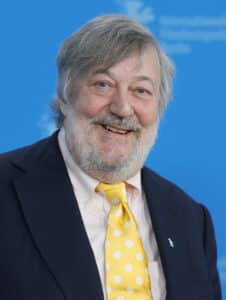
    Nevertheless my preparations for a world which would have gone by the time I got there were unusuall thorough. I think I must have been 11 or 12, when my younger brother Tim – who would have been nine or ten – began learning and performing Fry and Laurie sketches to family and friends and sometimes to perfect strangers in restaurants. One particular sketch which we performed entailed Stephen Fry as a pompous late night talkshow host, talking on and on in the most preposterous way: “Is our language too ironic to sustain Hitlerian styles?

    Would his language simply have run false in our ears?” My younger brother would play a baffled Hugh Laurie, who can’t understand what on earth the Stephen Fry character is saying. Amusingly, as I look back on it now, I had absolutely no idea what the language meant. This created a situation of considerable amusement when I performed before elderly relatives the following:


    Language is my mother, my brother, my father, my whore, my mistress , my niece, my check-out girl. Language is the dew on a fresh apple. Language is a creak on the stair. Language is a ray of light as you pluck from an old bookshelf, a half-forgotten book of erotic memoirs.


    I had no idea what any of it meant but I loved the music of it. It was the idea that language is a kind of music, that we can have fun with it, and play with it – and therefore, I suppose, that it has glorious function. It means that we can burst pomposity in this sketch, but of course, if you accept its use, then you must also admit that it can lead you onto new worlds. It can prise things open.

    As I continued my studies in Stephen Fry, I found in him an educator – indeed, a sort of a remote and unpaid mentor. The power of this mentorship seemed to me no less important simply because he didn’t know who I was, and would almost certainly never know. This didn’t matter one iota so long as I was receptive and so long as Fry continued to build his career around the communication of the things he loved.

    It is this love of things which I think defines Fry; it is a generosity in him which keeps spilling out. As I would go on in life, some people in the public eye would also give me great gifts. Amis, who I mentioned earlier, would give me Saul Bellow and Vladimir Nabokov; Julian Barnes, whose books I could never get on with, offered up Flaubert in almost every interview he gave; Gabriel Garcia Marquez recommended me Virginia Woolf and Juan Rulfo; John Updike showed me Henry Green and so on and so forth.

    It is perhaps the loveliest of all lessons for young people to know that in life, as in literature or art or music, there are a series of invisible threads to be grasped and which lead to pleasures you never could have imagined.

    But Fry, I think, was different to all these people. He loved things loved so much that he had to enact that love. He didn’t just tell you in no uncertain times that he loved PG Wodehouse; he played Jeeves on television. He didn’t just love the novels of Evelyn Waugh, he directed a film of Vile Bodies, replacing it with the far better title Bright Young Things. And then there was Oscar Wilde, who he rather resembles, and who he often seemed to embody in his chat show appearances, and then on film in Wilde, the role which he was born to play, and which he played beautifully.

    The world is a catty place and some would say that Fry has always been in some sense derivative. The argument runs that he has borrowed these personas and that there is accordingly some sort of gap within where the real Stephen Fry ought to be. The somewhat churlish columnist Peter Hitchens has called Fry ‘the stupid person’s idea of an intelligent person’.

    I dislike this remark not just because he repeats it in print regularly with a kind of calculated cruelty, but because it isn’t true. Fry didn’t write The Importance of Being Earnest, it’s true, but he has done more than anyone to proclaim Wilde’s genius at his having done so. I don’t think Fry, clever as he is, has ever made gigantic claims for himself; others have done so, seeing his value. In time, the nation reached something like a consensus around this. They loved to hear him talk – but I think they loved really to hear him talk about his loves.

    These seemed to have no obvious limit: in addition to Wilde, Wodehouse, and Waugh there was cricket, Paddington bear, nature, taxis, Abba, Sherlock Holmes, Ancient Greece, poetry, London, America. Really, we began to realise, he loves, or is capable of loving everything. This spirit, I note, is far closer to the Christian ideal than anything I have seen in the public domain written by Peter Hitchens.
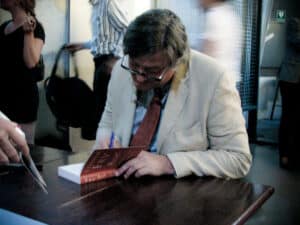
     

    Hitchens’ remark also lacks empathy. We now know what Fry was going through, and that he has suffered all his life with bipolar disorder which can lead him into manic moodswings; he has lived all his life with suicide as a realistic possibility. Here again, he has done more than anyone to raise public awareness about this health condition in his very important documentary The Secret Life of a Manic Depressive which aired in 2016, some four years before the pandemic when mental health really began to top the agenda.

    His condition, which wasn’t widely understood at the time, was most obvious when Fry famously left the cast of the Simon Gray play Cell Mates in 1994. In the days before mobile phones, there was genuine worry about his whereabouts and the fear that something appalling might have happened to him. Gray was upset at the time that his play had been, quite literally, upstaged, and wrote about it at book length in Fat Chance (1995).

    Nowadays, I doubt Fry would get to the end of his street without his whereabouts being broadly known; in those days, when he left the play mid-run, there was a genuine fear among his friends that he had vanished for good. Today, he is one of those people so famous, that he will never again be allowed to go missing.

    If I were to compile a list of Fry’s dislikes, I feel I might reduce it to one thing: cruelty. His friend Christopher Hitchens has sometimes been called the hater par excellence, but I think Fry is a greater purveyor of dismay at human cruelty than Hitchens was, because, on the flipside, I think Fry’s kindness is more active.

    The only kind of successful hate involves consistently pivoting to love, and my sense has always been that Fry is good at this. One early article which influenced me was his great defence of Freddie Mercury which is collected in his 1992 collection of journalism Paperweight, where – I am quoting from memory here since I can’t find the article online – he speaks of Mercury as having entertained with a ‘chutzpah bordering on genius’ and takes to task those who found his lifestyle immoral.

    Its tenor was really ‘judge not less ye be judged’ – and again, one feels that Fry is always actively generous in spirit in way which ties in with the Gospels far more than one might expect from a man who shared the stage in religion debates with Christopher Hitchens.

    His career grew in so many directions that it cannot easily be summarised. It has proceeded along novels (I especially recommend the first two The Liar (1991) and The Hippopotamus (1994), memoir (Moab is My Washpot (1997) may in fact be his best book) broadcasting (his best work here may be his brilliant hosting of the BAFTAS, which he did 12 times, finally giving up in 2018),

    TV shows (Jeeves and Wooster, Kingdom), a marvellous poetry handbook The Ode Less Travelled (2005) which was instrumental in my ever publishing any poetry myself, as well as a host of illuminating TV documentaries, TV interviews, podcasts, blogs, posts, tweets and many other things besides. Fame is difficult to quantify but by any measure Fry is among the most famous people in the UK today.

    My fame however is very easy to quantify: it is nil, and I am currently doing all I can to keep it so. However, just because I have ended up lucky enough to spend a lot of time carrying out interesting journalistic assignments, I must admit that it has involved meeting famous people of many different shapes and sizes all for the purpose of interviewing them. Some of them, from Sting and Andre Agassi to Sir David Attenborough, have been very famous indeed.

    Some like Sir Tom Stoppard, Clive James and Sir Anthony Gormley have a mystique to those who mind about literature or art. Others aren’t famous at all to almost everyone, though they might be revered in their field. Out of all the categories of people I have come to most dread, I would single out those who are just a tiny bit famous as the ones to watch: amid the dim lights of that particular inferno, ego can be at its most pronounced.

    At any rate, as you go through your journalistic career, you realise as you go on in your work that you are starting to meet your heroes. But even then, I never thought I’d meet Stephen Fry.

    What exactly is going on psychologically when we meet our heroes? Dr Paul Hokemeyer, the brilliant author of The Imposter Syndrome, tells me: “Our fascination with and attraction to heroes is primal and hard-wired into our central nervous system. This is because heroes become like celebrities who occupy elevated positions of prestige and power in our society. From an evolutionary standpoint, we are instinctively drawn to people who will take care of us and from whom we can learn vital life lessons to protect us from dangers and advance our station in life. Because this draw is so primal and integrated into our central nervous system it often overrides our critical and rational thinking.”

    In short, when you meet someone well known, we have a tendency to say stupid things. What is happening in the brain at such times? “As this relates to our neuroanatomy, being in the presence of a celebrity floods our central nervous system with a host of intoxicating hormones that override the intellectual reasoning found in our prefrontal cortex. Such disequilibrium causes us to say silly, often nonsensical things which place us further in a subordinate position to the celebrity.”

    And how does this all play out from the point of view of the celebrity. Put simply, it’s not great for them either. “ Too often, however, celebrities become exhausted from the weight of this elevated and never-ending dependency. People become only able to see them as resources to advance their station in life.

    They become like parasites sucking their life force and preventing them from finding any relational nourishment. In this regard, people become a source of danger and cause them a great deal of anxiety. This is one of the reasons why people of wealth, power and celebrity lead such isolated lives. They lack not just a circle of peers but also people who they can look to for nurturance and protection.”
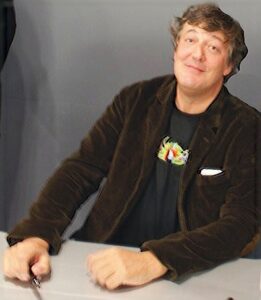
     

    What seems to happen is that a journalist – just by virtue of what he does for a living – comes into in a slightly different position when it comes to the famous. It might be that someone who isn’t battle-hardened when it comes to the sheer oddity of celebrity will meet someone, and the encounter may go badly because they will end up saying something just a bit odd in order to impress, or to draw attention to themselves. They feel the gulf between the famous person’s fame and their own obscurity too keenly and end up drawing attention to it.

    The famous person, who will be by their position, extremely experienced in this sort of mismatched encounter, will sometimes try to amend the awkwardness but at other times they won’t. This might be personal (they’re tired and/or having a bad day) or it may just be that the encounter cannot be rescued. The famous person may then resign themselves to the thought that maybe it’s just easier to spend time with other famous friends. Almost always when someone moans that so-and-so in the public eye isn’t pleasant to meet I suspect that there will be some element of this completely understandable lack of expertise which has intervened on the encounter and spoiled it.

    What’s interesting is that the way to remove the awkwardness of the encounter is not to care at all about fame, but to care about the person in front of you. This is not to say you should pretend they’re not famous as that would be to deny reality, but to treat fame as perhaps the least interesting thing about them.

    Sometimes I have seen, in the middle of an interview with someone known, the person themselves, and there one sees something deeper and truer which has nothing to do with the construct of celebrity, though it will also almost certainly give clues as to why that person was driven to become well-known and also why the public reciprocated that wish. I am not saying that I am a master of this art.

    I would not expect myself to behave with absolute equanimity if Elton John were to knock on my window as I write this, and offer up a private concert in my living-room. But it is what journalism teaches you, and it amounts to something like an inherent lesson of the profession.

    Hokemeyer explains: “What such a person is doing is modelling humanity. By pre-empting the biological calibration that occurs around the power dynamics inherent in a celebrity identity by engaging in your intellect and rational mind, a journalist is levelling the playing field. You pre-empt the hijacking of your intellect by grounding the relationship first in the prefrontal cortex and then allowing your central nervous system to catch up. For most people, the calibration of psyches occurs in reverse. The central nervous system leads. Too often the intellect never catches up and the relationship becomes fuelled by unrealistic fantasies and harmful stereotypes.”

    Quite by chance, on the 27th July 2023, I presented myself at the Oval Cricket Ground at the Micky Stewart Pavilion. I had, to put the matter as politely as possible, more or less had my fill of famous people. I am anxious here not to sound tiresomely world-weary since I have always been mindful of my luck in terms of meeting so many interesting people. However, it would be wrong to omit the fact that the encounter between famous person interviewee and non-famous interviewer is always on some level a sapping one, for the simple reason that by creating fame, and especially televisual fame, we have plainly released a set of completely crazy energies into the world.

    I wave my ticket at the security people, a piece of paper which conveys the unlikely, but true, story that today I happen to be attending the final test of the Ashes courtesy of the Duchy of Cornwall. Instead of the interrogation I half-expect, I am waved through to the Oval, scene of some of the great climaxes in Test Match history. Here in 2005, Kevin Petersen hit his magical 158, with Shane Warne bowling his heart out. It is also a place of significant goodbyes.

    Here it was that Alistair Cook scored 147 during his final innings having been short on form. Here too Don Bradman was famously bowled for a duck, when needing just four runs to end with an average above 4. Unknown to me, in a few days’ time, Stuart Broad will retire from international cricket having hit a six from his last delivery and a wicket with his last ball.

    Inside, all is cricket lore – a lesson in black-and-white pictures and old news clippings about the history of cricket. The Oval is a place where time is prised open a little, and you feel a sense of cricketing history. Perhaps it is more forceful in this respect than Lords, because the so-called Home of Cricket is always cumbrously reminding you of its importance. Here the past seeps in almost casually.

    I walk up the stairs and am asked to find my name on the guest list and sign in. As I scroll down the second page, I glimpse the names on the guest list: Sir John Major; Sir Trevor Macdonald, Chris Tremlett. My name must be on the first page, and there just down from my own, it reads: Stephen Fry.

    I am given a name tag and move through to the bar area. Now, it is important to convey a little about the Micky Stewart Pavilion. As I understand it, one of the most interesting things about becoming the Prince of Wales, and thereby coming into the possessions of the Duchy of Cornwall, is to discover all the things which one suddenly owns. One of these possessions is the Oval Cricket Ground.

    This means that if by some curious chance one is invited to the Micky Stewart Pavilion you are there to some extent because the Prince of Wales doesn’t mind you being there, or hasn’t noticed, or in my case, by a stroke of good fortune. In such places there is curious sense that everybody assumes you have some sort of validity just by being there at all.

    As I walk in Sir John Major walks by and, ever the politician, he reads my name badge and says: “Hello, Chris, it’s good to see you here.” We talk briefly about the great sadness of the weather-affected draw the week before, which certainly have meant we’d be coming into this match with the scores level at 2-2.

    I am always struck by the charm of senior politicians; I wasn’t able to vote in 1997 when Major was last on the ballot, but he has secured my vote retrospectively. We sit down for the opening session, and sit away from the bar in the stands. It only occurs to us once we have sat down that the green seats nearest the bar are for everybody to sit in. We might just as well, had we had the inclination, sat next to Sir John.

    But what is the proximity of an elderly prime minister compared to a good morning’s cricket? Australia chose to put England in, in the justified belief that overcast conditions would make the ball swing. However, England put up a spirited performance, led by a swashbuckling 85 by Harry Brook. As we head inside to the pavilion for lunch, Fry is seated next to the door and smile congenially at us – he looks like someone who, should the moment arise, wouldn’t mind a conversation.

    We head inside and there is a bit of mingling before lunch. Chris Tremlett towers above the company, looking like he could still take a wicket if suddenly summoned down to the pitch. By accident I find myself chatting to Fry, and I mention to him that my grandfather had grown up in the same village as him in Booton, in Norfolk.

    “Booton!” he cries, delightedly. I can see how much he enjoys saying the word – which is, indeed, rather fun to say now I think about it.

    I add that my great-grandfather was the rector of the church there. “Oh, I remember that cold church,” he says. “Were your family the Fishers?”

    I say they were the Jackson.

    “Ah the Jacksons!” he says, cheerfully, though I suspect that he can’t remember them and they may have been before his time.

    After lunch, we head out and find Fry sitting alone on the green seats, and in a moment of curious madness, decide to sit next to him. It is worth saying at the outset that a good place to meet your hero is at the cricket: the rhythm of the match can interweave with your conversation, and it is less adversarial than the typical interview.

    Early in our discussion, we talk a bit about our favourite Australians and I mention Clive James, who Fry knew well, and who I interviewed once towards the end of Clive’s life. I mention that I liked his poetry and that I was due to talk to him about The River In the Sky, one of Clive’s last publications. “Yes, I rather like Clive’s poetry too. He was a very good poet – when he wasn’t reading the whole of Western literature.” I mention that I was invited to Clive’s house for the launch of the book when I had committed to a press trip. Fry sympathetically winces: “That’s unfortunate.”

    We then discuss Sir Tom Stoppard and I mention how kind he had been to me when we interviewed him for this magazine. I say it is often difficult to know how much one should thank someone well-known. “Oh, you always should. Christopher Hitchens always used to say that – thank your heroes.”

    Does he miss Christopher Hitchens? “Hugely.” I ask him if Hitchens would have supported Trump or Clinton in the 2016 General Election. “It’s a well-framed question,” he smiles, “as if there was one thing for sure about Christopher it’s that he absolutely loathed the Clintons. But Trump? I think that would have been a step too far.”

    He then tells me a lovely story about Tom Stoppard at a cricket match which Fry attended. The party were discussing collective nouns – a parliament of birds, a pride of lions and so on – when Harold Pinter and Stoppard walked in. Fry wondered aloud what the collective noun for playwrights would be and Stoppard immediately replied: “A snarl of playwrights.”

    We discuss Leopoldstadt, Stoppard’s most recent play, which Fry has just been to see in New York. He asks if I have seen it and I say I have only read it but that the ending affected me deeply. Fry is wistful, no doubt thinking of the extraordinarily touching end scene, which I shan’t go away here: “Yes, I wonder what it would be like only to have read it.”

    Stoppard, Fry recalls, used to play cricket for Harold Pinter’s XI. “It was called The Gaieties which has to be the worst name for an XI of all time – and not a very Pinteresque name.” I recall to him an essay in Paperweight that he had written an essay on chess and playwrights, and how the story of styles in the 20th century theatre mirrors chess-playing styles around the same period. “Well that’s just the sort of pretentious stuff I would write.”

    I have throughout a sense of Fry which is rather touching. That is, even here, when he doesn’t need to be a performer. One senses the need to be loved, and that he is therefore always moving to make life easy for you in conversation – to make sure you’re at ease.

    Down on the pitch, Stuart Board, I note is trying to anger himself into greater pace, and this prompts a discussion on the importance of anger in fast-bowling. ‘Bob Willis is the great example there – he always bowled better when angry,” says Fry. He also quotes Mike Brearley: “Anger always brings presents.”

    As we talk, Fry explains that he is trying to do more to carve out time for the cricket, and that it was part of his motivation. “I have a lot of difficulty saying no,” he says, “which is why this summer has been so lovely.” It has been a time to pause work and spend some time with friends. “Hugh loves the cricket – he came along for a day,” Fry says.

    Talking of fast-bowling greats turns us inevitably to Shane Warne. I ask him if he’s read Gideon Haigh’s great biography of Warne, and Fry is enthusiastic. Fry has also a kindly way of finishing your sentences for you as a way of making you feel you are being listened to and understand. When I begin to say there have been times when I’ve considered getting a subscription to The Australian only to read Gideon Haigh, I find that Fry has said the last five words on my behalf. Did Fry get to know Warne? “Yes, I did a bit – a lovely man.”

    But of course you realise that however many people you might have met, Fry has known everyone. It comes with his position. Since we are here thanks to the Duchy of Cornwall we briefly discuss the Prince’s disinterest in cricket as opposed to football, Fry frowns in a comic way: “Well, yes, I have known for some time that the Prince is not especially interested in cricket. Prince George though when I saw him last talked of having ‘just been in the nets’ so perhaps things will be somewhat different in the next generation.”

    It is a lovely thing to let the conversation as the cricket changes. At one point, Fry jokes about Todd Murphy, the Australian off-spinner. “Well, he’s got the off break, and then there’s also the off break. And if that doesn’t work, at least he’s got – the off break.”

    At another point, enjoying the batting, I mention John Arlott’s description of Jack Hobbs, as what having made him great was his ‘infallible sympathy with the bowled ball’. Fry repeats it: “Oh Arlott! An infallible sympathy with the bowled ball. Marvellous!”

    There is time also to reminisce. I mention how Fry and Laurie caused me such delight as a young boy, and even tell my story of reciting his work as a boy, and not knowing what the words meant. When he asks which sketches we used to recite, I tell him: “There’s this sketch where you play a pompous interviewee on late night television. “ “Sounds like me,” Fry says swiftly.

    When I recite the sketch for me, I am able after all these years to thank him for it. To my astonishment, I see he is visibly moved to have had this impact. “We didn’t know the effect back then – it was like dropping a coin into a well. Every now and then with Fry and Laurie someone would stop you in the street – but it was very occasional indeed.”

    I had heard a story of Paul McCartney, which I mention to Fry. Apparently, when he seeks to hire someone he always gets his driver to befriend someone lower down in the organisation he wants to hire, so as to be sure that they’re kind to their subordinates. “Did you ever get to know David Tang?” Fry asks and I admit I’ve never heard from him. “I loved him he was an incredibly kind man. But he could be extraordinarily rude to his subordinates. On more than one occasion he was David was so rude to his driver, that I had to get out of the car.”

    As the often continues – and it was one of those rare giddy days in Test match cricket where wickets fall at regular intervals – I also get the opportunity to thank him for The Ode Less Travelled, his poetry handbook, without which I never would have been able to publish my own poetry books. I tell him his, and I also add that the poet Alison Brackenbury is an admirer. He is thrilled by this: “Alison Brackenbury! Well, I love her poetry so that means the world to me.”

    Later I mention this to Alison and she replies: “How wonderful! We never know where our writing goes. I do think Stephen must be fantastically well-read to have found my poems. I have tried hard over the years to scatter them in the most unlikely places, but I doubt if even the amazing Mr Fry ever read the now defunct Tewkesbury Advertiser.”

    I remind Fry that he says he writes poetry in The Ode Less Travelled, and tell him I think he should publish a volume of verse. He says: “Well, I did think during lockdown that I ought to compile that and I began it, but then I stopped.” How long would it be? He smiles: “Well that would depend on triage. Most likely it will probably have to wait for my will and then everybody will say: “What on earth was he thinking?”

    The afternoon drifts on, cricket always intertwining with talk. At one point Fry jokes that we must ‘avoid clichés like the plague.” He talks of his admiration of Rowan Atkinson (‘no one else can convey a line like him’). He spends some time on cricket trivia, reminding me, for instance that Alan Knott wasn’t a wicket keeper at first but a bowler – and that being so good at the latter craft helped him become so brilliant at the former. His beloved Wodehouse gets a mention: “Wodehouse was told that he was most read in hospitals and prisons and first thought it a bad thing but then decided there could be no greater compliment to an author.”

    And now I’m afraid I must go and do a talk in central London. He turns to me and says: “You’ve made an old man very happy.”

    And then he’s off – having made me happy too. But the curious thing is I think he means it – and I wonder about the isolation celebrity must bestow. Hokemeyer tells me: “Occupying a rarefied position in the world is incredibly isolating. There are very few people who can look through the celebrity veneer and see the human being who resides below the power and sparkle that defines a celebrity identity.” Later I think back to the look Fry gave us as we walked past him – it was the look of someone who wanted conversation.

    Do we perhaps all to some extent suffer from Imposter Syndrome? Hokemeyer explains: “Many celebrities, including male celebrities such as Tom Hanks and Ben Affleck have spoken publicly about their struggles with imposter syndrome. This is because attaining the status of celebrity on the scale that they have is akin to winning the lottery. It’s nearly an impossible goal that comes to too few. Being such a rarefied existence, their central nervous system can’t quite integrate it. As such, they live in fear that they will fall from grace and become irrelevant.”

    I don’t think this will happen to Fry, but his charm seemed to be something allied to a sort of need: I don’t think it can be external approval which he is seeking, or external love even, since he has both in such abundance. It is internal, and I think fame and celebrity have a terrible way of wreaking havoc with that. Yet who could be better to watch cricket with? They say don’t meet your heroes. In general, I’d agree with that – unless your hero happens to be Stephen Fry.


    Stephen Fry Education Timeline


    24th August 1957 – Born in Hampstead, but grows up in the village of Booton, Norfolk, having moved at an early age from Chesham, Buckinghamshire, where he had attended Chesham Preparatory School.


    1964 – Attends Uppingham School in Rutland, where he joined Fircroft house and was described as a “near-asthmatic genius”.


    1973 – Expelled from Uppingham half a term into the sixth form, and is moved to Norfolk College of Arts and Technology, where fails his A-Levels, not turning up for his English and French papers.


    1977 – Despite a brief period in Pucklechurch Remand Centre after stealing a credit card from a family friend, he passes the Cambridge entrance exams, and is offered a scholarship to Queens’ College, Cambridge, for matriculation in 1978, briefly teaching at Cundall Manor School.


    1978 – At Cambridge, he joins the Footlights, where he meets Hugh Laurie and Emma Thompson among others.


    1981 – Wins the Edinburgh Perrier Award for the Cambridge Footlights revue Cellar Tapes


    1986 – The BBC commissions a sketch show that was to become A Bit of Fry & Laurie. It runs for 26 episodes across four series between 1989 and 1995. During this time, Fry stars regularly as Melchett in Blackadder.


    1995 – Fry is awarded the honorary degree of Doctor of Laws (LL.D. h.c.) by the University of Dundee.


    1999 – Awarded an Honorary Doctorate in Letters (D.Litt. h.c.) by the University of East Anglia


    2010 – Fry is made an honorary fellow of Cardiff University,[148] and on 28 January 2011, he was made an honorary Doctor of the University(D.Univ. h.c.) by the University of Sussex, in recognition for his work campaigning for people suffering from mental health problems, bipolar disorder and HIV.

    2017 – The bird louse Saepocephalum stephenfryii is named after him, in honour of his contributions to the popularization of science as host of QI.

    2021 – Fry is appointed a Grand Commander of the Order of the Phoenix by Greek president Katerina Sakellaropoulou for his contribution in enhancing knowledge about Greece in the United Kingdom and reinforcing ties between the two countries.


    For more of our cover stories, see these links:


    Exclusive: how Emma Raducanu changed the world of tennis

    Exclusive: how Elon Musk is changing the global economy?

  • Essay: Paul Simon’s Strange Dreams

    Christopher Jackson


    What do you need to make a musical career? I’d say it comes down to one thing: a talent for immediacy. If you don’t have it, the chances are you’ll lose out to someone who does. I remember when I first listened to ‘The Sound of Silence’ in that wonderful Dustin Hoffman film The Graduate (1967): I was only 15 and as blank a listening canvas as can be imagined. But the effect was immediate: that day I went down to the old record store in Godalming and bought Simon and Garfunkel’s Greatest Hits.

    I’ve been listening to Paul Simon on and off ever since, so much so that it is hard to imagine my life without his consoling voice, his cunning lyrics, and his explorations of international rhythm. Now, with Seven Psalms released in 2023, and the two-part documentary In Restless Dreams released the same year – and updates regarding his Beethoven-esque hearing loss in one ear following in 2024 – we have an opportunity to consider the last act of Simon’s career.

    Late works are a subject of perennial interest. Something seems to happen when the grave nears: there can be a sharpening of perception, and a sense even of the material veil about to be lifted. In literature, Shakespeare’s The Tempest (1610-11) with its world of fairies and valedictions is perhaps the most notable example of a viewpoint shifting as this world’s impermanence becomes increasingly evident to the writer. In poetry the famous lines by WB Yeats in the poem ‘Sailing to Byzantium’ might be taken as a sort of mantra for the ageing artist:


    An aged man is but a paltry thing,

    A tattered coat upon a stick, unless

    Soul clap its hands and sing, and louder sing

    For every tatter in its mortal dress…


    That is what Simon is doing in Seven Psalms – singing for every tatter in his mortal dress. In music, the most obvious touchstone is those great late string quartets by Beethoven, where we feel the composer to be inhabiting a sort of ethereality. What appears to happen as mortality rears up is that the artist feels a heightened sense of the beauty of things and the fragility of the life they are about to leave. At the same time, we sometimes find the shape of intuitions about what may or may not come next, and Seven Psalms is a little like this.

    The album comes up on Spotify and Apple Music as one long track 33 minutes long, but it also consists of seven interconnected tracks beginning with ‘The Lord’. Every track feels wispy and valedictory –  like someone taking a last look around a house which they have just sold and are about to vacate for the last time.

    But throughout, a certain confidence underpins it and somehow or other, as shown by the title of the album, this seems to have to do with some sort of faith. This is a little unexpected since it isn’t something which Simon has spoken about much in his highly secular career, and in fact he has stated in interview that he isn’t religious at all.

    All one can say to this is that any cursory listen of this album makes you think he’s doing an excellent impression otherwise. In fact, the powerful nature of the testament Simon is giving us here makes one wonder whether it’s possible to be religious without knowing it – indeed perhaps it’s a far more common condition than we realise. Here’s a sample lyric from the opening track ‘The Lord’:


    I’ve been thinking about the great migration

    Noon and night they leave the flock
    And I imagine their destination
    Meadow grass, jagged rock

    The Lord is my engineer
    The Lord is the earth I ride on
    The Lord is the face in the atmosphere
    The path I slip and I slide on

    This is the language of the metaphysical poets, and is as religious as it gets. Even more interestingly, Simon has stated in interview that the idea for the album came to him in a vivid dream, where he received this clear instruction: “You are writing a piece called Seven Psalms”. Simon woke up in the middle of the night and wrote the title down at a time when he claims he didn’t even know what the word ‘psalms’ meant. This is odd since it’s quite a common word which one might expect an educated octogenarian to know about. Not since Paul McCartney woke up humming ‘Yesterday’ has music emanated so definitely from dream like this.

    It sometimes feels as though this album therefore has some sort of special validity; it is certainly quite different from all his other albums. In ‘The Lord’ Simon continues:


    And the Lord is a virgin forest
    The Lord is a forest ranger
    The Lord is a meal for the poorest
    A welcome door to the stranger


    The Covid virus is the Lord

    The Lord is the ocean rising
    The Lord is a terrible swift sword
    A simple truth surviving


    This achieves the sort of compression and reach which isn’t usually to be found in Simon’s songs – nor is it to be found generally in pop songs full stop. Here compression is allied to a sort of visionary certainty about the nature of divinity which may indeed have come through Simon, as an inspiration quite separate from the Paul Simon who presumably goes about his daily life.

    But there’s more. It turns out that the whole album was written by dream prompts. In the CBC interview he continues:

    Maybe three times a week, I would wake up between the hour of 3 a.m. and 5 a.m. with words coming, and I would just write them down…If I used my experience as a songwriter, it didn’t work. And I just went back into this passive state where I said, well, it’s just one of those things where words [were] flowing through me, and I’m just taking dictation. That’s happened to me in the past, but not to this degree.… I’ve dreamed things in the past — I didn’t necessarily think that they were worth noting. That’s why it’s unusual that I got up and wrote that down.

    Simon, then, appears to have entered into some process of communication with the psychological process which makes dreams: since this process also occurs in the wider universe and is impossible to divorce from it, we can say that he was also in some form of cosmological engagement which was wholly unusual for him. It was a reckoning of sorts – and one also that was presumably occurring, since people don’t live much longer than 80, fairly near to death. All in all, one cannot help but feel that this album amounted to a new kind of creative opportunity presented to Simon – and without being morbid, a last ditch one at that.

    We can further guess that this new sort of creativity may have been linked to some sense of inadequacy at all that he had achieved up until that point in his career. In the quote above he references how his previous songwriting practice felt irrelevant to this new project: I would guess that this is the manifestation of a certain dissatisfaction with the way in which he has gone about his creative life, no matter how successful and laurelled he is.

    Perhaps, despite his enormous achievements, there could even be said to be a certain justice about that verdict which, depending on how we view the meaning of dreams, was coming through him, or from him. As odd an admission as it may be for the person who wrote ‘The Boxer’, Simon has sometimes in interview expressed a sense that he is somehow in the second tier. In particular, he has always come in second to Bob Dylan. In 2011, Simon told Rolling Stone:


    I usually come in second to Dylan, and I don’t like coming in second. In the beginning, when we were first signed to Columbia, I really admired Dylan’s work. ‘The Sound of Silence’ wouldn’t have been written if it weren’t for Dylan. But I left that feeling around The Graduate and ‘Mrs Robinson’. They [my songs] weren’t folky any more.


    And why was Simon always runner-up like this? Simon continues:


    One of my deficiencies is my voice sounds sincere. I’ve tried to sound ironic. I don’t. I can’t. Dylan, everything he sings has two meanings. He’s telling you the truth and making fun of you at the same time. I sound sincere every time.

    This is worth unpacking. The truth is that Dylan came to songwriting almost weirdly fully formed. There was a specific reason for this: that he was drawing from the past, and often, frankly, copying it. That’s why there’s no juvenilia by Dylan: he comes straight out of the gate with ‘Blowin’ in the Wind’ and ‘Girl from the North Country’. These songs are sponsored by, it can sometimes seem, a great chorus of American experience.


    Well, if you’re travelin’ in the north country fair
    Where the winds hit heavy on the borderline
    Remember me to one who lives there
    She once was a true love of mine


    ‘Winds hit heavy on the borderline’ is excellent, but the song has both a fresh and ancient sound – and Dylan had the voice to convey those ideas simultaneously. The same was never true of Simon’s early work. We might take ‘Homeward Bound’ as an example:


    And all my words come back to me

    In shades of mediocrity

    Blank emptiness and harmony

    I need someone to comfort me.


    This amounts to an immature complaint about life on the road which Dylan would never have permitted himself. It is part of that unlovely genre: rich rock stars moaning about having to be away from home a bit to make their money. These deficiencies – though they are offset in ‘Homeward Bound’ by some nice chord changes, particularly in the verses – appear to have stayed with Simon throughout his life.

    There is a story of Simon playing a gig in Greenwich Village in the early 1960s, and noticing when up on stage that Dylan was sniggering about his performance with his own future biographer Robert Shelton. I’ve never been sure about the truth of that story, although Dylan could undoubtedly be harsh. Is it not more likely that they were laughing about something else?

    In fact, whether it happened precisely that way or not, the story touches on Simon’s insecurity in relation to Dylan: what really matters is that he thought Dylan was laughing at him whether he was or not. Why might Simon feel this way? It’s because he knows his inadequacy in relation to Dylan.

    Simon states in the Rolling Stone interview that this inferiority has to do with Dylan’s ability to apply layers of meaning not just in his lyrics, but to his vocal delivery. Simon is being hard on himself – as all artists need to be, provided that self-criticism doesn’t stymie creativity. But there is nevertheless truth to his verdict, and it is useful to have Simon articulate so clearly the central mystery of what makes Dylan uniquely compelling.

    How does Dylan achieve it? It is very difficult to say but my own sense is that Dylan’s immersion in the past – and really in life generally – has been so deep that he has come out so entirely soaked in art and experience that his singing is never entirely for himself. His experience is multifarious: he is many. His art can at times seem to have almost nothing to do with him. One never feels that there is any stability in the word ‘I’ in Dylan’s songs: nothing can ever be traced reliably back to him.

    The same isn’t true of Simon: in his songs, even the very best of them, there’s always a slight air of solipsism amid all the lovely melodies and the beautiful ideas. He is writing in order to unburden himself; Dylan is doing nothing less than carving out, or reimagining, nationhood in song.

    There are many ways in which this smaller tendency can illustrate itself in Simon’s career. The principle one is in being too clever. This exists across his canon. It is there in the Joe DiMaggio line in ‘Mrs Robinson’ which is probably too arbitrary; when Dylan namechecks people it is always as a way of going back to some definite idea, emotion, or set of principles, as in his great song ‘Blind Willie McTell’. Furthermore, this is a deficiency which Simon is aware of. There is also video footage in the 1990s of Paul Simon listening back to his magnificent song ‘Graceland’. He is being filmed listening to the words:


    And my travelling companions

    Are ghosts and empty sockets

    I’m looking at ghosts and empties.


    Listening back to this, his facial features twist with regret: “Too many words,” he says, genuinely berating himself. “Too many words”.

    He is right. And too many words is always a symptom of trying too hard which in turn is to do with lack of self-confidence. By contrast, we might note how the whole magnificent universe of Dylan’s “Mr Tambourine Man” unfolds effortlessly, without any ambition intervening.

    Dylan has superior knowledge about the world, which is really another way of saying that he understands himself better. Incidentally, Simon never wrote a line as good as: “I know that evening’s empire has returned into sand,” which shows a true poet’s innate perception of evenings – not to mention of empires and sand. I’m not sure Simon is ever seeing things so clearly as this; his ego, in the shape of his cleverness, keeps coming in between him and the thing he is trying to describe.

    This lack of self-confidence in Simon might have to do with an absence of historical roots. This was, to put it mildly, never the case with Dylan who has travelled the world on his Neverending Tour, but always as an American mining his Americanness. Lack of a real centre meant that Simon went journeying, first to South Africa to record his best solo album Graceland (1986) and then to Brazil to record his second best Rhythm of the Saints (1990).

    These albums were made in a completely different way – one might say that they have to do with avoidance regarding the core reasons for a restlessness which Simon has always felt. He recorded the rhythm track first and then recorded the melodies over the top. It was a fascinating exploration of another country, and produced some songs which border on being standards: ‘Boy in the Bubble’, ‘Graceland’ itself, ‘Diamonds on the Soles of Their Shoes’, although it might be that ‘You Can Call Me Al’ is marred by some slightly silly lyrics.

    But the only real limit on the Graceland album is tied to its core concept: the lyrics feel like journalism, and make one think of Sir Tom Stoppard’s joke in his 1978 play Night and Day, that a foreign correspondent is “someone who flies around from hotel to hotel and thinks the most interesting thing about any story is the fact that he has arrived to cover it.”

    Something like this appears to apply to Graceland and Rhythm of the Saints. There is a shallowness to his observations about poverty in South Africa for the very simple reason that Simon doesn’t live there, and can’t really know what’s going on. Damon Albarn faced a similar problem when he came to make his album of Mali Music.

    Surrealism in Simon has its limits too. In Dylan’s surrealism – especially in Blonde on Blonde – we experience the excitement of the poet’s discovery of Baudelaire and Rimbaud. It is probably true to say that Dylan doesn’t always make definite sense, but there is something vast and brave about the exploration being undertaken; and very often one senses a large world of meaning bordering the difficulty of the language – a world of dream-like correspondences. But in Simon surreal language too often goes in the direction of archness.

    Lyricists mustn’t let the listener know that they’re clever; what needs to be communicated instead is that they love truth, and then that they love language – and in that order. At the highest peaks of the Dylan songbook these two are in the right order – and of course, married to the music. With Simon, something is ever so slightly out of kilter and I think it must have been, despite his huge achievements, a frustrating career in some ways.

    I should say that these deficiencies have been minor, and they make very little dent in most people’s enjoyment of Paul Simon. But they have, it seems, made a dent in Paul Simon’s enjoyment of Paul Simon.

    For the rest of us we have a body of work which is full of charm, occasional wisdom – and almost always, a beautiful gift for melody which actually surpasses Dylan, and is probably only dwarfed in post-war song by Paul McCartney. Simon has always had the knack of writing a song which you can grasp on first listen but which you want to listen to again. We are extremely lucky to have a lullaby like ‘St Judy’s Comet’, which can still get my son reliably to sleep as he enters his ninth year; that perfect (except for the last verse) gospel song ‘Bridge Over Troubled Water’; ‘Mrs Robinson’ and many others.

    But if we take Paul Simon at his own estimate as in some way second tier, it strikes me to be of enormous interest that Seven Psalms came to him in the way it did – as something gifted through dream.

    We cannot say how this may have happened – and it is beyond the scope of this article to consider satisfactorily why we dream, and what dreams may mean. All we know is that dreaming is psychologically necessary. There have been experiments where people have been woken up just before REM – the period twice per night when we dream – and though they have slept, they have been denied dream. Such people have very quickly drifted into psychosis. From this we can realise that dreaming is psychologically necessary – a vital sorting of the day’s information.

    But there have long been thinkers, including Carl Jung, who have argued that dream is a form of essential communication, and that this isn’t best understood as a purely internal process. For such thinkers, our mind is open when we dream to the stream of external life, and it is this which constitutes the real necessity about dream.

    Be that as it may, we can see in Simon that something utterly essential has happened in Seven Psalms: we can see that his career would simply not have made any sense without it – though we noted no particular gap before. This is the wonderful thing about living a long time. A Paul Simon who had for some reason died in his 70s, without having done this, would be a completely different and inferior Paul Simon. Something similar happened to the Australian poet Clive James: he was a completely different creature at 80 to 70 and even 75.

    Seven Psalms then is an album which should give us all hope that if we continue to live we will continue to learn – and perhaps something may just land in our laps which we weren’t expecting. This might not be something as big as Seven Psalms – it doesn’t need to be.

    In fact, for all of us, in whatever career or task we’re chiefly working at, life is usually giving us little indications which might be seen as microscopic versions of these larger realisations. The lesson from the life of Paul Simon is to stay alert for the big change in direction, the essential shift in the self. It may just come your way – and if it does, you’ll know how much you needed it.


  • Design Centre Chelsea Harbour CEO Claire German on Stunning Design Directions for Autumn and Winter

    Claire German


    Home to an inspiring mix of luxury design houses, independent companies, flagship showrooms and over 600 international brands, Design Centre, Chelsea Harbour is the largest of its kind in Europe. Its unique sense of community, commitment to creative excellence and specialist expertise make it the first port of call for professional designers and architects sourcing for residential and commercial projects, as well as design enthusiasts seeking design and decoration inspiration for their own homes.


    The Design Centre hosts two ‘must-attend’ events each year to celebrate the new showroom collections. London Design Week takes in March to showcases spring/summer launches, and Focus is held every September to unveil the latest autumn/winter showstoppers. This year, Focus/24 sees a new approach when the well-established design and decoration show (16 – 20 September), will be augmented by Focus/24: The Longer View (23 September – 11 October). Aimed to coincide to a time when the vibrant London scene is buzzing with art and design, it will bring refreshed creativity to the Design Centre, with opportunities for visitors to see more inspirational exhibitors for a longer period.

    Adding another layer to the programme is Future Heritage, an installation showcasing work by contemporary craftmakers. With a track record for spotting the next big thing, curator and design journalist Corinne Julius has carefully selected works from makers including Borja Moranta, Tessa Silva, Nicholas Lees, Ane Christensen, Richard McVetis, Elliott Denny and Esna Su. With interior design placing ever greater value on craftmanship, visitors and collectors can also learn how to commission unique pieces for projects, get the inside track at discussions and demonstrations and discover how materials and finishes have been taken in new, imaginative directions.


    Alongside the new launches and a packed programme, visitors look to Focus/24 to keep one step ahead. Following weeks of investigation and sneak peeks of the new fabric, wallpaper, lighting and furniture collections, the Design Centre’s creative director Arabella McNie and wider team identify common threads such as new patterns, motifs, shapes and colour palettes. A voice of authority within the industry, these design directions showcase the latest standout products and the stories behind them, as well as highlight the incredible creativity, expertise and craftsmanship that is fundamental to the Design Centre’s DNA.


    In the following round-up, Claire German, CEO of Design Centre, Chelsea Harbour, outlines the design directions for autumn/winter 2024 for finito readers, sharing the narrative of each one through specifics wallcoverings, fabrics and objets. From classic contemporary to cutting-edge; new maximalism to chic simplicity; urbane sophisticate to rural retreat, whatever style you seek, at Focus/24 visitors can expect a bounty of new designs to inspire.


    To see these pieces in person, visit Focus/24 between Monday 16 – Friday 20 September where all interior design aficionados are welcome. 


    Return for more inspiration during Focus/24: The Longer View from Monday 23 September – Friday 11 October.


    Pictured: ‘Imari’ plate, Raynaud at SOURCE at Personal Shopping (Second Floor, Design Centre East)


    ‘Vivacious’ Design Direction


    This autumn/winter, design houses are celebrating the artistic, the vibrant and the bold. The aptly titled ‘Vivacious’ design direction is brimming with abstract botanical shapes and lively hues, reminiscent of carnival colours. This is an opportune moment to highlight the ‘Imari’ porcelain plate by Raynaud, available through the Design Centre’s recently launched Source at Personal Shopping service.

    In addition to some 40 china and glass brands, it is a veritable treasure trove for tableware, and showcases exquisite creativity, from traditional, ornate and highly coloured patterns through to sleek and bold modern styles. As well as famous heritage brands, such as Herand, Meissen and Royal Crown Derby, we are also proud to introduce newer names who are making waves in the tableware industry, such as ceramicist Deborah Brett. With its elegant interpretation, the ‘Imari’ plate (pictured here) embodies the ‘Vivacious’ design direction.


    Pictured: ‘Harlequin with Fiddle’ , Luke Edward Hall x Rubell, Rubelli (Ground Floor, Design Centre East)


    ‘Hooked on Classics’ Design Direction


    Another key design direction for this season is ‘Hooked on Classics’. Theatrical in nature, it is rooted in a classical approach, but there is a modern twist throughout. The colour palette is reminiscent of a country house with an abundance of blues, greens, golds, reds, and pinks. We find a play on the past here, with whimsical upgrades on furniture shapes that still allude to tradition. Rubelli’s upcoming collaboration with English artist and designer Luke Edward Hall really symbolises that.

    From the ‘Baroque Fountain’ which depicts a nautical scene with double dolphins and gushing water, to the ‘Harlequin with Fiddle’ wallcovering (pictured here) which shows a circus performer on stage during the improvised theatre of 16th-century Italy. Rubelli, the Venetian family-run company now in its fifth generation, designs and manufactures furnishing fabrics for residential and contract use. Globally distributed, its portfolio includes Rubelli Venezia, Rubelli Casa and Dominique Kieffer by Rubelli.


    Pictured: ‘Charlotte’ wallcovering, Claire de Quénetain at August + Co (Second Floor, North Dome)


    ‘Cactus Flower’ Design Direction


    The ‘Cactus Flower’ design direction is aptly named because of its refreshing colour palette, featuring aqua, prickly pear pink, spearmint green and sky blue. Epitomising this perfectly, we have ‘Charlotte’ by Claire de Quénetain at August + Co, available as both a wallcovering and a fabric. Known for her uplifting, stylised patterns, de Quénetain is a French surface designer whose fluid, illustrative aesthetic has seen her work chosen by renowned interior designers such as Laura Gonzalez for collaborations.

    She is a perfect brand for August + Co, whose curated space at the Design Centre converges innovation and artistry. From textile artisans to furniture visionaries, the showroom brings together a carefully chosen collective of British and European craftspeople and makers, shaping a dialogue between form and function, beauty and utility.


    Pictured: ‘Drawing Room’ painting by Angela Murray at Quote & Curate (First Floor, Design Centre East)


    ‘Brushstroke’ Design Direction

    Artfully inspired, the Design Centre has identified the ‘Brushstroke’ design direction as a dream-like trend featuring ink splots and impressionist dots that evoke misty landscapes. The artist’s palette comfortably mixes dreamy pastels with nighttime tones of teal, indigo and smoke. Here, we must mention the ‘Drawing Room’ painting by artist Angela Murray of Quote & Curate, a new studio, gallery space and art consultancy at the Design Centre. Visitors to Focus/24 will be able to visit Angela’s showroom in Design Centre East, as well as see her work via a pop-up exhibit in the Design Avenue, in situ for the duration of the show.


    Pictured: The ‘Avalon’ rug, Jeffrey Alan Marks for The Rug Company (Ground Floor, Design Centre North)


    ‘Sgraffito’ Design Direction


    ‘Sgraffito’ is derived from the Italian word ‘to scratch’, so it should be no surprise that the ‘Sgraffito’ design direction is inspired by the technique that involves scratching a motif or image into clay, often revealing a secondary colour below the surface slip. It is a technique that has been around since classical times, with examples adorning walls, ceramics and paintings in grand houses and palaces around the globe from as far back as the 6th century.

    This direction is angular and spirited, and features zigzags, chevrons and triangles, often in a simple two-tone colour combination. Starting with a base of warm neutrals and layered in earthy colours, the palette reflects the pigments that have been used for centuries to decorate ceramics. A standout piece for this direction is the ‘Avalon’ rug by Jeffrey Alan Marks for The Rug Company, which embodies the scratchy, free-spirited nature of ‘Sgraffito.’ Since its inception in 1997, The Rug Company has collaborated with the world’s leading creatives across fashion, art and architecture, while a talented in-house studio pioneers each design with unparalleled expertise. They can be found in Design Centre North showcasing rugs of expert craftsmanship and innovative design.


    Pictured: ‘Cordes Sensibles’, Foliage collection, Veronique de Soultrait at Elitis (First Floor, North Dome)


    ‘Elemental’ Design Direction

    When it comes to the ‘Elemental’ design direction, we are being transported to a place full of rugged cliffs, stony beaches and hidden lagoons. This look is all about dry textures that are reminiscent of erosion. We can see patterns that evoke memories of the movement of water on sand and rock. Here, we must spotlight a wallcovering from the Foliage collection by Veronique de Soultrait, in collaboration with Elitis. The showroom offers beautiful fabrics, wallcovering and home accessories, as well as high-end interior brands from around the world.


    The thrill of discovery is something the Design Centre strives to bring to every visitor, helping people discover great design, and supporting those doing it best. Free to register, secure your place at Focus/24 and see the new collections in-person alongside a packed calendar of workshops, masterclasses and talks: www.dcch.co.uk


  • Cricket Nostalgia: Henry Blofeld on PG Wodehouse, Ian Fleming and the Remarkable Cricket of the Past

    The great commentator Henry Blofeld permits himself a moment of cricket nostalgia about his upbringing and the cricket of his youth

    At my age, you’re permitted to look back a bit – to think of the circumstances of one’s family and the ways in which the world is changing. A bit of nostalgia never goes amiss when you’re in your eighties as I am.

    As I do this, I realise it’s the small things which tell you rather a lot. I recall that my father was a great reader aloud which is something which happens less and less today – but if you don’t do that you miss the sound of words, and it’s that which can really connect you to a writer. My father not only had a beautiful voice but was extremely articulate and was really an academic I suppose. Wodehouse was one of those authors he introduced me to between the ages of 10 and 16 – and taking those books close to my heart has shaped my life. It’s dated, of course, but it’s very funny.

    Sometimes Wodehouse seems to come near to my own life. There’s a book by Wodehouse Psmith in the City which describes an extraordinarily similar path to my early career. Wodehouse was in the City, and so was I – at a merchant bank called Robert Benson Lonsdale. I was there for three years; Wodehouse, of course, was quietly writing novels during his ordeal. But you could say that both of us were rather out of place and rather eager to leave.

    I was very lucky to get into sports-writing. One of my heroes was John Arlott, and that led me into an interest in the batsman Jack Hobbs. Arlott adored Jack Hobbs – Hobbs could be said to be the greatest batsman ever produced. He played his first test match in Melbourne in 1907, and played his last test in 1930 – the sort of longevity we’ve seen recently in the fast bowler James Anderson.

    Hobbs and Sutcliffe together were the most extraordinary pair – just as Anderson and Broad were. Hobbs and Sutcliffe even made runs on old-fashioned sticky wickets in Australia. He must have been the most supreme technician and was every bit as good in defence as Geoffrey Boycott – but in attack he lived in another world.

    I sometimes hear it said that bowlers used to appeal in somewhat meeker way in the 1940s and 50s. One hears it said that bowlers, seeing a possibility of a leg before wicket decision, would politely enquire of umpires: “How was that?” But this is sometimes exaggerated. I think of lots of photographs of cricket in the old days and they all go up like mad. It might perhaps be that distance may have learned a certain enchantment. Do people really think there was an age in life when bowlers were uncorrupted? I fear not.

    And distance lends lustre in lots of ways. WG Grace was an amazing cricketer, of course. In fact he was one of the greats – but not a great man. He comes quite badly out of the chapter in my book in 1882 when he ran out Sammy Jones when for all intents and purposes the ball was dead. That was entirely reprehensible and an appalling thing to do, and it was more appalling in 1882 than it would have been in 1982.

    Of course, in that year, Botham ran out Geoffrey Boycott – but that was done deliberately as he was sent in in Christchurch. It took Botham two balls and was one of the funniest things I’ve ever seen. He pushed it to the offside and a lot of sashaying up the pitch, and “Yes-no-wait!” After he was run out, Boycott said: “Do you know what you’ve done? You’ve ruined my average!” I can’t remember what Botham said in return, but it was something very flowery and Boycott withdrew in a sulk.

    I am sometimes asked about my surname, since it is used in the Bond novels, and I suspect Ian Fleming thought of it because of me. I knew Fleming a bit, but I didn’t exactly think much of him – and I don’t go to the Bond films to see my family name written in lights. Fleming and I were elected to Boodle’s on the same day; I had dinner with him and my first wife in Jamaica, when I was 22. I was quite young to be meeting such well-known people. I suppose that did make me more confident later on.

    And confidence would come in handy in my career. In the early days of broadcasting, doing reports of county matches, stopwatch in hand – that was a very hairy business and to do that one had to have a certain confidence.

    Sometimes one had to commentate in rather bizarre situations. I can also remember sitting on a sack of sawdust in the groundman’s office at Sydney at the back of the Noble stand without any windows at all, doing a report for Sport on Four. I can also recall doing reporting on a total eclipse of the sun from Bombay – not to mention reporting on the riots in Lahore during the 1977 Test Match. It was nothing if not varied.

    I do wonder about the future of the sport. I can see the point of One Day Cricket in the same way I can see the point of instant coffee – which I find quite undrinkable. One Day Cricket was introduced as a financial palliative, and it’s not ideal in my view. Perhaps one day we’ll have the ultimate cricket match where each side will have one ball, bowled in front of 100,000 people. I wonder what WG Grace and John Arlott would make of that – and PG Wodehouse for that matter.


  • Friday poem: Chess by Laura Murray

    Chess


    Sometimes, impatient just to have things happen

    I take your pawn, knowing you’ll take mine.

    How else will the game develop? We can’t skirt each other

    endlessly, and I respect how the game deprives

    us both of room. Better to get on with it:

    brotherhood doesn’t exist on this board.

    Instead, there’s hardship, competition – this medieval

    game, a form of early capitalism.

    I love the pensive bishops, the tangential rooks.

    I love the knights, their horses flailing in battle –

    but they keep jumping into the future

    where the tanks and the nuclear bombs are:

    aggression rises as it does in modern nations.

    Even today, we still experience the frail type,

    whose power is predominantly symbolic

    who can only dodder one space at a time.

    And then there is the truly regal one –

    who, suddenly, half by chance, finds supremacy –

    like the queen moving along a vector

    nobody had foreseen, and she transforms our life.


    Laura Murray