Dir: James Mangold | Writers: James Mangold, Jay Cocks | Cast: Timothee Chalamet, Elle Fanning, Monica Barbaro, Edward Norton, Scoot McNairy, Boyd Holbrook | US Docudrama 141’
New York 1961. Against the backdrop of a vibrant music scene and tumultuous cultural upheaval an enigmatic 19-year-old from Hibbing Missouri arrives with his guitar and revolutionary talent destined to change the course of American music, at the same time as the Beatles across the Atlantic in England.
A Complete Unknown is the 13th movie about the American singer Bob Dylan. James Mangold’s docudrama takes its title from a song from the 1965 album ‘Highway 61 Revisited’. It charts Dylan’s meteoric rise to fame embarking on a journey from Minnesota to New York to meet Woody Guthrie and culminating with his ground-breaking 1965 performance at the Newport Folk Festival when he plugged in an electric guitar to pioneer his transition into rock to the dismay of folk fans. Dylan forges intimate relationships with folk icons of Greenwich Village: Joan Baez, Pete Seeger, and Johnny Cash who were all pivotal in his future success, along with his manager Albert Grossman (Dan Folger). Taking the city by storm Dylan cuts a swathe through the music scene beating his own path from folk singer to rock star with a controversial performance that reverberates worldwide.
Timothee Chalamet, now a superstar himself, plays Dylan with same gravelly voice and recalcitrant insouciance in an electrifying performance that rocks from the rafters in James Mangold’s docudrama. Chalamet embodies the vulnerability and subversive unruliness of one of music history’s most iconic singer songwriters, still rocking at 83 and in the midst of his three-year world tour.
According to sources, Dylan was ‘hands-on with the script’ for this rousing epic, and even has an executive producer credit. Edward Norton plays Pete Seeger with empathetic confidence while pioneering his own music as an instrument for social change. Elle Fanning shimmers as Dylan’s stable rock Sylvie Russo (real name Rotolo), a poignant and thoughtful first lover who knows, as a fellow artist, only too well when her time has come to bow out of his life. Monica Barbaro, sparkles as the sultry storied folk singer with an impressive vocal delivery as Joan Baez who shared a tempestuous relationship with Dylan, but also enabled his path to stardom by covering his breakout songs. Boyd Holbrook stirs it all up as Johnny Cash with his assured pizzazz and dashing guitar numbers he believed in Dylan and supported his vision. Mangold’s Johnny Cash biopic Walk The Line won an Oscar. There’s humour too: one scene pictures Dylan and his manager in bed together. This is a film that never takes itself too seriously and one you won’t want to miss, fan or no fan, picturing a celebrated cultural decade, and a living legend with over 40 recorded albums to his 60 year career, and still counting.
In an interview in ‘Rolling Stone’ magazine James Mangold describes his film as ‘more of an ensemble piece rather than only about Dylan’ who granted the director music rights for his film whose focus is “a very specific moment” in time. Mangold and his co-writer Jay Cocks capture the zeitgeist of a memorable time of flux when significant events coalesce and become seared to the collective consciousness: JFK’s 1963 shooting; the Civil Rights Act, and footage of CBSNews Anchorman Walter Cronkite reporting on the Cuban Missile Crisis as it breaks on Bob’s TV while the singer crafts his own musical bombshell.
Chalamet, Norton, Barbaro, Holbrook and others sang every song live on set and their performances were extensively used in the final film. Chalamet remained strictly in character during filming, insisting on being referred to as “Bob Dylan” throughout, and learned to play over 30 Bob Dylan songs fluently. Norton and Barbaro trained for many months to learn the banjo and guitar for the film.
The New Yorker once wrote that Taylor Swift has ‘the pretty, but not aggressively sexy, look of a nineteen-thirties movie siren’. But perhaps most notable is how it has changed over the years: to look at her is to try to gauge what the white skin and essentially kind eyes really do look like when set against all the confusions created by her ubiquity.
To look at her – even on the TV screen – is to look at fame on a scale which is very rarely attained. This is the perennial camouflage of celebrity – all that we think we know about her has come to us second-hand, and it’s misleading because a person is not an aggregation of what has been said about her. A person is an accumulation of raw experience: the camera cannot capture that – it keeps removing us from the lived actual.
On the other hand, Taylor Swift’s success is partly due her ability to communicate through contemporary media. She has become so well-known really due to the authenticity of joy – or at least the authentic search for it. “Happiness isn’t a constant,” she has said. “You get fleeting glimpses. You have to fight for those moments, but they make it all worth it.” The impression one has of Swift is of someone increasingly adept at that search – precisely because she knows that it isn’t only to do with what one attains for oneself but what one can return back into the world.
Swift seems to me to represent some new need – or rather a new way in which an old need has been answered when no other public figure, and especially not our politicians, are able to answer it. At her core is a commitment to kindness, and this, through her songs – but at least as importantly by her deeds – has become catching.
It has created a movement around what some clever people might deride as a cliché. Of course, she swears (“Fuck it, if I can’t have him” she sings on ‘Down Bad’ on her latest album), and issues the occasional diss track – but really her generosity as a performer, as a famous person and as a philanthropist us the leitmotif which runs through all she does.
This anchors her. How many people are actually good at being famous in the way that Taylor Swift is good at it? Very few can accept it with any degree of balance and humility – and it is vanishingly rare to find a sane identity. It was Marilynne Robinson who observed of her friend Barack Obama – one of the few people, along with the tennis-player Roger Federer to seem as comfortable with fame as Swift is – that he showed ‘tremendous alertness as to what the moment may require of him.”
As one watches Swift on her Eras Tour, one senses something similar in play – a hypersensitivity to what her audience needs from her, and a willingness and an ability to supply it. It is a question of an optimistic and accommodating attitude on a scale hard to imagine. “My fans don’t feel like I hold anything back from them. They know whatever I’m going through now, they’ll hear about it on a record someday,” she has explained, but it is more than that – she has embarked on a life which is more relentlessly public than anyone I can think of. Her life is the community she has created through her music.
Consider this quote, in which she shares her experience with her fans: “When I was a little girl I used to read fairy tales. In fairy tales you meet Prince Charming and he’s everything you ever wanted. In fairy tales the bad guy is very easy to spot. The bad guy is always wearing a black cape so you always know who he is. Then you grow up and you realize that Prince Charming is not as easy to find as you thought. You realize the bad guy is not wearing a black cape and he’s not easy to spot; he’s really funny, and he makes you laugh, and he has perfect hair.”
This is a beautifully articulated observation about the distance between fairytale and life, and I think there’s no doubt why she’s making it: it’s because she doesn’t want others to suffer. She cares.
2TE0DBA File – Taylor Swift performs during “The Eras Tour,” Monday, Aug. 7, 2023, at SoFi Stadium in Los Angeles. Megastar Swift dominated popular culture in 2023, going on the first-ever $1 billion tour and getting named Time magazine’s Person of the Year. (AP Photo/Chris Pizzello, File)
Her work can be seen as a working through of this difficulty – even its dramatization. We enter a world which feels at first insufficiently signed, and we must learn to discover what things are like: art is a way of coming into knowledge about this. Taylor Swift’s songs are about this journey, and she has described with a mining obsession. She is one of those writers who isn’t content to skim her topic; she delves.
Even so her fame has made it difficult to discern what drives her as a songwriter. The course convener for the Taylor Swift course at Basel University Dr Andrew Shields says in our Question of Degree in this issue that many people misunderstand the essential genesis of Swift’s work: ”When I stumbled on ‘Blank Space’, I came to understand that she was writing fiction. Even in songs where you think she may have just sat down and versified her biography, even there, there’s still fictionalisation,” he explains.
Shields argues that we have difficulty in placing Swift, since she comes out of the country milieu but has crossed over into pop. Shields compares her to Adele: “Around the time, I first got into Taylor Swift, I also bought my daughters the albums 21 and 25 by Adele. I took them to the gym and everything about those albums is about excellence. The voice is excellent. The framing of the voice in the mix is superb. Her articulation in the mix is superb. Her articulation is fantastic. She also writes harmonically and melodically richer stuff than Swift does.”
I feel a ‘but’ coming and indeed it does come. “But the lyrics sound like they’re just scribbled down stuff. Adele is working in studios with some of the best people in the world, and that is what makes her successful along with her incredible voice, but apparently they don’t need to have decent lyrics. ‘Hello’, for example, is an incoherent text.”
This, says Shields, is what makes Swift so special: “Swift tells stories: she has characters, and she has wit.” For Shields, Folklore, which landed at the start of the pandemic, is the breakthrough album. “Until that album, I’d find listening to more than an album’s worth at a time a little too much, but there’s more room in Folklore.”
Like Dylan’s ‘Murder Most Foul’, Folklore arrived to console us at a time none of us shall forget: it is part of that historical moment.
When one sees Paul McCartney at the Eras tour, we are reminded that he likely wouldn’t be there if he didn’t think the performer on stage were a songwriter: and of all people he should know. McCartney’s attendance was especially interesting since he is one of the few people alive today who know what this kind of fame is like.
As Swift swung through London, emitting minor earthquakes at the biggest venues in the country, her physical presence in one’s general vicinity wasn’t something possible to ignore even if one were inclined to do so.
The evidence is that Swift is capable of getting to more or less anybody capable of being got to. One is Angelina Giovani, who describes for me the scenes in London at Wembley Stadium. What was it that turned her into a Swiftie? “I am not on original, die hard Swiftie, to be honest,” she replies, though her eyes are shining slightly at the mention of Swift’s name. “I first started paying attention to her when she started re-recording her old albums so she could own them. I thought that was very brave and very smart.
But what really brought her into my radar was the Eras tour. I remember last year, early in the tour it rained through many of the early performances, and she carried on singing her entire track list completely unbothered by it. She did the same in the Brazil, where the heat was insufferable and she managed to keep performing, while visibly struggling with her breathing between songs. I was very impressed by the endurance and commitment.”
This is something which one can easily miss: her professionalism, which is such a fait accompli now that one can easily underestimate the effort which went into its acquisition. Up there onstage during the Eras tour, one can see, behind the theatre of it all, the sheer extent of her determination: a work ethic which again is hard to think of having been matched in pop since McCartney.
We see in the marvellous Peter Jackson film Get Back how for every song that each of the other band members were writing, McCartney was writing ten and it ended up being too much for the rest of the band to cope with. Swift is a little like this, issuing earlier this year not the expected album, but a double album in the shape of The Tortured Poets Department: the impression is of hyperactivity, and an energy going in all directions – into her music videos, and indeed into her every move. She is an advert for superior planning – and for doing things for the right reason.
C672PF Taylor Swift on stage for NBC TODAY Show Concert Series with Taylor Swift, Rockefeller Plaza, New York, NY October 26, 2010. Photo By: Rob Kim/Everett Collection
But predominantly, nowadays it is going into her Eras show, which treats each of her albums as an epoch to be explored and re-enacted. It was the late great Tony Bennett who said in relation to Amy Winehouse that no jazz singer likes to see 90,000 people staring back at her. Swift doesn’t seem to mind that at all.
The author of the best book about Swift is The Secret Critic who speaks to me over email in order to retain his or her anonymity. His book Taylor Swift: The Anatomy of Fame is like no other: a tour de force of literary criticism, which addresses the Swift phenomenon in highly original terms.
The author tells me: “Swift can’t sing like Winehouse – which is no shame, as she was a one-off – but the quote is a reminder that large stadiums are a problem to be solved. The only person really to solve it before Swift was Freddie Mercury – and I occasionally see Swift deploying gestures at the piano which remind me a little of him, tipping her whole body back theatrically. Mercury knew that these arena require exaggerated gestures – and Swift knows this too.”
For the Secret Critic, it is also a question of intimacy: “Mercury also understood that the only way to make the space smaller is to connect intimately with the people in it as he did with his famous ‘Day-dos!” So how does Swift do it? “What’s unique is that she does it through respect, humility, and an earned familiarity.
She couldn’t play these venues if she’d ever put a foot wrong in displaying respect towards her audience; the act simply wouldn’t work if she had ever done that. It is this peculiar bond between her and her audience which enables her to handle these enormous audiences. There has never been anything like this – by comparison, Mercury looks remote from his audience. There was no Queen community in quite the same way that there’s a Swift community.”
For me, the Eras show works partly due to its choreography where Swift accepts a central role while also sharing it with others. Again, in compiling the show she is able to borrow from her own hard work in her music videos, which she has always controlled. Some of these are now on display in the V & A Museum. Kate Bailey, Senior Curator, Theatre & Performance, says: “We are delighted to be able to display a range of iconic looks worn by Taylor Swift at the V&A this summer. Each celebrating a chapter in the artist’s musical journey.”
2T41TF4 OCTOBER 27th 2023: Taylor Swift is officially a billionaire according to multiple published reports which now estimate her net worth at roughly $1.1 billion. – File Photo by: zz/Patricia Schlein/STAR MAX/IPx 2019 8/26/19 Taylor Swift at the 2019 MTV Video Music Awards held on August 26, 2019 at the Prudential Center in Newark, New Jersey, USA.
And what is the idea behind the show? “Taylor Swift’s songs like objects tell stories, often drawing from art, history and literature. We hope this theatrical trail across the museum will inspire curious visitors to discover more about the performer, her creativity and V&A objects.”
These outfits, above all, always make one think, for the simple reason that there is never any doubt that a considerable amount of thought has gone into their creation. It is all of a piece with someone who won’t leave anything to chance. The looks that she has produced each speak to a particular mood; her albums represent self-contained aesthetics, which is part of what makes the Eras tour viable at all. Here is Swift, gloriously rainbow-coloured during her Lover era, cabin chic during Folklore, and suitably red during the Red era.
Angelina Giovani explains that even making her way to the concert was an eye-opening experience: “On my way to the concert I saw how most houses on Wembley Hill had put out signs, renting out their driveways to concert goers so they could park. They were all full, going at about £20 for the afternoon.
Swift is playing at Wembley Stadium eight times this summer, during which the average family will make £160 per parking spot. It is not ground-breaking, but it is not nothing. Her fans travel around in thousands to see the concert, they eat, drink and sleep locally and as far as fans go – they’re not football fans. Their most threatening weapon is glitter, so they are made very welcome.”
She is also eloquent about the greatness of Swift as a live performer: “The concert was electric. I have been to many concerts before, primarily rock bands, but this was quite special. I had never seen such a mix of young and old before at Wembley. The youngest concert goer was no more than five years old and the oldest, in their eighties. I found it very heart-warming to find a common source of joy across generations.
There were 84,449 people on her first day at Wembley, and throughout the 46 song track list that she sings she never sang alone. The people who had purchased seated tickets, did not sit down.” Giovanni brilliantly captures the uniquenesss of live concerts: “There’s something about concerts that makes everyone think they can sing, which is endearing. At times it was hard to distinguish Swift’s voice from the crowd. But you can see her relishing in it. She is so tuned it and plugged into the audience. She kept spotting people who needed help in the standing crowd and pointing them out to the first aid crew.”
This is an important point. If one looks at Swift’s predecessors in the 60s, whether it be The Beatles or The Rolling Stones, they had become famous in order to put distance between themselves and others; Bob Dylan, meanwhile, has sometimes shown a kind of lofty contempt for his audience.
The examples of Swift’s good nature are too numerous to have been faked and it is this which causes such widespread happiness: we haven’t been watching a musical phenomenon sweeping through the country so much as a sort of spiritual force. Swift has given huge amounts to charity – and not done it any showy or self-aggrandising way. We can find the friendship bracelets which are handed out at her concerts kitsch if we want, but the moment we think friendship itself is kitsch, we have become cynical, and the joke may have rebounded on us.
Dr Paul Hokemeyer, an extremely successful psychologist, agrees: ”One of the things I find most valuable about Taylor Swift’s uber celebrity is how it transcends the veneer of social media celebrities such as the Kardashians and rejects the meanness of the Real Housewife franchises. In contrast to these other celebrity phenomena, Taylor Swift sends a message of kindness, inclusion, respect and hope. Her music is uplifting. It celebrates the vulnerability inherent in being human and creates connections through communities of joy and the celebration of love and life.”
C672YY Taylor Swift on stage for NBC TODAY Show Concert Series with Taylor Swift, Rockefeller Plaza, New York, NY October 26, 2010. Photo By: Kristin Callahan/Everett Collection
This is well-put. As we look at the world of politics at time of writing, the UK for all its problems seems a sort of curious bright spot. We find an unhappy American election where some think a new civil war may be imminent; in France things seem even worse – and, of course, the Russia-Ukraine and Middle East conflicts continue, as do threats to our Western way of life from China, North Korea and Iran. The opportunities for despair appear to be legion.
But Taylor Swift, whether one likes her music or not, is against all that, says Hokemeyer. “As a mental health professional, I find the hunger for such messages indicative of the pernicious impact our current culture of ideological division, violence, patriarchy and ecological destruction is having on the younger generations of humans. They are looking, like Harry Harlow’s monkeys, for love, nurturance, benevolent leadership and comfort in their lives.
When Taylor takes the stage, or is heard over earbuds on the tube, she touches her fans on a deeply emotional level. She models power through vulnerability rather than malignant narcissism. She speaks to her tribe in a way that nourishes their hearts, minds and bodies. She makes them feel important, seen, understood and, most of all, valued in ways that our political, religious, corporate and even family leaders have failed them.”
Giovanni agrees: “You can love or hate Taylor Swift, it doesn’t really matter in the grand scheme of things. Her music is not everyone’s cup of tea and that’s fair enough. But in the past year, Taylor Swift has done more to help with hunger than governments. Measurably so. In every city she plays, she donates to food banks enough money to keep them running for a whole year. Many roll their eyes, it’s all for show, it’s all to paint a certain picture. But does that matter? Not to the people who are getting regular, hot meals.”
In other words, Swift is now in effect beyond her art – she exists in a realm of willy-nilly cultural significance, exactly as the Beatles did. It was a futile thing to announce that one didn’t much like Sergeant Pepper’s Lonely Hearts Club Band in the 1966, the year of its release. It was what was happening then; it was how the world was. Years, later Sir Martin Amis would write in his 1973 novel The Rachel Papers that: ‘To be against the Beatles is against life.” It is the same with Swift today: she is, whether one likes it or not, part of the life force.
But how exactly has this force come about and what does it say about us? Just as in old footage one sees young girls in a sort of delighted panic at the sight of the Beatles performing ‘She Loves You’, today we see their progeny experiencing similar emotions with Taylor Swift. This is interesting because in the case of The Beatles one assumed that sex might have had something to do with the extent of the obsession; but that doesn’t seem to be the case when it comes to Swift.
2BP33RG NEW YORK, NY, USA – MAY 29, 2009: Taylor Swift Performs on NBC’s “Today” Show Concert Series at Rockefeller Plaza.
So what’s going on here? Hokemeyer tells me: “For time eternal, humans have engaged in celebrity worship and oriented themselves in tribal hierarchies. In the realm of psychology, such patterns of being are known as archetypal. They are accepted as part of the universal human experience and involve behaviours that reoccur consistently over millennia and across cultures.”
In other words, what we are seeing is only the latest manifestation of a tendency as ancient as the hills. Hokemeyer continues: “But while this overall pattern of being remains constant, over time, the objects of our celebrity worship change to reflect the contemporary zeitgeist. In ancient Greece, humans worshiped celebrities such as Aristotle and Socrates. These men provided clarity and comfort in a dangerous and chaotic world through logic, reason and intelligence. Fast forward to modern times when today’s celebrities are human beings who have attained elevated levels of financial success and captured the world’s attention by features of their beings: their talent, their power, their beauty, their wealth.”
So we’ve gone away from celebrating intellect towards worshipping money? It isn’t quite as simple as that, says Hokemeyer: “Today’s celebrities such as Taylor Swift, garner and hold society’s projections of superiority over the banality of human existence while providing transcendental experiences to people longing for connection, joy, comfort. She, through her music and charisma, provides a momentary reprieve from what remains a dangerous and chaotic world while allowing us to organize ourselves like honeybees, under a superior other and in colonies of shared purpose and identity.”
What is remarkable about this is just how universal it appears to be. “What is most interesting about Taylor Swift is how she’s been able to garner uber celebrity amongst a geographically, racially, economically and culturally diverse group of people,” Hokemeyer continues. “In contrast to celebrities of the past whose celebrity has been more limited, Taylor has been able to utilize the power of the internet to unite a humanity suffering from an acute state of division, disconnection, violence and environmental degradation by making her fans feel seen, valued and understood through her music, charisma and the community she’s created.”
When I put all this over email to the Secret Critic, the mystery author agrees but also has more to say: “I would argue that Swift, though she seems to have arrived out of the milieu of pop, and even of American Idol and so on, in fact has more in common with the Sixties songwriters than we sometimes think, and far more than her detractors realise. She isn’t only a live concert experience; there’s a genuine listening experience to be had as well.”
Like Shields, The Secret Critic points to Folklore as a period when her songwriting went to a new level where, notwithstanding some dissent over her new album, it has largely stayed. “From Folklore onwards, you’ll find more complex language – a deeper commitment to character. In my book I have an analysis of the Betty trilogy on Folklore and there are some remarkably telling details and some very clever touches in terms of character: she can do the male character voice, and the two very different female characters.
This is far harder than it looks – and she does it.” These three songs, consisting of ‘Cardigan’, ‘August’ and ‘Betty’ are redolent, says The Secret Critic, of those times. “I think that the pandemic period was an opportunity which she seized in some way. She watched a lot of movies and read a lot of books -and the result was a kind of deepening in her art. I would argue that her best song is ‘Exile’ where there is a depth of feeling about the collaboration with The National which has to do with the odd static urgency of that time. I don’t think we see such depth in her recent collaboration with Post Malone.”
Swift herself is very interesting about her craft. “Throughout all of the changes that have happened in my life, one of the priorities I’ve had is to never change the way I write songs and the reasons I write songs. I write songs to help me understand life a little more. I write songs to get past things that cause me pain. And I write songs because sometimes life makes more sense to me when it’s being sung in a chorus, and when I can write it in a verse.”
Love continues to obsess her – relationships are to her, to paraphrase Larkin, what daffodils were to Wordsworth: “I write a lot of songs about love and I think that’s because to me love seems like this huge complicated thing,” she has said. “But it seems like every once in a while, two people get it figured out, two people get it right.
And so I think the rest of us, we walk around daydreaming about what that might be like. To find that one great love, where all of a sudden everything that seemed to be so complicated, became simple. And everything that used to seem so wrong all of a sudden seemed right because you were with the person who made you feel fearless.”
But does The Secret Critic see The Tortured Poets Department as a weaker album? “I do think it’s a problem which pop stars face, and it’s to do with musical education. Classical composers tend not to become samey because they just have so many musical resources at their disposal.
The same just isn’t the case in popular music – even when you look at McCartney who is just this immensely musical guy. Take ‘All Too Well’ as an example. The chord sequence is essentially, C, A minor, F, G – which is broadly the same chord sequence as ‘Let It Be’. But it’s very simple, and the danger is that when you’re writing according to simple structures, you find there are fewer places to go musically.
As I listen to the latest single ‘Fortnite’ I find myself understanding what The Secret Critic is saying: in ways which are difficult to pinpoint the melody, feels of a piece with Midnights but it lacks the excitement of the inspiration which must have accompanied that album.
Why is this? “I’m not saying it’s a terrible album. But I do think its weakness has been masked somewhat by the ongoing success of the Eras tour. Why does pop music tend to fall off a little? There are a few reasons. One was described by Stephen Sondheim. He pointed out that after a while, muscle memory means that when a composer approaches their instrument their hands, by habit, gravitate back to the same chords.
This habitual element to songwriting can be very damaging and create samey work, as I believe it is beginning to do with Swift. John Updike wrote a famous essay called ‘The Writer in Winter’ where he writes of every sentence ‘bumping up against one you wrote 50 years ago’. Updike lived to a fairly decent age, and his prose was rich. Pop tends to stale quicker as the options for creativity appear to be far fewer.”
But there’s another problem. “The other thing is that pop music is the expression of youth. Now, there are a few exceptions here and there to this – Bob Dylan and Leonard Cohen were still breaking ground into their 80s. But they came from folk music which is a more cerebral form. Swift is interesting because in Folklore and Evermore, she has shown that she’s comfortable with this genre so there are places for her to explore as a songwriter. It’s just that both Midnights – and now The Tortured Poets Department – have shown her moving in a more disco beat direction. I don’t think the quality will be sustainable in that line.”
Angelina Giovani disagrees: “My favourite album is by far the most recent one The Tortured Poets Department. It’s quite a departure from her usual style of writing, but it is an immersive experience that is very emotionally charged. All feelings come through very clearly, whether it’s heartbreak, pain, anger, relief, reassignment or juvenile joy. My favourite song of the album is ‘The Smallest Man Who Ever Lived’. I can absolutely see it turned into another short film.”
The Secret Critic responds: “If you listen to that song, even the melody along the line ‘ever lived’ is too similar to the melody to Bad Blood. There’s no way to avoid the fact that she’s likely going to go into an artistic decline, and that once this tour is over, and all the noise has died down, we might well have seen peak Swift.”
But the Secret Critic also has fascinating things to say about the scale of the Swift phenomenon. In The Anatomy of Fame he cites what he calls The Peyton Predicament, which references a football commentator and Swiftie called Jared Peyton. Peyton found himself as the Kansas City stadium where Swift’s latest boyfriend Travis Kelce was playing. He decided to go and find her and filmed his quest on Twitter.
2J7C92H Taylor Swift live on stage – The 1989 World Tour Live – 2015
What followed went briefly viral online. Peyton, using his insider’s knowledge of the geography of the stadium managed to get to the end of a tunnel just as Swift went past. “I was fanboying out!” he said on the video he streamed on Twitter, which in itself earned him a certain fleeting celebrity. “The Peyton Predicament speaks to the huge importance in many people’s lives,” says The Secret Critic. “My book seeks to ask the question: Why does he feel the need to do that? What is it about her and what is it about us that means that it has come to this?”
It would be easy to be cynical about this and to consider Payton little better than insane to place such emphasis on saying hello to a fellow mortal being. But Dr. Paul Hokemeyer takes a somewhat different view: “At the most primal level of our being, we all need to feel seen and validated by a superior other. This need is hard-wired into our central nervous system. We come out of the womb completely dependent on another human being to feed, love and comfort us. Without this love, we, like the monkeys in the famous Harry Harlow study, will suffer from profound states of emotional despair and poor physical health outcomes.”
By this reckoning then Payton’s behaviour, far from being a bit mad, is in fact deeply human: “When Taylor Swift not just saw, but also gracefully acknowledged Payton’s presence, his central nervous system lit up like Harrods on Christmas Eve and flooded him with a host of endogenous opioids such as dopamine, serotonin and oxytocin. He was elevated to a state of being, ecstasy actually, that might defy logic, but which is consistent with our basic human need to be validated by a superior other. In the experience, Payton transcended his human frailties and became intoxicated with the elixir of celebrity.”
In The Anatomy of Fame, The Secret Critic goes into the matter in even greater detail and analyses the constituents of this appeal from the philosophical perspective. “I wanted to write a book where at the beginning we see Payton in one way – but by the end we’re brought round to his way of seeing – or at least to understanding it. If someone said to you: ‘Taylor Swift is over there, you might want to go and see her,’ you’d think one set of thoughts. But if I said: ‘Somebody who embodies beauty, creativity, kindness and power’ is over there, you’d say: ‘Well, you should definitely go and talk to her’. But to Peyton that’s exactly what Swift is.”
The book therefore breaks down Swift’s appeal looking at her songwriting, her beauty, and above all her morality. The effect is very profound. We see how Swift has effectively straddled the songwriting of the 1960s and written songs which are close to being standards, while also becoming the premier live performer of our time. She exhibits beauty but also vulnerability. But above all she joins power with a matter-of-fact kindness which never feels affected.
I decide I want to test The Secret Critic’s theory on Angelina Giovanni, who enthuses: “I find it rather impressive that people who work with and for her and don’t seem to have a bad word to say and are always raving about her generosity. Everyone on her team from truck drivers, to back up singers have received life changing bonuses, totalling a whopping $55 million dollars. That’s why I’m rooting for her to be even bigger. I love the fact that it is someone of my generation that has made it so big, so young and is on track to breaking so many musical records previously held by music’s biggest names.”
Of course, there are limits to her power. As the Netflix film Miss Americana shows, her intervention on an abortion referendum in her home state did nothing to sway the result, and there is a sense too that the way in which politicians, especially the Biden administration, fall over her for her endorsement borders on the absurd.
But her business skills – or her ‘power moves’ as she refers to her own acumen in the song ‘The Man’ – are both considerable, but also very far from being the main reason for her fame. It is a mark of her uniqueness to think that she came up with the line “I swear to be melodramatic and true to my lover”, but also the brilliant savviness of the Taylor’s Versions project, whereby she wrested back control of her back catalogue taking advantage of the fact that she continued to own the copyright of her songs.
When it comes to the management of her career, one suspects the influence – perhaps both genetic and direct – of her financially savvy father: Swift used to tell her contemporaries at school that she would be a stockbroker when she grew up.
But there is no doubt that Swift’s principle achievement is to have created by the power of her music and her example, a change of direction away from selfishness towards kindness. Dylan was always acerbic; the Gallagher brothers were demonstrably offensive and the world is full of rock stars who don’t donate to food banks – and likely never consider it something which they might do.
Taylor Swift does and it is wonderful that she does. It seems to me as though she is an aspect of something which appears to be happening the world over: a realisation that the values of self-interest which arguably date as far back as the Renaissance are insufficient to live by. We vaguely know this – but sometimes it helps if someone sings about it too.
Christopher Jackson asks why Only Murders in the Building is such a hit
In one sense Only Murders in the Building – known to fans as OMITB – is just another TV show. It’s well-made, and moreish. It takes its place among umpteen other binge possibilities on Disney Plus and the other streaming channels.
Yet there’s something so clever about it that makes one want to make claims for it. One wants to call it culturally significant and see if the label fits.
Put simply, why is Only Murders in the Building so good?
All-Star Cast
Well, the show stars Steve Martin, Martin Short and star of the moment Selena Gomez, and has just been renewed for its 5th season. The location of the show is The Belnord on West 86th Street, a building whose residents have included Marilyn Monroe and Martha Stewart.
This location is a clever choice since it creates a set of structures – dramatic laws – even which make the sure admirably tight. For instance, a murder has to take place in the building for it to qualify. This means that we get to know its layout, and its regulations and the people who live there. There’s a sort of cosiness to this – something almost familial.
The Belnord is where Only Murders in the Building is set
It’s a good tip for young writers to consider exploring a location as OMITB brilliantly does. A place will engender characters – and sometimes do so better than our imagination. Once you’ve chosen a communal building, then you have the janitor, the receptionist, the chairman of the building board – probably not the other way round.
So who lives in the building where all these murders take place? Steve Martin plays Charles Hayden-Savage, a slightly has-been actor. Hayden-Savage probably has enough money to live there by virtue of having bought his apartment before Manhattan became unaffordable to anyone but the superrich.
Martin’s character is, like so many he has played in the past, eager to please but with a tendency to put his foot in it. He aspires to goodness, but something about that trait means he’s romantically alone, but that unexpected friendship comes to him.
Steve Martin plays Charles Hayden-Savage in Only Murders in the Building
That’s true too of Oliver Putnam, played by Martin Short, a name-dropping Broadway director whose failures – especially his disastrous musical Splash – are far more memorable than his successes. Putnam can begin to grate a little by the fourth season, but he is essentially loveable, a fantasist who thinks the next big thing is round the corner – and also that his past is more illustrious than it was.
He has a sort of Tourette’s when it comes to other people and can be delightfully rude about people to their faces because everybody knows he doesn’t quite mean anything he says.
Martin Short plays Oliver Putnam in Only Murders in the Building
Age Gap
Finally, Selena Gomez’s character Mabel Mora is only in the building at all because her aunt lets her live there. It’s this age gap which provides much of the comedy. Mabel isn’t sure who she is yet, but it turns out – as so often – that who she is will be determined by the relationships she makes – in this case, the two older men.
At one point Mabel says: “A murderer probably lives in the building, but I guess old white guys are only afraid of colon cancer and societal change.” At another point, a walk-on character thinks Mabel is Hayden-Savage and Putnam’s carer.
Early on in Season One, Martin hilariously signs off a text to Gomez with ‘Best regards, Charles Hayden-Savage.” Her smile as she reads this is marvellous, full of the knowledge one generation cannot convey to the next. This shows tells us that the world moves fast – but also that on another level, the human heart is a realm of possible stability if we can manage to be open and kind.
In fact, the reason the show works so well is precisely because of the inter-generational nature of the humour – and also because audiences inherently enjoy unlikely friendships.
There is a sense in all of us that only befriending people of our own age narrows us somehow: it is as if, deep down, time doesn’t feel entirely linear and we want to teach it that lesson by striking out in surprising directions.
Clockwork plots
But all this would be incidental if the plots didn’t work. Murder is hard, not because it isn’t inherently interesting. It’s hard, because it’s so interesting it’s been done every which way a million times. When you write a murder mystery you’re up against Edgar Allen Poe, Arthur Conan Doyle, GK Chesterton and Agatha Christie for a start – and they’re just the headliners.
Added to that, because the audience is reliably dedicated, they’ve seen every plot-twist. So you need to be extremely clever to surprise people likely to tune into a murder mystery: you have to secrete your clues carefully, you have to feint to the wrong killers plausibly, and you have to get your pacing right.
OMITB does all these things, and for the most part fabulously. It’s also brought together by acting which it can be easy to underestimate. The best for me is Martin, because you don’t notice he’s acting. But the main three all combine a genuine off-screen friendship with on-screen rapport.
Walk-on Parts
In fact, the first season gives you the best possible measure of that when Sting appears as a cameo playing himself. Sting is a great musician, and an okay actor – but what makes him only okay at the latter is that you can see him trying too hard.
The camera loathes exaggeration – and Sting slightly strains for effect. In his day job, and especially in his heyday, he doesn’t know how to make a clumsy chord change. But this isn’t his day job.
It’s Martin’s though, and you can see that he’s always been much more than just a comedian. Nothing he does draws attention to the fact that he is trying to convey it; he becomes that emotion, that predicament.
This is what lifts OMITB – its ability to keep you engaged in the storyline while providing laughs, and also moments of surreal drift. In the first episode, Putnam tells us that in New York City we sometimes fall down only to bounce back up again.
It’s a metaphor but we end up seeing this enacted, as he falls off some stairs and floats dreamily upwards when something promising happens to him at the end of the episode. The famous White Room episode in Season 3 provides a similar moment for Martin.
In this scene, Martin corpses and enters a strange parallel dimension: a white room where he is walking with a wonderful manic grin on his face. When he wakes, he is without his trousers and everybody is traumatised. It’s the funniest scene in the show.
More than Whimsy
It’s whimsy, yes, but there’s something more solid about OMITB than that. Twin Peaks made a habit of such playfulness, and perhaps in the end didn’t quite know what it was. OMITB has stronger delineation, since everything which happens in some way serves the mystery. To do this while offering up brilliant one-liners is a rare achievement.
The show is a good indicator of where society is now. This is a world dominated by new media – the murders all revolve around a podcast which the three main characters are producing, and which becomes a surprise hit.
But while it has its finger on the pulse, it’s a show that also knows that the latest thing is just the latest thing: the age gap between the main characters shows us how we all react to the modern world at a slightly staggered pace, according to what we wish to assimilate, and we can manage to accept.
Along the way there are nuggets of wisdom. In Season 2, Episode 6, Tina Fey’s recurring character says: “Never become too good at a job you don’t want.” She doesn’t add that if you do that you can wake up halfway through your life with your options narrower than you’d ever thought possible: she doesn’t have to because the dialogue is so taut.
The Here and Now
Ultimately, the show is to do with a sort of light touch unity. Why is Only Murders in the Building so good? Perhaps for the reason that good art always is. It says, cleverly, even tangentially: the world’s like this now.
But it also knows in Martin and Short’s characters that now will soon be then. To say that without being portentous or preachy, and to make you laugh and tell a story at the same time is a rare achievement.
With the sad news of the great artist’s death, we look back at our review of Frank Auerbach’s Charcoal Heads, Iris Spark
Sometimes I think of those who achieved a lot young: John Keats, assured of immortality by writing a handful of odes, but dead at 26. Then of course we have Schubert, learning counterpoint on his death bed, but surely certain that the music would survive. It is a source of continual amazement that Georges Seurat managed to paint such perfect and revolutionary canvases by the age of 31. In each of these cases we have a navigable oeuvre: Keats’ output, though considerable for his age, can be encountered in a few days. You can make a provisional assessment of Seurat’s pictures online in ten minutes.
But then there are those at the other end of the longevity spectrum – the fantastically productive and long-lived. In music, Elliott Carter wrote music every morning until his death at 103 and I suspect I’m not the only person who doesn’t know where to begin. In literature, the Greek playwrights were all fantastically long-lived. In retrospect perhaps it’s a blessing that we have only seven plays by Sophocles, who lived to be 90; he wrote 120. Art, as David Hockney pointed out, seems to be good for life expectancy. Picasso, Monet, Renoir – not to mention Hockney himself – are all long-livers.
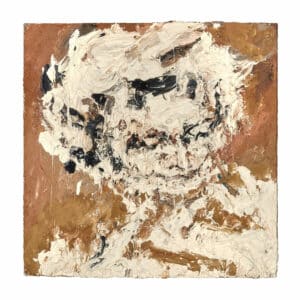
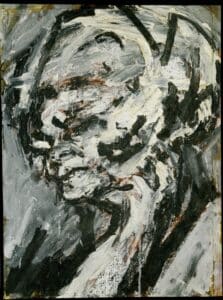
Which brings us to Frank Auerbach, already 93 and counting. It is fascinating, if you go to the Courtauld Institute, to be confronted with a little corner of his oeuvre across two rooms in that lovely gallery on the top floor.
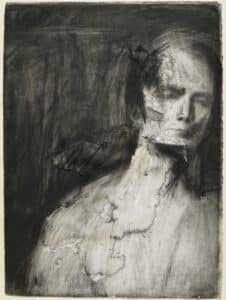
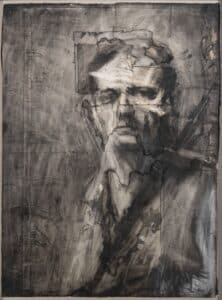
These are the magnificent charcoal drawings which Auerbach made just after the Second World War on his way to becoming, with Francis Bacon and Lucien Freud, one of the three most important artists of the so-called School of London. The Courtauld introduces the drawings with the following claim: “Auerbach’s charcoal heads – heavily worked and scarred but enduring and vital – connect us to the tenor of the post-war years.” Just when you think that the gallery may even be underselling Auerbach’s achievements, the next part of the placard expands on that thought: “Made over long periods of time, the drawings offer us experiences of what it feels like to engage deeply with another person.”
This rings true. For a long-lived artist, Auerbach is in fact relatively easy to place. He is not, like Picasso or Hockney, continually moving onto the next thing. This is, in fact, to put the matter rather mildly. He still works today out of the same Camden Town studio that he worked in in the days which this exhibition charts over half a century ago.
Auerbach seems to be a creature of stasis and even of obsession. Just as Degas had his ballet-dancers and his women at their toilette, so Auerbach has his heads, and a bit of Mornington Crescent. We might say that he is a vertical and not a horizontal artist. To gauge his obsessions we must consider all that he doesn’t paint: hills, trees, fruit, any buildings not on Mornington Crescent, and any people apart from his small circle of friends who interest him. Even in respect of the last category, he tends to paint their heads and not the rest of their bodies.
Auerbach then seeks to understand the world by excluding all that doesn’t interest him, but this is not a problem. What I think he is proclaiming is his love for the things that he does paint. It was John Donne who spoke in his great love poem The Good Morrow of ‘one little room an everywhere’. Something similar is happening in Auerbach: he proclaims in paint that all the universe might be found in a face, or in a section of street.
He is helped enormously in this endeavour by the fact that he is so obviously correct, as these marvellous pictures prove time again. An Auerbach head is a document of the artist’s engagement with the sitter over a long period of time. Each day the sitting would accrue its truth, and often then be scrubbed away at by the artist, sometimes so violently as to tear the paper. This creates a startling effect where creation and destruction are in some way married in one image, as is the case with one of his few living rivals Gerhard Richter.
The curators explain that these pictures are of historical interest in terms of charting how people looked and what they felt just after the war. This is true. At this safe distance from World War Two, which itself contained not only millions of individual tragedies, but a collective horror at what humankind was now capable of, we might look with a certain historical interest at these people. Of course, there is a limit in our ability to do so since we are still shaped to some extent by it.
But really this interpretation is limited because it doesn’t take into account the sheer extent of attention which Auerbach gives to his sitters, over 80, 90 or 100 sittings. To engage with a subject at such depth might be to go beyond the historical moment into deeper strata of life which have little to do with the latest circumstances, even those so gigantic as World War II. The effect is almost of creatures swimming up from their depths, eerily exposed.
The technique here backs up this interpretation. We have, accumulated across so many sittings, an extraordinarily stable architecture when it comes to the features of a face. The lines of the skull – jaw, and eye-sockets, and the shape of the head – are always laid down with a profound confidence. This underlayer allows Auerbach extraordinary freedom in other parts of the drawing, which conveys movement and changes of mood. He shows that the flux of life skims along a certain set of structures.
Take, for instance, his self-portrait. Nobody can be in any doubt about the shape of the face; but once that is made known to the viewer, Auerbach allows himself a freedom of interpretation which we can wonder at: a rush of charcoal at the forehead perhaps conveying the movement of thought.
Certain subjects recur and we feel that this was because he loved them. However, all these images are maimed and torn, and remade and it is hard not to feel that this mimics the frustration we feel when we really try to grapple with another person: however much we love them, they are not us, and these large drawings seem to reflect that. Iris Murdoch wrote that in love we get to the end of people; but Auerbach, you feel, only comes to the end of each drawing reluctantly, his feelings unresolved.
Irresolution though is an excellent basis for a long career; it keeps you at it. I think that Auerbach’s obsessive body of work needs to be distinguished from Degas’ ballet dancers, or from Stubbs’ lifelong need to paint horses. Those obsessions occurred in the open air. There is a feeling of necessary sequestration about Auberbach’s art, a self-sheltering from global currents. This may even amount to a sort of refusal of the outside world.
And yet this turning away never works: in the end we cannot avoid ourselves. Auerbach knows this – it is the very essence of vertical art to mine downwards, and insodoing, to find a space which other things not of that time and place can enter.
It all amounts to a perfect little exhibition. Of course, it is a very serious one, and as you walk out into the rooms with all the impressionists in, blazing with so much colour, you might reflect that this sort of picture-making is for a certain mood only. But there’s greatness here – the greatness of a thing done well out of passionate belief in art’s potential, hard work, monomania, and love.
Frank Auerbach: The Charcoal Heads closes on 27th May, but an online tour will be available thereafter on the Courtauld Institute website.
Christopher Jackson tours a fine new exhibition at the Sainsbury Centre about the many ways drugs impact our lives
After reading about the death of Liam Payne in Buenos Aries recently, one felt a sense of grim recognition. It was another story of a famous person with a bleak ending up, where the prime mover in the tragedy was drug addiction. This followed on from Matthew Perry‘s sad death the previous year.
But you don’t have to look far in recent history to find others: Amy Winehouse, Jimi Hendrix, Jim Morrison, Michael Hutchence. It is a grim roll call of squandered talent. The trouble with talent is that it all too often distracts you from learning how to live. Know thyself, was the injunction above the entrance to Plato’s Academy.
Drugs certainly can prevent that process, but the Sainsbury Centre has embarked on a larger mission: to consider drugs from many angles and therefore to arrive at a deeper sense of what drugs have meant to the species recreationally, socially, politically, in healthcare, as well as artistically and even spiritually. The results are shown in a series of exhibitions, and also in an accompanying book which is both well-written and beautifully designed.
It was Gore Vidal who, in his usual lordly manner, said he’d tried each drug and rejected them all. He settled in the end on alcohol as his main source of recreation and it didn’t do him a huge amount of good, especially in his old age. But most people in their forties and fifties today will have dabbled in some form of drug, usually when too young to know precisely what kind of self they were supposedly meant to be experimenting with.
This has without question hugely contributed to the mental health crisis which we see all around us. It manifests all too often as an employability problem, but this is ordinarily a symptom of addiction and not a cause.
There is much in this exhibition to warn us off drugs, with heroin singled out as a particular disaster area. This was the tipple of the great Nick Cave, and he got through by the skin of his teeth to his present incarnation as a musical seer and global agony uncle.
Cave always made sure he was at his desk at 9am, and wrote some of the great songs of this or any age while in the clutches of this particularly brutal drug. The section of the exhibition called Heroin Falls makes it clear that the high-functioning heroin addict is likely to be an extremely rare phenomenon.
One such is Graham MacIndoe who chronicles his own addiction in photos of raw power. MacIndoe wasn’t robbed of agency by his addiction – or not entirely – and found that the drug made him focus with considerable obsessiveness on lighting his pictures.
My Addiction, Graham MacIndoe
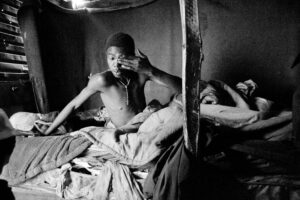
And yet heroin remains a grim topic whatever spin you put on it. That’s even more the case when you consider the current trend in South Africa for Nyaope, known as ‘poor man’s heroin’. This is highly addictive and can contain anything from detergent to rat poison or antiretroviral medications. Anybody who has been to Johannesburg knows that it can be hell on earth: and here’s why.
SOUTH AFRICA. Johannesburg. Thokoza. 2015. Thabang waking up in the early hours of the morning.
SOUTH AFRICA. Johannesburg. Katlehong. 2015. Bathing in Katlehong after a long day.
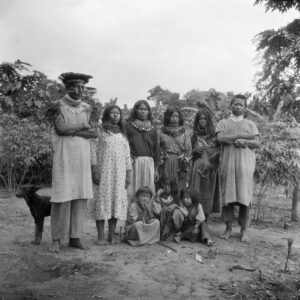
But the Sainsbury Centre frequently points out that drug use hasn’t always been this destructive. The message is that, as with anything in life, it helps to know what you’re doing. There still exist today peoples in South America with a positive relationship to Ayahuasca.
Richard Evans Schultes, The Cofan Family that met Schultes at Canejo, Rio Sucumbios, April 1942
Richard Evans Schultes, Cano Guacaya, Miritiparana, 1962
Richard Evans Scultes, Youth on the Paramo of San Antonio above the Valley of Subondoy, 1941
These pictures show another setting to drug exploration: we are in the great outdoors where drugs really originate. Quite simply, they grow in nature, and it is a relief to the viewer to be out of the urban setting where drug addiction so often goes badly wrong, into landscapes where the existence of drugs has a saner context.
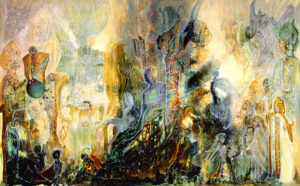
As interesting as they are, they rather pale in comparison to some of the images of visionary art in this exhibition, the best of which is Robert Venosa’s Ayahuasca Dream, 1994.
Robert Venosa, Ayahuasca Dream, 1994
All one can say about this picture is that if this is how the world looks on ayahuasca, you’d be a bit crazy not to want to try some. This is why people take drugs: they sense that the external world might be an end effect of something larger and that drugs might be a way to move towards that cause.
Venosa’s picture, with its sense of a drama we can’t quite grasp conducted involving figures whose identity we only vaguely know will touch a chord with many. It is impossible to look at something of this scale and beauty, and feel that drugs can be of no benefit to humankind.
Most people suspect that their mind is operating at a very low percentage as they conduct the rote tasks which the modern world can sometimes seem to require of them. They know they’re capable of more.
I think it’s more than possible to do all that in a state of sobriety, and that route will be better in the vast majority of cases, simply because so many people lack the willpower not to fall into perennial addiction. Who can sort the real drug mentors in the Amazon jungle from the charlatans?
But the Sainsbury Centre has done a great thing by tackling this subject in such an encyclopaedic fashion to remind us that though we each have our inner Amy Winehouse where everything can go badly wrong, we also potentially have a sort of Sergeant Pepper Lonely Hearts Club Band within as well – a new level to go to, whoever we are.
Christopher Jackson reviews Bodysgallen Hall and enjoys every minute of it
It is always a curious thing to arrive somewhere at night: we experience a world without contours and landmarks – a dense dark which really could be anywhere, and yet we also know we are entering somewhere new.
We arrived in northern Wales just in time for a storm to lambast Conwy, just as storms have been doing for millions of years: Wales always feels like ancient history.
My main memory is of watching the windscreen wipers rushing back and forth in increasing desperation to rid the windscreen of rain, as if seeking some slightly higher setting than the maximum.
We negotiated a long winding drive, unimpressed sheep crossing the pathway in their own time to move out of the way of our car. As we emerged from our vehicle, our bags immediately weeping with rain, we scaled some steps and the door peeled back magically: this was the greeting of the avuncular night porter Marion.
First impressions
As I glanced at the décor of Bodysgallen Hall – the fireplace, the 17th century panelling, the venerable portraiture – I thought: “Well, this is a whole better than the M6.” Better than the M6, and indeed better than more or less any hotel I’ve stayed at, as it would turn out.
Reception, Bodysgallen Hall
We were shown upstairs to a warm upper room, and learned from Marion that the building was initially constructed as a tower house at some unspecified point in the Middle Ages. Its meaning was to serve as support for Conwy Castle, that marvellously preserved stronghold overlooking the bay: from Bodysgallen you can replay how a signalling system might have worked between this place and Conwy. One imagines Irish ships, a flame of warning, and then the bustle of preparation for whatever came next.
What came next is what always comes: invasion, conquest, resistance, peace – the known variations of human life. It is, in fact, a marvellous place for a spa, as the history here is so rich you know precisely what it is you’re seeking to get away from.
I had just enough time before I drifted into sleep to learn that Bodysgallen had once been a place where Cadwallon Lawhir, King of Gwynedd – the name means ‘long-fingered’ – had lived, when a luxurious peace enveloped me, which probably had something to do with not being on the M6 but also something to do with excellent bedding.
Into Enchantment
The following morning, the first amazing thing I did in what was to be an entirely enchanted day, was to open the curtains. This isn’t normally a particularly marvellous aspect of life in London: my curtains usually reveal Southwark Council branded bins and houses opposite which look identical to the house I have just woken in.
At Bodysgallen Hall, the experience is very different: you look out onto an unbroken glory of horticulture, leading onto a still more beautiful and dreamy landscape: that masterpiece of nature which is Wales’ northern coastline.
It must be admitted that Wales probably gets about three days of delightful sunshine per year: we got one of them, and in late October. The trees everywhere were having their annual rethink, deciding on russets and umbers. Their dying can sometimes seem peculiarly optimistic.
Our first move was to eat a breakfast of champions in the tall-windowed breakfast room: a full English exactly as it should be done – heartily, and without any unnecessary complications. The food in the restaurant is Michelin standard.
Kitchen Garden at Bodysgallen Hall
The views from the gardens are not to be forgotten. It was a day of bronze and misty light: Conwy seemed in shadow. The medieval folly can be seen in the distance, and it’s possible to walk up there for a better view of the coastline beyond the Orme and Little Orme headlands.
The garden has a remarkable history. The original garden design dates from 1678 and is credited to Robert Wynn, son of Hugh Wynn, who was the first of that family to come into ownership of the Hall. A sundial bears that same date 1678. In that year Bunyan published the first part of The Pilgrim’s Progress, and the Battle of Saint-Denis was conducted between the French and the Dutch, with the verdict disputed by both sides, though its result all too clear to the 5,000 or so soldiers who lost their lives.
In those days, everything was in the Dutch fashion: with high walls which make you want to know what lies beyond them. There is also a topiary maze, and a rose-garden which was still giving out a beautiful scent even in mid-October. The herb garden produces herbs and vegetables which form part of the menu in the first-class restaurant.
Everywhere you go is beauty – and this was an unusually beautiful day. One could really spend a week walking these grounds, and not be near the end of it, but our time was more limited.
The Spa
Bodysgallen Hall is known also as a spa, and so we went there during children’s hour. Newspapers I would not have time to read were laid out in civilised fashion in the reception area.
The spa itself consists of a warm swimming pool, a jacuzzi, steam room and sauna. My eight year old boy splashed around in children’s hour, which wasn’t quite long enough for him, and one sometimes wishes there weren’t such severe regulations around jacuzzi use when it comes to children.
Spa at Bodysgallen Hall
After that we walked again up to the obelisk, which was built in 1993 and a landmark visible from all around. It is, like Kafka’s castle, a thing which one nears but never quite gets to. But the trying to get there yields acres of mushroomy woodland, and a sense of blessing at trying to get there at all.
Lunch consisted of sandwiches taken in the crocodile alcove. Bodysgallen Hall is a place of little nooks and surprises. It is also a place of superb beef sandwiches. My son and I agreed we could quite easily have eaten 400 of them, but had to settle for eight.
The Land Beyond
As the afternoon began I sensed Conwy calling. We had been in the castle before on a previous visit: it is an extraordinary place which the first-time visitor will need to do. But the joy of second-time visits is to strike out in surprising directions, and so we decided instead on two churches.
The first is Llangelynnin Old Church, which is to be found a 20 minute drive out of Conwy up a winding slope. It isn’t where you’d expect to find a church, amid the beginnings of the Welsh hills. We didn’t expect it to be open, but the door had an obliging give when we tried it: inside the side walls date from the 13th century and the impression is of a peace which is worth climbing up here for.
Round the corner is St Mary’s church which is on the site of Aberconwy Abbey which was founded in 1172. Here, you begin to get to the nub of the matter: two yew trees older than Chaucer preside over the church, and there is information inside establishing the ancient nature of this site, where the Romans also had an outpost. Both these churches are supported by the National Churches Trust.
This is the infinite nature of Wales: its wonder is to do with deep time, and the many layers it contains. Bodysgallen is the way to explore it and also to experience a luxury which is both classy and not too ostentatious. It is an additional pleasure that to come here is also to support the National Trust, which in addition to maintaining our nation’s heritage, also clearly knows how to run a hotel. A special mention must also go to the magnificent receptionists Catherine and Hayley who were helpful and kind throughout our all-too-brief stay.
In our second swimming session, my son Beau, determined now and fortified by a fine day in Wales, swam his first length – a cunningly constructed amalgamation of front crawl and breaststroke. We might have arrived at night – but we left sensing a sort of dawn in ourselves.
Finito World interviews Katia Luna Benaï on her Amazigh heritage, her design vision and her plans for the future
Your grandmother was clearly a very important figure for you – can you talk about your upbringing? Was it an aesthetic culture which laid the groundwork for your future career?
My upbringing in Algeria, deeply rooted in my Amazigh heritage, was where my journey as an artist truly began. Living with my grandmother and aunts, I was surrounded by a world where every element of life was infused with vibrant colours, patterns, and stories—each one shaping my essence as an artist. The silver jewellery we crafted was more than just adornment; it was history gleaming in every piece, with stones whispering tales of identity. Our tattoos, symbols etched into flesh, represented a tradition now fading, yet they carried deep significance, a connection to our past. Even I carry one of those tattoos, symbolizing five generations of women.
The architecture of our region, shaped by influences from the Roman and Ottoman Empires, was another source of inspiration, with arches that seemed to embrace the sky and courtyards that echoed with communal songs. Music, dance, and the act of sharing within the community were integral to our way of life, bonding my soul to the instruments of time and land.
As I travelled later in life with my father, experiencing different cultures and their unique traditions, this early immersion in my heritage continued to influence me. It deepened my fascination with the arts and stories that connect us all as humans. These experiences laid the foundation for my work with Luna Benaï, where I strive to create artefacts that not only capture beauty but also tell multi-layered stories rooted in cultural and historical research.
Through Luna Benaï, each piece I create is a tribute to the communities and traditions that inspire it. I am deeply committed to ensuring that our work gives back to these local communities, preserving the very cultures that have shaped my identity and continue to inspire my creative vision.
Your father was a diplomat – has growing up in lots of different places deepened your sense of commitment to the Amazigh culture?
My father was a man of the people, a true polyglot who spoke eight different languages and was an intellectual deeply respected in Algeria. His work with the UN took our family to many places, and each new city or country we visited was embraced with enthusiasm and a deep commitment to understanding the local culture. This passion for learning and cultural exchange was a fundamental part of our family life.
The Amazigh people have historically been diplomatic and open-minded, known for their ability to share cultures and live harmoniously with others throughout the centuries. Although not widely recognized, the Amazigh are indigenous to the Mediterranean region and have played a significant role in history, mythology, and culture, with connections that trace back to ancient Egypt and continue to the present day.
Growing up in diverse environments only deepened my commitment to the Amazigh culture. I see it as part of my mission to represent their essence through the arts, bringing their rich heritage to the forefront and ensuring that their stories and traditions are not forgotten but celebrated and shared with the world.
Were there creative challenges to be surmounted when it came to negotiating any feelings of rootlessness growing up which diplomats’ children often have?
It’s a bittersweet symphony, indeed. Growing up as a diplomat’s child often brings a sense of rootlessness, but with that comes a profound thirst for understanding and a deep compassion for the world around you. The feeling of being displaced at times fuels a desire to connect with others on a more meaningful level, to truly understand the nuances of different cultures and perspectives.
For me, this has been both a challenge and a gift. Art and creativity have become my signature tools for navigating these feelings, allowing me to express the complexities of my experiences and communicate across cultural boundaries. This ever-evolving journey has enriched my work, infusing it with a depth and authenticity that comes from a life lived between worlds.
Have you had a mentor who gave you the confidence to create?
Pursuing my postgraduate studies at the Royal College of Art was a transformative experience that truly pushed my boundaries. The philosophy there of deconstructing everything and then rebuilding it, blending academia, research, and art practice, gave me a profound new perspective on identity and communication. Being at one of the finest art institutions in the world, I found a space where intellectual freedom was not just encouraged but expected. This environment allowed me to explore and redefine my creative voice, giving me the confidence to push the limits of my artistry and to trust in my vision.
I’m fascinated by your process. You have said that you want to think about creating things which stand the test of time. How do you go about sifting your inspirations to make sure that it is likely to produce work which has that sort of longevity?
At Luna Benaï, we take a vertical approach to creation, guided by the belief that “every object has a story,” and those stories must endure through time. To ensure that our work stands the test of time, I collaborate closely with museums, scholars, and architects from the initial concept to the final creation, always prioritizing absolute authenticity.
My process involves immersing myself in artefacts that are often 2,000 to 4,000 years old. I fall in love with these pieces and bring them back to life, blending their ancient essence with modern mediums and technology. Through masterful artisanal craftsmanship, honed by decades of experience, we create objects that not only resonate with historical depth but are also built to endure.
By taking history and completing a full circle—much like our Luna Benaï logo—I strive to ensure that each piece we produce is timeless, capable of supporting its own story across generations.
Your collaboration with Sotheby’s was obviously a wonderful moment in your career. How did you come to think in terms of the rhombicuboctahedron and what does that particular shape mean to you?
Geometry is the visible manifestation of math, embodying themes of continuation and infinity. When I was commissioned by Tiffany Dubin, a curator at Sotheby’s, to create a bespoke jewellery box for the “Art as Jewellery as Art” exhibition in New York, I wanted to design something that embodied these timeless concepts. The exhibition aimed to reintroduce jewellery and accessories by famed masters of the 20th century and beyond, placing them in a unique juxtaposition with contemporary visionaries and modern artists.
The specific shape of the Atlas Box, a rhombicuboctahedron, was chosen for its symbolic resonance. The rhombicuboctahedron, with its harmonious blend of triangles and squares, represents balance and unity—qualities that are deeply connected to the myth of Atlas, the Titan who bore the weight of the heavens. Just as Atlas symbolizes strength and endurance, the shape reflects the idea of holding together different forces in perfect harmony.
The carvings and metalwork on the Atlas Box are traditional Amazigh designs, merging ancient craftsmanship with a contemporary vision. This fusion of geometry, mythology, and cultural heritage makes the Atlas Box not only a functional object but a piece that tells a story of harmony and timelessness.
I think it’s wonderful that you give 15 per cent of your earnings to charitable projects. Was that something that you resolved to do from the beginning? How do you go about choosing the causes that you give to?
Creating synergy with the local community has always been a core value for me, and it’s something I resolved to do from the very beginning. When we embark on a project, we actively engage with the local communities, seeking out grassroots causes that create visible, tangible impact. It is important to us that these initiatives are ones we can track, interact with, and even participate in directly.
For instance, with our Sotheby’s piece, we chose to support the UK-based charity Hannan School, which has a genuine and significant impact on improving education for remote communities in the Atlas Mountains. This hands-on approach ensures that our contributions not only make a difference but also align closely with the values and needs of the communities we aim to uplift.
What would you say to young people looking to work in the luxury sector? What do you look for in a hire?
Look beyond superficiality. If you pursue what you truly love, you will excel, and don’t be afraid to make mistakes—they are an essential part of the learning process. For young people choosing a career path in the luxury sector, I would advise prioritizing knowledge and experience over superficial gains. Think long-term and focus on building a solid foundation of skills and understanding across different sectors.
If you eventually decide to embark on your own entrepreneurial journey, believe in your vision and stay committed to it. Your vision will be tested repeatedly, but perseverance is key. Over time, you’ll start to see the building blocks come together, and that’s when your dedication will truly pay off.
Luna Benaï are entering the Middle Eastern market. Can you describe that journey and tell us more about the thinking behind it?
The Middle Eastern market is currently undergoing a significant transformation, with new initiatives aimed at diversifying tourism, enhancing arts and culture, and promoting their rich and vibrant heritage. I find this cultural renaissance absolutely captivating, and it’s a landscape I can easily immerse myself in.
As a British, French-Algerian artist, I have a deep understanding of both Western and Middle Eastern worlds, which has uniquely positioned me to contribute to this evolving market. This strategic expansion is an exciting chapter for Luna Benaï, and I’m thrilled to be embarking on this journey with my business partner, Denise Ricci. Denise is my right-hand woman—a former Goldman Sachs professional with an incredible background rooted in Italian culture and the film industry. She’s a polyglot and a true powerhouse, bringing her diverse expertise to our team.
This cultural renaissance in the Middle East aligns perfectly with our vision as a woman-led team, allowing us to make a powerful impact. Together, Denise and I are committed to deepening our engagement with the region through bespoke cultural and artistic commissions. This expansion represents not just a business opportunity, but a chance to bridge cultures and celebrate the region’s rich heritage through the arts.
Which cultural figures most inform your aesthetic? Do you find inspiration in other art forms, whether it be literature, film, music or the visual arts?
I’m a bit of an eccentric, and there isn’t just one figure that drives my inspiration. My aesthetic is informed by a diverse range of cultural figures across history. The artistic legacy of ancient Greek sculptors and the intricate mosaics of Byzantine artisans have always captivated me. In the modern realm, Zaha Hadid’s groundbreaking architectural designs, which challenge conventional forms and spaces, serve as a major inspiration.
I’m also deeply influenced by the Bauhaus movement, which revolutionized design with its emphasis on functionality and simplicity, merging art with everyday life. Sonia Delaunay’s bold use of color and geometric abstraction, Hilma af Klint’s exploration of spiritual abstraction, and Dana Awartani’s meticulous blending of cultural traditions with contemporary expression all resonate deeply with me. These varied influences, spanning ancient to contemporary, each contribute to the unique narrative I aim to express through my work.
What are you working on at the moment?
We’re entering an incredibly exciting phase at Luna Benaï as we expand into a full-fledged atelier and bespoke design studio. We’ve joined forces with our esteemed Italian partners, who bring over four decades of master artisanal experience. This collaboration enhances our ability to work across various mediums, all while preserving the integrity and creative DNA that defines Luna Benaï.
Our first atelier collection, Tessellation, is set to launch this winter. This 11-piece, post-modern inspired collection draws from the rich aesthetics of Middle Eastern and North African design, reimagined through a contemporary monumental lens. Each piece in the collection marries fine art and architecture, making a distinctive statement in the world of interior design and bespoke furniture. Made-to-order, Tessellation seamlessly blends timeless cultural influences with modern innovation. We’re thrilled to introduce this next chapter in our journey, where tradition and cutting-edge design converge.
There used to be a dead tree in Ruskin Park in South-East London, which always struck me as somehow sculptural. The other day I saw that it had fallen. I had grown so fond of this particular tree, it’s optimistic reach towards the skies, that I was bereft when I saw it had collapsed.
But this probably minor development in the history of my local parklands makes me all the more delighted that this same tree is still standing in the work of a remarkable artist Nadeem Chughtai. Chughtai’s recent exhibition A Liminal Statehas people talking in Peckham, which as everybody knows is also the artistic centre of the universe. Chughtai used the tree as a basis for his picture There’s This Place On The Edge of Town (2020).
There’s This Place on the Edge of Town
One of the most basic requirements of an artist is power: Chughtai’s images always have an immediacy which nevertheless lets you know that your first impression is only the first part of your journey with that work of art. In this picture we see how we have become mechanised in ourselves, and how this can only lead to stunted growth. But the beauty of the tree, which looks like it almost wants to be an upwards staircase, suggests potential.
It’s a brilliant conception, like all Chughtai’s pictures. So was it always art for him, or did he toy with other careers? “It really was art all the way for me,” Chughtai tells me. “Ever since I was very young I’d draw. Encouraged by my mum and influenced by a beautiful framed pencil drawing my dad made of my mum in the 1960’s. However, I did loads of jobs before going full time with an art publishing contract which set me on my way. Before that I always kept myself in the minimum wage positions for fear of committing myself further down other career paths.”
Chughtai has had some major successes, with some celebrity clients including Roger Federer who chanced upon his work in Wimbledon village one year. Chughtai is particularly well-known for Nowhere Man, his character which he gave up at the start of the pandemic. These pictures, taken together, amount to a vast dystopian opus which tell the viewer unequivocally what we all sense: we are not headed in the right direction as a species.
We never see Nowhere Man’s face. Sometimes there’s more than one of him. It is also possible to say that Nowhere Man is always in a negative setting, beset by the circumstances of modern life: alarming architecture, the trippiness of drug culture, the terrifying ramifications of contemporary uniformity.
I Dream of a World That the Capitalist Philosophy Will Never Make Possible. Oil on three canvases (2017)
I also note that they’re always dramatic force in these pictures, and I related this to the career Chughtai had on film sets, with his work including the Bourne series and Love Actually. Did that experience impact the way he paints now? “Yes, I always mention my scenic art days. I call it my apprenticeship. It was absolutely magical to be working on those film sets at Pinewood and Shepperton Studios,” Chughtai recalls. “I originally went there to try and make films after losing my way with drawing and painting after college, but as soon as I saw the huge painted scenery backdrops surrounding the sets I was sucked back in.
I had hands on experience of painting pictures on giant canvases, off scissor lifts using strings, hooks and chalk to draw our lines. I learnt about so many aspects of painting as well as the cameras eye. The big one was perspective. Learning about that was enlightening for me.”
I ask Chughtai if he has had any artistic mentors, and his answer also dates to this time: “Well, I always mention Steve Mitchell, the scenic artist who I assisted over a five year period from 1999- 2004. He’s still doing it at 70 and we’re still in touch. He’s one of the world’s top scenics. I can’t tell you what I learnt over those scenic years and how it got me back into the art of painting.”
I can tell how passionate Chughtai is about his calling, but the melancholy of these pictures is always there. It seems to cry out for some kind of remedy. Is Chughtai pessimistic about the human race and its future? “I believe we are not only on the path to a dystopian future but within it now. Just look at all the horrific and unnecessary human suffering going on all over the world and right down to our own neighbourhoods. However, I remain an eternal optimist and have every faith that the human race will unite to overcome this and bring about the necessary change required.”
The new pictures, with their liminal greens, seem to be the start of some new potential. Here we see Green Park as it might be seen in a dream, or in the hypnagogic state between sleep and waking. The journey to the centre of town to make these pictures is perhaps indicative of an interior shift in Chughtai. The new pictures also mark a big change away from character towards some other kind of painting which feels like it is yearning for mysticism – maybe even a metanoia away from despair.
Was it hard to give up Nowhere Man? Might he ever experiment with another character? “It was very hard to shed the Nowhere Man. I doubt there would ever be another character. For me it represented humanity. If I ever need a central character again I’m pretty sure I’d call him up.”
Humanity then is for Chughtai somehow passive and faceless – asleep perhaps. This makes the notion of an exploration of the liminal all the more important; it is to do with exploring what Seamus Heaney called ‘the limen world’, that curious borderland of the unconscious. I have a sense that these recent works are a necessary transition period and that it may in time lead to some sort of reconciliation between Chughtai and the damage of the world – a more optimistic vision perhaps.
How did these new paintings come about? “The works exhibited recently at the Liminal State exhibition are exactly that; Liminal, as in kind of between or on the threshold. For me personally, up until just before lockdown in 2020 I was creating paintings with a central anonymous figure – the Nowhere Man. 16 years through the eyes of this character, so, shedding that to allow the next body of work to arrive has taken these last four years, and counting… The title, A Liminal State can also have numerous interpretations and could additionally refer to many other aspects; mentally,, physically, technically, artistically, societally… liminal.”
These then are between states, and that means flux – in Chughtai’s art certainly, and therefore, since artists are their art, in his life. I ask Chughtai about his method of composition. Is it evolving? “It’s evolving and continuing its journey. I’ve changed the approach, technique, materials used and so much more since 2020. In fact, almost everything – but still the work has naturally evolved through different states to where it is now.
It’s a continual fluid journey. I have also been developing an artistic theory and putting that into practice. It involves perspective and the way the eyes see and the brain interprets an image. It’s great testing a science based theory on my artistic practice… and it actually works. My most recent painting entitled, Turn Left. (2024) shows the theory in practice in its most developed stage to date, and I was blown away by the positive reaction it got when exhibited for the first time at the show.
Turn Left, 2024
This again, seems to me like a dream where the dreamer is sometimes given clear but mysterious indications of what to do – strange snatches of disembodied advice. To look at these pictures after immersing oneself in the Nowhere Man corpus is to see a kind of hope peeping through, because the world seems to be acquiring a kind of charge, groping towards some form of meaning. My sense is that this makes the next few years of decisive importance for Chughtai’s art. If we follow that sign, where does it lead?
This new work has also sent Chughtai on a rewarding course of study. “Over the last four years I have really delved deep into studying and expanding my artistic learning. Visiting the London galleries on a weekly basis and getting to understand the philosophies of some of the great painters, while also educating myself about the amazing artists from around the world and their histories.”
So who are his heroes? “I have to mention Van Gogh, I just love. His pencil drawings, they make me wanna scream. I would say that more recently I have been appreciating 20th century Western heavyweights such as Bacon, Klee, and Rothko who’s section 3 of the Seagram murals brought me to tears on more than one occasion. It was during a particularly emotional time for me personally whilst simultaneously looking to move my work along an different path. That painting allowed me to see within it what I wanted to do with my own work.”
Chughtai has been going strong for a long time. So what are his tips for young artists about the business side? “Well, yes, it is a business – if you do it full time for your living. So if you don’t have the luxury of financial security, you will need to sell your work.
This predicament will most likely influence the type of work you produce and therefore could involve compromise. That’s the tightrope. It can work in your favour but can also be a hindrance if not deterrent, which is a real shame because then we miss out on hearing and experiencing the voices from within those walks of life. So, believe in what you’re doing, put the time in and keep on making your art.”
Maxted Morning, 2024
And would Chughtai recommend the art fair route? “I love going to art fairs. It’s where it all started for me. Like our society, the art world is very hierarchical, but whether you’re at the bottom rung or at the very top, when all is said and done they’re markets with their stalls out. It’s great because people can stand in front of the work in the flesh, which is how I feel art works are best experienced… and there is so much under one roof. Art fairs are a great way to spend an afternoon… if you can afford the entrance fee, of course.”
That’s often the problem for young artists at all. Has the conversation around NFTs affected him at all? “I did look into NFT’s a little some years ago but it seems to have gone quiet on that front so am unaware of where it currently stands. The whole digital thing is obviously a direction the art world is going down and there are many possibilities to explore. However, my focus and studies are with oil paint and a canvas because there’s so much more to come from there and that will always be ahead of any artificial intelligence.”
Chughtai is an artist of rare talent, who is doing something very valuable: he is pursuing his vision where it leads. It takes courage to do that. Every artist can learn from somebody who has chosen his path so decisively then pursued his craft with such passion.
Christopher Jackson hears from Malcom McDowell about his career in film
Malcolm McDowell is talking to me from what looks like a spacious octagonal attic, the dark at the window behind him shows no stars. He is wearing splendid Ronnie Barker specs and a black hoodie, his white hair tufted behind a domed forehead.
It’s not that far in the scheme of things from Christmas and he is immediately humorous about the predicament. “My God, I’ve seen enough of those. Here we go again!” Then he lets a pause go by which wouldn’t be out of place in a Harold Pinter play. “But the kids love it, don’t they?”
Here’s happy to discuss his work, and understanding when A Clockwork Orange (1971) immediately comes up: ”I am thrilled to talk to fans – about anything really, but especially that film which I suppose you might say is the jewel in the crown of my career.” He says this without a trace of pomposity, even somewhat humorously: he seems to be one of those rare actors who doesn’t necessarily consider himself the centre of the universe.
In the same vein he continues sincerely: “Without the fans, I wouldn’t have a career: neither would any of us. The fans are very important and I always have time to say hello to fans.”
But it’s A Clockwork Orange which has most endured, partly due to its sheer quality, and also because it’s the work of what we might call mid-period Stanley Kubrick, at a time when his films become scarcer and therefore more precious.
McDowell is exceptionally forthcoming and relaxed about talking about something which he will have been asked about numerous times. He will be no stranger to being asked about the scene where Alex and the droogs kicks the poor tramp. It is the film’s anarchic streak which has endured: its author, the polymathic Anthony Burgess, intuited that the brakes on traditional morality would been an outpouring of violence, which we see on our screens now day in day out.
But did McDowell ever meet Burgess? “After we shot the movie and it opened, I went during the first week of the opening to New York. That was when I met for the first time with Anthony Burgess who wrote the book.”
So he hadn’t ever met him set. McDowell says: “I’d never met him before – I wasn’t allowed to meet him. I guess Stanley didn’t want me to be influenced by the writer. Writers on film are really just complications we could do without.”
This is a lovely detail about Kubrick, who was famously meticulous in the compilation of his movies. What can certainly imagine that a literary titan on set might be one titan too many. It is a window to the hierarchy of the movies which may look topsy-turvy for Burgess fans.
Then McDowell launches into an astonishing anecdote: “I asked burgess in New York about the phrase ‘a clockwork orange’ and he came upon the title.”
I am craned forward, faintly astonished to be hearing this little piece of literary history unbidden. McDowell continues: “He told me he was in an East End pub in London and he was sitting next to a friend of his and they were chatting. Suddenly the door opened and this strange-looking guy comes in and his friend looked at him and said: “He’s as queer as a clockwork orange.’”
Many people think authors should look up in a deep trance from their desks to find inspiration, and perhaps that is sometimes the case. But McDowell’s anecdote reminds us they should also go down the pub.” Burgess said : ‘I just loved the sound of that phrase and I thought it would make a good title for a book some time.’ Which indeed it did.”
That’s some understatement but McDowell isn’t finished yet. He finishes: “So I said to Burgess: ‘Yeah but what does it mean? He said: “I don’t know. I think it just means look at this guy, he’s really strange and odd – as queer as a clockwork orange.”
Having changed my understanding of a small but important nook of 210th century literary history, McDowell finishes. “So there you are, you have it from the chief orange himself.”
It was Henry James who said a writer should be the sort of person who notices things. This can be the case. But young writers should know that what you really need to do is be able to identify a certain charge which useful things have – sometimes things will leap up and say they want to be a name in your novel, a setting, a scene – or perhaps a title to the book you may just get around to writing one day.