With Rishi Sunak’s announcement of the Budget comes a beacon of hope for the struggling arts and culture sector. In what he calls “a historic package”, Sunak has pledged a £400 million bonus to help keep afloat gigs, theatres and galleries and his Covid Recovery Fund, which has so far supported over 3,000 organisations, will be increased to £1.87 billion.
“This industry is a significant driver of economic activity, employing more than 700,000 people in jobs across the UK”, says Sunak. “I am committed to ensuring the arts are equipped to captivate audiences in the months and years to come.”
The Chancellor’s words are music to sore ears; an industry which is financially reliant on live events, the music sector has been hard hit by the pandemic. The sector generates £5.2bn a year for the economy, £2.7bn in exports and sustains 210,000 jobs.
But eight in every ten pounds of the average musician’s income comes from live performances; recording revenues have drastically dwindled in the digital age. Musicians receive next to nothing from Spotify plays, and live gigs and festivals have provided the backbone of their income over the past decade.
Even before the pandemic, the industry was under close inspection by the government because of the poor financial model used by streaming services like Spotify. A poll by Musicians’ Union last year found that eight out of ten musicians (82%) earn less than £200 each year from online streaming: 92% said streaming made up less than 5% of their yearly salary and half that their income from recorded music had declined over the past decade. Sunak’s financial offering pales in comparison to the huge deficit which faces thousands of struggling musicians, venues and organisations.
With such a small fraction of money made from streaming and a greater financial emphasis on live performance, it is no wonder that musicians have suffered over the past year. There’s a glint of hope for live performers in the rapid vaccine roll-out but it will take decades for the industry to recover from the covid shock. There’s been little to no activity in the music industry since the first lockdown in March, apart from a select few big names at well-established records labels, like Laura Marling or Dua Lipa.
As usual, the hardest hit have been the least known. This has halted the emergence of new talent – the veins of the UKs globally-renowned music scene – many of whom are scouted in-person at gigs. In an NME interview, co-founder of indie label Speedy Wunderground said that “it’s a very difficult time to be a musician” because the pandemic has meant that there will be a backlog of talent “blocking the road”, and Brexit will likely impact touring Europe.
With most live events set to reopen in May and return to full capacity in June, and given financial fuel by Sunak, the future is looking brighter for musicians. Like other art forms, could it have impacted the industry in a positive way? Has it been a catalyst for change?
Booking Agent Phil Simpson had 200 shows cancelled in 2020
For Phil Simpson, a Booking Agent who pre-pandemic coordinated the entire live careers for musicians – including booking tours and festival appearances – the pandemic has been “really difficult”.
“With booking I’m always thinking 12 months ahead, and the way I make money is that I take a commission from what the band earns at a live event. So obviously if the gig doesn’t happen and the band doesn’t get paid, then I don’t get paid,” says Simpson.
“That’s why this year has been so hard. I had almost 200 shows booked for 2020, and when everything first kicked off we moved the shows to autumn, which was a massive process. As things got worse we had to move them again and again. In some instances we moved shows 3 or 4 times.” Simpson says they’ve been stuck in a “terrible limbo” where old shows haven’t happened, but they’ve done all the work for them, and new shows haven’t been able to happen. Most venues don’t have availability until spring next year.
Because he was seeing such a shortfall of income, Simpson decided to step away from his company and go back to being an independent agent. “We are seeing that a lot in the industry at the moment,” he says. “All the bigger companies are having to make redundancies and branch off into smaller outlets, just to keep overhead down and be agile.”
The pandemic, and his frustration, shifted Simpson’s career in other ways: he wrote a book on his experiences being a Booking Agent, started mentoring and teaching music. “We’ve all been doing everything we can to diversify our work lives and keep the trickle of income coming in,” he says.
Some of his friends in the wider business of professional music have had to go back into other employment and take on part time jobs. “Some”, says Simpson, “have even given up professional music altogether. I’m lucky that most of my clients are quite well established so that they can find other means to make money like selling CDs or merchandise”.
The effect of the pandemic on musicians has not been exclusively financial. “Musicians are particularly susceptible to mental health issues,” Simpson tells me, “because the highs are high, and the lows are very low”.
“It was a really worrying time”: over lockdown, Newcastle musician Anna Reay started doing door-step performances
And the catch-22 is that the quagmire which the industry is in predominantly effects younger, lesser known artists who are just starting to emerge onto the scene: Simpson says that going forward, the event organisers will be looking for artists who will guarantee them tickets. The unwillingness to take risks will result in younger artists getting less of a chance than their older, better established peers.
As one of those lesser known artists, the pandemic brought huge challenges for Anna Reay. A singer from Newcastle, before lockdown Reay sang at big weddings and corporate events, and had just got a big contract with a cruise liner.
“It was a really worrying time”, she says. “Being a single parent my main income is music. The first couple of weeks were just horrific. I cried every day.”
Once she decided to move back in with her parents and share the homeschooling load, things started to turn around for Reay. “Singing is like a kind of therapy for me, so I started to come up with new ideas just to keep me sane”.
From this sprung an ingenious idea which became hugely popular and has kept her career going since: virtual singing Anagrams. Reay began recording a song every Thursday to coincide with the clap for carers: kids, adults, artists and businesses began sending in videos and photos every week which documented their lockdown activities, which Reay then turned into videos which she shared on social media. She soon got a following, and started to get requests to sing songs for birthdays, cancelled weddings, cancelled parties and postponed events.
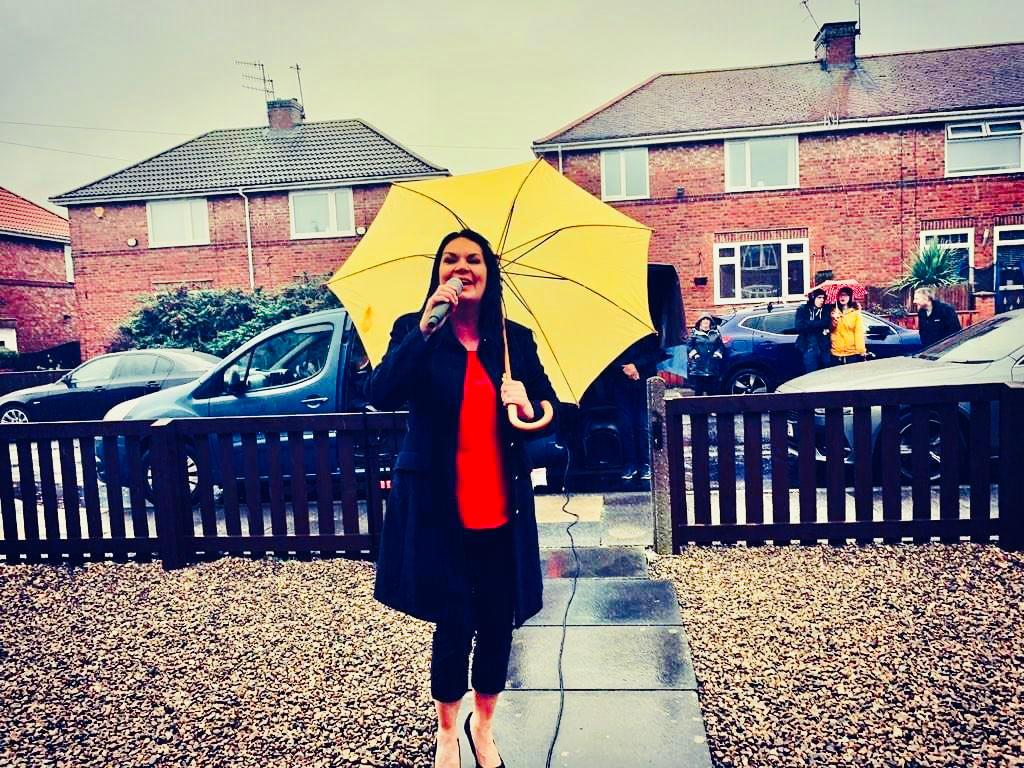
At the same time, Reay did doorstep performances – her mic powered by a car generator and with Covid-safety checks in place like ‘keep your distance signs’. For her first ever performance Reay sang for a family who’d just lost a young girl to a rare disease.
“To be honest I’ve never been so busy. I’ve even managed to get a mortgage from it,” says Reay.
“It all just fell into place for me, I think because I panicked and my creative survival kicked in. Every business has had to diversify. So I thought, ‘If they can do it, why can’t we?’”
As Reay says, she’s been “lucky” that she’s been able to “pivot” her business and adapt to the pandemic. Others haven’t. “I’ve seen musicians that have decided to hang their microphones up. It really saddens me how much everything has changed.”
Continuing our regular series, we spoke to former Salt director Christopher Hamilton-Emery about juggling life as a publisher, with his work as a poet.
Christopher Hamilton-Emery was born in Manchester in 1963. He studied sculpture, painting and printmaking at Manchester College of Art and Design before taking a degree in graphics at Leeds Polytechnic, graduating in 1986. Emery has published three collections of poetry, as well as a writer’s guide, an anthology of art and poems, and pocket editions of Emily Brontë, Keats and Rossetti. His work has been widely published in magazines and anthologised. He lives in Cromer, North Norfolk, with his wife and children.
Until recently, Hamilton-Emery was the director of Salt Publishing, and there is a sense in which he has given so much of his time to other authors – Luke Kennard, Xan Brooks and Sian Hughes are among those who much to thank him for – that his own work may be somewhat underestimated. Recently he left his role at Salt to start a new role as Director of Operations at Shrine of Our Lady of Walsingham in Norfolk.
For Finito World, Hamilton-Emery has written a remarkable poem ‘And Then We’. By telling details we are transported to another time and place – a world of ‘bound flax sail cloth’, ‘would dyed with kermis’ and a ‘tangled feast of eels’. This poem asks us to wonder what deeper meaning our work has and it demands that we imagine our way back into the shared past. It could only have been written by a poet with a profound sense of meaning, and moral duty. It shows a poet at the top of his form, whose strength is to have found a new lease of life in his work.
As ever, we print an interview with the poet after the poem itself.
And Then We
And then we embraced, sprawling on the green deck like scattered gulls.
And then we knelt under bound flax sail cloth, stinking and making the day.
And then we carried whom could not stand to the red chapel blithely.
And then we walked through your pristine marsh without hours or love or trees.
And then we drew about us buckram cloth and wool dyed with kermes and slept.
And then we pierced cockleshells and yearned for a tangled feast of eels.
And then we walked by sordid wolves and boars in corporal torment.
And then we met with hirsute leather brigands and were lost.
And then we starved, Lord, and knew concupiscence, gnawing your works.
And then we heralded salt wind, seal routes and spectres and walked dully on.
And then we saw your slipper chapel and spread our toes on a mile of stones.
And then we wept. At the ruin of our bodies we wept. At our just ruin.
And then we dressed and swayed, all the same, through the unifying street in a love queue.
And then we bent and entered Nazareth to see her and to know her choice.
And then we knew a high permanent land, our eyes fixed on accommodating angels.
And then we fell in stone-sealed Walsingham, with our fiat ringing, unanchored, teeming.
And then we left to see ice oak burials, flame drift farms, our backwards night talk blazing.
And then we sailed on, working new bones, each a prayer to the star of the sea.
Interview
You’re rare in that you’ve managed to be both a high-functioning poet and businessman – two skills that don’t always go together in the same person! What is the relationship between poetry and work like for you? Is it antagonistic or fruitful?
At one level work simply pays for my writing life, or at least the space to have a writing life, though this wasn’t always the case. I was an editor at Salt for over twenty years, and that was complex and at times bad for my writing. It left no room; though I didn’t realise this when I started out in 1999. Of course, I came to choose to give up a large part of my life to my authors – thousands of them over the years – but the sacrifice, if we can call it that, came to swallow up almost all of my life. There was a lot of collision between my sense of myself as a writer and my publishing activities, yet I came to be wholly subsumed into the publishing role. The switch back to being employed elsewhere has been liberating, and I’ve been able to separate out my business life from my writing life and, more broadly, my private life. I mean, I actually have a private life now! I’m only eighteen months into this new operational role but going back to being a general manager has been very rewarding. I’m fortunate to have a great boss and wonderful colleagues and the move into the Church has been personally enriching for me. So certainly very fruitful, and not antagonistic at all. In fact, I’ve never written so much. I’ve always believed that I needed to be in the world of business, I didn’t want to teach, I didn’t want to live through grants or patronage, I wanted to do something commercial and, don’t get me wrong, for years I enjoyed my private sector life. But everything comes to an end. All endings are beginnings.
You decided to step back a bit from Salt in order to work for The Shrine of Our Lady of Walsingham. Can you talk us through your decision to move careers?
I’ve touched on this earlier. However, the decision to leave Salt and move to work for a Shrine wasn’t prompted by some calculated sense of balancing my writing life. I was going through a profound personal realignment. I’d lived a successful and content secular life for forty years, I had a rather dim view of religion, when suddenly I was dislodged from my own convictions. This was in part a process of disbelief, disbelief in secular satisfactions. I came to doubt the limitations of my own world view. I also realised, and had in my own writings, the limits of science in dealing with human experience, I used to consider how we cannot live in a world without mystery, but I didn’t know quite what this phrase meant. As I was travelling through this accommodation of my past – I’m a cradle Catholic – within a matter of weeks, I was interviewed and employed by the Shrine. I shan’t bore you with the personal narrative and experiences that fed into this, but it was the right decision for me and, after two decades of publishing and running my own business, I decided to serve Christ.
The government has recently said that poetry should be optional at the GCSE level – a significant demotion in its importance on the curriculum. What is your view on that and what do you feel the impact will be?
Whether poetry is inherently part of a curriculum or not, it will survive as an art form, so I don’t worry about its relationship to fiction or drama in the framework of syllabus development. I don’t worry about poetry in terms of its share of the education establishment. But there’s a wider context to this and that’s the way kids come into contact with poetry, or orchestral music, or ballet, or opera, or theatre. In this sense, education is the gateway, the space that gives permission to children, and in this context there’s a political and egalitarian component to this debate around poetry. The children of middleclass parents, those enjoying private education, the rich, are afforded more opportunities for this kind of assimilation into culture, and without the rebalancing of access within state education, we end up with a form of cultural apartheid. I hope this makes some kind of sense – it’s not the qualifications or curriculum, it’s the introduction, the initiation to this cultural capital that I find disturbing. I also recognise that poetry is a pain in the arse, yet it’s meant to be awkward, tricksy, resistant to authority, dissonant – things that are hard to teach and accommodate, things that can’t easily be measured or controlled. Poetry provides a critical citizenship and, I think, helps form the unity of the person and offers a living communion today and indeed through history.
Was there a particular teacher when you were younger who turned you onto poetry?
If memory serves, Mr Deacon, a supply teacher or trainee English teacher at my grammar school in Manchester, who was so exasperated with the boys not paying attention to some prticular text he threw his book through a window, smashing it. The headmaster promptly turned up and invited him to step out of the classroom for a private word. This singular act made me realise that something could have so much meaning to someone that they would physically act upon it. It was the perfect illustration of genuine literary passion and it set me off on the lifelong task of trying to create beauty and rapture. Or, not getting ahead of myself, at the very least, poignancy. Anyway, I do hope Mr Deacon survived his spell at St Peter’s and went on to do great things in teaching.
What’s your favourite poem(s) about the workplace?
Naturally, Larkin springs to mind, though his signal contribution is rather around the comedy of drudgery – and the progress of working life to its eschatological conclusion. Working life needn’t be quite so dreary! Most of us meet our spouses in this space. Most of find friends through work. A few of us find meaning in it. Elizabeth Bishop’s ‘Filling Station’ recovers the tiny spiritual attendances of working life. Plath’s ‘The Applicant’ is a terrific feminist retort to Hughes’ ‘Secretary’. Gary Snyder, Philip Levine great on work.
As part of our regular series which looks at the relationship between poets and the workplace, Alison Brackenbury discusses her how she has managed to juggle the need to earn a living with her commitment to her art.
Alison Brackenbury has had an unusually interesting working life. She won a scholarship to Oxford and left with a First in English. She subsequently married and moved to a small town in Gloucestershire, where she combined writing with horse-keeping, parenthood, grassroots politics and a variety of non-academic jobs. For twenty-three years, until retirement, she worked as a manual worker and bookkeeper in her husband’s family metal finishing firm.
Her poetry shows deep respect for tradition. It has a worked-at burnish and commitment to form which reminds us of manual labour. Brackenbury is a maker, too worldy-wise not to know that a poem must reach as wide an audience as possible. There is a streak of pragmatism in her poetry, which sits alongside – and is perhaps fed by – a rare knowledge of nature.
For Finito World, she has produced an exceptional poem ‘Metal Finishing’ which illustrates her many strengths: impeccable technique; a knowledge of the real world; the quiet humanity of her noticing. Above all, we always feel that Brackenbury, like Larkin – another poet who did actual jobs – understands that if poetry is to have any place at all in our busy lives it must be memorable.
And that, more often than not, will mean that it will rhyme. But the point is that it is an insight that could only have been arrived at by her having once been busy herself. Brackenbury is a great advert for the idea that in order to write you first need to have done jobs.
Metal finishing
Nobody worked like the West Midlanders.
I scrambled off my bike from one sharp frost
to find a driver dozing in his van.
God knows when he set off from Birmingham
to have his tooling first in Monday’s queue,
be ‘Just in Time’, words spat by me and you
as by steamed vats of acid or oxide
we plated, coated, fought off rust, then dried
laser-cut tools in our Victorian mews.
‘Like Dickens!’ grinned the driver while he chewed
three o’clock lunch, then roared down our back lane.
Metal finishing: processes which protect metal from corrosion. I worked for 23 years in a tiny family company which spent half a century battling with rust.
Just in Time: a production system in which manufacturers do not hold stock. Components are delivered by sub-contractors, ‘Just in Time’. It was not popular with metal finishers..
Finito World: Metal Finishing is a wonderful poem. Whenever I read your poems I always feel: ‘This is someone who has done something else in their life other than poetry.’ Did your career empower you to write?
Alison Brackenbury: I think that my work – especially in industry – gave me material for poems which is rather unusual in British poetry. For example, there may not have been too many poems in the Times Literary Supplement about a van driver’s narrowly averted industrial accident…
I have always had paid jobs which had no direct connection with poetry. This did make me aware that many people are unacquainted with or even frightened of poetry. This strengthened my own desire to write poems which attempt to be as musical as possible, and relatively clear. There’s always room for a little mystery!
Conversely, what role did your love of poetry have in giving you confidence in the workplace?
Like many people – perhaps, especially women? – I have had to be pretty pragmatic about what I did, simply to keep the financial show on the road.
I have had three, very varied main jobs. When I ran a technical college library, I was regarded (rather optimistically) as a source of knowledge about literature and poetry. There was (then!) just enough spare money in the budget to buy a little poetry. I was amazed and pleased to find one day that a young woman police cadet had plucked a copy of Wordsworth’s poetry from a display and was reading it aloud to some remarkably meek male colleagues… In a public sector admin. job, I again had a rather undeserved reputation as an expert on literature and language. When consulted on knotty points of grammar, I would point out blithely, that poets simply dodged such issues and wrote something quite different, invented if necessary! In my hectic industrial job, few of our sixty customers knew that I wrote. But I was sufficiently fierce about language to be unimpressed by various waves of fashionable phrases, used in larger companies. Privately, I always referred to ‘Just in Time’ as ‘Just Too Late’. Post- Brexit, I fear that this international supply system may be ‘Much Too Late’…
The government has recently said that poetry should be optional at the GCSE level – a significant demotion in its importance on the curriculum. What is your view on that and what do you feel the impact will be?
I have great admiration for teachers, but I’ve never taught, and my daughter is now in her thirties. So I don’t consider myself an expert on poetry in the curriculum. But I do know that many people ONLY know – and value – those poems which they encountered at school, especially if they learnt them by heart. If they don’t come across poetry which appeals to them in their curriculum, the one chance may be gone.
What poetry should be on the curriculum? I can only offer three observations. First, having to study one set text which is the work of a single contemporary poet may have the very unfortunate effect of turning many pupils against that poet! I’ve heard this widely reported from university lecturers, who find that most of their students are prejudiced against the major living poets on their former school curriculum. Secondly, I think that the subject matter of a poem may be more important than its period. My daughter reported from her (very mixed) comprehensive that the boys in her class were truly impressed by the poetry of the First World War. Finally, I think there is a case for studying an anthology – possibly a themed one, with poems from various periods? There’s a better chance, in that variety, that a student will find one poem whose sense speaks to them, and whose music stays in their mind.
Was there a particular teacher when you were younger who turned you onto poetry?
No, although I did have some very good teachers who introduced us to a range of work. I remember poetry books being available to read in the later years of primary school. I discovered much! But I could have been put off poetry for life by my first class in that small village school. Our (untrained?) infant teacher used the dullest doggerel I have ever encountered. I don’t know where she found it. I dreaded those afternoons.
What’s your favourite poem about the workplace?
‘A Psalm for the Scaffolders’, by Kim Moore. It’s a compelling – and fiercely humorous – account of a dangerous, skilful job. Technically, the poem is entrancing, with its repetitions and powerful beats: truly, a modern psalm. Kim is much younger than me, and has so far only published one collection. She is a poet to listen out for – and she had her own skilled previous career, teaching children to play the trumpet.
I can reveal, after hearing her read, that the man who fell thirty feet (and lived) is her father… Here are the scaffolders:
In an original response to the ongoing coronavirus pandemic the Barber Institute of Fine Arts, founded in 1932 by Lady Barber, is set to become the first ever museum with its own ‘Nurse in Residence’.
In a creative twist on the familiar concept of the artist-in-residence the Barber Institute will welcome Jane Nicol, Senior Lecturer at the University of Birmingham’s School of Nursing and a registered nurse who has specialised in palliative and end of life care.
With the £40,000 received from the Art Fund’s Respond & Reimagine scheme, the Barber will work with Nicol for twelve months as part of the new initiative, Barber Health. Nicol explains that she will be looking at the Barber’s collection through her unique experience in healthcare “to rethink the role the arts have in the education of our future healthcare professionals and in promoting the sustainable health and wellbeing of our wider community.
This ambitious project has four interconnecting strands: a Nurse in Residence, Death and Dying Community Conversations, Care Home Outreach and a Social Prescribing pilot. Students from the University of Birmingham’s College of Medical and Dental Sciences will contribute through volunteering and placements.
“We felt we had a responsibility [to] use our collection and our engagement programme to address some of the big issues Covid has created. The Art Fund have given us a unique opportunity to address these questions in real time over the next year” said Jen Ridding, the Barber’s Head of Public Engagement.
One of the more positive aspects of the last pandemic year has been a marked reshuffling and redefining of different work sectors. For the art world this has taken the shape of a shift towards digitalisation and experimentation with different art forms: one thinks of livestreaming plays and virtual exhibitions. For the most part, the arts have undergone serious damage since the forced closure of venues and live events. Artists across the world have had to readjust in what was already a financially volatile sector.
But for Lorna May Wadsworth, a renowned British artist who has done portraits of Margaret Thatcher, former Archbishop of Canterbury Rowan Williams and writer Neil Gaiman, the pandemic brought with it considerable success. But it was a success built on firm foundations. All of those pictures had already been exhibited in her 2019-20 Gaze Retrospective exhibition at Sheffield’s Graves Gallery alongside 100 other of her major portraits.
Wadsworth’s painting ‘A Last Supper’, an important reworking of Leonardo Da Vinci’s great fresco, brilliantly captures the diversity of modern culture. It was first painted in 2008-2009 but rose to fame in 2020, as the Black Lives Matter protests took the world by storm.
In a recent live Instagram conversation with Isabelle Kent (@izzy_kent) from the Colnaghi Foundation, a not-for-profit platform which promotes Old Masters and Antiquities to a 21st Century audience, Wadsworth spoke of how the painting’s revival was one of the many “strange surprises” of lockdown.
Over a decade ago, Wadsworth was approached by a church in the Cotswolds which wanted to commission a reworking of the great masterpiece. “I said I’d do it on the condition that Jesus be a black model and the disciples beautiful young men,” Wadsworth said. She had just painted her portrait of Thatcher, and wanted a “challenge” after her 2007 debut solo show in London, Beautiful Boys, which consisted of individual portraits of handsome young men painted from life in her studio, who she scouted out and about in London.
Despite the painting’s technical virtuosity and bold subject matter, Wadsworth said that when she first unveiled it at St Martin-in-the-Fields she couldn’t get the double exhibition A Last Supper/Sacred Or Profane included in the Time Out listings. It was only when a 9 foot print of the painting was installed in St Albans Cathedral in solidarity with the Black Lives Matter movement that it was noticed. And noticed is an understatement: Wadsworth’s piece was soon plastered across newspapers around the world even prompting questions surrounding a mysterious bullet hole in the aluminum panels behind the painting in Christ’s right side.
The strange, even spiritual, journey of Wadsworth’s masterpiece reminds us that there is no one linear path to success, and that recognition can come at unexpected times and in unexpected ways; an artist’s work can be revalued years after its composition.
Perhaps this is a silver lining artists can take from the pandemic: despite the difficulty of the artistic life, when artists can sometimes feel they are toiling to little appreciation, the moment for recognition can arrive suddenly. Success is neither finite nor time-bound.
State of the arts
The arts sector has, in recent times, been self-consciously defined by its deviation from the norm: venerated 21st century artistic giants, such as Tracy Emin or Damien Hirst, have made their mark through a distinctively unconventional approach to the practice and concept of ‘art’.
For Wadsworth, the commercial art world has become “glib and ironic”, and she says that satisfaction in her work comes through its impact on the community: “I love the fact that I was painting an actual altarpiece that people would live their lives around and pray to,” she says of A Last Supper.
Wadsworth’s work treads a delicate middle-ground between the modern and the traditional. She is in thrall to Old Masters such as Van Dyck, Rembrandt and Singer-Sargent, and says that after sketching them from life, visiting their work in a gallery is like “bumping into an old friend”.
But she’s also interested in challenging a tradition and canon which is predominantly male-centred: many of her works – A Last Supper included – aim to subvert the male gaze. Wadsworth is keen to stress that her conception of the ‘female’ gaze is not correspondingly voyeuristic. An observer, she says, should not be an imposition. They should feel compassion, and they should honour the subject.
“We are all a bit sick of the myth of the male genius, aren’t we?” she says. Personally, I find it hard to disagree.
To view the talk between Lorna May Wadsworth and Isabelle Kent please visit @colnaghifoundation on Instagram and click on the image on their grid of Wadsworth’s A Last Supper.
The Colnaghi Foundation are organising a series of live interviews over Instagram with artists and creatives whose work reframes art history in a modern and relevant context. Recent guests have included artists Kent Monkman, Babajide Olatunji and Nancy Cadogan, and historian Simon Schama. You can find them here: https://www.instagram.com/colnaghifoundation/?hl=en
ROBERT GOLDING LOOKS BACK ON A TOUGH YEAR FOR THE ARTS AND HERITAGE SECTOR BUT DISCOVERS HOPE AHEAD
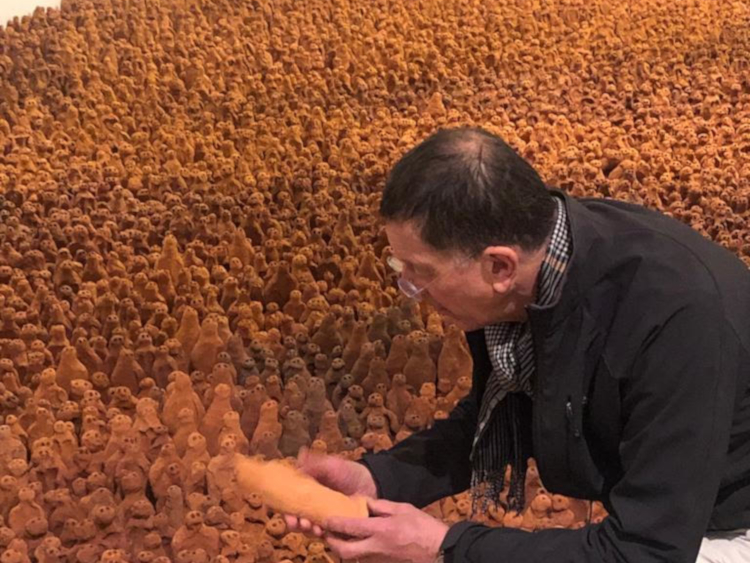
Anthony Gormley stands before a sea of small clay figurines at the First Site gallery in Colchester and poses for photographs. ‘I’m very, very thrilled,’ he says. ‘It’s never been more relevant than now.’ He is referring to his thought-provoking sculpture Field for the British Isles: a sea of faces, all open-mouthed looking eerily back at the viewer. First produced in 1993, it won him the Turner Prize in 1994.
Gormley never looked back, and the work too has shifted, as good art does, with the times. ‘I’m proud to see it here,’ he says. ‘Colchester has a long, proud history of immigration.’ Then pointing to the inspired installation, where the faces amass until they reach a corner and then disappear off unseen, Gormley exhibits a boyish thrill: ‘It’s never been shown ‘on the angle’ as it were, where the first bit of orthogonal architecture promises to dispense with orthogonality.’
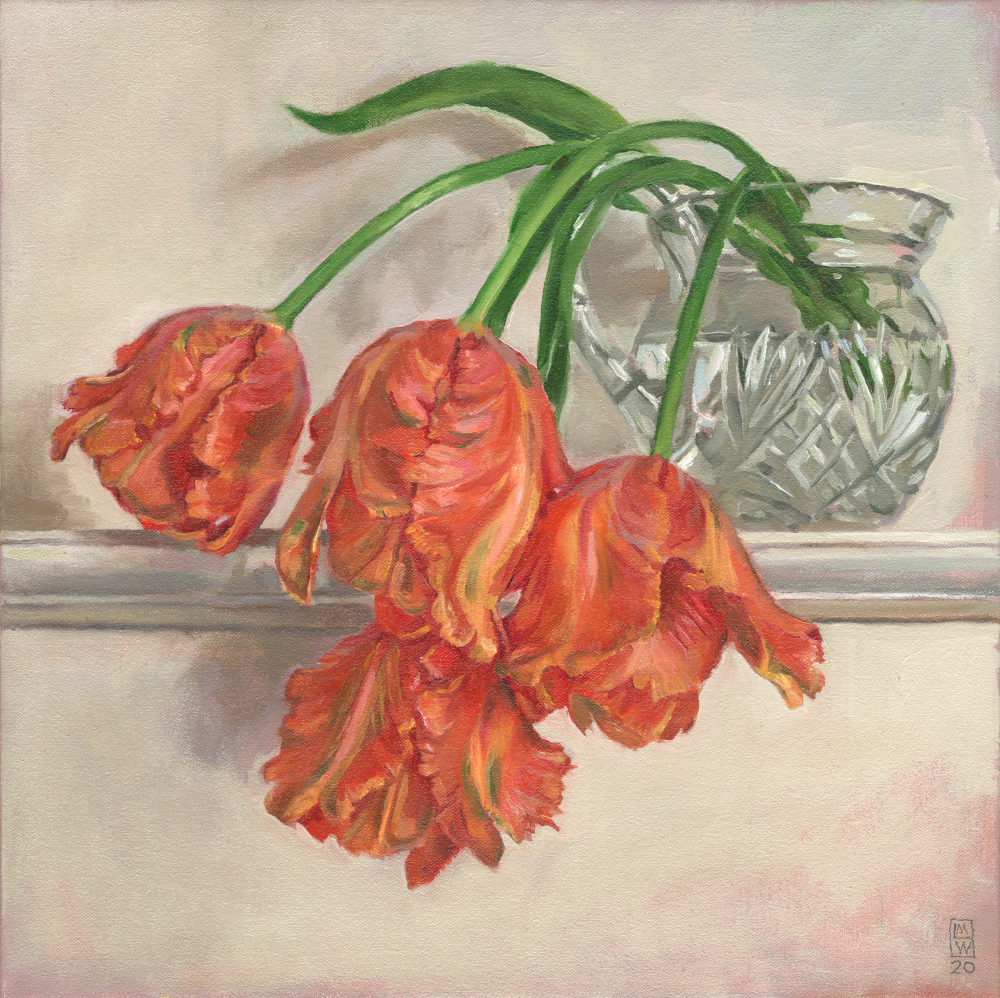
Perfect Tulips Escape Fictional Jug by Lorna May Wadsworth, 2020
All of which would ordinarily be perfectly normal – a famous artist using the word ‘orthogonality’ while journalists and gallery directors nod sagely, enjoying their proximity to greatness, and concealing their bafflement. In the ordinary scheme of things, one might also relate all that the sculptor went on to say about Brexit; how generous he was with his time; and how marvellous it is when an artist plainly enjoys elaborating on their work.
Except that this is not the ordinary scheme of things, as Gormley was speaking on the eve of the coronavirus. The world, without anyone being aware of it, was primed for change.
The Ides of March
2020 was set to be another year of treats: Titian at the National Gallery, Van Eyck at MSK Gent, Cranach at Compton Verney. As the virus proliferated, anxious gallery directors had suddenly to cope with dramatically suspended footfall. They examined not just their balance sheets, but in many cases their raison d’être. Curators turned themselves overnight into online TV presenters, as galleries pivoted to virtual exhibitions, with mixed results.
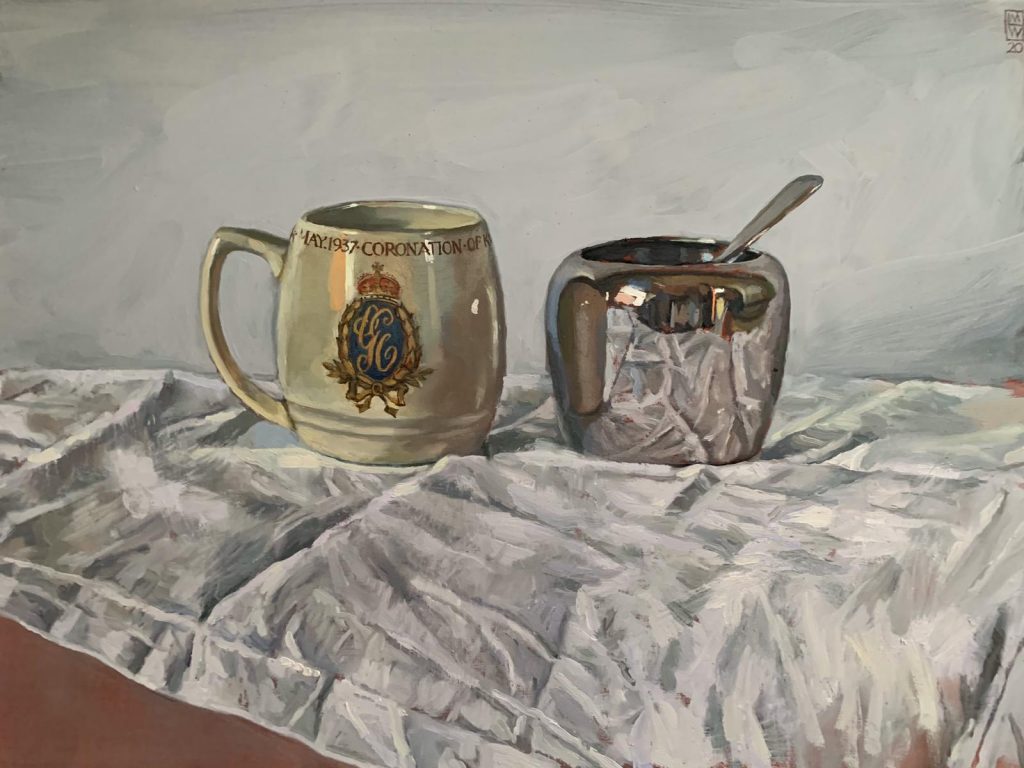
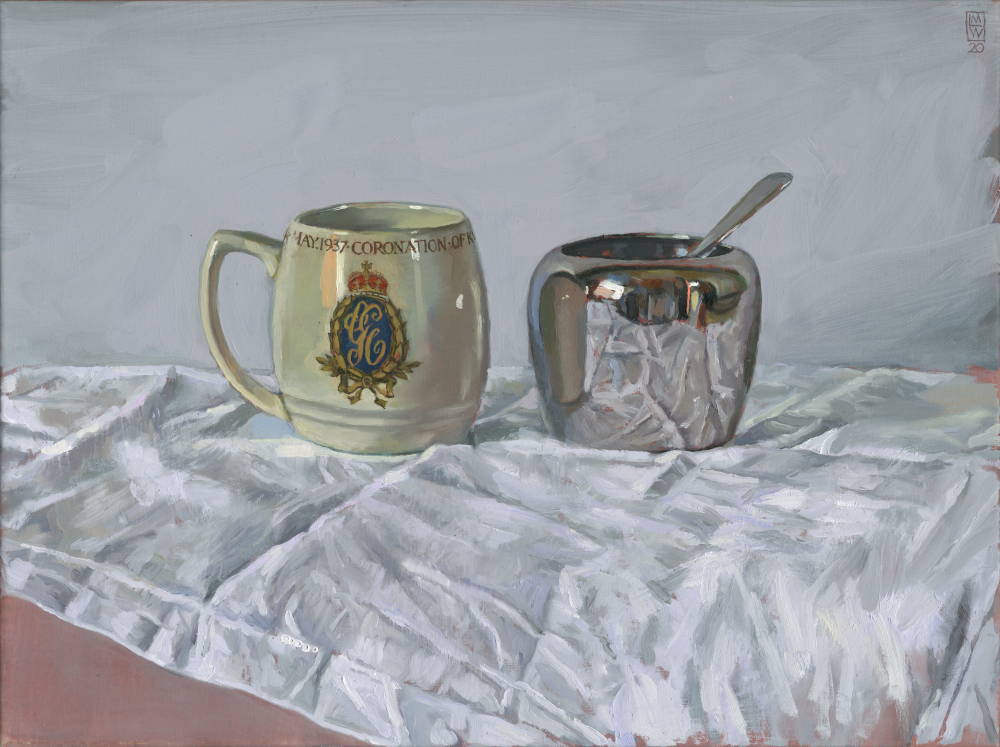
Still Life by Lorna May Wadsworth, 2020
As with the wider economic story of coronavirus, there was a terrible randomness about 2020: the arbitrariness of the virus ruled all. Survival depended on one’s cash flow going into the crisis, yes, but also on the layout of a site. Did your gallery have monetisable outside space like Hampton Court? If so, you could at least reopen your gardens. But what if your gallery was urban, like, say, the Handel House off New Bond Street, a space where social distancing was impossible? For such sites, a long road lay ahead.
Maev Kennedy, the former arts editor at The Guardian and BBC Radio 4 presenter, had been due to travel to Ghent for the Van Eyck exhibition, but had to cancel. Naturally ebullient, with a warm Irish voice, she seems an unlikely messenger of pessimism, but pessimistic she undoubtedly is. She tells me that the urban sites face ‘a gigantic problem’. The example she gives is Turner’s House, known as Sandycombe Lodge in Twickenham. ‘It’s the only surviving property Turner designed himself. It has a handful of small rooms and one winding staircase. You might be talking admitting five visitors at a time, so how do you make the numbers stack up?’ she asks.
Kennedy is also worried for the National Trust, which announced 1200 job losses in late July. ‘It has a huge advantage of the enormous and incredibly loyal friends base, but the problem will be a demographic one. The volunteer base are overwhelmingly over 60s and that might be being polite.’
Kennedy speaks with great authority, and her pessimism is especially convincing since it plainly comes from a place of longstanding love. Even in September, as many galleries and museums embark on reopening strategies, her voice remains with me, urging caution.
The Pivot to Digital
Not every gallery we spoke to was caught off guard by the pandemic. Compton Verney’s director Julie Finch was well-prepared for the virus thanks to a journey she took to the Far East at the start of the year.
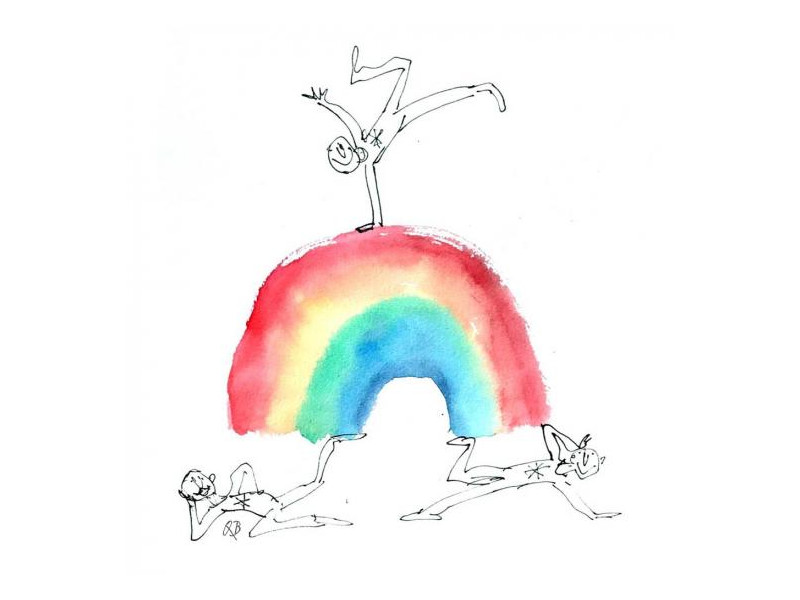
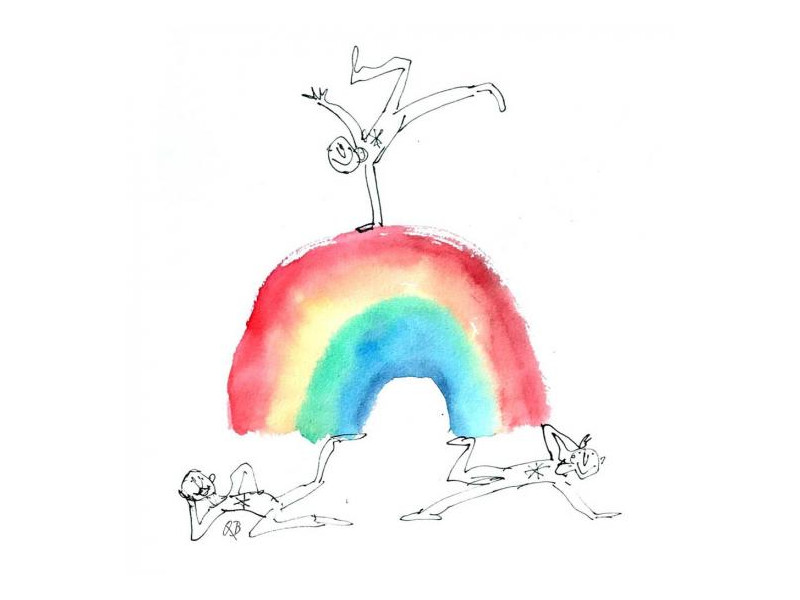
One of Quentin Blake’s ‘portable rainbows
‘I travelled in February through Singapore and so I saw it coming,’ she tells us. ‘As soon as I got back, I set up a Covid-19 team. I was insisting at the end of February that people not sit close together in meetings and everyone thought I was bonkers.’ Finch now realises she was fortunate to be a step ahead: ‘We prepared for a staged closure and had a social distancing policy before lockdown. It was only for a week but people carried on visiting and the feedback was that everyone felt safe. But we ended up locking down the house, and closing the grounds on 20th March.’
So although Finch soon realised that she’d ‘lost a year of income’ – the shortfall stemmed particularly from reorganised weddings – she also realised she had to seek ‘the good will to rebook.’ Finch had also proved to herself and others that she could make the Compton Verney experience viable going forwards.
The great anxiety for the heritage sector is that the cost of opening can sometimes exceed the cost of staying closed. Finch explains: ‘We generate about £1.6 million a year through commercial activity but just to house the collection at Compton Verney costs £300,000 a year. You’re talking security, air handling units, management processes, conservation.’ A museum cannot just sit tight in a way some businesses can.
Galleries were therefore thrown back on their digital smarts – an area which many institutions subsequently realised they’d not been paying sufficient attention to prior to the pandemic. ‘We invented a digital strategy overnight and went live with the Cranach exhibition,’ Finch explains. But this was no silver bullet: ‘The question is: “How can you monetise digital and reach a wider audience going forwards?” In its first week we had 22,000 views and we would never have received that normally. But we had no pay wall.’
Ay, there’s the rub. Finch notes that the virus creates an opportunity to ‘nurture the virtual community,’ but there does seem a lack of detail as to how this will ever make up the shortfalls in revenue.
Maev Kennedy is unconvinced about the proliferation of online content: ‘I don’t think they’re doing much more than reminding people they exist.’
Even so, what would this virtual community entail? According to Finch, you could make exhibitions ‘more of a festival of ideas around our creative content and collections. You can zoom someone in from America to take part, and create new perspectives and intellect.’ But Finch also concedes that ‘you can’t beat the real thing for a minute.’
From Portraits to Still Lives
But art’s perennial strength is its adaptability, and it might be consoling for young people considering careers in the arts to hear that there are signs that artists are beginning to look afresh at the world. Some have even found lockdown enriching, and challenged themselves to find new ways of working, and to discover fresh forms of expression.
Lorna May Wadsworth is a portrait painter, especially noted for her famous Last Supper with a black Christ (a print of which now hangs in St Alban’s cathedral), and for her magnificent portraits of Margaret Thatcher, who sat for Wadsworth five times towards the end of her life when Wadsworth herself was in her 20s.
But her portrait work necessarily dried up at the outset of the virus and she found herself doing still lives in her flat.
Wadsworth is infectious and kind, and you can detect the steel of ambition beneath her warmth: ‘In many ways, for artists themselves the virus is not that big a jump. I spent the whole of last year on lockdown preparing for my retrospective at Sheffield’s Graves Gallery. It was odd to see the world react in horror to your life basically!’ And how has the work been? ‘Lots of artists have said they’ve not been able to work because of the stress and the worry. My reaction was to go gung-ho on these still lives.’
These turn out to be a leap forward for her artistically: Wadsworth has turned her gaze away from people and found a sort of personality in these objects. ‘The tea pots are talking to each other or dancing. They project the need for connection,’ she says. The move towards online has had hopeful ramifications for her: she has sold pictures on Instagram. Even so, there is a limit to her embrace of the digital sphere: ‘We’re so sick of being online,’ she says. ‘I hold a belief: a good painting never reproduces as good in real life, a mediocre painting will reproduce better.’ So caveat emptor.
But there was also good to be done. Wadsworth signed the Artists Support Pledge, meaning that she will buy £200 of art for every £1,000 she sells. She also helped launch the Bourlet Young Masters Art Prize which aimed to get children busy during lockdown while raising money for the Cavell Nurses’ Trust.
This marvellous initiative – as Stephen Fry put it, ‘from the fridge to national recognition’ – chimes with the sense of community which Finch has also tried to promote at Compton Verney. ‘The profession has been massively supportive of one another which is brilliant,’ she says. ‘We’ve been thinking about how Compton Verney can help the local area. One of those is health and well-being and use of the grounds. We have a local pass and have put in a cheap ticket for people to come as many times as they want over a five-week period. We also have special price-ticketing for NHS staff.’
This noble approach was also evident in the delightful series of free rainbow e-cards (see left), produced by Quentin Blake for the House of Illustration which are, he says, ‘for people to send to loved ones they cannot currently see due to the coronavirus lockdown, to show they are thinking of them at this difficult time.’
The generosity seems to connect back to a comment Anthony Gormley made to me regarding Field for the British Isles: ‘‘The idea that my name is on this is rubbish. It is a collective work made by the collective hands of a collective people.
So one’s best version of coronavirus in the arts world would entail precisely this: an arrival at not only new ways of seeing, but a new sense of community. Perhaps it might not be too much to argue that we have moved more quickly than we might otherwise have done towards a kind of collective seeing.
The Outlook for the Young
But is the arts world still worth going into? Julie Finch is optimistic: ‘The sector has to modernise now. Compton Verney will need to prioritise digital audience development, and give the lead for being a more diverse organisation. Since Covid-19 things have moved on exponentially. I think there will be roles coming up, so I wouldn’t discourage people from going down that route.’
Maev Kennedy remains concerned: ‘There’s going to be a flood of good people all released out into a shrunken market at the same time. For younger people, the consequences of this are going to be felt for a very long time.’
Despite this, the contemporary art market has remained vibrant throughout the crisis: the wealthy locked-down have been staring at that blank patch of wall, and wondering what to fill it with.
A well-known London art dealer lists for me the sheer range of opportunities in the arts worlds, from framing to the legal side, to forgery and counterfeiting and academia. She sees a predominantly optimistic landscape: ‘It’s been a difficult time but the world hasn’t stopped.
The US stock market is back to where it was a year ago. We’ve sent things to Australia.’ Then she rattles off other professions which she expects will be resilient: ‘There’s insurance and transportation of art – and then there’s the massive multi-layered business of buying and selling artists, representing artists, not to mention the buying and auction house routes. A lot of this has been hit, but it hasn’t been death blows.’
She adds: ‘What we’ve learned in all sectors is to use digital communication. We’re helped by the fact that the private buyer is now prepared to make more decisions from a screen than they were before.’
Maev Kennedy agrees, but emphasises that it’s just one segment of the art market: ‘Once you go upwards it’s going to be okay. That whole business of bringing in a Russian oligarch to see a Titian with a glass of champagne: that won’t be affected at all.’
But for Kennedy this is cold comfort when we look at the sheer enormity of the ructions for museums and galleries more generally.
A Modest Reopening
All of which sounded grim over the summer, and sounds grim now. But as we moved into July and August, galleries did begin opening again. Dr. Gabriele Finaldi, the director of the National Gallery, had been sending out bulletins about his favourite pictures during lockdown. (‘He seemed a bit like a Renaissance prince alone in his castle, it rather suited him,’ jokes Kennedy).
Covid-proof routes had been designed. It was a cathartic moment for the nation’s oldest institution to be leading the way. But it was still a sign of how much things had changed: a place you used to walk in from off the street was now operating on a still-free but competitive ticket-booking system. This seemed to spell the suspension of the impromptu 20-minute gallery visit at lunchtime.
A few weeks later the Tate Britain opened and felt a fairly eerie experience. The Clore Galleries where the famous collection of J. M. W. Turners’ hang was closed, cordoning off visitor access to the William Blakes’ without explanation. And the gallery was structured according to two routes: the British Art from 1560-1930 route and the contemporary route. It was good to be back but impossible to ignore that the galleries felt somehow sad. I began to find myself in the Kennedy school of pessimism.
This pessimism was to some extent improved by a day in Twickenham in August where I attended Strawberry Hill House, and Turner’s House. In both instances, I book ahead and become part of a small group of three in structured socially distanced tours of small spaces (both houses are structures round vertical staircases where it would be impossible to socially distance).
On the plus side, the new tour group approach makes for a sense of camaraderie among gallery-goers; on each occasion I find I enjoy the company of those I am with. But for me, the experience of museum going is all to do with entering a state of private meditation and communion in a public setting. This has always made me sceptical about audio guides and guided tours. If the world has moved more towards face-to-face interaction while we look at our heritage then that might not always find me in the right mood.
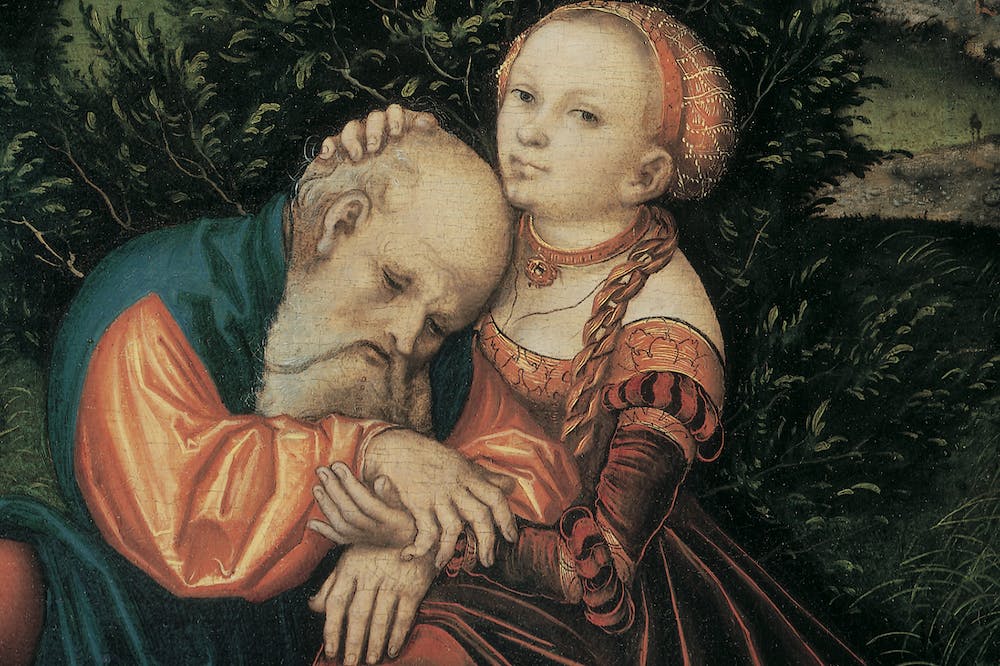
Lucas Cranach, Lot and His Daughters
Back to the Future
Whenever I think back on that day in Colchester with Anthony Gormley it is impossible not to feel grief at what we were so suddenly deprived of in March. In an attempt to correct this, I sometimes find myself groping a bit too obviously after positives.
When I speak to Sally Shaw, the director of First Site and a friend of the sculptor, she says, ‘I’m currently sitting in an empty gallery which is odd.’ It is another sad image.
But she tells me of an optimistic project she embarked upon during lockdown. It occurred to Shaw to start a series of Artist Activity Packs, and the first person she thought to contact was Gormley. ‘We thought it would be brilliant to get people to do something in their homes. I always remember colouring-in as a kid. We’d just done Field for the British Isles with Anthony and so I held my breath and wrote an email and asked him if he wanted to partner with us. Within ten minutes, I got a reply and we were doing it.’
The resulting project, in Shaw’s words, ‘went bonkers. We’ve done three packs and they’ve been distributed to 65,000 households. People were desperate to do something.’
There is something here which is more than just pie-in-the-sky consolation. During this time, the art world has shown tremendous resourcefulness, and an absolute commitment to the transformative power of art at this time.
When I was with Gormley before Field for the British Isles, I asked him how that piece would change if Scotland were to leave the Union. It was a question about the way in which art itself changes, as the world mutates.
On that occasion, Gormley dodged the question, answering that that would be the ‘next chapter in a long national story of unfolding madness.’
But a few months later, the B word has been replaced by the C-word, but looking over my transcripts I realise that not as much changes as we think it does.
At one point, Gormley says in his inimitably digressive way: ‘We’ve got to achieve social justice in a time when goods have absolute free passage globally, and yet somehow people do not. Why are we going backwards in time when we’ve been given all of the tools of the collective mind? The internet is the realisation of the idea of the biosphere circled by mind.’
A biosphere circled by mind’. It would be hard to think of a more apt or prescient description of the times we live in. It took an artist to say it, and it would take an artist to show it.
In Twickenham, it occurs to me that history is full of intended restorations and easy romanticisms which were thwarted in the end by the irreversible nature of time. For Gormley, Brexit was just the most recent of these. In reality we never restore past eras – and we shall not restore the world to March 17th 2020.
What hope might be placed in opposition to this? I find it in Turner’s House. Upstairs, where only three of us are allowed at a time, there’s a telescope which seeks to show the visitor what the view out of the artist’s bedroom would have been in his day. It is an image of an Arcadian landscape unimpinged-upon by the rows of samey semi-detached houses which we experience today. Marble House, occluded now, seemed right before the artist then. The river could be seen, and though you can’t see it now, the museum has rescued for us as an ingenious act of rescuing.
It strikes me that this project to understand the past shall continue, and in doing form our future. This endeavour shall include understanding better the past six months. To do that, you could do a lot worse than start with Lorna May Wadsworth’s exciting and original still lives. And it is a hopeful fact that at Turner’s House, though there is a bottle of hand sanitiser on the table next to it, visitors are still encouraged to touch that telescope.
Will we ever return to our offices? And what will they look like if we do? George Achebe talks to renowned designer Thomas Heatherwick
Journalists I speak to lately have begun to notice a new presence within their recordings of interviews and Zoom call presentations: birdsong. Lockdown coincided with marvellous weather; our offices became our gardens.
And the sky on our road in Islington reverberates with the sound of spanner on metal; our friends over in Muswell Hill have replanted their garden since they spend so much time looking at it; my conveyancing lawyer tells me he may, or may not, return to the office. If so, he says, it will be used primarily as a storage space.
There is, in other words, a unanimity about lockdown: you can be sure that your own experience can be extrapolated into the general. And yet if you ever leave your cosy home and venture to the centre of town, you’ll discover the flipside of all this neighbourliness and quiet domestic improvement.
Soho strikes me as especially melancholy. There’s the sandwich bar I used to frequent now boarded up; a new kind of silence, not so much contemplative as eerily touristless; and with around one in ten businesses open, you have a sense that this place has insufficient residential activity to last in its current form beyond the end of furlough.
Will these businesses return? It is dependent on what decision we make about our office arrangements. This varies from business to business of course. For a more in-depth analysis of the landscape see our exclusive employability survey which begins on page 79. But what are the implications for architects?
Thomas Heatherwick, the famous founder of the Heatherwick Studio, explains that he has seen some positives come out of the coronavirus period: ‘The most interesting thing has been reflecting on what this means and how it’s going to change our lives. I’m wrestling with the sense that [preCovid 19] there was more and more sharing – of cars, workspaces and living spaces. The world was becoming more efficient because people were learning to live together in different ways.’
In Heatherwick’s eyes, the pandemic represented a ‘retreat’ into the private space – a world of Victorian studies, and stockpiled toilet roll. But Heatherwick, who in person is infectiously optimistic and free-wheeling, is already solving the problem the world has set him: ‘The positive side is that people will be spending more time on their homes, and thinking on how their homes work for any situation.’ In the meantime, he says, businessowners have decisions to make about whether to redesign their office space.
We are all aware that this is a sort of drawn-out inflection point, where the human behaviour that will dictate what solution we end up with is latent, and yet to be revealed. Furthermore, it will likely differ from country to country; sector to sector; and CEO to CEO.
When I talk to Alan S – the CEO of a leading boutique creative agency, who also has the sound of birds in his garden – he speaks only on the condition that he remains anonymous. This is because he isn’t quite sure where his business will land and he doesn’t want to give any misleading or worrying information to his workforce.
‘As a small business we have always worked from a fixed office in central London and although we have let employees work from home when required we have never all worked remotely at the same time,’ he explains. ‘We did a trial run before lockdown was announced in order to iron out any issues that might possibly arise, so when lockdown happened we were as ready as possible.’ So how did it pan out? ‘The overriding response was that everyone found it productive, but missed the typical office interactions and camaraderie when seeing each other.’
This will no doubt be a familiar experience for many. What changes has that made to Alan’s view of his existing central London office space? ‘It suddenly became a burden and we were realising that the more we worked from home, the benefits this gave to everyone [would accrue].’ And what are these? ‘Everyone would save on travel expenses and commuting time could be spent with partners and families.’ The perennial bugbear or exorbitant business rates has also been front of mind for the business. ‘The rent, rates and insurance saved by surrendering a central London office will enable us to invest in people, equipment and technology to increase our efficiency and service our clients.’
So Alan S has to some extent made up his mind, and there are plenty of him.
But it is by no means a unanimous view. In fact you’ll find some who argue that an imminent vaccine, most likely arriving in 2021, and distributed towards the end of that year or in 2022, will see a return to a world reminiscent of pre-Covid 19 office-centric life.
Olly Olsen, the CEO of the Office Group, which has over 40 flexible workspaces across the UK, is one of these, although he admits it may be a way off. ‘I spoke to Network Rail, with whom I have a joint venture, and in a number of stations, footfall is down 88 percent. That’s catastrophic,’ he concedes.
In addition, Olsen, whose livelihood is bound up in office life, also makes some admissions about the benefits of working from home. For him, they’re linked to wellness. ‘In the afternoon, I get tired with too much coffee and a big lunch and so I’ll lie down on the sofa for half an hour which is almost socially unacceptable to do in the office.’ Olsen sees it as a positive future driver of business that we’re now finding ourselves more attuned to what he calls ‘wellness fluctuations’ in each other. Workers with children are another example. ‘It used to be that if someone said “Can I make that meeting 11 instead of 10?’, you’d say: “Deal with your kids another time.” Now when a member of staff says, “I’m not feeling myself ”, I say, “Have a rest, there’s no problem. Speak to you later, speak to you next week”.
All this is an indicator of how power has moved rapidly away from the employer towards the employee. For Olsen, it’s not that the office model needs to go; it’s that it needs to change and be adapted to reflect our new reality.
What ramifications will this have for the buildings around us? Thomas Heatherwick agrees with Olsen, but he sees it from an architect’s perspective. For him, there has simply been too much ‘lazy place-making’, and the pre-Covid office was a case of ‘Stockholm syndrome where someone falls in love with their captor. Your employer effectively had you in a headlock.’ The new office space will have to ‘engender real loyalty’ and become a ‘temple of the real values and ethical thrust of an organisation.’
For Heatherwick, the pre-Covid workspace ‘prioritised how [businesses] communicate to the outside world. So if you go to Canary Wharf ’ – an example perhaps of Heatherwick’s ‘lazy placemaking’ – ‘there’s a grand lobby; huge marble floors; pieces of art looking spectacular; a reception desk with great flowers, and lovely-looking people sitting looking great. But if you go inside the elevator you go up to just an ordinary place of work. The show was for the outside.’
All this has to change now that power has moved in the direction of the employee. ‘You need to have them coming in and thinking, “Yes. I need to be here.” So the workspace will become less about being a show for the outside world. It’s about finding your voice as an organisation. The employer has to up their game which the brilliant people were starting to do anyway.’
So how will this look? Heatherwick is a prescient artist who, it could be said, was already beginning to answer some of these questions in his previrus work. His magnificent shopping centre Coal Drop’s Yard in King’s Cross was all about creating a space which people who could internet shop in their bedrooms would still wish to visit.
‘Public togetherness is something which motivates me,’ he says with infectious enthusiasm. Heatherwick has always been alive to the fact that change must be built on the back of existing infrastructure: as always, the future will be built on the back of past structures. ‘We’ve got this legacy of Victorian and Georgian warehouses, which are very robust and changeable. Think how many people are living in older industrial buildings. That was the ethos which drove the Google buildings that we’ve worked on.’ Covid-19 might seem to open up onto the future, but it will also be anchored, Heatherwick argues, to what we have already.
The first project the studio worked on for Google was the company’s offices in California. ‘Next-door to the sites we were working on there was this airship hangar – a NASA airbase,’ he recalls. ‘These are amazing spaces which are super-flexible so you can do anything you want. So our proposal to Google suggested we make really flexible space since we’re not sure whether in a decade people sitting at desks will be what we need. We’ll be manufacturing instead.’
So in a sense the post-coronavirus requirement of flexibility might be met by the sorts of structures already around us: there shall be that element of continuity even as we change.
But this isn’t to say Heatherwick lacks a vision of just how extraordinary the shift in architecture shall be. Round the corner from his studio in King’s Cross, Heatherwick is working on Google’s new London base: ‘It’s the biggest use of timber in a central London building. All the façades are wood.’
What is the ethos of that building? ‘One thing we’ve spent time talking about on that is community,’ says the 50-year-old. ‘The idea that here is just a mercenary organisation doing their thing, and the employees come in eat all their food and drink their drinks, sit at their computers, and get well-paid…’
Heatherwick trails off, then refinds his thread. ‘Given what we’re saying about really getting a deeper engagement with an organisation and it’s team: How does that really contribute to the community around? On the ground floor, you don’t just want another shop that sells ties.’
So what would a new communityoriented architecture entail? ‘Close by King’s Cross there’s Somers Town, where there’s great deprivation and low life possibilities in terms of housing and education.’ For Heatherwick the lively pedestrianised ground floor is a way of energising the whole area.
So while our conversation began with fears of a new individualism, perhaps we might after all find a new communitarianism emerge? Heatherwick agrees: ‘If you’re going into work two days a week you may not need to be based in London.
Out of this may come some strong community-making away from conventional urban settings. Energy had seeped away from villages but now you could get super-villages. It’s okay to spend two hours on a train journey if you’re only doing that twice a week. I just hope we will use brownfield sites rather than consuming greenfield sites.’
But again this seems to spell trouble for the City and, though few may lament the fact, the property development sector. Olsen admits: ‘If you ask people where they most prefer working, it’s on their own – it’s at home where it’s quiet. Not an office which is openplan with people talking, and which is smelly and so on.’
So what’s the purpose of going to an office? Olsen is clear: ‘We’re built to connect. I can’t have guests and clients to my house and I can’t bring a team together to my home. If I do that business will fall – as it’s falling now from lack of human interactions.’
So what kind of spaces will we see? In answering this, Olsen sounds a lot like Heatherwick: ‘It’s difficult to forecast what will happen next but I think where you choose to work will be driven by who you are and what you believe. Our places of work will become more of an extension of our social lives.
The overwhelming impression is that we’re in a hiatus – a period of hedging, where people are living in tentative expectation of a vaccine. Olsen agrees (‘we just don’t know) but he has clarity on another point: ‘Before this happened, I would have said that all my buildings were clear, tidy, safe and healthy. Well, they’ll have to be clearer, tidier, safer, and healthier now.’
So it seems likely we’ll be hearing the birds in the garden for a while yet. And when we get back to them, perhaps we’ll hear them in our offices too.
The life of William Shakespeare has lessons for how to make the best of your talents during a time of pandemic, writes Robert Golding
In January 1593, the Privy Council of Elizabeth I issued the following order: ‘Forasmuch as by the certificate of the last week it appeared the infection doth increase…we think it fit that all manner of concourse and public meetings of the people at plays, bear-baiting, bowling’s and other like assemblies for sports be forbidden.’
This was bad news for many, but perhaps especially so for a young playwright who was beginning to come out of the shadow of Christopher Marlowe and forge a place at the forefront of the city’s theatre. At the time of the plague’s outbreak, a certain William Shakespeare had begun to find his voice.
Though plague was a fact of Elizabethan life, it must have come as a setback. His life up until that point had not been without gamble. William – Will, as he appears to have been known to friends – had left his wife and family behind in Stratford-upon-Avon and embarked on a career in the slightly louche world of the contemporary theatre.
The language of the edict with its courtly leisure – ‘it appeared the infection doth increase’ – shouldn’t blind us to the cataclysmic impact on Shakespeare and his contemporaries. Shakespeare’s contemporary John Stow – responsible for so much of our knowledge of Elizabethan London – recorded that 11,000 out of 200,000 died between December 1592 and December 1593.
The Elizabethan plague was, of course, far worse than anything we have experienced in 2020. People died in the street, rendering death an ever-present aspect of daily experience. We might miss, for example, the force of the famous insult in Romeo and Juliet: ‘A plague on both your houses’. What is being wished here is something far more awful than we, even as we live out this unsettling year, can imagine.
It ought to be a certain comfort to us now, to realize that Shakespeare’s life – among the most marvelous that history records – was beset by plague at every turn. And those of us who fear even a vaccine won’t put an end to our woes might remind themselves that plague was both a constant and a mutating reality for Elizabethans.
There was a serious bout of plague in Warwickshire the year of Shakespeare’s birth; the young Will would not have been expected to survive. Whatever talk may have swirled about ‘a merrie meeting’ having precipitated the playwright’s death in 1616 at the age of 52, there is nothing to say it wasn’t the proximate cause of his death. We worry about a second wave of coronavirus – our finest poet existed within an unbaiting wave of mortality.
Yet he continued – and not only that, time and again reinvented himself. The plays and poems which follow on from the big plague years are evidence of a profound pooling of resources and a taking stock. Love’s Labor’s Lost, Midsummer Night’s Dream and Romeo and Juliet follow on from the plague year of 1593. They exhibit a richness, and even an urgency, difficult to discern in the ghoulish Titus Andronicus or the bombastic Henry VI trilogy, written the year before the plague struck.
But William Baker points out in his book William Shakespeare, that between 1603 and 1613, London’s theatre land was closed for 78 months. Though the poet inhabited a society without any social safety net, let alone the largesse of today’s furlough scheme, there are lessons here for today’s young people starting out on their careers.
In 1593, Shakespeare was swift to man oeuvre when the severity of that particular bout of plague became evident. Faced with an income gap due to a sudden pestilence, he was in no different a position to an airline pilot or live events manager today.
So what did he do? He launched himself immediately as a courtly poet. For a country boy, it was an act of tremendous gumption, under the patronage of the Earl of Southampton. We therefore have two epic poems – Venus and Adonis and the Rape of Lucrece – which might be termed plague poems. Each breathes freshness, health and life; they must have been cathartic to those reading them, and indeed these long poems were hits among the student population at the Inns of Court.
For some times, the theory has circulated – and been brilliantly argued on the website The Shakespeare Code – that Shakespeare was using existing connections to forge his career: it is argued that Shakespeare had in fact taught and conducted secretarial work in Titchfield, where the Earls of Southampton lived, prior to the plague. This might have particular resonance for those casting around for contacts during the time of coronavirus: open that contact book. It also shows the willingness of our greatest mind to undertake menial tasks if it meant getting in close proximity to someone with the power to make a difference to his life.
What is clear is that Shakespeare was flexible and imaginative; at the critical point, he was willing to imagine another version of his life. He also remained true to his gifts. There is a strong hint in Sonnet 111 that Shakespeare found playwriting a drudgery: ‘my nature is subsumed/ to what it works in like the dyers hand’. He seems to lament his low birth. But when the moment came, he didn’t attempt the impossible. There is a strong pragmatic streak about Will; he might seem in the stratosphere now but this was no dreamer.
What also might chime with today’s young is that he remained patient and took the long view. He might have been forgiven for thinking in 1593 that the long-term prospects for life in the theatre weren’t good. What was there to stop plague returning and scotching year after year of possible revenue? But he appears to have kept his options open, and retained connections within theatre land even while branching out into poetry. There is a strong hint throughout his career that Shakespeare had a quiet talent both for friendship – contemporaries would refer to him as ‘sweet’ and ‘honey-tongued’ – but also for business relationships. In his last will, he would bequeath memorial rings to the actors John Hemminge’s and Henry Condell; they would repay his memory by editing the First Folio in 1623, seven years after the poet’s death.
This was networking, as it were, from beyond the grave. The hard realities of inhabiting a plague-riddled society appear to have made Shakespeare not just a better poet but a better businessman. This has sometimes been an inconvenient fact to those who would have preferred the Bard to be more Keatsian – more head-in-the-clouds, and klutzy with money. The record shows he was anything but.
Instead, Shakespeare continually found ways to expand not only his poetic capacity and his knowledge of human nature, but also to develop what we now call his career. In 1594, he bought a one of James I would become the King’s Men: Shakespeare saw the main chance and took it. Again, there is a hint – but no real proof – that he was utilizing his connections. It has long been rumored that it was the Earl of Southampton who loaned Shakespeare the capital. If so, we might wonder whether he wisely used his time in lockdown to deepen existing connections.
There is an onwards pressure to Shakespeare’s life which suggests a refusal to become down-hearted from which we might learn. The year’s show him steadily more active both as a property owner in London and Stratford, as a shareholder in his theatre company, and as someone with small businesses on the side in malt dealing, in lending, even going so far as to turn a property he owned in Henley Street into a pub.
As for the plays, it’s true that they don’t always exist within a milieu of work which we recognize, unless that milieu is the court. But once you look past that you find a good deal is implied about loyalty and about the dignity of work, and indeed a certain amount about the kind of adaptability which we can vaguely detect in Shakespeare’s own life.
It has been said that the characters Shakespeare most admires are Horatio in Hamlet, Kent in King Lear; Cassio in Othello, and Enobarbus in Anthony and Cleopatra. These are the characters still standing at the end in the tragedies; those who will be charged with rebuilding the state. This a recurring type: the hard-working, flexible, loyal aide who becomes clearer in his moral purpose as difficulty mounts.
These are plays written by a man thrown back continually on his own resources, and who time again rose to that situation. William Shakespeare found new things within himself – new forms of language, yes, but also new forms of life. His relevance ought not to be surprising. Every period of history has found in Shakespeare a friend and teacher – but it’s fascinating during these unsettling times to see how much his life, and not just his poetry, has to teach us.
In July 2020 the government announced £1.5bn funding to help the arts and entertainment sector recover from the Covid pandemic. This means that the books, films, music, TV streaming and gaming we relied on during lockdown will still get made. And we’ll be able to enjoy live performance – theatre, musicals, bands, festivals, concerts – in the years ahead.
Lockdown underlined just how much we rely on these things. We need the distraction, glamour and excitement – even, sometimes, the consolation – they offer. What isn’t necessarily so obvious is that the arts and entertainment are an industry, one which in Britain alone employs around 364,000 people and is worth £10.8bn annually to the economy. Indeed, it’s economically vital, every year generating a further knock-on £23bn and contributing £2.8bn to the Treasury. All of which means there are thousands of jobs in hundreds of different roles in the sector, and you don’t have to be either well-connected, or wildly lucky, to break in: as our inspiring interview guest shows. The world-leading tenor Mark Padmore is a musical ‘star’, used to touring internationally all year round. But, as he reveals here, he’s risen to the summit of his profession without elitist hothousing – although helped by public education structures that aren’t currently in place.
So what does his career look like? Mark Padmore collaborates with the world’s leading musicians and directors, opera houses and orchestras to worldwide acclaim. He performs across genres, creates new roles in key contemporary work, and directs the St Endellion Summer Festival. A list of highlights includes his Artist in Residency at the Berlin Philharmonic Orchestra 2017-18; his extensive discography has received numerous awards, including Gramophone magazine’s Vocal Award, the Edison Klassiek Award (Nederlands), and the ECHO/Klassik 2013 award (Germany). Voted 2016 Vocalist of the Year by Musical America, he was awarded an Honorary Doctorate by the University of Kent in 2014 and appointed CBE in 2019. We asked him to talk us through life as a contemporary performer right now.
Can you tell us how you got interested in music?
I received a recorder from Santa Claus when I was four and immediately took to the excitement of learning to play. From there I was given the opportunity to learn another instrument and chose the clarinet. My parents weren’t particularly musical nor well off but they understood that I had a particular passion for music.
Fortunately the Kent County Music Service was very strong and offered opportunities to children who showed some talent. From the age of 12 I was supported by the Kent Junior Music School and each Saturday morning was enabled to travel to Maidstone, the county town, for intensive lessons. I also joined the Kent County Youth Orchestra and each school holiday attended week-long courses. These provisions have long been reduced and had I been starting out now I may well not have become a musician.
When did you first know you wanted to be a musician – and did you always plan to be a singer?
Singing was always something I enjoyed but there was no opportunity to attend a choir school. Playing the clarinet and then the piano had developed my sightreading skills and it was through this that the possibilities of singing opened up. I had decided that I didn’t want to be a professional clarinet player – the competition was very tough and I was not really good enough – but someone in the Youth Orchestra suggested I try for a choral scholarship to Cambridge. Getting in to King’s College choir was the first step to realising that I could become a professional singer.
That’s a lot of commitment from an early age. Has music ever become a chore for you?
There are definitely moments when perseverance is necessary – courage and determination are vital. Even now there are times when I can be daunted by the task ahead and need to grit my teeth to make progress.
What did you feel was your first big professional success?
My Chinese horoscope sign is the ox, and I have always been a plodder. Fortunately I have plodded on and on and have caught up with a hare and even a tortoise or two! I have really tried to do my best at each stage and although there have been moments of satisfaction they are fleeting. I guess my first real experience of success was being asked to appear in Charpentier’s Medée with Les Arts Florissants at the Opéra Comique in Paris playing Jason to Lorraine Hunt’s Medée. Being on stage with Lorraine was thrilling.
You do extraordinary work across a whole range of fields: opera, oratorio, lieder & chamber music. Could you share some favourite experiences with us?
I have always felt an urge to escape pigeon-holes. I love moving between genres and exploring new territory. My favourite opera experiences have been Billy Budd at Glyndebourne and Death in Venice at Covent Garden along with creating roles in Tansy Davies’ Cave and Harrison Birtwistle’s Corridor and The Cure. I also loved being in two Katie Mitchell productions – Handel’s Jephtha at WNO and Bach’s Matthew Passion at Glyndebourne.
The Bach Passions with Simon Rattle and the Berlin Philharmonic in stagings by Peter Sellars were some of the most profound and thought-provoking experiences I have had. In lieder and chamber music it is the collaborations with great musicians that have given the most pleasure.
Can you talk about the advantages and disadvantages of such an international career?
We live in a culture of celebrity and sometimes the performer is disproportionally the focus of attention. I have had wonderful experiences travelling as an ‘international’ soloist but I am beginning to question the desirability and viability of this way of life. I have, along with my colleagues, used up an unsustainable number of air miles and whilst I understand the huge benefits of cultural exchange I also believe that we need to engage more deeply and meaningfully with our local communities. Days away vary each year and I have tried to avoid being away for longer than about two weeks at a time.
As one of the world’s leading tenors, you’re at the forefront of international music-making, and its disruption by the pandemic. What does it mean for performers themselves?
Covid-19 is causing a reassessment of how we access music. Having done just two concerts in the last four months – both to empty halls for streaming services – I miss the buzz of looking out at an attentive audience.
Music-making is essentially a communal activity that needs interaction between performer(s) and audience. This period is full of uncertainty but also full of possibility – both reassessment of what performance has been in the past and what it can be in the future. As the cancellations came in, my first instinct was to take the opportunity to reflect on what it is I do and why and to explore thoughts of how I might do things differently. Creatively,
I have been liberated from the need to prepare a large repertoire – I normally have between 70 and 80 performances a season. This has meant I can take time to practice in my studio and go back to basics with pieces that I have known well for many years without the urgency of having them available for immediate performance. Financially, I have had to extend my mortgage and face the possibility of no significant income for many months and a realisation that I will probably have to accept that my income will remain at a much lower level than before. Emotionally, it has been up and down. The adrenalin of performing has been sorely missed.
On what platforms do you listen to music, when it’s not live?
Any recorded performance is in some ways mediated and therefore more distant. I find myself less engaged when listening to a performance I can interrupt at anytime to take a phone call or make a cup of tea. Music is ‘heard’ rather than ‘listened to’ – a distinction similar to John Berger’s notion of the difference between ‘seeing’ and ‘looking at’. I use all the methods above but none comes close to the experience of being in amongst an audience.
How much does a musician get paid for a performance downloaded on a digital platform such as Spotify?
I have received no money direct or through a record company for Spotify even though at least one track has had more than 3 million plays. I also get paid less for recording than I did in the 1980s. If musicians are to survive in a new digital era this will have to be addressed urgently.
What does this shift away from paying for the music we listen to mean for musicians working in Britain?
State subsidy in the UK has diminished greatly over the last ten years and all arts organisations are expected to generate something like 80 percent of their income from ticket sales or sponsorship. Without a paying public this model is unsustainable. Other countries, particularly in Europe, are much more generous. I fear for the viability of the arts unless the UK government has a change of approach. Music-making is essentially collaborative, and the better the conversation between performers and composers/writers the better the resulting work. This will be true also for innovative ways of producing performance in the future. Discussions are already happening about how best to film ‘concerts’ so as to deliver the best possible experience for audiences. One thing we have been able to do during lockdown is talk to one another and I am excited by some of the ideas that are beginning to emerge.
What are your hopes and fears for the future of international music-making?
Many of the models for international music-making are teetering on the brink of collapse. Will opera houses and large symphony orchestras, concert halls and international music festivals survive? These were the main producers of classical music. They initiated most of the engagements and artist agents acted as intermediaries. I think we may be looking at a very changed world in the next few years.
The positive side may be a much greater investment in community and nurturing a local and loyal audience. Climate change and travel restrictions will also make the jet-set lifestyle much less attractive. What I hope will not be lost is the passionate engagement of performers and audiences with the wonders of the classical music repertoire
Fiona Sampson is a leading British writer, whose latest book Come Down is published by Corsair. www.fionasampson.co.uk
It’s a not uncommon thought during these times: “Is this reality or some awful dream?” As we queue in masked silence, told to keep two metres apart over the tannoys, our lives now feel post-apocalyptic, as if a dystopia fit for the silver screen had migrated somehow into our actual lives.
But if the pandemic is the stuff of movies, how is it impacting the way films are made and consumed? Finito World has identified the four key hurdles filmmakers are facing over the next few months. Strap yourself into your home cinema seats: it’s going to be a bumpy ride.
“Just keep swimming”: Keeping the momentum
Although filming has started again, many productions are still reeling from the psychological and logistical consequences of lockdown.
Finito World spoke to James Kent whose directing credits include Testament of Youth, starring Kit Harrington, and The Aftermath, starring Keira Knightley.
If you’re in the middle of a project and it has to be stopped, it’s a pain to remount it,’ he explains. ‘It’s very complicated to get your actors back as many of them will be booked on to other jobs. It’s definitely a bit of a logistical nightmare.”
But in some ways making movies is always a precarious business, he adds: “Filming is all about momentum. There’s a famous saying in the industry: You’re never sure it’s happening until you’ve got your bacon butty. The bacon butty guarantees the fact that you’re filming and until that moment comes, a film cannot happen.”
But perhaps it’s not all doom and gloom. Rebecca Johnson, who has directed an array of shows including Call the Midwife as well as her own critically acclaimed feature film, Honeytrap, says viewers might see a rise in indie films since they aren’t so vulnerable to the loss of momentum. “What’s good about indie films is they are usually shot over a short period of time. Usually about four weeks so potentially there will be a rise in these sorts of films. Cost is going to be an issue but if people really did isolate and it was just like a hermetically sealed unit that is fairly safe and easy to maintain.”
“Houston, we have a problem”: Keeping the crew healthy
Keeping cast and crew Covid-free presents an ongoing challenge. It was hard not to cringe while watching films in lockdown and noticing how recklessly the characters shake hands and spread their germs all over the set. So, should we expect the latest films to be sanitised and devoid of intimacy?
Rebecca Johnson says: “For me the most concerning thing is keeping actors apart. I just don’t see how you can do that. It’s too creatively inhibiting. There’s just too much content that you wouldn’t be able to make while keeping actors at a distance.”
James Kent worries about the costs associated with keeping people safe. He said: “If there’s an outbreak on set then your whole crew is off, there’s a whole issue about insurance and how that’s being covered. If Chris Pratt gets coronavirus when acting in Jurassic Park they won’t be able to shoot.”
And it looks like productions won’t be getting any financial assistance if coronavirus strikes on set. Kris Barnfather from the creative insurance broker Eggar Forrester Creative is blunt: “Without meaning to sound all doom and gloom, realistically there’s just not a way forward. Insurers are explicitly writing coronavirus cover out of contracts.
The reality does indeed sound grim. “Some people are worried about being sued if someone catches Covid-19 on set,’ Barnfather continues, ‘so we are suggesting everyone does a coronavirus risk assessment and that they make sure people understand the risks and sign documents to mark this understanding if necessary.”
Production companies are having to be especially careful. Actor Tyler Perry who owns studios in Atlanta was one of the first people to outline, in great detail, how to start filming amid the Covid-19 outbreak. His 30-page plan titled “Camp Quarantine” reveals the steps individuals should take. It says all luggage has to be disinfected, cast and crew should isolate before filming and they will also be required to take nasal swabs.
“Well, nobody’s perfect”: Keeping the cast looking good
Nasal swabs hardly scream movie industry glitz and glamour. Indeed, during lockdown, viewers watched TV presenters’ faces droop from lack of botox and saw their blonde fade to grey. So will coronavirus mark an end of polished stars?
James Kent explains: “Makeup is a real issue, particularly for period dramas. You can get away with it in a modern drama because you’ve got your own hair but with wigs or anything that involves prosthetics, it’s impossible.”
Sandra Exelby, who has done makeup on the sets of Doctor Who, Dad’s Army, and Bugsy Malone and now chairs the National Association of Screen Make-up Artists and Hairdressers, has been coming up with solutions to keep the stars looking good.
She explained: “We are advising all of our artists to wear appropriate PPE. This includes aprons and a visor as well as a mask. Of course, we are saying hand-washing must be regular. We are also suggesting that makeup brushes are left overnight in a UV cabinet.”
But hairdryers are getting the cut. She explains: “Hairdryers move air around and so they increase the likelihood of infection spreading and therefore we are saying no to hairdryers.”
“Makeup artists cannot adhere to social distancing. They are essential on set and with the right precautions risk can be minimised,” she says.
“I’ll be back”: Keeping people in the cinema
We’ve highlighted the hurdles and shown, for the most part, there are ways to minimise risk. So the shows will go on. But the question is, who will dare to venture to the cinema to watch them?
Cinemas in the UK have reopened again albeit without singalong screenings and pick’n’mix. Nonetheless, the industry is on track for its worst year since 1996, with box office and advertising revenue set to be down almost £900 million.
Rebecca Johnson admits: “I’m not sure I’m going to go to the cinema in a hurry, to be honest. Going to the cinema feels like an unnecessary risk. I’m not that scared of getting it but I will avoid it if I can.”
James Kent is also pessimistic: “The real problem is with film: how does anyone make any money when you can only put half the amount of people in the cinema?”
“Oscar winning films are generally skewed towards an older demographic and they are going to be the ones least wanting to go back into the cinema. Anybody over 55 is not going to be rushing back to the movie theatre.”
Which all sounds a bit bleak. So where’s the uplifting riding-off-into-the-sunset ending? Well, University of Exeter film professor James Lyons points out that coronavirus could encourage the film industry to consider its impact on the climate.
He said: “The film industry is a very resource-intensive enterprise in many respects, and it needs to come to terms much more seriously and urgently with its contribution to climate change.” Looking ahead, Kent is intent on identifying the positives: “This moment is one for us to all reflect on what we have taken for granted, and adapting in the months and years to come must surely involve thinking of more sustainable ways to live and work. The film industry is no exception.”
So hopefully in the future we will view post-apocalyptic scenes exclusively on the screen.