Category: Arts

  • No Time To Die: what James Bond tells us about the workplace

    By Robert Golding

    I’m lucky to possess an attractive vintage edition of On Her Majesty’s Secret Service (1963). Whenever I take it down from the shelf, as I do now, it reminds me that more people should read Ian Fleming. The writer may be best known now for the multimedia phenomenon he has given the world, but he began as a good prose stylist. For instance, this book, the twelfth Bond novel Fleming wrote, begins with a description of a seaside sunset: ‘Then the orange ball would hiss down into the sea and the beach would, for a while, be entirely deserted, until, under cover of darkness, the prowling lovers would come to writhe briefly, grittily in the dark corners.”

    This isn’t writing of the first rank. Anyone who’s ever watched a sunset knows that the setting sun doesn’t hiss at all and I don’t think lovers prowl the beach so much as loiter – but if we’re seeing all this through the eyes of Bond, then perhaps they do. In Bond, women are always an aspect of struggle. His weakness for them is the thing most likely to get him killed.

    Any discussion of Bond and the question of work must always come back to that crucial fact, also punchily described in the opening pages of OHMSS: ‘Today he was a grown-up, a man with years of dirty, dangerous memories – a spy.’

    Empire Broccoli

    But before we get to life at MI6 in No Time To Die, it’s worth noting that each time a Bond film comes out, it’s a reminder that we exist just after the greatest shift in human experience since the advent of Guttenberg’s Bible – namely, the move away from print towards the moving image.

    It might be that Bond encapsulates this change more vividly than any other character. That’s partly because of the sheer enormity of the franchise. It’s also because someone whom the previous generation got to know through language in Fleming’s books, is now someone we’re acquainted with predominantly as spectacle. Even so, the books remain reasonably near.
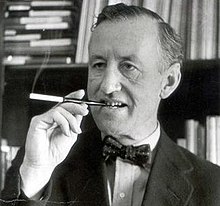
    Ian Fleming

    And, of course, there are still the books for those who want them. They reliably take up three quarters of a shelf in each outlet of Waterstone’s. But the sheer number of people who see these films is a reminder of their addictive, joyous quality.

    Our collective need of Bond on the big screen stretches all the way back to Sean Connery’s debut in Dr No (1962). No Time to Die is the 25th instalment. During that time, the film industry has grown exponentially: this state of affairs is best illustrated by the credits at the end, which denote a bewildering array of jobs in the sector from casting directors, to stunt men, makeup artists, production crew, runners, textile technicians and others. While a film of this scale is being made, it exists as something between a camping site and a corporation.
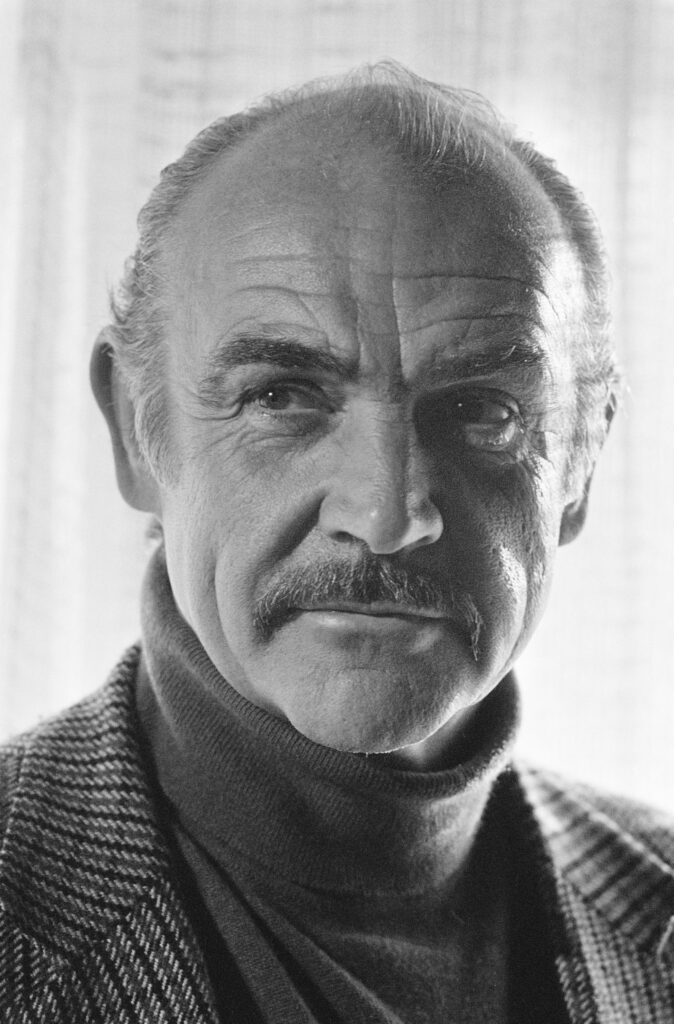
    Aankomst Sean Connery op Schiphol *23 november 1983

    The figures continues to impress. In 2019, the Department for Culture, Media and Sport estimated that there were 289,000 jobs in the UK film, television, radio and photography sector.

    From the Pandemic with Panic

    No Time to Die arrives at a time when all these jobs are in flux, and the industry in peril. This is a situation which, one suspects, only James Bond can remove. As punters, we are separated for the most part from the stress of the impact of the pandemic on the film world.

    But we do glimpse it occasionally. Earlier this year, audio was leaked of an apoplectic Tom Cruise on the set of the latest Mission Impossible 7 haranguing crew for failing to take proper Covid safety precautions. 

    If you heard Cruise’s stressed pep-talk, you’ll know that the industry has never needed a good Bond film quite like it needs it now. But the world is in a similar predicament. One thing Covid-19 appears to have wrested from us is a sense of harmless fun. In spite of every attempt to reach for gravitas, Bond cannot help but remain that.

    Even so, a desire for seriousness is what has defined the Craig films. This needs to be placed in context. The gritty – and for some unbeatable – performances of Sean Connery kicked off the series. His tenure began with Dr. No and took us through From Russia with Love (1963) – for many purists, the best of them all – Goldfinger (1964), Thunderball (1965) and You Only Live Twice (1967). There then ensued a brief hiatus where George Lazenby, in an underrated film, took over in the filmed version of On Her Majesty’s Secret Service (1969), before handing back to Connery for that notable dud Diamonds Are Forever (1971).

    Golden Moore

    The advent of Roger Moore changed everything. Moore’s spirited and amusing performances moved the films far from the books, and seemed to bust forever the notion that Bond was a character of any psychological depth. These films, beginning with Live and Let Die (1973), and ending with A View To A Kill (1985), where Moore looks almost elderly as he puffs his way up the Eiffel Tower in pursuit of Grace Jones, are great fun, though not untainted by a casual imperialism and misogyny which wouldn’t pass muster today. Even so, few Bond fans would want to be without them. They are of their time – but more than that, they were undertaken with the understanding that Fleming’s world is predominantly fairytale.
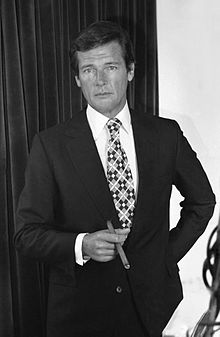
    The Moore films have been subject to push back, in some degree or other, by all the actors who have played Bond since. Timothy Dalton, better known as a stage actor, sought inspiration from the Fleming books in License to Kill (1987) and The Living Daylights (1989). Piers Brosnan channelled Moore to some extent, but there were some attempts – especially in the casting of Judi Dench as M – to bring the series up to date. Those films declined precipitously in quality following the credible first showing Goldeneye in 1995.

    And so to Daniel Craig, where the seriousness has been amped up throughout, and everything possible done to give Craig the opportunity to explore what it really means to be a spy – and especially a 00 with a famous licence to kill.

    Low Morale

    Underpinning all the Bond films is the unavoidable fact that our hero is a serial murderer. During the early films, we are permitted to consider him a hero because he is always protecting the free world from the diabolical schemes of Ernst Stavro Blofeld. The more diabolical the scheme, the more comfortable we are with the notion of him as a hero, since we can turn a blind eye to what he is capable of.

    Geopolitically, we need to feel that Britain is in some sense ‘good’ for these films to work – otherwise the murder is all for nothing, and we can’t quite cheer on the hero.

    The unseen factor on all these films is the parallel success of the books of John Le Carré. For their style alone, Le Carré’s books will go down as some of the finest of the post-War period. Those books work by intrigue, and make particular use of the device of the double agent. This in turn creates a strange world where the excitement is not knowing who to trust – and whether all the sacrifice is worth anything.

    For Le Carré, the British Empire was an object of suspicion. These suspicions had their climax in Brexit, and we now know that the novelist died an Irishman. It’s difficult to imagine Fleming as anything other than British.

    It could be argued that Bond was never supposed to be Le Carré-esque. Fleming’s stories work on the implicit assumption that democracy is a more desirable thing than communism – and that there is such a thing as good and evil, and right and wrong.

    One also wonders whether the biggest mistake was to try to apply Bond to the world which grew up after the fall of the Soviet Union. The decision to do so can seem as absurd as placing the Three Musketeers in a battle against the Taleban in Afghanistan.

    At any rate, during the Brosnan-Craig years, something like the Le Carré worldview was appropriated and smuggled into the Bond movies, where it didn’t belong. It was Lord Alfred Tennyson who wrote of the ‘long unlovely street’ referring to almost any street in London – and the Daniel Craig Bond movies show a London just as drizzly and depressing. It is a city hardly worth fighting for. It’s Le Carré’s London – a city to make you want to get an Irish passport.

    Faulty Leiter

    In No Time to Die, the role of the spy has shifted still further. Craig’s cold eyes are uniquely able to convince us that he kills for a living – but we are not always sure if we should be supporting him. In No Time To Die, Bond himself seems to be afflicted by a peculiar kind of self-loathing – and, as throughout Craig’s tenure, is continually retiring from espionage. It has been said that the power of the name ‘Bond’ has to do with his being in some way wedded to Queen and country. Here that central bond has loosened.

    One of the perennial images of Craig’s time in the role – and it arises again in No Time to Die – is of Bond, who must be on slender government provision, retired from active service in five star luxury, somewhere in the Caribbean or the Pacific. He is always questioning the validity of his own job – the series isn’t a particularly good advert for recruitment into MI6, and very misleading as to pension expectations.
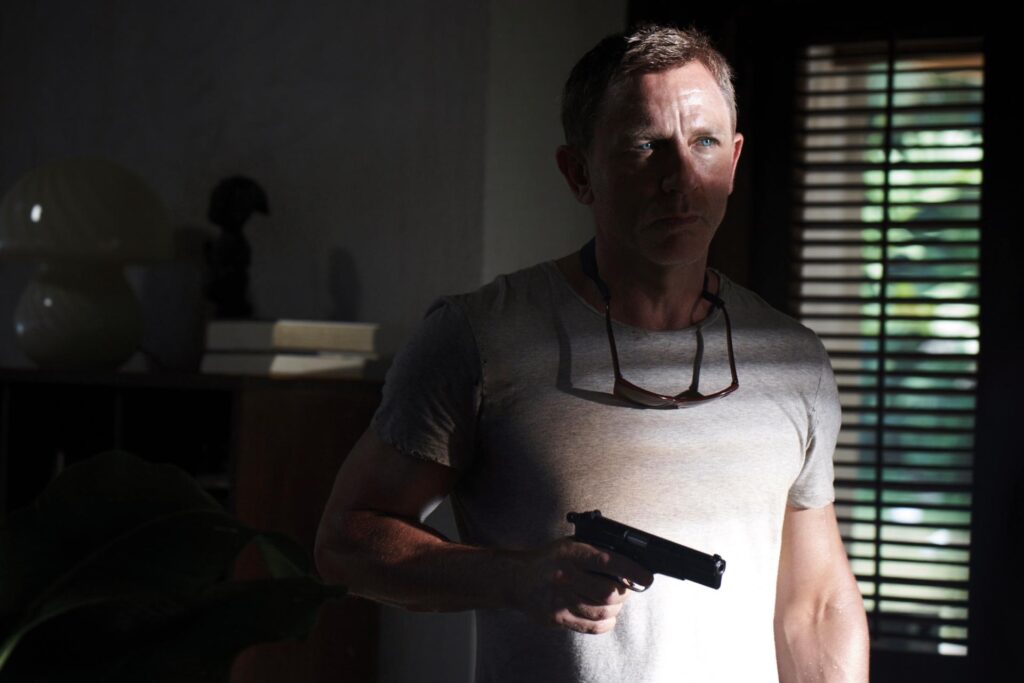
    A further complexity is the US-UK relationship which, we are told in this film, has strongly declined. The friendship between Felix Leiter and Bond, which wheels about throughout the franchise, is here not wholly believable. In License to Kill, Bond is very close to Leiter and driven to revenge by the villain’s murder of his wife. But by Casino Royale (2006), Bond is only just being introduced to Leiter at the casino after experiencing a defeat by Le Chiffre at poker. Yet by No Time To Die, the pair has somehow reverted to a sort of nostalgic friendship which doesn’t feel to have been quite earned by the intervening films.

    The Leiter-Bond relationship is always a yardstick for describing the nature of the US-UK ‘special relationship’. In Casino Royale, when Leiter offers to stand Bond at poker, the moment expresses the benevolent view of America which formed during the Obama administration. In No Time to Die, Bond observes that operational coordination between the two countries has become all too sporadic: “That’s not good,” Bond says grimly.

    If we’re being strict about it, this is probably wrong historically, since during the Trump administration, when this film was made, the former president made repeated promises of an imminent trade deal with the UK: cooperation was actually somewhat better than it has subsequently been under President Biden. But the point is that whatever political observation is being made – and it’s not particularly clear – the moment doesn’t work as drama.

    Artistic Freefall

    This sort of thing wouldn’t matter if the film didn’t continually present itself as high art. This makes one want to nit-pick. The fact is that slips and inconsistencies have beset Craig’s time as Bond, all marked by a slightly cavalier approach to the way the world actually works. There often appear to be logistical difficulties in the villain’s enterprises which are skimmed over. I have sometimes – though I realise I’m not supposed to – wondered about the property ownership situation of the farmhouse at the end of Skyfall (2012). Out of nowhere, Bond reappropriates his childhood home in order to lure Javier Bardem’s villain to it. Inevitably, it is destroyed, and Bond assisted in its defence by Albert Finney, who seems to be a sort of steward of the manor – but who owns it now?

    If the film is to end with a meaningful death scene with an actor as good as Judi Dench doing the dying, then this must all be put in context, as it always is in Shakespeare. We are entitled to wonder whose house she’s dying in.

    Even so, the films do show the way in which the world – and the workplace – has changed. Diversity and inclusion is now represented by Naomi Harris as Moneypenney and – in No Time to Die – by Lashana Lynch as having taken over Bond’s number 007. The presence of women generally in powerful positions had been addressed by Dench’s six appearances as M, and it is now thought acceptable to revert to Ralph Fiennes. Perhaps this in itself might be a truthful indicator of the sometimes slow progress of equality in the workplace. Whether we like it or not, many CEO positions are still filled by men who resemble Fiennes, and many secretarial roles by women: there’s still a long way to go, and it’s good that the Bond films reflect this.

    Meanwhile, a more modern attitude to sexuality is shown by the casting of the tremendous Ben Whishaw as Q, who in this film is shown preparing for a date, and the identity of the date referred to as a ‘him’.

    The film contains some references which feel prescient – the central plot, as is also the case in other Bond films, involves the development and possible global dissemination of a deadly toxin which can kill millions. This brings in human touch as an aspect of the plot, and the word ‘quarantine’ features – this has a weight now in our lives which it can’t have had when this film was being made.

    But in general this movie entails people being back in a room together. We see crowded bars, and no social distancing – almost as if the whole pandemic had never happened – which is, of course, precisely what we want to feel as Bond returns to our screens.

    And so Bond continues to reflect the times, even though there was never any real need for him to do so. Bond was always a creature of the Cold War, and my sense is that this alone is what makes the Connery films superior: they’ve kept Fleming’s context. That might yet turn out well for the franchise. As Vladimir Putin ramps up his attack on the world’s gasoline prices and democracies, Bond may soon be relevant all over again, and sooner than we think.
  • A new poem by Martin Plantinga: Between Jobs at Il Palagio

    Between Jobs at Il Palagio


    At the point between work and leisure,

    rote hours retain their claim in the body,

    and will not yet be shed:

    they live in the bone, as a signature

    of what was necessary this past year and more.

    Flip-flop-shod,

    without anything particular to do,

    I keep appointment with the vineyard path,

    walking the patterns of the olive shade,

    the ancient curves of Tuscany

    the best the world has come up with,

    my sole calendar the mountain’s tracery.

    Toil had this missing in its addictions.

    Toil took me away from…what exactly?


    Now a cockerel screams,

    and renders me leftwards-turning,

    towards a portion of what I’ve needed –

    and which I so suddenly see,

    it is as if I never held a job nor will again:


    indiscriminate wildflower, poppy and daisy,

    bank-grasses –

    and most of all, the wind playing in all that,

    incarnate, and whipping the light,

    or the light catching it, just ever so slightly,

    in the gaps between the flowers,

    and the heart quickening its pace

    at something it’s seen, and knows again,

    having not known this in so long –

    that there is a kind of bell that hides in nature,

    which we’re meant to hear, and even obey,

    and I move on, a new role triggered within

    which shall keep me busy

    this side of things being tethered to the temporal.


  • An interview with divorce lawyer Jeremy Levison about his office art collection

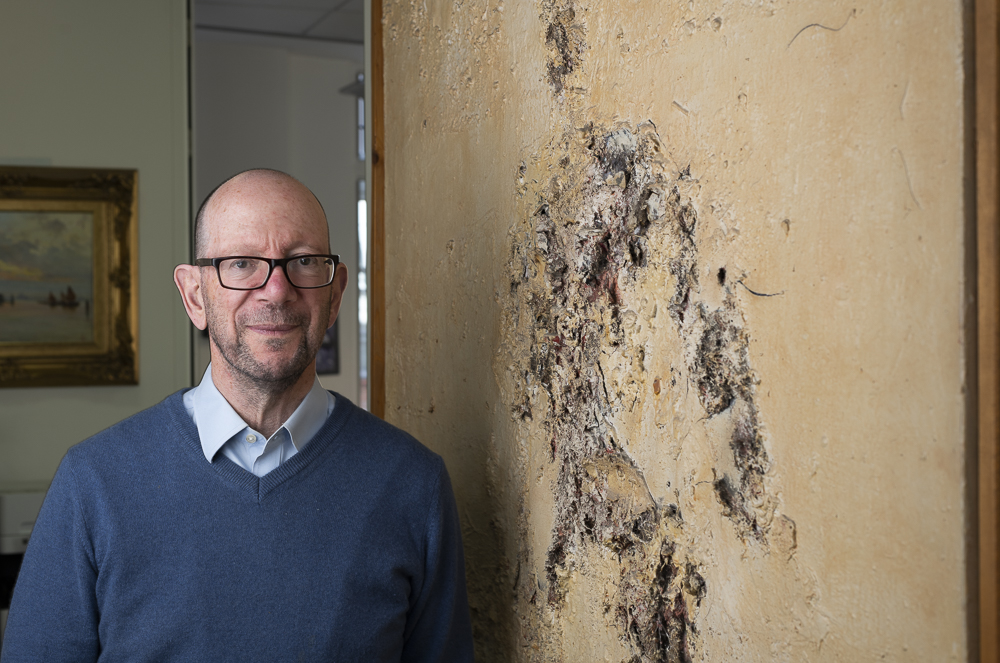
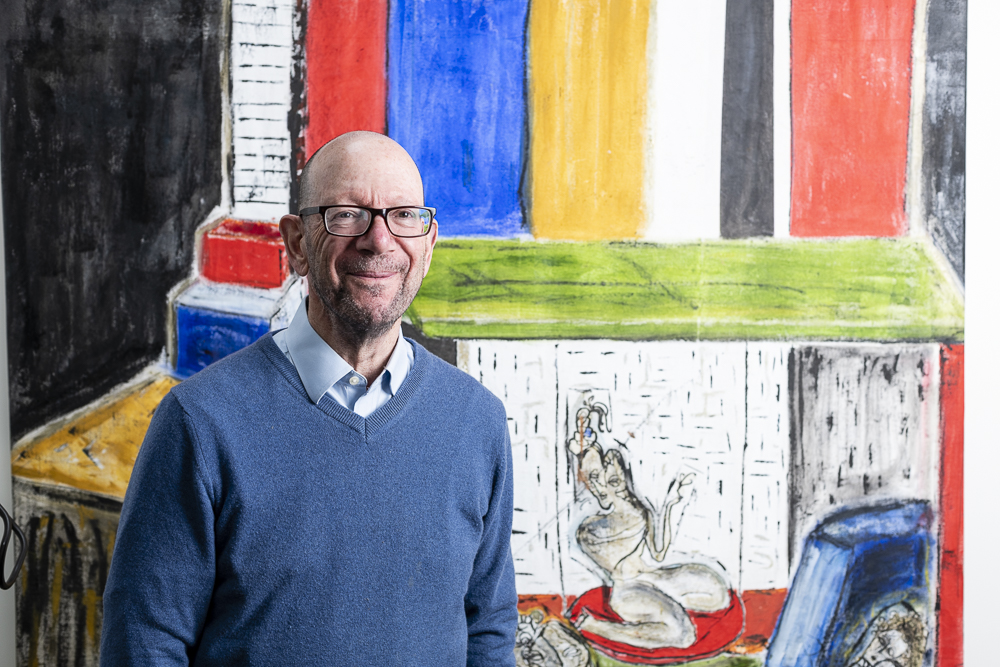
    Christopher Jackson meets divorce lawyer Jeremy Levison, the co-founder of Levison Meltzer Pigott, and finds the art collector on top form

    If I were starting out my legal career again, I’d be a divorce lawyer. But I wouldn’t be doing it specifically for the pay, or for the ringside seat on marital breakdown. I’d be doing it with a more specific intention: I’d be aiming to work in the offices of Levison Meltzer Pigott.

    There again, I’d have a particular reason in mind, other than the quality of the firm. This, incidentally, is beyond question. Jeremy Levison and Simon Pigott (and later Alison Hayes) have been a regular fixture among lists of top family lawyers since founding the firm – their partner Clare Meltzer sadly died in 2003. Even so, I’d be going there for the art.

    Many workplaces have fine art collections. One thinks particularly of Deutsche Bank (‘the art collection probably keeps the bank afloat for liquidity,’ says Levison), and I recall stumbling out of a meeting at UBS once to be standing in front of a sea of Lucian Freud sketches. But Levison’s collection is different.

    For one thing it’s personal. It’s also part of a smaller business and so feels more special. So does he paint himself? “At school, I had no artistic ability whatsoever,” Levison tells me. “A couple of years ago, I went on a two-day oil painting class in Sussex. I absolutely loved it. However, the experience convinced me not to give up the day job.”

    So when did he first start collecting? “It started in the 1970s. I met a chap who was doing prints; he had created a print and I liked it so I bought it. The next major purchase was in 1979. I had a broken heart at the time and there was this beautiful painting of a woman by an artist called ‘Molinari’ in a very ordinary shop window in Rome. That day my worldly wealth was 32 pounds, and this cost me 29 pounds then. I couldn’t resist it, and I still love the work to this day.”

    Over time, art collecting became an aspect of travel. His full success as a solicitor was in the future, and at that time he couldn’t have begun to realise how his collection – which now stands at around 500 pieces – would expand. “Whenever I went away anywhere I would buy a piece of art as the souvenir from that trip,” he recalls. “It just sort of went on from there. I was very fortunate, in that I became friends with someone who came into the office from off the street. He wanted to change his name from Christopher Holloway to Christopher Bledowski. He was not able to pay me, but he gave me a drawing. He was very influential in introducing me to various artists and the infinite creativity of the art world.”

    Bledowski is an intriguing figure in his own right and deserves more attention. Bledowski would kill himself in Switzerland some time later, and Levison maintains that the quality of the work, which he has come to appreciate ever more over the years, might well have led to world fame.

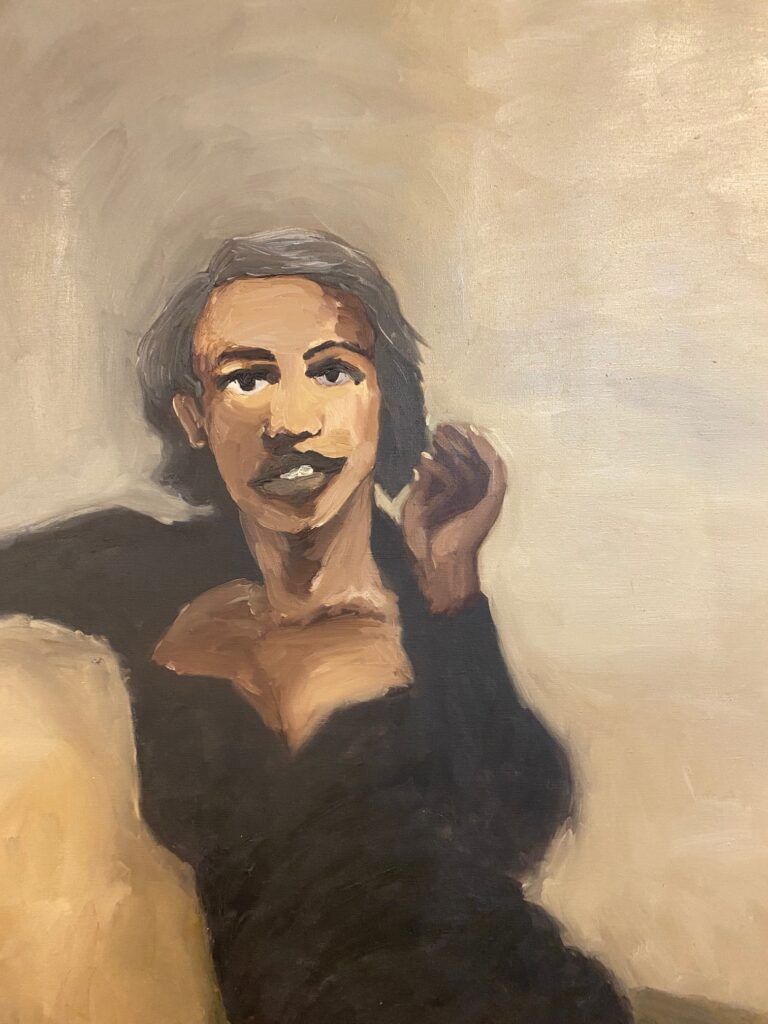
    Lynette Yiadom-Boakye, Case

    But Levison’s art collection is a legacy of sorts for Bledowski. In time, Levison joined the firm Collyer Bristow and his art collecting continued. “We had all these bare walls,” Levison recalls, “and we had lots of artistic clients.  I thought to myself, “Well, why don’t we give the clients an art exhibition on our walls. We did and it was great fun.”’

    The idea of a more formal art gallery at Collyer Bristow was born. This was based on a belief that there is far more talent in existence than the art market – always caught up in the almost random anointing of the ‘next big thing’ – has time to recognise. In fact, Levison regrets the notion of the art market, preferring to talk instead about the art world. “The art world has morphed into the art market,” he explains. “I have a lot of time for the art world, but I don’t worry about the art market.”

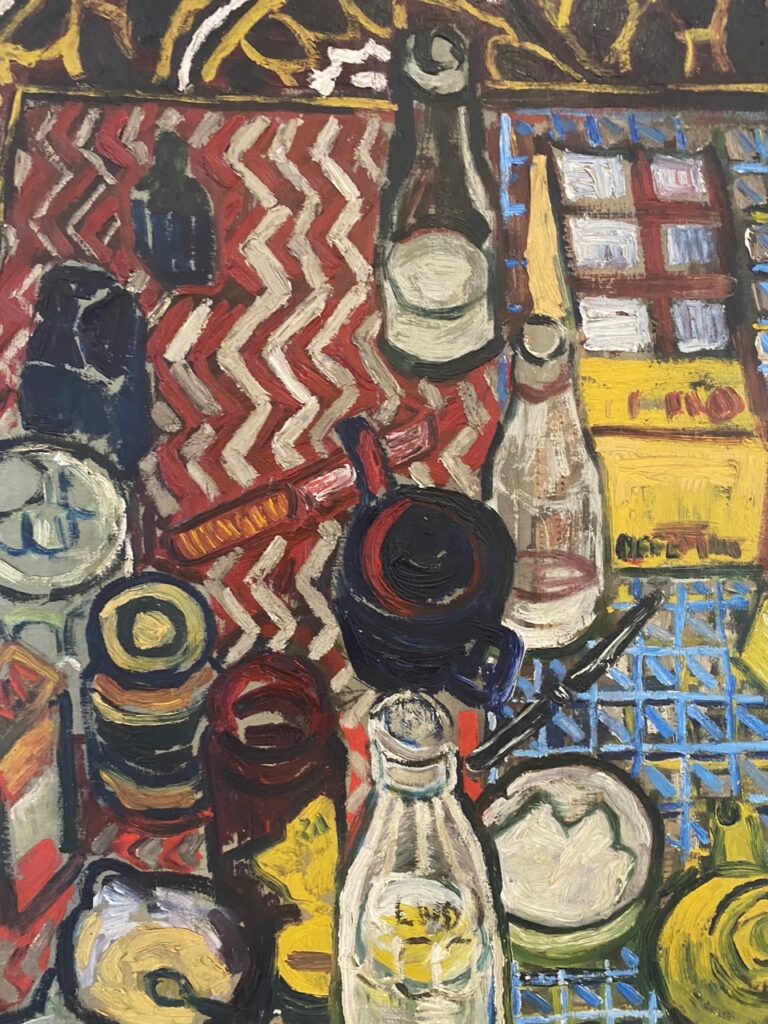
    J. Bratby, Still Life

    It’s this essentially generous estimate of the talents of those who aren’t famous – or in some cases, aren’t famous yet – which informs Levison’s approach to buying art. “I love living with art, so it’s never worried me if a piece becomes valuable or not. If it does, that’s an added bonus, but if it doesn’t, it doesn’t matter in the slightest because of the joy of living with it.”

    There is always generosity at work in Levison’s collecting. “At Collyer Bristow, I thought, ‘Well, we’ve got an acre of wall space here, and within 100 miles of London you’ve got probably 5,000 artists of real talent. Let’s do something to put them together.” The resulting space was a great place to work, and it began to alter the lives of clients and employees. “From an initial sort of quixotic curiosity among the members of staff, suddenly they all became more involved and began to look forward to the various shows. For instance, we had this young secretary and she began to take an interest. There came a time when she found herself needing to make a choice between whether to go on holiday for two weeks in southern Spain or whether to buy this little sculpture. She chose the sculpture. That sculpture over the years will have given her so much more joy than those two weeks of Sangria-fuelled sunshine would have done.”

    For Levison, art continues to be a no-brainer. “At some restaurants in London you can go out to dinner with four of you and it’ll easily cost you £1,000 and we all know how that ends up the next day. Or you can go to any number of artists, and buy any number of works for up to £1,000, and enjoy them forever.”

    So has the pandemic altered his approach to collecting? “Well, the one thing I did do was to buy a much larger house in order to have more wall space. The problem with my collection is that as it’s grown so has my ability to display it, so I lend a lot of it out.”

    I mention that my first stop in New York is always the Frick Collection, just as my first stop in Cambridge is always Kettle’s Yard. Would he ever consider a Levison Collection somewhere in the UK? “I mean my collection is very modest compared to those. But I own this building down in Bermondsey and I wonder whether at some point that might become a home for the collection.  I think my collection is an example that quite a lot can be achieved by someone who doesn’t have a great deal of money.”

    It certainly does. I recall my own training at Stevens and Bolton LLP in Guildford – a perfectly decent firm but notable mainly for its blank walls. To some trainees, especially if you’re not sure if you want to be a lawyer, life at a law firm can seem like the end of the world. I say I hope the staff realise how lucky they are. Levison replies: “I think they do. And the clients love it as well. It gets constantly talked about, and a lot of clients ask for tours around the gallery.” Levison also concedes that it can be ‘quite a useful PR exercise because we can do evenings where outside organisations come in, and I can talk about how the collection came about.”

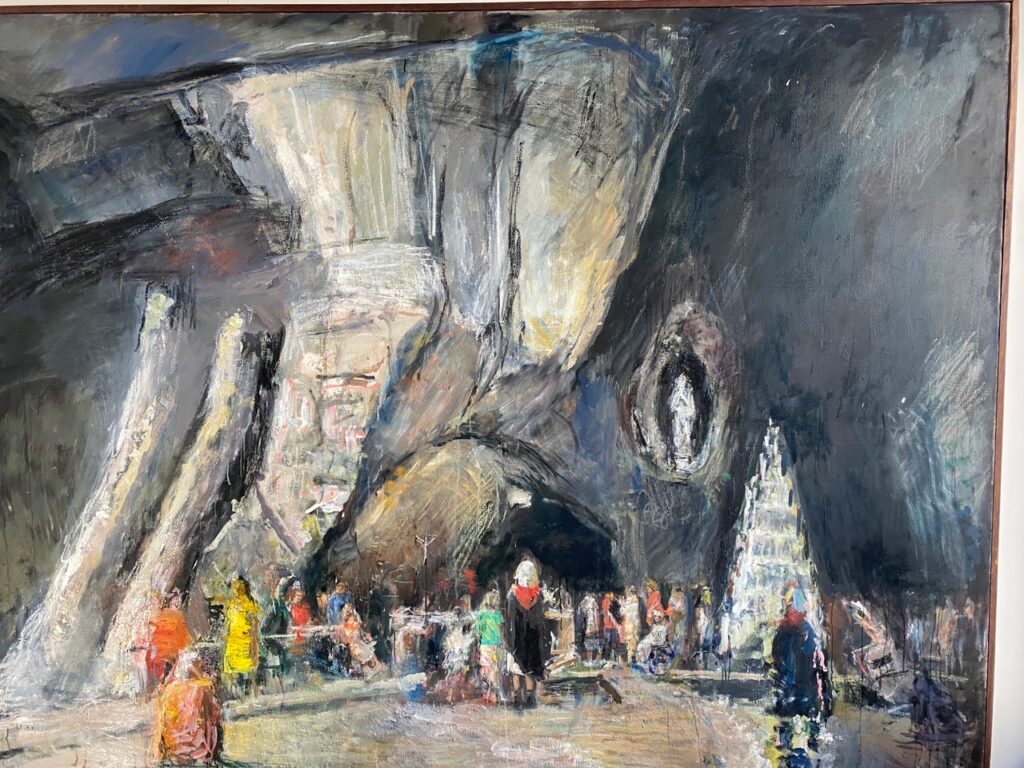
    A. Eyton, The Grotto, Lourdes

    And of course, when you’re getting divorced it must be something to see such a collection on the walls – to know, in effect, that there are other narratives beyond your own, especially if the divorce is contentious.

    Levison laughs. “Yes, I think coming to see your divorce lawyer is ten times worse than going to the dentist. It’s the moment when you’re admitting that your marriage is definitely over. I often think of myself as being, to a certain extent, a doctor. Some just can’t think about anything other than their predicament. But for others, the art collection is a relief – it’s something else to talk about.”

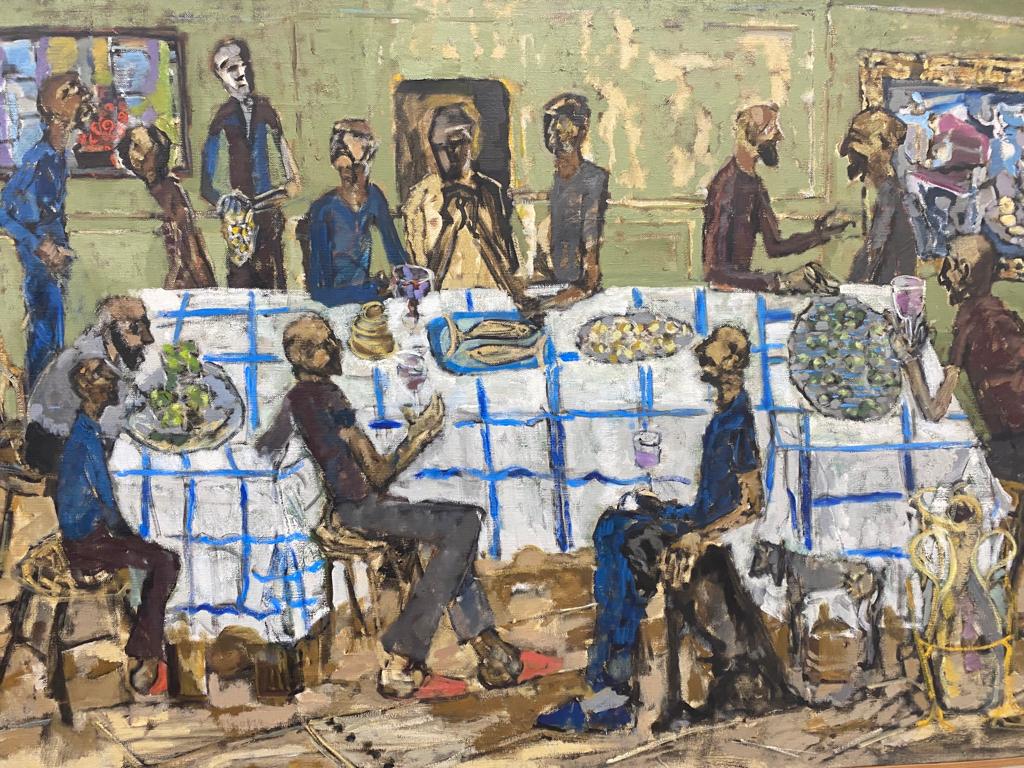
    Conrad Romyn, The Last Supper

    I’ve done the tour many times with Jeremy, but I am always ready to do it again. I happen to know that some of the best works – the Rose Wylies, a Lynette Yiadom-Boakye and a truly wonderful Ollie Epp are now at his new house. But the disappointment of that can easily be met by the fact that what’s here is still remarkable. There’s an Andrew Marr over a photocopier (“I’m not sure how good he really is, but I like it”), a wonderful picture by Anthony Eyton called “Our Lady’s Grotto at Lourdes”, a superb Still Life by John Bratby, various Eileen Coopers, a host of Stanley Spencer drawings, a Last Supper by Conrad Romyn and many, many others.

    With the possible exception of Spencer, Bratby and Cooper, who feature in most surveys of 21st century art, all the artists here deserve more recognition – but each has also met with a superb champion in Levison. As always I return out into the street, not exactly regretting my decision to leave the law, but thinking that things might have turned out differently had I had the good luck to train at Levison Meltzer Pigott.

  • Exclusive with legendary photographer Paul Joyce: ‘We all have feet of clay in the end”

    By Paul Joyce

    When people ask me as a photographer what my tip is, I say, “Follow and chase the light.” It’s a thing my old friend David Hockney told me: when the day is beginning to close and the sun is on the last buildings – go to those buildings. That’s what Van Gogh did. If you look at his early Dutch paintings, they’re dark interiors, and everything’s grim and brown. Then you get the wonderful Yellow Period, and it all changes.

    My subjects vary, but I’ve come to learn that celebrity has its dangers. I remember Elijah Moshinsky, who was a very fine theatre director, and who died of Covid recently, saying of Placido Domingo that he’s totally isolated from the world. Everything was done for him – he’s cut off. He never talked to ordinary people, or mixed with them.

    I’ve always photographed my subjects out of an artistic need. The only commissioned portrait I did was for Condé Nast and was of Ruth Prawer Jhabvala, the writer of Heat and Dust – a wonderful Indian lady. I took one of the worst portraits I ever took in my life and Condé Nast and I agreed it shouldn’t be published. Why was that? It was because I didn’t choose her. Even though I admired her, I couldn’t do anything with that face. You have to have the admiration for the work, and also a sense that the face is going to tell some kind of story.

    So I could never be David Bailey. I have a story of David Hockney being photographed by Bailey. Hockney was told to go to the studio and was waved in and shown his way to a white background. And David Hockney said: “Where do you want me?’ Bailey says: “Against the background.” David stands there. Bailey gives him a scarf and he says, “Make like a bat!’ And Hockney says, “What?” Bailey repeats: “Make like a bat!” And David waved his arms. Click, thank you – and that was it.

    Samuel Beckett was wonderful. I’d tried various careers including banking and estate agency, and not got anywhere. This was before film schools. They were trying to establish a National Film School. Also there was a rogue organisation called the London School of Film Technique which occupied a building in Charlotte Street which subsequently was occupied by Channel Four. The Greater London Council began to give grants, and they’d send you some money to help make films. I sold my MG, my golf clubs, banked the cheque and made a film.

    I’d seen the Royal Shakespeare Company used to do readings rather than full scale productions on a Sunday, and one was by Beckett called Act Without Words II, which was about 15-20 minutes long. I thought it was great, and I set my version on a rubbish dump. I didn’t have the rights to the film. I finished the film and didn’t know what to do. I showed it to Harold Pinter and Pat McGee, one of the great Beckett actors. The word got out to Sam I’d done this, and to John Calder, who was his publisher. They summoned me to Calder’s house.

    I set up a screen and a projector, and I went to Beckett’s Harley Street apartment. I went up, and there in the corner was this figure with a Guinness: Sam. “Oh Sam, this is Mr. Joyce,” said Calder. I set up. Beckett pulls his chair up and sits about two feet from the screen meaning all you could see was his shadow. I started the film, and I was nervously waiting by the projector. I noticed that his shadow was shaking. I thought: “Oh God, he’s seething.” But I went closer and he was laughing – shaking with laughter.

    At the end, he said: “What do you want to do with it?” Calder interjected: “You own it, Sam! This is where you negotiate.” Beckett said: “Well, Mr Joyce, what would you say to 50p?” I said: “Yes”. He said: “Would you like some Guinness?”

    As a frustrated drama director, I turned to photography as a way of surviving. You’re treated suspiciously if you wear different hats. I miss theatre directing – I’d love to do Chekhov now.

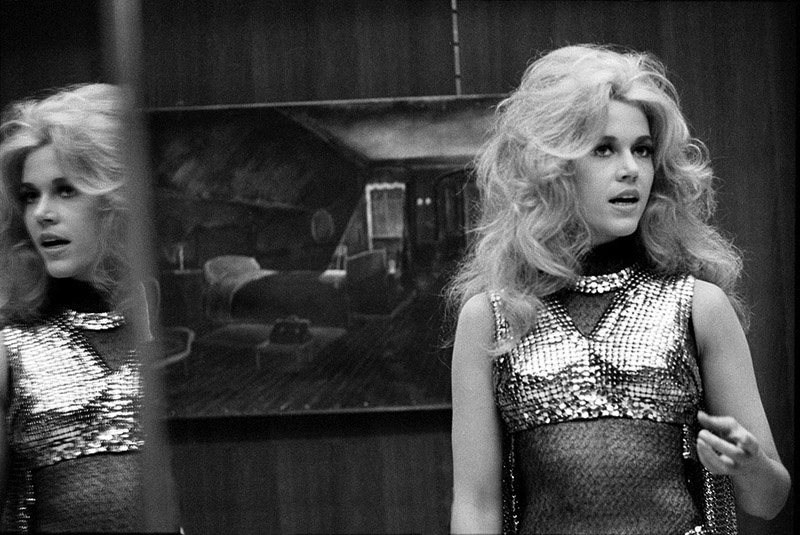
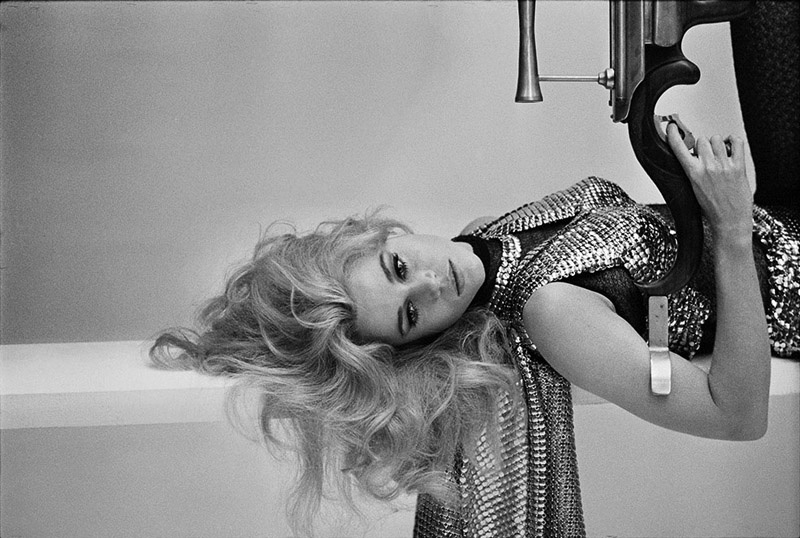
    I think back on the people I’ve photographed and it does seem unreal. Jane Fonda was wonderful. I was a callow youth on secondment to Paramount to do a documentary. I remember the Rolling Stones arrived, and looked like ruffians – that was an eye-opener.

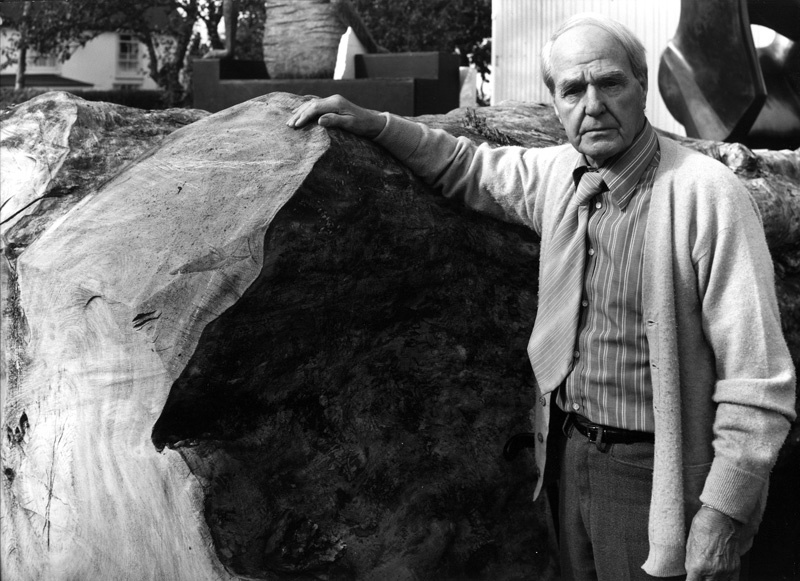
    Henry Moore was a pretty tough, short Yorkshireman. He didn’t suffer fools. He also told me something I never knew: you can’t do decent sculptures in wood if the wood is from a tree that’s died. You have to have fresh, green wood and when I was there, there were huge lorries of wood delivered just for him.  I don’t understand sculpture really. Either it’s realist or it’s not but I suppose you could say the same about painting.

    Quentin Tarantino – we don’t keep in touch now, but I knew him earlier in his career, and he owns one of my paintings. I saw Reservoir Dogs before anyone else. He’s pretty sparky and very opinionated. Years ago, before Groundhog Day became a classic we agreed it was a classic. I think we disagree a bit about the value of such as Bollywood and horror!

    As you get older you realise, we all have feet of clay. There was only one saint I met and that was Cesar Chavez. He represented Mexicans workers who were exploited in gathering the grape harvest. He campaigned long and hard. I met him through Kris Kristofferson who did concerts for Chavez’s cause. He was in danger constantly of assassination. He was disrupting this system of relying on cheap labour.

    We have a need to deify and the need to imbue someone with the power of celebrity. It’s as if we will it on them so we can help them in some way. If they’re not powerful, what’s their use? With artists, they have a vision to transmit which is beyond what we have. It’s not saintliness, it’s not goodness, or grace or anything like that– it’s a vision, a way of looking at the world which changes our own way of looking at the world. Let that be enough.

    I met Johnny Cash through Kris Kristofferson. I never met Dylan. I think he’s one of the great authentic geniuses. I had my doubts about the poetry – but the lyrics are finally amazing poetry.

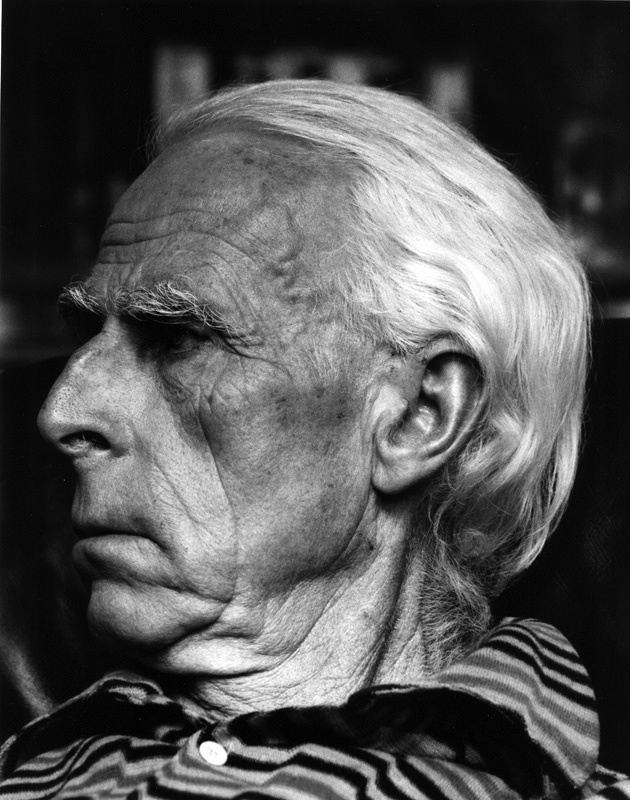
    Spike Milligan I got to know – he was lovely, difficult and mad – as you can see in this photograph. He’d come to dinner and tell us stories about how during the Second World War, they’d paint on the bombs: “Good luck boys, up yours!”

    Jane Fonda
    Henry Moore
    John Piper
    Jane Fonda
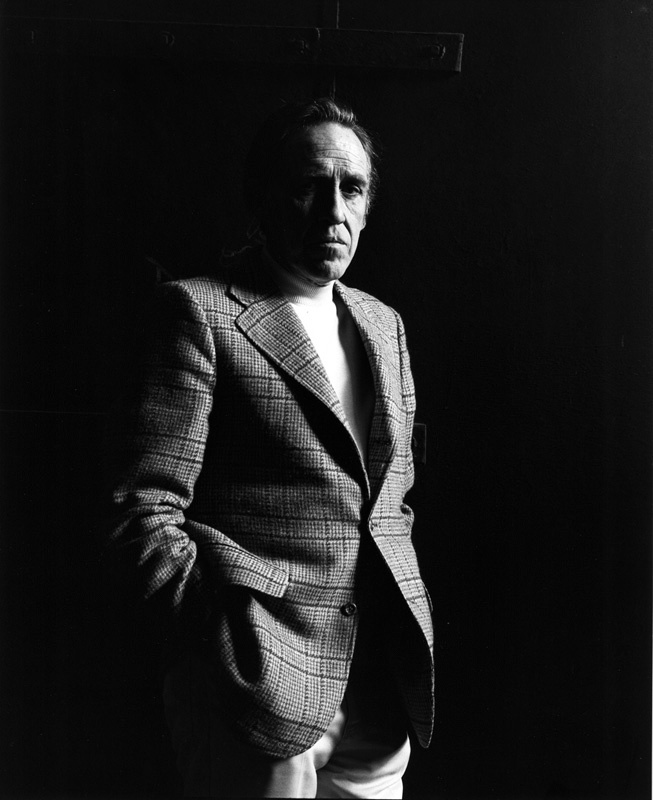
    Jason Robards
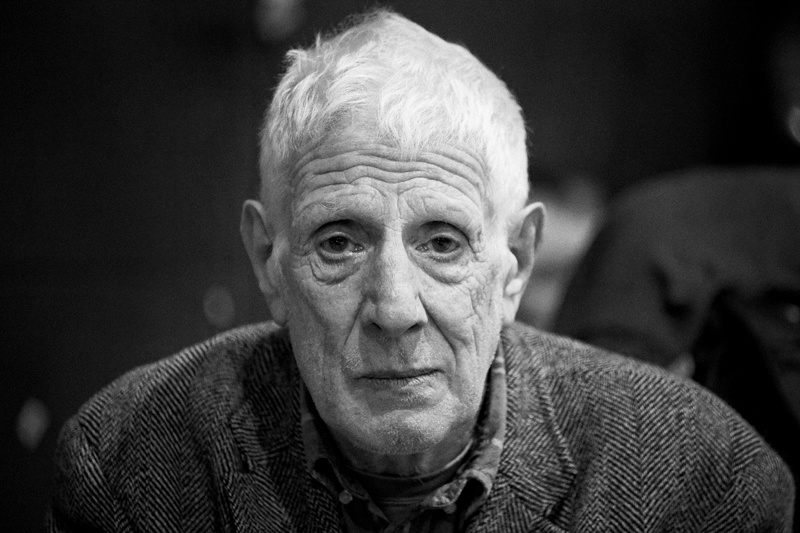
    Jonathan Miller
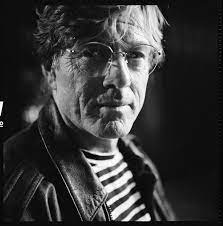
    Robert Redford: “At the 1994 Sundance Film Festival, I asked Robert Redford, its director, to sit for a portrait. I jammed my camera up to his face to get a sense of his middle aged visage. He wanted approval before I released the picture, but he never got it!”
    Dennis Hopper
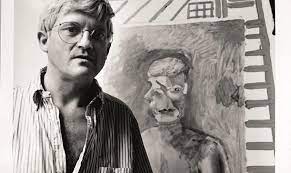
    David Hockney
  • Why poetry must not be demoted on the national curriculum

    Why poetry must not be demoted on the national curriculum

    Has poetry been demoted on the national curriculum? If so what does that mean? And do poets really know anything about work? George Achebe did a little digging 

    When Finito World spoke to former shadow schools minister Margaret Greenwood recently, she recalled an episode during the 1970s, before the national curriculum even came in. Greenwood was teaching a particularly difficult class in secondary school. “It was a real challenge, but then I hit on an idea. I was going to give them all poetry books to read to themselves, and I was going to say: ‘This is a quiet reading lesson’.” 

    It was the sort of inspiration which could be permitted to strike in those comparatively targets-free days. What’s more, it worked – though some of her fellow teachers were sceptical. “I remember one teacher looked at me askance and said ‘You’ll never get them to sit still’,” Greenwood continues. “But I went to the library and got all the poetry books and dished them out and explained that this was what we were going to be doing every Tuesday.” 

    The strategy took time to yield results. “It was fascinating. At first, there was a struggle and a bit of resistance. Then they got into it. We need to let teachers be the professionals they are.” 

    It’s a story about teaching, yes, but it’s also a tale about poetry. It posits the idea that poetry is capable of crossing boundaries, of overcoming indifference – and ultimately that a poem – even a line of poetry – can alter the course of a life.  

    And yet if you look at recent government policy, it seems rather to tend in the opposite direction. It began with a storm last year – in the world of poetry, a storm usually amounts to a single article in The Guardian. In this case – a measure of the seriousness of the issue – there were two articles in The Guardian.  

    The cause of the storm? This was to do with Ofqual’s decision to make poetry optional at the GCSE level. The ruling states that for this year students must compulsorily take a paper on Shakespeare, but that they can choose two out of three from the 19th-century novel, a modern drama or novel, and poetry. Poet and teacher Kate Clanchy summed it up: “For the first time, poetry is a choice.” 

    The indignation – in Clanchy’s article, and also evident in a similar piece by poet Kadish Morris – was open to some objections. In the first place, Shakespeare is nothing if not a poet – and has for five hundred years proven a pretty good ambassador for poetry. Meanwhile, much modern drama – especially TS Eliot – deals in verse, and its prose dramatists – one thinks of Pinter and Beckett – tend to be poets as well. So it wasn’t quite the dagger through the poetic heart which it was reported as. 

    Secondly, teachers are, of course, able to teach poetry anyhow regardless of what Ofqual says. When I spoke to a secondary teacher friend, who asked not to be named, she said, “It’s not like my children aren’t exposed to poetry; they are. All this sort of thing does is demoralise teachers.” 

    When Finito World approached Ofqual for an explanation, a spokesperson further explained that the changes are temporary and “designed to free up teaching time and reduce pressure on students”. In other words it’s a specifically pandemic-based change, which should be repealed once we return to normal. Even Clanchy seemed to admit this in her article: “Plenty of teachers will stick with the poems, especially if they’ve already studied them,” she wrote. 

    In addition to this Ofqual pointed out to us in their statement, that exam boards retain the freedom to add to the common core if they wished. Meanwhile, the Department for Education didn’t reply to our request for comment.  

    So is the whole thing a storm in a teacup? Well, not quite. In the first place, Clanchy surely has a point when she draws attention to a double standard: “The content of double science – the popular three-in-one science GCSE – is presumably also, as Ofqual says of poetry, difficult to deliver online, but Ofqual isn’t telling teachers they can pick between chemistry and biology next year providing they stick with the physics.” 

    It’s a reminder that this decision feeds into poetry’s worst fears about itself – about its sliding into irrelevance. This is probably misplaced: when we have a funeral or a wedding – that is, when we really want to say something important to one another – we tend to reach for the music and springiness of poetry ahead of prose. That will probably always be the case.  

    But there wasn’t a similar storm over the optional nature of drama or the Victorian novel to quite the same extent. In the first instance, in an age of theatres closing, drama writers are more concerned about their works being put on again than they are about their texts being studied. And the Victorian novel, regularly adapted for film, seems invulnerable.  

    Poetry is different; it feels fragile. As Alison Brackenbury, one of our greatest living poets told Finito World: “Many people only know – and value – those poems which they encountered at school, especially if they learned them by heart. If they don’t come across poetry which appeals to them in their curriculum, the one chance may be gone.”  

    The Chair of the Education Select Committee Robert Halfon MP also expressed his worries: “In some ways what the government has done is understandable because of Covid. There are worries that with the Fourth Industrial Revolution 28 per cent of jobs might be lost to young people by 2030, and so the curriculum has to adapt and change.”  

    But then Halfon pauses, thinks and delivers his verdict: ”Having said all that, poetry and literature are one and the same. In my view, you can’t promote one over the other.” He is also uncertain over whether it’s really such a temporary thing. “DfE is saying this is a temporary measure, and it’s designed to help take the strain off pupils because poetry is perceived as difficult. But temporary measures can become precedent and poetry trains your mind in a very different way. If this becomes permanent it would be very worrying.” 

    It can seem to some that since the hyperactive tenure of Michael Gove as Secretary of State for Education, aided and abetted by Dominic Cummings that “English has been shrunk, confined and battered into rote learning and stock responses,” to use Clanchy’s phrase. 

    Halfon agrees: “Culture has an absolutely important role, not just in the economy but in our society and shaping our lives. It’s not just good for our learning – it’s good for our mental health, and it’s good for expanding our horizons. We don’t want to be a society of Gradgrinds where all we want is facts.” 

    Halfon is reminding us that just at the moment when we are all looking at our mental health, the government appears to be demoting the branch of human affairs most designed to improve it. 

    Christopher Hamilton-Emery, the poet and former director of the immensely successful Salt Publishing adds that the question of poetry’s status on the curriculum is relevant also to the increasingly discussed area of social mobility: “There’s a wider context to this and that’s the way kids come into contact with poetry, or orchestral music, or ballet, or opera, or theatre. In this sense, education is the gateway, the space that gives permission to children, and in this context there’s a political and egalitarian component to this debate around poetry.” 

    But Hamilton-Emery adds, only half-jokingly: “I also recognise that poetry is a pain in the arse. Yet it’s meant to be awkward, tricksy, resistant to authority, dissonant – things that are hard to teach and accommodate, things that can’t easily be measured or controlled. Poetry provides a critical citizenship and, I think, helps form the unity of the person and offers a living communion today and indeed through history.” 

    This goes to the heart of the matter – the sense that the Conservative party represents authority, and that poetry is somehow being punished for being anti-establishment. Of course, these sorts of generalisations can never be the whole truth – even if there is often some truth in them. You could probably make a case that from Philip Larkin and WB Yeats to TS Eliot and Ezra Pound, there were more ‘great’ right-wing poets in the 20th century than among their left wing counterparts. 

    And yet one wonders whether there is a sense in which in our technology driven, factual lives we have ceased to credit marvels and insodoing come to see poetry as somehow wishy-washy, and even insufficiently grounded in the commercial. Tishani Doshi is a world famous writer and dancer who continues to make poetry the centre of her life. She speaks revealingly of the poetry and the administration sides of her being: I studied business administration and communications before ditching it for poetry, so I can get around economics and accountancy alright, but that’s not to say I thrill in it. I move in waves. Sometimes I’m terribly productive about everything – to-do lists and all. Other times I want to be left alone to watch the flowers.” 

    It is this idea that the government no longer wants us to watch the flowers which riles people so much when this kind of decision is made. But Doshi is adamant that we need a more nuanced conversation: ‘One of my first jobs was to teach an introduction to poetry and fiction class to students at Johns Hopkins University. It was a required class, most of my students were pre-med or engineering. I like to think as a result that in future dentist waiting rooms, there may be a volume of Elizabeth Bishop lying around, or that someone designing a bridge might dip into the poems of Imtiaz Dharker for inspiration.” 

    Halfon agrees: “My reading goes into my subconscious. It helps me when I’m writing articles – I may think of things and quote things and use metaphors. It just infuses my thoughts and the way I think. Something permeates like a beautiful stew that’s been cooking for a long time – and it always tastes much nicer on the second or third day of eating it.” 

    Doshi adds: “I don’t know what the UK government’s motivations for demoting poetry are, but I hope usefulness was not a factor. Everything is connected. I can’t imagine any kind of life that doesn’t need the intuition and imagination of poetry.” 

    WH Auden once wrote that ‘poetry makes nothing happen’, adding that it ‘survives in the valley of its being said, where executives would never want to tamper.” And yet in being so lofty it has made itself vulnerable to demotion.  

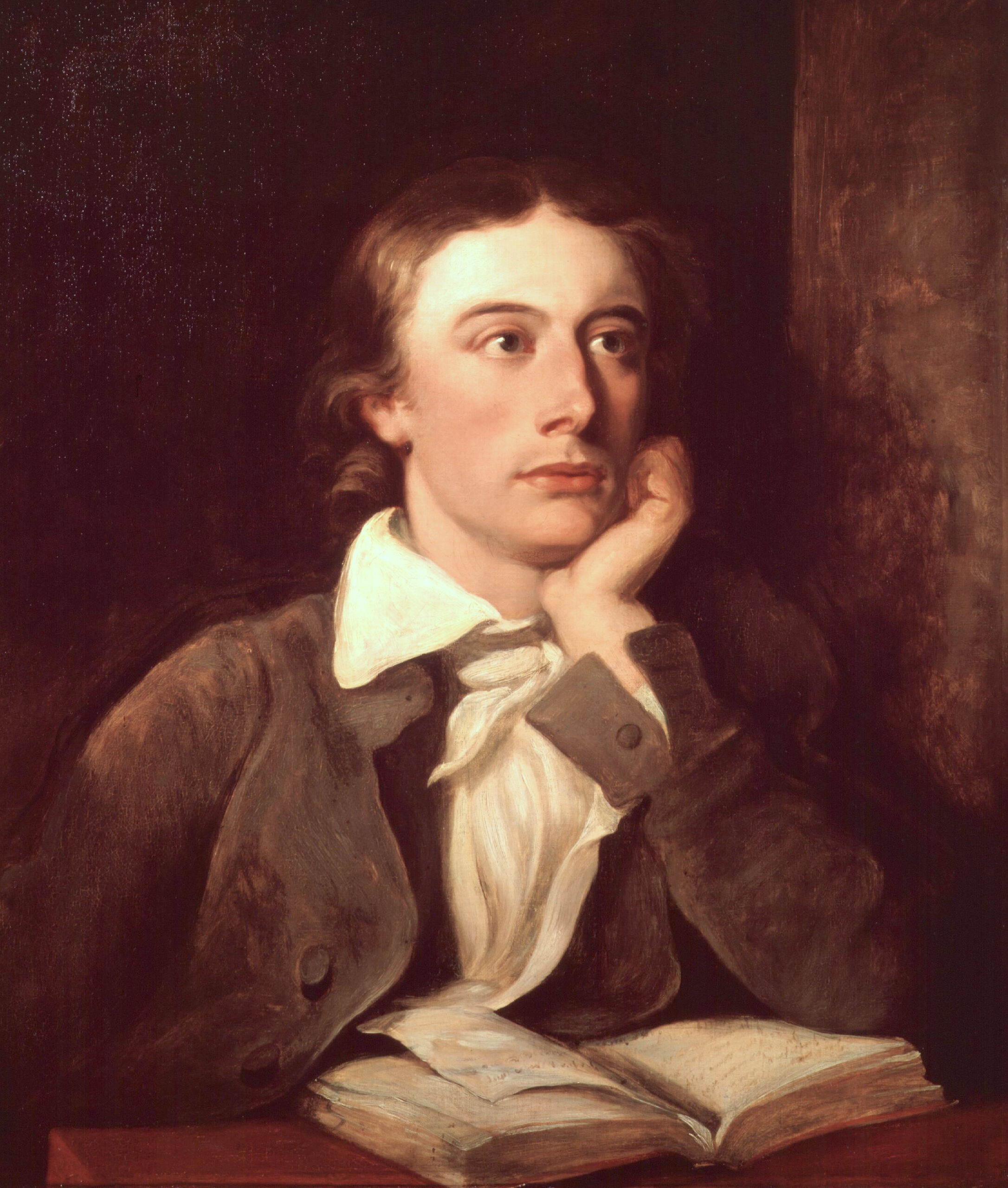
    Yet the poets one meets tend to be tougher than you might think – they cannot afford to be Keatsian and head in the clouds. They have to work. We’ll update on progress in a subsequent issue.  

  • David Hockney at the Royal Academy: ‘Get Up and Work Immediately’

    David Hockney at the Royal Academy: ‘Get Up and Work Immediately’

    Robert Golding

    There is a story that David Hockney tells often about being a young film enthusiast in Yorkshire, watching black and white Laurel and Hardy movies. Seeing the long shadows, he realised that Los Angeles, where they were filmed, must experience a lot of sunshine. Accordingly, he resolved to go there. 

    Today, Hockney is still enthralled by light – as you can see in the tree house picture with which this article is illustrated. Here is something like that same light which attracted the young Hockney, still attracting him at the age of 83. But this isn’t Californian light – it’s the light of Normandy, at the house called La Grande Cour, where he has lived in isolation since 2018 with his lucky assistants Jean-Pierre Gonçalves de Lima, known as J-P and Jonathan Wilkinson, together with his dog Ruby. 

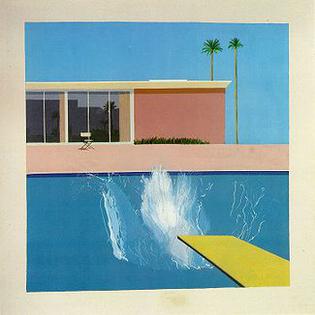
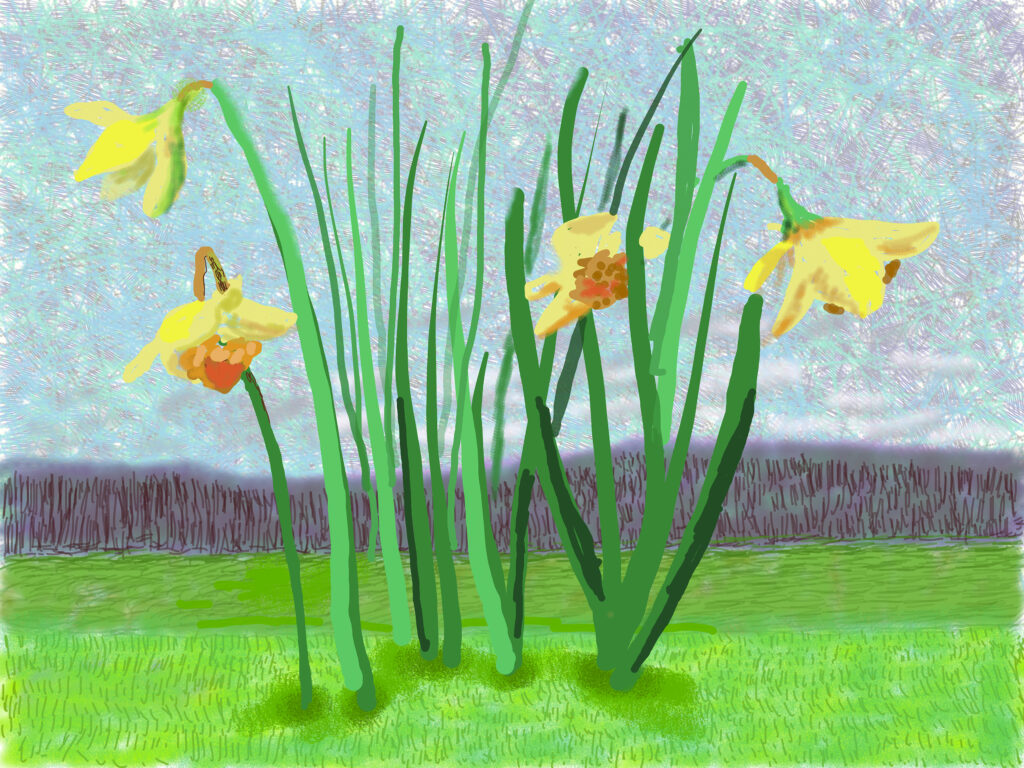
    And, of course, unlike the images of California – such as 1967’s A Bigger Splash, for which he is still most famous – Hockney’s new works are not essays in paint but drawn on the free Brushes app on his iPad. The layered nature of paint has been replaced by marks which bear – perhaps a little too obviously – a digital mark: the dots, the pixelly sky. 

    “Ratified by time and the art market, David Hockney has never been one to mind what people say about him.”

    To move forward but to stay the same – as with his hero Picasso, Hockney’s way of seeing is always his, no matter how much his method might be bound up in new technologies, and advances in his own understanding of what makes art. 

    Hockney’s A Bigger Splash remains his most famous picture

    The eye always remains forensic and supremely confident – ratified by time and the art market, David Hockney has never been one to mind what others say about him. Right now that’s probably a good thing as the art world has rounded on him for his Piccadilly Circus tube sign, drawn with a whimsical humour which looked to struggling artists like cosy facetiousness – the ‘s’ in ‘Circus’ dropped off the end, the gag somewhat too easy, like someone used to having his jokes laughed at by acolytes. 

    Hockney’s new work has been much derided on the Internet (GLA)

    The Royal Academy exhibition The Arrival of Spring hasn’t been particularly well-received either. It’s doubtful that the criticism will affect the supremely confident Yorkshireman. A contrarian spirit seems to replicate itself in many successful people. This is so with Hockney, whose love of life appears to begin in a healthy contempt for all do not share it, and who prefer to conform. ‘Boring old England,’ was his famous reasoning for leaving his home country for LA in the 1960s.

    To study Hockney’s life and his art is to get to know the benefits of particular kind of bluff decisiveness. The octogenarian has always known his next move – or found it materialise it before him as a thing to be straightaway acted upon. 

    In Paris in the 1970s, he realised too many people were visiting him and that he wasn’t getting enough work done – keenly alive to the danger to his productivity, he straightaway upped and left. When he stayed on in England after Christmas in 2002, he realised that he had been missing the seasons of his native Yorkshire, and rearranged his life to take advantage of it.

    Here he is describing the move in 2013’s A Bigger Message: “I began to see that that was something you miss in California because you don’t really get spring there. If you know the flowers well, you notice them coming out – but it’s not like northern Europe, where the transition from winter and the arrival of spring is this big dramatic event.”

    “I began to see that that was something you miss in California because you don’t really get spring there.”

    David Hockney

    Then just before lockdown, came another example of the Hockney decisiveness: during a brief visit to Paris, he realised that Normandy attracted him sufficiently to be worth moving to. Here he is telling the story to Martin Gayford in the pair’s excellent collaboration Spring Cannot Be Cancelled: “It happened like this. We travelled to Normandy after the stained-glass window at Westminster Abbey was opened. We went through the Eurotunnel, via Calais. We stayed in this lovely hotel at Honfleur, where we saw this sunset.” In time, J-P was dispatched to an estate agents: “When we came in and saw the higgledy-piggledy building and that it had a tree house in the grounds, I said, ‘Yes, OK – let’s buy it’.” 

    “This house is for David Hockney and he wants to paint the arrival of spring in 2020, not in 2021!”

    Fame had come for Le Grand Cour – destined no doubt to be a tourist attraction to rival Monet’s lily pond at Giverny. Of course, this freedom is partly the freedom of the immensely successful.

    David Hockney “No. 118”, 16th March 2020 iPad painting © David Hockney

    In Gayford’s telling of the house purchase, the sense of Hockney’s importance is evident when J-P is quoted as saying impatiently to delaying builders: “This house is for David Hockney and he wants to paint the arrival of spring in 2020, not in 2021!” One senses that he has surrounded himself with the right people; Hockney has the gift for friendship and loyalty. This hasn’t necessarily always been to the good: there are signs in The Arrival of Spring that a certain cosiness may finally have seeped into his work to its detriment.

    Certainly the current exhibition which has been widely panned in the media, except by his friend-reviewers such as Jonathan Jones of The Guardian and Martin Gayford at The Spectator

    So are the negative reviews fair? Undoubtedly some of them are written with the pantomimic disdain which journalists sometimes level at people who have become more famous than them. One example would be the overdone headline in City AM: “I hate these paintings in my bones.” If we look at a painting this way, what emotion do we have leftover for atrocities of war?

    David Hockney “No. 316”, 30th April 2020 iPad painting © David Hockney

    Besides, in among the sameiness, there are magnificent images here. I was taken particularly by a sequence of images of the sun rising over the slopes that surround Hockney’s new home. Hockney has rightly objected to the idea that you can’t paint a sunrise or a sunset by pointing out that such things ‘are never clichés in nature’. Here we see the old cliché of the yellow orb with tentacles of yellow seeping out of it rejuvenated to some extent: there is a lovely passage where the tree in the foreground takes the red of the sun, and becomes aflame with red, like something Moses might have seen. 

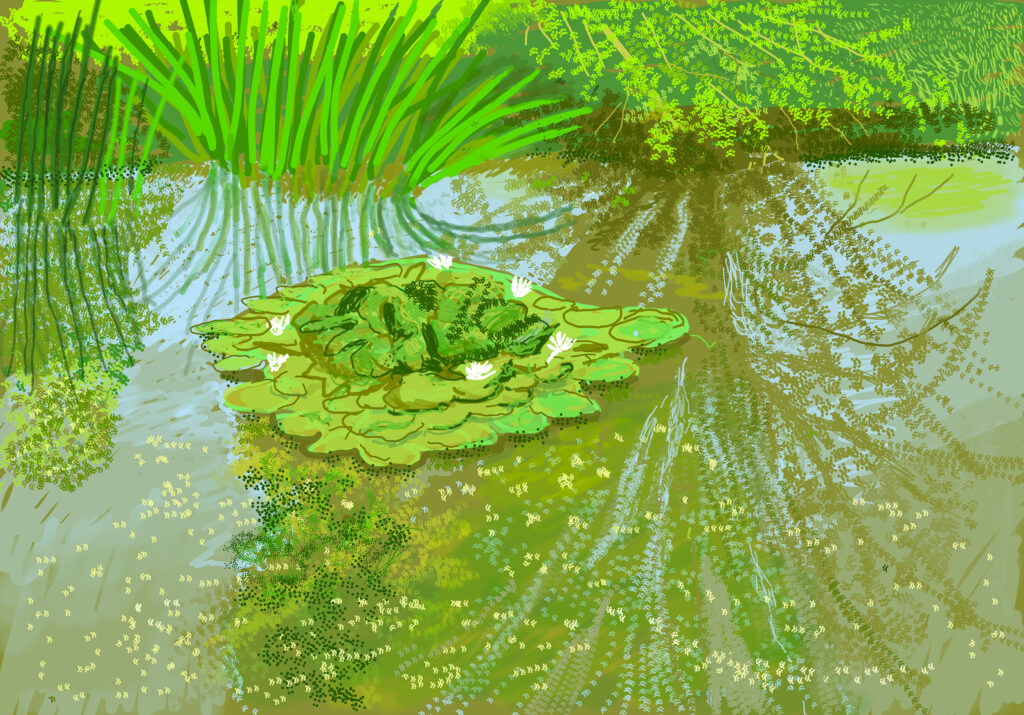
    There are other such moments – especially where Hockney reminds us that the iPad is especially good at handling complexity of space. One such example is No. 340 (see below) which directly recalls – and in recalling, competes with – Monet.

    It’s worth restating that Hockney is an intensely competitive artist – his career is a reminder that there is nothing wrong with that. Once we have decided what to do, we may as well attempt to do it as well as anyone has ever done it before. The attempt may fall short, but will likely provide us with the energy we need to do our best. 

    An exhibition I attended at the Dulwich Picture Gallery in 2014 called David Hockney, Printmaker, showed him wholly able to assimilate Japanese pictures – Hokusai is another hero of his – and he remains an essentially competitive artist: the 2012 exhibition A Bigger Picture– also at the Royal Academy, was a direct challenge across the centuries to Paul Cezanne. 

    David Hockney “No. 340”, 21st May 2020 iPad painting © David Hockney

    Besides, in this instance, Hockney doesn’t fall short. The entire picture is sumptuous, an act of deep and respectful noticing – to hate this in one’s bones would be in the regrettable position of hating life to one’s bones. Especially good are the dots in the bottom left, where three or four kinds of reflection are rendered alongside water and things which might be bobbing on the surface. This is done all at once with great joy and even bravery.

    Nobody with any sense would claim that Hockney can’t draw a face…it’s just that here he’s chosen not to

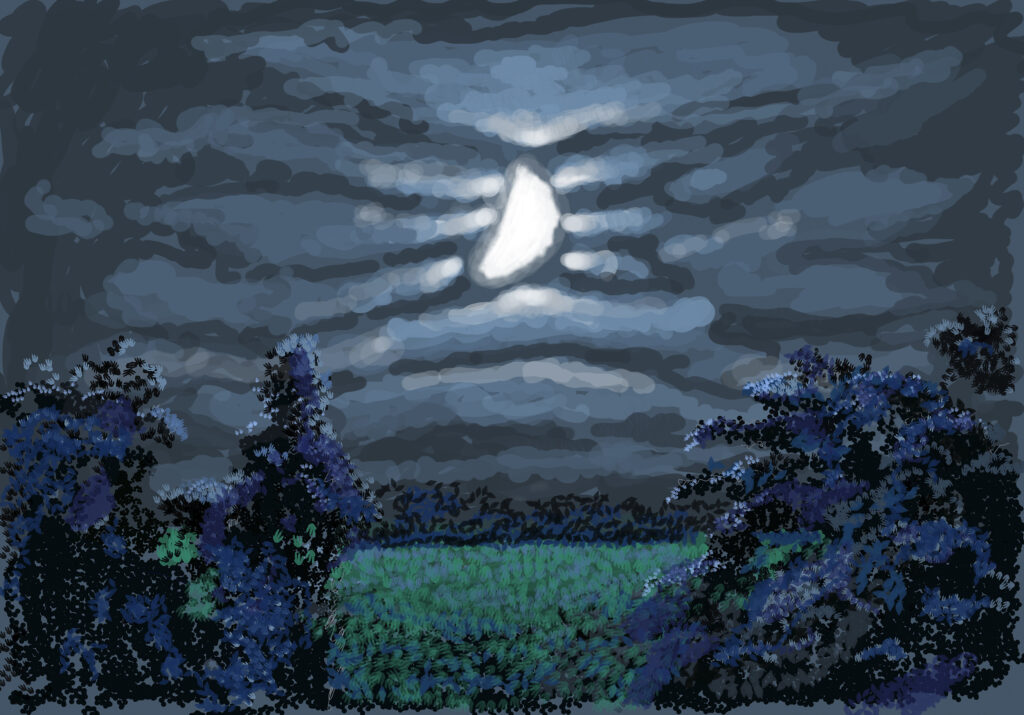
    There are other virtues to this exhibition. The iPad – as Hockney has pointed out – is very good for immediacy. There is no need to set up materials, instead you can simply get drawing – as in No. 370 beneath. This picture has its literary antecedent in Philip Larkin’s poem ‘Sad Steps’:

    Groping back to bed after a piss
    I part thick curtains, and am startled by
    The rapid clouds, the moon’s cleanliness. 

    Here Hockney, doing the same, is equally startled – and again, what’s good is the journey of the moonlight through the clouds onto the edges of the bushes. We are told here that moonlight on a dark bush isn’t moon-coloured – it’s actually a kind of turquoise. We are also shown how moonlight doesn’t quite get in between all the way into the bushes; the image is a precise assessment of moonlight’s force and power. Even the most radiant nights have numerous hiding-places. 

    David Hockney “No. 370”, 2nd May 2020 iPad painting © David Hockney

    But there are problems with the exhibition too which one’s admiration for a lifetime of extraordinary achievement cannot quite oust. Samuel Johnson once wrote that a book that’s fun to write cannot be fun to read. When considering what might be wrong with The Arrival of Spring, Johnson’s remark is a useful place to start. 

    ‘I think I am in a paradise,’ says Hockney to Gayford in Spring Cannot be Cancelled. While these images have rightly been praised for their exuberance, they remind you a little too much that Hockney is happy. The compositions are too often simplistic, and I am a little confused, having loved the accompanying book, that there isn’t greater diversity of subject matter. In the book, we see images of the artist’s foot, and of his iPad which would have made for a less repetitive exhibition.

    Falsity in art can sneak in with terrible proclivity

    Furthermore, the image contains not a single face. This isn’t because Hockney can’t do it – nobody with any sense would claim that Hockney can’t draw a face; in fact he’s probably the best draughtsman alive. It’s just that here he’s chosen not to. It might be that he has decided that spring is his subject – but if so, he needn’t have excluded the rest of life around him. We experience spring in relation to other people – as we’re almost tired of learning, in our little locked down bubbles.

    Perhaps the timing of their composition might also have made them age more. They were no doubt begun in a more contrarian spirit during the beginning of lockdown than we can now recall, full of a defiant desire to show the world that there are worse things than being circumscribed to just one place. 

    David Hockney “No. 259”, 24th April 2020 iPad painting © David Hockney

    But falsity in art can sneak in with terrible proclivity. As an example, Larkin’s poem ‘Sad Steps’ spins to a false conclusion, about how youth cannot come again but is ‘for others undiminished somewhere’. It is a crystalline poem of marvellous technical brilliance reaching the wrong idea – because if youth is indeed irreversible then it is diminished for everyone everywhere all the time. The poet isolates himself in a bogus despair.

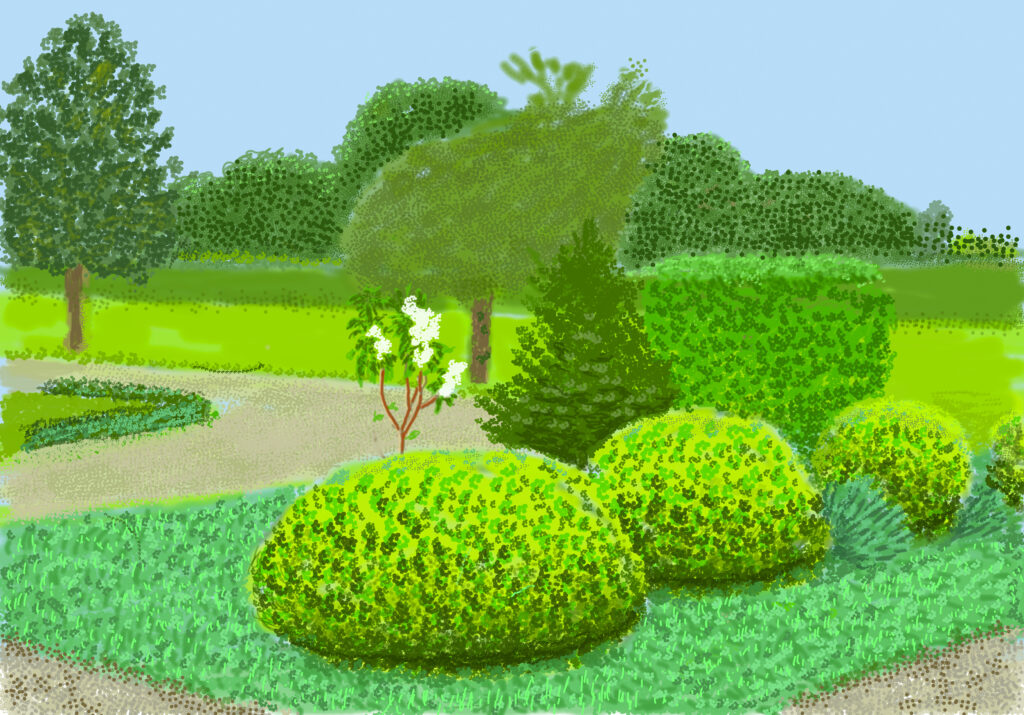
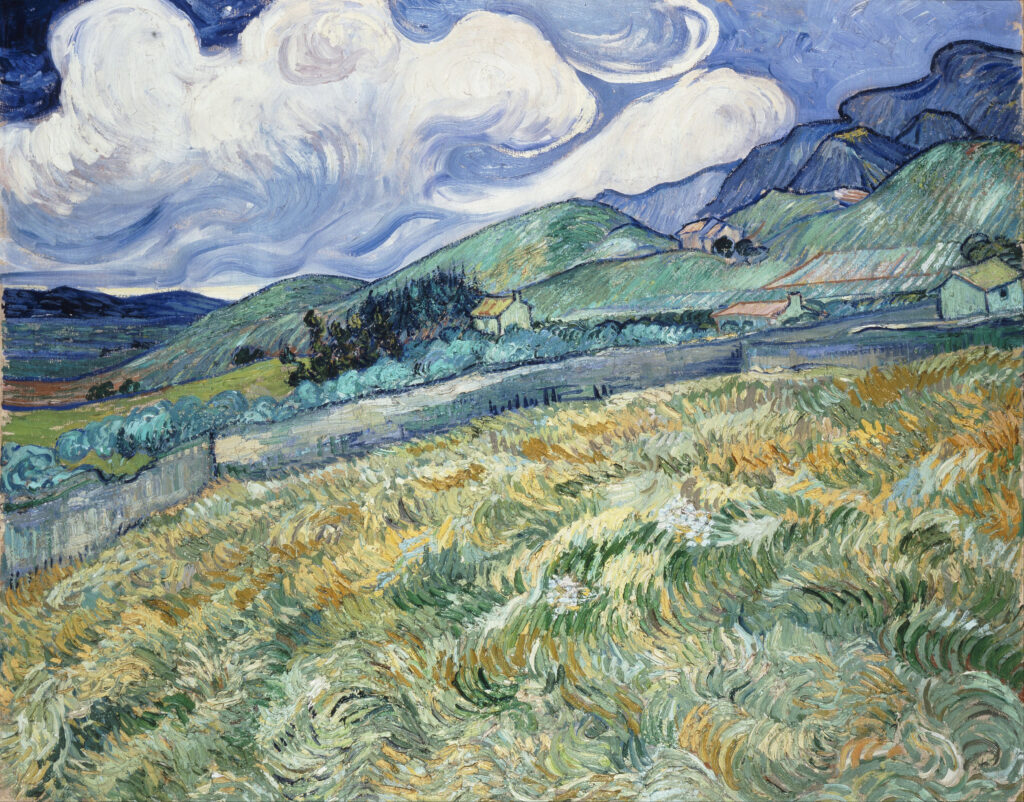
    Hockney may perhaps be making the opposite mistake – readers of his History of Pictures (also produced with Gayford), may finish the book still in the dark as to why he makes them, besides the pleasure of being good at making them. Certainly, these images sometimes feel ultimately untethered from meaning, or perhaps insufficiently urgent in their pursuit of truth. Look at No. 259, for example, and then look at any Van Gogh – whom Hockney is also ostensibly competing with here.

    Van Gogh’s Landscape from Saint-Remy (1889)

    In the Van Gogh you’ll find that things are never quite the colour to Van Gogh as they are to you – and your sense of the world is accordingly changed utterly. In Hockney, except for the few passages of painting I have isolated, they are almost always the colour you expected them to be. They look very very green. Hockney is as exuberant as Van Gogh, but Van Gogh is more alert to what the world actually looks and feels like, and so is the greater artist, and sometimes by a long distance.

    This brings me to a bunch – namely, that there’s a slight sense that Hockney may not have avoided the dangers of sycophancy in those around him. He has always been very good at self-editing but I wonder if this business of sending his drawings out to his friends – among them Martin Kemp, Gayford and Jones – has led to the creation of an echo chamber and a slight diminishing in standard. Gayford is a brilliant critic and writer, but every page he writes with Hockney breathes his excitement at being in the great man’s company. Such people do not tend to tell you when your game has dipped. 

    Exuberance, in short, isn’t enough in itself. You have to have setback, difficulty, and vexation. We might distinguish between intense and casual exuberance, with Van Gogh in the former category, and Hockney – at least in The Arrival of Spring – all too often in the latter.

    And yet this exhibition is still worthwhile in that it shows a worthy intention – to show the spring and to capture its beauty. Hockney’s career is a reminder to all of us as to what can be achieved if we find what we love, and work hard. Back in the 1960s, Hockney had a note next to his bed which read: ‘GET UP AND WORK IMMEDIATELY.’ If nothing else, this exhibition is a reminder of the tremendous grace of hard toil. And if you wish he’d sometimes worked harder to challenge himself then that only reinforces the lesson. 

    David Hockney’s The Arrival of Spring is at The Royal Academy from 23rd May until 26th September

    Spring Cannot be Cancelled by David Hockney and Martin Gayford is published by Thames & Hudson priced £25.

  • Inside NFTs: the concept taking the art world by storm

    Inside NFTs: the concept taking the art world by storm

    Thomas Flynn

    For most people in the UK, the letters NFT used to refer to the National Film Theatre on the South Bank of the Thames. Now they stand for something entirely different — so-called Non-Fungible Tokens.

    If that term means almost nothing to you, don’t worry. You are not alone. However, you may be interested to learn that NFTs are currently taking the art world by storm (as well as the music and sports industries) and are very likely to remain an important concept in the future right across commerce and culture. 

    So let’s try and explain.

    Fungibility is a term from economics, but stay with me for a moment. A five or ten-pound note, or a dollar bill, are fungible. A painting by Banksy is non-fungible. So if I lend you a fiver, when you give it back to me a week later I won’t mind if the five-pound note you give me isn’t the same five-pound note I gave you a week ago. As long as it’s a legitimate five pound note, I’ll be happy.

    However, if I lend you my Banksy painting and a year later you give me back a different Banksy painting, I might not be too happy. That’s because unlike paper money or metal coins, paintings are Non-Fungible. 

    Three or four years ago, the only people who were familiar with Non-Fungible Tokens were people from the tech world of computers and so-called crypto-currencies (digital money). And that’s another concept that’s making a big impact. 

    In essence, a Non-Fungible Token is simply a piece of computer code — a string of alphanumeric symbols (known as a ‘hash’) of the kind that sits invisibly behind a computer image such as a JPEG, a Gif or a TIFF. 

    In the ‘real’ world, if I buy a painting at an auction or from an art gallery, I can walk away with the painting after paying for it. I now own it. Unlike a ten-pound note, that painting is a unique object that belongs to me and to me only, until I decide to sell it. 

    Yet only a few weeks ago, a JPEG of a computerised work of graphic art by an artist who goes by the name of Beeple, was sold for $69.3 million dollars at Christie’s auction house in New York. The person who bought it didn’t buy the graphic art; they bought the algorithmic code that sits behind the image on the computer. That computer code is the NFT. It means that the person who bought the NFT of Beeple’s work of art is the sole owner of it. The NFT guarantees their ownership, now and forever, or until they decide to sell it. 

    The actual computer graphic (or in the case of sports memorabilia, a baseball card, for example) is a separate thing from its NFT. You can find a JPEG of Beeple’s actual work of art on the web right now if you bother to Google it. The work is called Everydays: The First 5,000 Days. You can even download it onto your computer if you wish, but you won’t own it in any meaningful sense. The true owner of it is the person who bought the NFT of it — the computer code, or hash. In the case of the Beeple, that person happens to be Vignesh Sundaresan, a Singapore-based blockchain entrepreneur and investor who goes by the name of Metakovan (pseudonyms are all the rage in the tech world.) As it turned out, he’d been prepared to pay even more than $69.3 million, so that perhaps indicates how seriously he takes this new NFT ‘revolution’ as he calls it. 

    It doesn’t end there. Metakovan’s NFT of Beeple’s Everydays was immediately uploaded onto a computer platform called the Ethereum Blockchain. This is another tech concept that is promising to change commerce and culture in a very significant way. The Blockchain is a decentralised, distributed, peer-to-peer (person-to-person) network, a digital ledger that records transactions. It means that any data (such as NFTs, or cryptocurrencies) can be sent from one individual to anyone else in the network, bypassing intermediaries like banks.  

    Once an NFT is uploaded to the Ethereum Blockchain it cannot be changed. It contains what computer scientists call ‘metadata’ — which means that embedded in the code is everything relating to that object or work of art, including its name, its size, its owner, its ownership history, location, etc. It essentially guarantees the authenticity of the object (and in the case of the Beeple, Metakovan’s ownership of it). This means that nobody can dispute Metakovan’s ownership. If he ever decides to sell it, the new owner’s details will also be uploaded as another block on the Ethereum Blockchain. You can add blocks to the Blockchain but you can’t change blocks that have been previously uploaded. 

    If you’re still with me, let’s touch on one or two other issues here. 

    Ownership history and authenticity are two of the most important concepts in establishing the value of any work of art. The Blockchain promises to make that process easier and more transparent. It means that if an artist creates a digital work of art and ‘mints’ it onto an NFT platform (a site called Nifty Gateway is one of the most popular), it can be bought as an NFT which is then uploaded onto the Blockchain, thereby guaranteeing the work’s authenticity and the buyer’s rightful ownership of it. What’s more, if they wish, the artist can arrange for a so-called ‘smart contract’ to be written into the NFT on the Ethereum Blockchain so that if the work is ever re-sold, the artist will be guaranteed a percentage of any subsequent sale price.  

    Now, there are a few problems here that are yet to be overcome. First of all, we are already hearing of some people ‘minting’ NFTs of works of art they neither created nor own. This is a breach of copyright law. The legal world has not yet caught up with the implications of these new technological innovations. 

    Even more importantly, cryptocurrencies — such as Bitcoin and Ether — that underpin the Blockchain consume a staggering amount of energy. Every Bitcoin has to be ‘mined’ using numerous linked computers slaving away together 24/7 to ‘solve’ a complex computer algorithm. This is called ‘Proof of Work’. The ecological impact of this process is jaw-dropping. For example, according to the Cambridge Centre for Alternative Finance, the amount of electricity consumed by the Bitcoin-mining network in one year could power all the kettles used to boil water in the UK for 29 years, or satisfy the energy needs of the University of Cambridge for 748 years. That surely cannot be acceptable at a moment when global warming is at such a tipping point. 

    The inescapable irony is that many of the young digital artists now exploiting the new NFT craze are of the so-called Generation Z (who constitute a significant percentage of Greta Thunberg’s global following, for example). It’s curious that many of them appear to be turning a blind eye to the catastrophic ecological footprint created by Bitcoin mining.

    Are Non-Fungible Tokens here to stay? The answer is surely yes, in some form or another. What are the barriers to progress? Well, you may have already concluded from the above that these new concepts are a hard thing for those of us unfamiliar with computer science to wrap our brains around. But many people said that about the Internet and the World Wide Web when they emerged in the 1990s. 

    As the late American baseball star Yogi Berra memorably remarked, “Making predictions is tough, particularly about the future.”

    The writer is the co-founder of www.FlynnGiovani.com

  • Q & A: Grange Park Opera CEO Wasfi Kani

    Q & A: Grange Park Opera CEO Wasfi Kani

    Can you tell us about your reaction to the Covid-19 pandemic at Grange Park opera and how you sought to navigate the last year?

    Exactly a year ago (and a week beforethe Government announced a belated lockdown) we cancelled the 2020 Season. When I’d finished faffing around doing refunds, it immediately struck me that people were allowed to go to work, if they couldn’t work from home and why shouldn’t we create new performances . . . but film them. Thus, we created the Found Season involving 108 artists in 15 new events, eight filmed from the stage of the Theatre in the Woods. Other appearances included Bryn Terfel, Roderick Williams performing Schumann, piano virtuoso Pavel Kolesnikov playing Chopin and Beethoven and a pas de deux from English National Ballet.

    Covid-19 has actually given us a unique opportunity to share the magic of great musical experiences – which are original, stimulating and food for the soul – with as many people as possible around the world. After the Found Season, we have created the Interim Season – employing more artists.

    How many people do you employ at Grange Park? 

    During the season we employ 350-400. The core team is only 14. Well, it was 14 until all this happened.

    Did you take advantage of the government furlough scheme?

    Yes

    Did you benefit at all from the DCMS’ funds for charities? 

    No, we didn’t apply for it! This was because I thought smaller charities with less access to London wealth should get the money. Little did I realise that it was a free for all. Some classical music agents applied for money and got it! Yet a singer who has earned £55k pa has no access to any money.

    Overall, do you feel the Government response was satisfactory?

    If you mean the Government response to the pandemic overall, I would say it was catastrophic (a) locking down so late in March (b) not having any checks on arrivals in the UK … there were 15k per day UNTESTED in any shape or form (c) eat out to help out (d) locking down in November . . . opening for two weeks partly . . . then allowing anyone to do anything over Xmas. I could go on and on.

    Questions must be asked why so many people have died in the UK. And it isn’t over.

    Tell us about your work with the Romanoff Foundation.

    This is a new collaboration. Normally there would have been fascinating talks about the two Russian operas in this year’s season (Ivan the Terrible, The Life and Death of Alexander Litvinenko) but uncertainty is limiting what we can do.

    Just how terrible was Ivan the Terrible?

    Well, he loved his son. And he was probably damaged by his own lack of a father figure – his father died when Ivan was 3. I’ve been studying a long history of Russia and it seems that what happened before Ivan was there were bunches of gangs going round Russia proclaiming ownership of territories. Ivan tried to unify the country but at a cost to its people and long-term economy.

    Has your audience become more global during the pandemic?

    Our extensive filmed output has had 120k views. Some are in far-flung corners. However, when they will be able to get on a plane and visit the Theatre in the Woods . . . who knows??

    Owen Wingrave sounds a fascinating project. Do you think you might continue to explore film as an avenue post-pandemic?

    On Saturday 20 March we launched another filmed opera: Ravel’sL’heure Espagnole – filmed in a clock shop in Kensington. I am already planning more for the autumn. It’s a great way to keep close to the Grange Park Opera family.

    What do you think we most miss about the live experience?

    Feelings. Having a collective emotional experience.

    Is there anything about the online music experience that is superior that you’ll want to keep once we’re all fully vaccinated?

    I’ve been listening to a lot of the oldies playing the piano – Michelangeli, Lipatti and so on. 

    People are fed up of looking at screens. They are flat. That says it all.

    It’s fascinating to see that you worked in the City designing computer systems – did you miss music during that time? Is there tension between the businesswoman and the artist in you?

    While I was in the City, I continued to have an active music life, playing the violin in orchestras and chamber music. I used to practice in the lunch break. I know some of my computer colleagues thought I was a bit nuts. 

    Do you have any mental health concerns about people in the arts? In what ways have you reached out to support artists, musicians and those in your sector affected by the pandemic?

    We have an Artist in Need fund and have distributed nearly 200k and our filmed projects are often the only performance work that an artist has been offered for a year. Even someone like Simon Keenlyside whose diary is absolutely full. Empty diary. One cancellation after another. What does it do to your mental health? Artists have to learn to live with rejection so some will be more resilient than others.

    What would be your Desert Island Discs?

    • Michelangeli playing something
    • Brahms string sextet – either of them
    • Rimsky Korsakov Scheherazade
    • Verdi Don Carlo
    • Wagner Tristan

    It’s a secret. I’m waiting for the phone call.

    Goethe, looking back on his life, made a good and bad column. Totting it all up, he decided that music was what made the difference and had made his life worth living. Is there a listening experience that really changed you?

    I love music – it gives my life another dimension. And I have a bond with people who feel similarly. Those that don’t . . . I want to open that door. The greatest gift of my life is being able to play a Mozart string quartet.

    Was there a music teacher who really had an impact on you?

    Probably my first piano teacher Gillian Stacey. She died about a year ago and I saw her in hospital the week before.

    What character traits do you particularly look for in young employees?

    Hard work. I don’t want to see them waiting for 5.30 and rushing out of the door. 

  • Founder of the Blue Pencil Agency Sara Sarre: “Writing is a gift”

    Founder of the Blue Pencil Agency Sara Sarre: “Writing is a gift”

    Editor, writer and founder of the Blue Pencil Agency Sara Sarre speaks to Georgia Heneage about the bureaucracy of the publishing industry, the personal events which led to her first novel and buckets of advice to budding young writers.

    The publishing industry has changed

    An artist is a rule breaker, boundary pusher, and brave commentator on the state of society; art is a dangerous craft which should challenge the status quo. These have been the governing principles of the arts sector for centuries. “Learn the rules like a pro, so you can break them like an artist,” said Pablo Picasso as he transformed traditional portraiture into strange, abstract shapes. Banksy- an artist whose work is almost self-consciously defined against the commercial art world- argues that artists should “think outside the box, collapse the box, and take a f**king sharp knife to it.”

    The fact that the term ‘Creative Industries’ was first coined by New Labour in 1998 shows how even in its inception the industry was born out of economic interests. And the fact that the artists themselves were not beneficiaries of the employment boom which ensued- and led to more jobs in areas like marketing and sales- is even more telling. 

    Despite what Banksy says, the freedom of the artist to work against the commercial, money-oriented mainstream seems to be the luxury of a bygone era. No longer can artists bend the “rules” towards their own craft, as Picasso said. The rules now exist as binding mantras which keep artists under the bureaucratic grip of the industry, and it’s now near impossible for artists to have complete freedom over the direction their art takes.

    This prioritising of profit as the capitalist edge of the arts sector has inflected the publishing industry in the UK. Sara Sarre, whose work as an editor, writer and founder of literary consultancy Blue Pencil Agency has given her an insight into the rotten core of the publishing industry, says the problem is that it has become prescriptive and books now have to have a marketing hook over and above all else.

    “Twenty years ago the publishing industry started to change,” says Sarre. “Editors once nurtured young writers, and it was all about what a writer had to say. Now the sales team have far more power than editorial.

    “Writers are now more concious of the market; a lot of authors are getting out there not because they are brilliant writers but because they have brilliant concepts. You really have to consider your audience and understand that this is a business”.

    It was from this recognition of the power imbalance in relationships between writers and publishers that Blue Pencil Agency was founded: “I set it up really to help writers edit their own work and get to a stage when an agent would then have a look at it”, says Sarre. The agency is focused on bringing back that element of nurture which she believes should be the bedrock of every literary relationship.

    Covid-19:  are we seeing the best of our time?

    It has become somewhat of a post-pandemic truism that great art (in particular great literature, because of its unique medium) is born from worldwide catastrophes- the war, the depression, the bubonic plague. The events of the past year will no doubt be no different.

    But, like post-war literature, it may take decades for works to emerge which reflect quite literally on the pandemic. Sarre says that though BPA have received lots of submissions inspired by the pandemic, “as a literary subject, at the moment everyone’s avoiding it. I don’t think anyone wants to hear or read it because we’re still in the middle of it: it’s hard to reflect on because we don’t really know the outcome yet”.

    Like the book market as a whole, Blue Pencil Agency’s business has soared since Covid. Sarre jokes that agents and editors have developed a regularly-discussed “submission fatigue” because of the sheer amount of material which has been created over lockdown.

    One of the more negative aspects of Covid on the literary world has been that it’s made an already saturated market almost unbearably impenetrable, especially for young writers. According to Sarre, there’s a lot of good writers not getting published just because of the sheer amount of material being generated at the moment.

    The spirit of youth: what advice does Sarre have for emerging writers?

    Despite the overloaded market, Sarre is adamant that now is a “very good time to be a young author”. The phoenix-like literary moment of Sally Rooney’s Normal People was pivotal for young writers, and Sarre says there’s since been a massive wave of fresh young voices.

    So for those budding young authors out there just starting to dip their toes in what can feel like a challenging sector to breach, what are Sarre’s nuggets of wisdom?

    • Learn to write for a readership rather than yourself. “Writers love to write for themselves because it can be a really cathartic process, and writers are specific types of people. There’s almost a masochistic element to it.” But readers are the most important thing: “Go and stand in a bookshop and ask yourself where you want to be in that bookshop. You are writing for a public, not for yourself.”
    • Empathy, tenacity and imagination. “Empathy: you have to be able to put yourself in the shoes of the character. Tenacity: you’re going to be turned down again and again. Imagination: having the ability constantly invent worlds that are not similar to your own (or are).”
    • “Learn to read as a writer; we all read for pleasure, but part of being a writer is understand how particular writers work.”
    • Show not tell: Sarre says that though a lot of journalists make good writers because of their professional ability to tighten language to a wordcount, they are “the worst” in terms of telling a reader something, rather than showing them. ‘Showing’, says Sarre, is letting your characters and the events of the story do the work; if you’re ‘telling’, the writer is doing the work, and therefore the reader is not.
    • “Learn the technical side of writing, such as tone of voice and narrative distance. They are your tools.” Sarre says she found her creative writing MA unhelpful in this respect, but recommends looking at useful online tools or short courses where you can learn the basic skills.
    • Story over style: Sarre says the problem with many first-time writers is the tendency to prioritise descriptive writing over the sheer weight of a good story. “Each paragraph each scene each chapter has to move the story forward. That took me a while to understand.” Though literature in the past had more freedom to subjugate narrative for style, nowadays everything has become focused on the story. This is partly a result of a culture where immediacy is everything: “If it doesn’t hook us straight away, we’re onto the next thing”.

    ‘Writing is a gift- it has to be’

    Last week, Sarre published her novel Mothering Sunday under her pen name Sara James. It tells the story of a young mother who has to give up her child. The reception, she says, has been unexpectedly “fantastic”, and the book has taken on “a life of its own”.

    Did her own principles of writing and her perspective as an editor come into play? “Definitely. Being an editor taught me to write- you learn to avoid all those typical mistakes that every author makes.”

    Sarre’s book, though, seems to have bucked the trend she herself identified: that in tailoring one’s work towards a particular commercial readership, a writer inevitably loses a sense of the autobiographical.

    Mothering Sunday sprung (albeit subconsciously) from deeply personal experiences. “It’s a young woman’s story with an older woman’s perspective”, Sarre ruminates. “My mother abandoned my brother and sister for a short time. The ripple effects of that decision were huge; the whole family never got over it.

    “Everyone one of us, including my mother- who died quite young I think as a result of the stress- suffered.” Then, when Sarre got pregnant as a student, her sister’s response was to give it up for adoption. “Though I didn’t marry the father, I wanted to keep my child and now he’s very much a part of my life.”

    It’s a book for mothers. And though she wrote for her reader, which is clearly why the book has been such a commercial success, the process of writing was indeed “healing” for Sarre, who felt like she was “bringing out into the air” an issue which lay at the core of her wider family.

    Sarre’s next book, however, has nothing to do with her own life. “I’ve learnt to write for the reader, and I now know my audience- or I’ve been told my audience by my publisher- which is women.

    “You take what you know- what you’ve learnt, what you’ve lived- into the work. But one of the biggest steps I’ve made as a writer is understanding that it’s not for you. It’s a gift; it has to be. It’s your responsibility to take your reader on a journey away from the world they know and into another. By doing that, you let go of your own fears.”

  • Axel Scheffler: ‘Arts education in schools isn’t priority anymore’

    Axel Scheffler: ‘Arts education in schools isn’t priority anymore’

    The great illustrator talks to Iris Spark about his journey to success

    Fame has its peculiar pockets. The man I’m talking to could walk down any street unmolested and you wouldn’t recognise his voice, which comes in polite and clipped, but surprisingly thick, German. But his name is one of the most ubiquitous on the planet. You’d have to look to a certain former President, and his co-author Julia Donaldson to find someone with comparable name recognition. 

    At 63, Scheffler is best-known as the illustrator of The Gruffalo and its sequel The Gruffalo’s Child. The first alone has sold 13 million copies in 59 editions worldwide, and has been made into a film. It’s a favourite book of Michelle Obama – and just about every parent.

    Did his parents encourage him in his chosen career? At first, there was friction. “They weren’t artistic,” he explains. “My father was a businessman and my mother was a housewife. So yes, my father considered me a hopeless case when it came to anything to do with numbers and business. But they were fine in the end.”

    Did they know before they died how successful he’d been? “They saw the beginning of it, yes. The Gruffalo was beginning to be successful before they went.”

    Scheffler talks to me over Zoom from his studio in the house he shares with his wife and 13 year old daughter. I can see books ranged beyond him, and everything lit by an appealing skylight. 

    He looks the epitome of established success – and is. But Scheffler had to find his own way, independently from what his family expected of him. “I always liked drawing,” he recalls. “I could see I had friends who liked my drawings and made them smile – but it took me a while to see that this was my profession. At arts college I found that illustration was what I could do; I knew that by my late twenties.”

    What distinguishes Scheffler is the memorability of his illustrations. The illustration of the Gruffalo itself is a magnificently weird creation, full of an outlandish comedy which is only hinted at in Donaldson’s poem. The books simply wouldn’t exist as they are without Scheffler’s ability to delineate absurdity. 

    And yet they’re also essentially inclusive, creating the illusion that anyone might have a go. That makes him a wonderful person to come into schools and give talks (“If someone says to draw a cow or a dolphin or whatever, I can do that, I’ve been doing this a long time!”) but there’s a quiet professionalism beneath the humour. 

    How long does it take him to do a double-page spread? “If everything goes well, I will do it in a day and a half or two days but normally I’m not happy! It might depend how much detail I have to do. If there’s a sky or not, or whether I’m using watercolours with colour pencils on top, but a double spread in two days is possible. I hope my publishers won’t read this!”

    For a moment, I’m in his world – briefly aware of the technical skill involved. Is he a great gallery-goer? “I’m sad that there were a few exhibitions I wanted to see when corona came. I wanted them extended but I don’t think there’s a direct link to me.”

    I ask if he sees positives in the NHS art in the windows now. He is immediately enthusiastic: “I think it’s lovely – especially the chalk drawings on the pavement round here in Richmond. It’s very touching, something which has been around for so long – chalk on a pavement or a wall. It’s very nice and retro.”

    There’s a generosity about Scheffler – a love of children. He continues, almost wistfully. “I don’t know whether there are numbers on whether Covid-19 has made children more creative but it would be a good thing if that was the case. Arts education in school isn’t priority in this country anymore, and it’s good if children can create.”

    Scheffler’s seems such a one-off career that it seems hard to imagine how it could ever be repeated. But does he have any advice for the younger generation? “I would say it’s not always the first choice you make which is the right thing for you. The situation has changed for young people compared to what people grew up with in the mid-80s. This concept of a job for life is under question, and in some ways it’s harder now to do what I did. But hopefully there will still be authors and will be illustrators. My advice is to be open and try.”

    Photo credit: Martin Kraft