Category: Arts

  • Book Review: Richard Osman’s The Last Devil to Die

    Richard Osman’s Thursday Murder Club series is very popular – don’t underestimate it, writes Christopher Jackson

    In our age, there is an increasing suspicion that reading isn’t really that popular a pursuit at all. If we ask why this might be, we can alight on the Internet and television as explanations – but only partially. It is no coincidence that at the same time that the novel has declined, many newspapers are in thrall to the notion of ‘literary fiction’. This umbrella term, unhelpful as it is, broadly refers to writers who have no interest in story or character but are instead ‘noted for their prose’. Really they’re writing poetry without form or rhyme.

    One might legitimately add that almost all these writers are of the left and therefore coming at the world with a series of preconceived ideas about things: the passivity of their prose feels allied to an inherited world view. Independent thought cedes to long waffly passages of description, where the psychological condition of a character is told not by exposure to event but as one-noted perception.

    We’ve forgotten what’s difficult – to tell a good story and to show how people really go through the world. In certain circles you can be met with gales of hatred if you say you prefer CJ Sansom to Ian McEwan as I do, or Ursula K. Le Guin to Zadie Smith; but I am prepared to take this a step further and announce to an astonished world that I prefer Richard Osman to Salman Rushdie.

    Within the world of books which are actually fun to read, the hardest of all genres is crime fiction. The main reason for this is that you are writing for an audience largely made up of people who have read thousands of such novels before. They’re a tough crowd. In addition to this, you have to work within a formula – in the same way that a formal poet will be caught up in metre and rhyme, the writer of murder mystery must have a victim and a murderer, a series of clues and red herrings, and at least one desirable detective. To do all this successfully is sufficiently rare for readers to want to punch the air when they encounter it.

    Richard Osman’s achievement in The Thursday Murder Club series is to create funny and joyful narratives in a genre which you might think of as staid. Simultaneously he manages to say something definitely true about human nature: you shouldn’t count out the old.

    The Thursday Murder Club series is set in a Kent retirement village and is now into its fourth book. In order of publication, these are: The Thursday Murder Club (2020), The Man Who Died Twice (2021), The Bullet that Missed (2022), and the new book The Last Devil to Die (2023). The inspiration behind the books was delightfully simple. Osman, best known for being the presenter of TV’s Pointless, was visiting his mother at one such place, having lunch with her and her intelligent friends, and he looked around and thought: “This is a perfect place for a murder.” Then came the ensuing thought: “And I bet these old folk would be the ones to solve it.”

    What is good about the conception is that it reminds us that we tend to look through the old when we really shouldn’t. Almost by definition they know more than we do – even if, as one character does in the series, they’re beginning to lose their marbles. Osman knows that dementia is a terrible thing, but it is also a kind of experience and therefore a kind of wisdom.

    In a world where judges retire at 70, and accountants somewhat earlier, these books can be read as a quiet broadside to the way we treat the elderly: in forgetting what they did for us, we also forget what they’re now capable of.

    The Thursday Murder Club itself consists of Elizabeth, a retired spook, who is very much the ring-leader; her best friend the widow Joyce, through whose eyes we see many events in the books; Ibrahim, a gay retired psychotherapist; and Ron, a left-wing divorcee, whose boxer son Jason also features from time to time in the books.

    It is worth sampling Joyce’s voice to get an idea of the comedy of Osman’s world:

    We’ve had the most wonderful New Year’s bash. We drank, we counted down to midnight and watched the fireworks on TV. We sang ‘Auld Lang Syne’, Ron fell over a coffee table, and we all went home.

    The humour is almost always dropped in like this, incidental to the plot – or perhaps bundled in with it. We can see the comedy of Ron falling over, but it rushes past us and doesn’t hold us up: this is what distinguishes the books from those of, say, PG Wodehouse, where we are always building towards set pieces like the Gussy Fink-Nottle prizegiving scene in Right Ho, Jeeves. Wodehouse is pure knockabout comedy; Osman’s laughs are part of the fabric of a world where crime occurs.

    The crimes themselves lead onto another set of characters – specifically Chris and Donna, the likeable detectives whose love lives the Thursday Murder Club quartet also mind about. Chris has been given Osman’s own eating addiction, which the writer has been open about in interview. The image of the police which the books gives is broadly favourable – but then this is to be expected of a writer whose overall view of humanity is generous. In fact, if it comes to that he’s generous also to the criminals. Here is a representative passage about Mitch Maxwell in The Last Devil to Die who is probably Osman’s funniest creation to date:


    Here’s the thing. It’s a great deal easier being interviewed by the police than another criminal. Mitch Maxwell has been interviewed by the police many times, and their resources and opportunities are limited. Everything is on tape, your overpaid solicitor gets to sit next to you shaking her head at the questions, and, by law, they have to make you a cup of tea.

    Sometimes this sort of writing has led critics, who should be enjoying the books, to tut and say that Osman doesn’t in the end take crime very seriously at all. Personally, I think he is just a better writer than the people writing about him. Who’s to say that it’s not slightly annoying to be a book reviewer dealing in prose – and perhaps with an unpublished novel or two sitting in the desk drawer – and to find that a mere TV man can write so well?

    The other magnificent thing about these books is that because we’re dealing with a group of elderly detectives, we get a sense of how much time matters. The action across all four books probably takes place over a mere calendar year. This means that a new set of murders is usually kicking off a matter of weeks after the previous. This creates a sense that the characters are packing lots into their lives, and we feel we might emulate this in ours, even if we’re not solving murders ourselves.

    But this is not to say that Osman turns his attention away from the aging process: without wishing to give spoiler alerts, in The Last Devil to Die, he confronts it head on with great wisdom and tenderness. About the plot itself I shall say little for fear of giving it away. But in this book Elizabeth, the leader of the gang, is undergoing some personal difficulties which mean that Joyce now takes centre stage in solving the murders: the Thursday Murder Club is evolving over time. I was pleased to see we also get to know Ibrahim better in this book too.

    Naturally, we mustn’t go too far. Osman isn’t Shakespeare; the real poetic pleasures aren’t to be found in these books as they might be in those rare literary novels which tell exciting stories. But the joy they give is far better than what we’re all too often faced with in literary fiction today: no joy at all.

  • Paul Joyce: My Brush with Still Life

    Paul Joyce


    Art has always been distinguished by separate genres within its compass, but it was as late as 1669 that these were actually categorised into distinct genres. An art- theoretician called Andre Felibien ranked them in this order of importance: 1) History Painting; (2) Portraiture; (3) Genre painting; (4) Landscapes; (5) Still Lives.


    Of course, the final, casually dismissed category of Still Lives, has formed part of Art’s history from the earliest depictions made by man on the walls of caves, all the way up to the doodlings of David Hockney on his iPad. In the era before Christ, and indeed right up to the Middle Ages, the painting of objects such as fruit, as well as food of other kinds including dead animals, was not just an attempt to arrest the ravages of time. For example, in Egyptian art the placing of depictions of objects in a tomb was considered a practical aid in the journey of the soul towards heaven. It was thought the images would transform into actual nourishment to help the deceased on their travels.

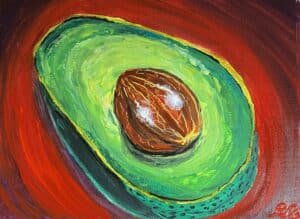
    Paul Joyce, Avocado Study

    Again, in Roman art, large murals in the villas of the rich showing the bounty of nature, along with the inhabitants of those very productive fields, namely birds and small animals, demonstrated the superiority of an upper elite class and their ability to feast of the best. Pliny the Elder wrote of one artist who came to be called “ a painter of vulgar objects” as he depicted shops, animals and food. But he made it clear that the results were extremely popular and far outsold work of artists in other genres.


    Paul Joyce, Avocado No. 2


    The fact that Still Live painting is relatively easy to distinguish and therefore categorise, meant that for centuries it was associated with academic principals of depiction, with styles and subject matter being handed down from generation to generation.  An Academy, after all, is fundamentally an organ of the Establishment, usually conservative and anti-liberal. The Adademie Francaise up until the Nineteenth Century still had strict guidelines distinguishing subject matter in art, with historical, biblical or religious pictures occupying the highest category and with Still Lives (again) relegated to the outer darkness.


    Paul Joyce, Fruit Study


    However, the arrival of the Impressionists blew all previous assumptions out of the water. They were more concerned with the emotional impact of colour on the viewer and their choice of subject matter was as wide as any previously written hierarchy. The greatest exponent of this rapid emergence of new approaches to ways of seeing the world was undoubtably Van Gogh. His series of Sunflower paintings took the humble Still Life to heights of greatness he himself, dead by the age of 37, could never have imagined.  All of us struggling in his footsteps owe him an immeasurable debt of gratitude.


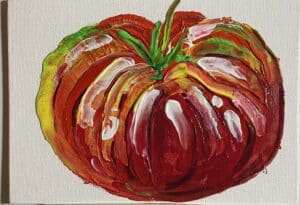
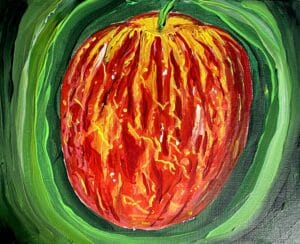
    So, my current attempts to come to terms with this lowest form of art is part inspired by Vincent, of course, but also very much by the “painter’s painter” Paul Cezanne as well. Cezanne famously stated that he wanted “to astonish Paris with an apple”. Well, mine is to attempt to amaze Brighton with an avocado. The images reproduced here are very much the start of a journey to investigate one of the most influential, successful and popular genres in the history of Art.  Nature can provide us with so much, particularly in terms of structures, forms and especially colours.  It is no accident that most of the best artist’s pigments come directly from actual elements culled from within our natural environment.


    I have come to understand even more than before, as I embark on this voyage of discovery, that the marked differences between the application of paint both by brush and palette knife produce totally different results. Using a conventional cotton canvas, a brush will drag across the dimpled cotton texture, frequently leaving details of the individual bristles. Whereas a knife will glide over the surface, allowing colours to mix together, sometimes in an almost magical way. This together with an attempt to use that sensuality that paint has in its very essence, itself attempts to mirror how tactile and toothsome still lives can be.  If I can literally make some viewer’s mouths water, I will feel that I have at least in part succeeded. But this of course I shall never know, unless some concerned reader tells me so.


    The writer is a celebrated artist and photographer


  • Simon Callow on his upbringing, life as an actor and the dangers of the art house flop

    Simon Callow

    I am sometimes asked by young people who want to be actors whether I can help – realistically, there’s not much I can do because I’m not Laurence Olivier so I can’t invite people to come and work in my theatre.

    But when asked for advice, I tell young people that it’s a very, very hard life.   If you are considering this route, you must first ask yourself: “Do you need to be an actor?” Unless your life depends on it – unless it’s the only thing that you can imagine yourself doing – then don’t even think about it because it’s a life of rejection and disappointment.

    I lived in Streatham until I was five and then I went to live in Berkshire where my mother was the school secretary for two years, before we returned to Streatham. When I was nine, I went to Africa; we returned eventually in 1962, and I lived then in Gypsy Hill.

    I didn’t think I was going to be an artist until much later. I had no idea but my grandmother had been a singer, and even been on the stage. She was a contralto – one of those deep female voices that you don’t really hear so much nowadays.  But the life was not for her since she suffered quite badly from nerves so big concerts were difficult. However, she did sing at the Albert Hall to celebrate the end of the war in 1919.

    She was a very theatrical human being as was her father – who was Danish and had been a clown in the Tivoli Club, and then became a ringmaster in Copenhagen where he married my great grandmother, a bare back horse rider. He came from a long line of equestrian folk and came to London and became an impresario. So theatre was there but not close to hand.

    As a child I was rather extrovert.  When I was out with my grandmother shopping I would be doing routines and someone said to my grandmother: “This child should be on stage, he is very gifted.” My grandmother was delighted by that idea and told my mother the good news and my mother said: “Over my dead body!”

    When I was in Africa, aged 9 or 12, in Lusaka, Zambia at school we did little playlets but tiny stuff. When I went to boarding school in South Africa at a school called St Aidens in what was then Grahamstown, I did actually act in plays but I have very little memory of it – except there is a photograph of me dressed up as an angry old man shaking my fist.

    When I came back to England, I went to a school called the London Oratory which was in those days in Chelsea but subsequently moved to Fulham and became quite a famous school partly because Tony Blair went there. It was a pretty terrible school and we had no drama at all. I knew nothing about acting at all. But London was all around me, and from my personal experience, I was overwhelmed by the work of the National Theatre and the Old Vic. I wrote a letter to Laurence Olivier who suggested that I might apply for a job in the box office.

    Since that time, I’ve been very lucky in my career, and I do get recognised, especially after Four Weddings and A Funeral. However I’m not Jennifer Lopez and I’m not Brad Pitt so the true burdens of fame aren’t something I’ve had to bear.

    I’ve had my share of setbacks. Not all movie executives or financiers are especially responsive to my art, but then that’s especially normal when people cross over from theatre into film. Take Tom Stoppard, as an example, who has sometimes seen his scripts go unmade: he is essentially a playwright, and he knows what he’s doing. But when executives read a Tom Stoppard script they probably don’t see dollar signs. Instead they think: “This is very clever, this is very interesting but where’s the money and the audience?”

    I have sometimes had to face the fact that I’m not commercial. I directed one film called The Ballad of the Sad Café which was a sort of mildly respected flop. An art house flop is the worst sort of film you can make. You could make an art house success, and that’s very good. You can also make a commercial flop – but if you brought it in on time and under budget then you would still be a safe pair of hands. But an art house flop is an absolute no-no.

    Even so, things are looking up and I have some movies in the pipeline, which are very promising. But the thing about making movies is that it’s very expensive, and people don’t like spending their money – except when they sometimes go mad and think that they are making art like Warren Beatty’s famous flop Ishtar, where everybody spent more and more money because he was Warren Beatty.

    This is all partly why I am quite nervous when I am doing plays with other people: on my own I am my own master completely and even if were to forget a lump of the text I can make it up, and I am now quite good at improvising Dickens and Shakespeare. I note that the solo play is becoming a trend. I see that Eddie Izzard has just done Great Expectations, and that Andrew Scott has done Uncle Vanya as a one man show. The only novel that I have ever done as a one man show is A Christmas Carol which works because it is this amazing magical performance where you can jump from one scene to another: the narrator of A Christmas Carol in our version is a conjurer and that makes sense.

    I am often asked about my next one man show. I’m sure Gore Vidal would make an entertaining evening but I don’t think I would be the person to do it. I am always nobbling writers to write me things and they are always a bit daunted by it. They are adapting at the moment a novel by an American novelist called John Clinch. Clinch he writes two kinds of novels: straightforward narratives and prequels somehow interconnected to already existing novels. One he wrote was called Marley; I happened to review it for The New York Times – and I immediately took an option out on it because I could see huge cinematic potential in it, as well as solo performance potential. I’m on a third draft of it, and getting close to something performable now.

    I’ve now been writing about Orson Welles for over a quarter of a century: I have become a more nuanced viewer of the human scene than I was when I was younger but that’s not surprising. But lately I’ve been thinking about fiction too: there are about half a dozen novels swirling around in my brain and I would love to write them, but I have so many other things that I have still got to do before that. I also want to write about my family – but not in fictional form:  I have just got to get it out of my system.

  • Book review: Ronel Lehmann reviews Dame Esther Rantzen’s Older and Bolder

    Ronel Lehmann


    I often remind our student candidates that it is normal to be nervous before an interview. At their age, I was so very fortunate to shadow Esther Rantzen from her green room to live broadcast on BBC That’s Life and Hearts of Gold. The minute before she waited to walk on to receive rapturous live audience applause, you could see stage fright kick in and the shear look of terror on her face. Of course, it was all gone as quick as it arrived once the programme titles started rolling. It is good that in her golden years, she is still inspiring the next generation with her wisdom.

    Her sixth book Over entitled “Older & Bolder” is crammed with advice, gleaned from her own experience, what she has learned as a journalist, author and broadcaster, and from what she has been told on the rare occasions when she has actually listened to somebody else who turned out to be worth hearing.

    This energising book charts her time travels through her most significant memories, from meeting Princess Diana to creating a national outrage with a mischievous short film about a driving dog and reflects with candour and humour on the life lessons she has learned, revealing the hints, hacks and personal philosophies that have been her secrets to surviving almost everything.

    We may not all achieve what Dame Esther has, but here we can soak up her wisdom, laughter and learn from her, embracing the passing years and march boldly on.

    Over a career spanning five decades Dame Esther Rantzen has appeared in more than 2,000 television broadcasts, in her regular contributions to political and news programmes, including The One Show, she especially advocates protecting vulnerable people and growing old ungracefully. She is also a reality TV favourite with appearances on Strictly Come Dancing, First Dates, and I’m a Celebrity. As a journalist, she writes for the Daily mail, the Guardian, the Telegraph and The Times.

    She was awarded a DBE in 2015 for her services to children and older people, through her pioneering work as founder of Childline and The Silver Line.

    I am still in touch with Dame Esther today. Sadly, she was recently diagnosed with stage 4 lung cancer. Her quote “Remember that history is written by the survivors, be bolder as you grow older and make sure you float above any challenges that threaten to overwhelm you,” will resonate with all those who have had the privilege of meeting or working with her and the audiences of tens of millions who avidly placed their trust in her during a career spanning five decades.

    Her generosity of spirit to others less fortunate will always live on.

    Older and Bolder: My A-Z of Surviving Almost Everything is out now from Penguin Books

  • A Novel Way of Working: Tim Robinson on the best books about jobs

    Tim Robinson


    Writing my novel Hatham Hall (Northside House), I realised that characters who support themselves are generally more interesting than those who simply sit on inherited wealth. Yet the world of work, which dominates most real lives, is too rarely the focus of novels – and when it is, often features as a negative, for strivers and servants alike.

    To Strive


    Whilst the pursuit of money has won a thumbs up from some women writers of block/bonkbusters such as Shirley Conran, Jackie Collins and Julie Burchill, who link it to girl power, big beast male ‘literary’ writers seem less sure – if Marin Amis’ Money, Bret Easton Ellis’ American Psycho and Tom Wolfe’s Bonfire of the Vanities are anything to go by. Amis’ John Self and Ellis’ Patrick Bateman both sell their shrivelled souls to a consumerist devil and while Wolfe brings a plague on every house, it is the Wasp ‘Master of the Universe’ bond trader, Sherman McCoy whose hubristic arrogance sets a match to the eponymous bonfire. The love of money, it seems, is the root of all evil. Or sometimes simply personal pain. In Hanya Yanagihara’s wildly successful A Little Life (recently dramatized in the West End, starring James Norton) fame and fortune effortlessly visit her characters only to be accompanied by misery and drug abuse – like Jacqueline Susann’s three heroines in Valley of the Dolls decades earlier.

    To Serve

    If striving is bad, what then of its opposite: serving others? The character of Wilkie Collins’ benign principal narrator in The Moonstone, Gabriel Betteredge – a kind of head butler – is given a sinister twist by Kazuo Ishiguro in The Remains of the Day, where Stevens becomes an unwitting accomplice to the Nazi leanings of his boss, Lord Darlington, who throws out maids simply for being Jewish. Ishiguro repeats this blindly-loyal-servant-as-facilitator-of-evil theme in Never Let Me Go, where genetic clone Kathy H coaches other clones to meekly accept the harvesting of their internal organs. In his latest, Klara and the Sun, the robot Klara’s years of unwavering loyalty are rewarded with a fate similar to Boxer’s in Orwell’s Animal Farm: she is dumped in a scrapyard. In Marilynne Robinson’s Gilead (Barack Obama’s favourite novel), her apparently conscionable narrator Reverend Ames serves his local community only by blinding himself to the racism that drove the African-American community out of town and allowing his jealousy of a troubled young man to taint his pastoral duties. A rare exception is Anne Tyler, who combines melancholy with compassion in Saint Maybe. ‘Clutter Counsellor’, Rita DiCarlo appears towards the end, making a living by helping old people discard objects which have become the burdensome detritus of accumulating years, thus bringing healing. Rita is both entrepreneur and kind servant of her community.

    To create

    Perhaps unsurprisingly, writers often prefer to concentrate on creative jobs. Dickens’ most autobiographical novel, David Copperfield, charts his journey from child factory worker to solicitor’s clerk to successful novelist – but his hideous period as an exploited boy in a bottle factory is far more vivid than the blandly-depicted writing life. Both Evelyn Waugh’s Brideshead Revisited and Virginia’s Woolf’s To the Lighthouse feature painters prominently, but it is unclear if they do it for money and one suspects that Mrs Woolf would have thought it rather vulgar if they did. My favourite novel about creative work – perhaps about any job at all – is Muriel Spark’s A Far Cry From Kensington, which satirises London’s post-war publishing industry. Her heroine, Mrs Hawkins, is employed because she is so fat that aspiring writers feel too guilty to abuse her when she tells them they won’t be published. She demonstrates her integrity, risking her job, by repeatedly telling an intellectual pseud of a writer that he is no more than a ‘pisseur de copie’. If only work was always such fun.

    Tim Robinson’s latest novel is Hatham Hall: northsidehouse.com


  • Paul Joyce: An Artist’s Memories of Sycamore Gap

    The artist and photographer Paul Joyce considers the death of an iconic tree

    Hadrian’s Wall started construction about AD 122 and took nearly a decade to complete. It was intended to “keep the barbarians at bay” but it certainly failed to do so a couple of nights ago when the most famous tree of this legendary boundary was hacked down.

    At first a 16 year old was suspected, but currently the opinion has grown that the perpetrator was an older professional with a heavy professional chainsaw. This act of wanton destruction has provoked intense reactions not just in the UK but worldwide as at least a million foreign visitors descended on the site every year. Adult locals have been reduced to tears and police have urged people to stay away from the site, even those who genuinely just want to honour the memory of what had become for many an icon of regeneration of the natural world in the force of relentless technological advances.

    The Roman treatment of prisoners does not make for pleasant reading. Any near at hand to The Coliseum would have been tossed into the arena willy-nilly, whist others in foreign climes would have been subject to beatings, amputations, and numerous other indignities up to and including Crucifixion. Many others above and beyond Jesus Christ were accorded that privilege.

    Sycamore Gap, where the tree dominated the landscape for many centuries, has overnight been stripped of both its tangible and intangible magic. It formed a natural end point for many travellers who had just come to see it, and others who passed by as they walked the Wall, stopping to gaze at it in wonder.

    The tree has been in my own consciousness for over half a century, and I remember well visiting it one winter over 40 years ago with the photographer and artist, Chris Wainwright. We were then experimenting with photographic images of ritual fires in the landscape. Around dusk we lit flares which we carried around and across the tree, having set up a large field camera on a tripod to take time exposures. We were in our own way paying homage to ancestors who celebrated key events in their calendar with the use of fire in its various forms.

    We were of course very careful not to do any damage, or leave traces of our presence there. Whoever is responsible for this senseless act deserves, in my opinion at least, to be accorded some of the delights awaiting Roman prisoners of war. At the very least I would force them to walk the length of the wall (without shoes) picking up any litter they might find on the way.

    If I had the talent of say, a David Nash, I would suggest erecting a piece of sculpture in place of the fallen warrior. If initiated quickly, a mound could be cast from the remains of the felled icon and re-erected there as a permanent reminder of one of the most beautiful and well-loved trees in not just the British Isles, but world-wide as well.

    The fact that the totemic Gap Sycamore was felled is probably, at least in part, due to its being used by Kevin Costner in his “Robin Hood” epic and therefore its unavoidable and graphic location received world-wide exposure. As it happens, the painting which accompanies this piece was done some time before this tragic event occurred, as it is a location I always returned to when going anywhere close to the Scottish borders.

    On this particular visit, in the constructed stone circle near the base of the tree, which I took to be the remains of on old sheep pen, was a small tree growing – an almost exact replica of its bigger sister. If only that sapling had been taken care of, it would provide a perfect substitute for its now decapitated parent.

    Great British artists such as Paul Nash and Eric Ravilious would talk openly about “the spirit of a place” which would draw them to, and then in the case of Nash, in one sense through the object to a world beyond – part-mythical, part spiritual. This led them to unique and unforgettable depictions of landscapes part real but almost wholly imagined.

    As some folks would tackle the Munroe Hills or run up as many mountains as possible in 24 hours, so I would seek out these magical places in order to try and follow Nash and his circle towards my own personal Arcadia. This is in part the reason for my series of paintings of “Great British Landscapes” of which this marks the first; to share these crucially important physical touchstones and, so to speak, roll the boulder back from the cave entrance, allowing light in from a more peaceful, better organised and artistically constructed world.


  • Friday poem: The Bay by Christopher Hamilton-Emery

    The Bay


    A sort of dislodged washed-out bay

    we fell into after hours of hill torture.

    No terns or boats, no breeze to speak of,

    but laces of white water moving fast and,

    farther off, the shattered hem of a ness.

    Spilled before it, a wide green stony spread

    and the afterthought of winter crofting:

    salt white walls, salt white doors, copper roofs,

    turf-piled yards and sweet tails of smoke.


    Most things will end, the mind in time,

    work and teeth and knees and hips, but there

    among the still weather and homesteads

    all the short-lived shadows you could know

    hold their ounce of love before the land runs out.


    Christopher Hamilton-Emery is a poet and founder of Salt Publishing

  • Blur and the Narcissism of the Entertainment Sector

    Christopher Jackson

    There is a moment in the Beatles’ catalogue of which I’m particularly fond. It comes on the album Sergeant Pepper’s Lonely Hearts Club Band when Paul McCartney, ever the panting optimist, sings: “It’s getting better all the time.” Lennon improvises back: “It couldn’t get much worse.”

    The essentially dual spirit of the Beatles is encapsulated in that – and, of course, it’s the want of instances like it which, one feels, diminishes their respective solo careers. It’s one of those moments which charts the ideal of ‘being in a band’ whereby two contrasting personalities lay aside competitiveness, and work together for the creation of something grander, more expansive, and stranger than their individual selves could muster.

    A writer of manuals for office etiquette might call this ‘teamwork’. Musicians and listeners alike know it’s something far more magical: human difference overcome in the name of art.

    I remembered this moment when, on a sunny morning in May, I placed Blur’s new single ‘The Narcissist’ onto iTunes, and in the joy of the moment, on a wide and deserted road, almost went above the stipulated 20mph speed limit, risking a £100 fine.

    What does the new song sound like? For one thing, your summer suddenly has its soundtrack. What is it that makes a summer tune? When the intricate growth of spring gives way to the lazy months of July and August, we want our summer songs to mimic that: they should eschew detail and fiddly chord changes in favour of a languorous unfolding, leading with no particular hurry to anthemic choruses, simplicities learnable even in the heat. A summer anthem must speak to the most passive version of ourselves.

    ‘The Narcissist’ easily ticks all these boxes: the chord sequence turns out to be a straightforward exploration of the possibilities of E, C sharp and A, with various bouncings off the Asus11 and a cunning shift to the augmented chord of E in the chorus. An augmented chord, by the way, is a very good way of separating the amateur musician from the pro: an amateur will peer at its notation with a narrowing sceptical frown, myopically mortified at a difficulty. A true musician will instinctively see the progression, and intuit its justice, fingers manoeuvring knowledgeably.

    The song possesses a pattern of ingenious simplicity. This is frontman Damon Albarn taking it easy, and telling us it’s okay to relax. Next up, the singer’s regal and essentially inexplicable cockney imitations enter, immediately recognisable to any Brit between the age of 40 and 50:


    Looked in the mirror

    So many people standing there

    I walked towards them

    Into the floodlights


    The lyrical and the musical theme are perfectly intertwined. Not only this, but it’s the right thing for Blur to be singing about in this age of TikTok, Instagram live feeds, disposable memes, and Holly and Phil.

    Let’s consider the narcissism of the music industry. It is sui generis. Theatre, which might otherwise have given the sector a run for its money, lacks the turbocharger of a huge audience; if narcissism is ever attained it happens in a comparative vacuum, with insufficient adoration to feed off. Meanwhile film, though also a contender with its ludicrous red carpet set pieces and softball promotional interviews, seems to have its saving grace in the dull slog of a working environment which ostentatiously lacks glamour.

    The music industry by comparison is a cauldron of narcissism. Firstly, the musical skills required to make a ‘hit’ are relatively limited. You can get a long way in pop with an affinity for G, D, C and A minor. Most sentient adults can be taught to play ‘Knockin’ on Heaven’s Door’ from scratch in an hour (though it goes without saying only Dylan could write it). Of course some – the members of Blur among them – become gifted musicians, but I don’t think any of them would say they were to begin with.

    Pop music is a question of conveying an appealing mood. The offshoot of this is that, if successful, just as one is being lavished with money and sexual attention, one’s intellect is likely being overpraised. These things taken together make narcissism all but inevitable. And once arrived at as a condition, it appears irreversible: witness Pete Docherty’s adolescent ramblings, still ongoing now at the age of 44; Liam Gallagher’s tweets, the work of a 50 year old; and even Dylan’s plain weirdness, undertaken at the age of 82.

    You can add to that the demographic certainty that pop stars are not made in middle age: my own experience tells me that the young are reasonably narcissistic even if they don’t have a hit with ‘There’s No Other Way’.

    Incidentally, what would the music industry do if someone in, say, their mid-50s suddenly wrote a string of brilliant pop songs? This intellectual feat would not necessarily be difficult for anyone with musical training: its equivalent happens all the time in literature and art. But there is simply no precedent for sudden middle-aged achievement in this art form, meaning that there can be no economic migration from other sectors. When you turn on the radio you are almost certainly hearing the thoughts of the under-40’s, and usually the under-30’s – and if you’re not you’re probably hearing someone whose identity was frozen in place around then: we are hearing Narnias bereft of Aslans.

    Is Damon Albarn a narcissist? Some of the signs have always been bad. Even his defenders must concede the knowing inauthenticity of his East End vocals. There was the Damien Hirst-directed video to ‘Country House’ in 1995, Albarn in a bubble bath surrounded by Page Three models. One never recalls without baffled solemnity his initial willingness to submit to the extraordinary dullness of the Blur v Oasis spat, an esoteric competition he only soured on when it seemed to be going against him. And always in these narratives there is the bland submission to drugs and alcohol, the back and forth of addiction and rehab, leading to other yawns: fallouts with bandmates and rivals; dewy-eyed ‘hurt’ at the tenor of press coverage; all leading to a generalised and moneyed whingeing, and its inevitable offshoot, rubbish music.

    Blur went through this phase with 13 – though note that even their low point contained ‘Tender’, perhaps their masterpiece. Despite all this, Blur has given the impression it knows what it’s doing, that it’s able to conduct the rituals of hedonism with a degree of ironic distance. Alex James, the band’s likeably louche bassist, is on record as saying: “Food is one of life’s really great pleasures. My 20th birthday party was all about booze, my 30th birthday was about drugs, and now I realise that my 40s are about food. It’s something you appreciate more and more as you get older.” This is a pleasing progression. By the way, where James says ‘food’ he predominantly means ‘cheese’.

    Blur are reminiscent again of the Beatles in that their ‘third’ member also turns out to be a highly interesting person in his own right, just as George Harrison was. For some reason it is pleasing to me to know when listening to Blur that a major cheese-farmer is playing bass, and that the band’s drums player Dave Rowntree is also a minor Labour politician and former Kingsley Napley solicitor. Blur have jobs – they have experience.

    Happily, that initial – and let’s face it, narcissistic – immersion in fame had its second act, consisting of a surprisingly mature resolution of the routine jeopardy of the pop star ‘predicament’. Albarn found salvation in the Hell of fame by discovering within himself an astonishing work ethic; he always seems to have five projects on the go, and all are ambitious. This might be why, in 2023, he feels able to tackle the question of narcissism and the entertainment industry: he’s traversed it.

    For the record, I don’t know how sane Albarn is. For all I know, he may possess all the usual madnesses of pop stars: the unwillingness to begin any sentence without the word ‘I’; the childish need to have a pool of secretaries, bouncers and admin staff to conduct the basics of daily administration; a powerful lack of interest in philanthropy of any kind, especially if any outlay doesn’t get in the press with their own name attached to it.

    But I think his work is sane: in his solo career, his Gorillaz albums, his musicals, and now in ‘The Narcissist’, he seems always to be using music to arrange the world, and make sense of it. In doing that for himself, he does it also for us. His artistry, and the endeavour required to produce it, breaks the typical cycle of narcissism.

    As ‘The Narcissist’ enters its second verse, we are reminded how happy he is when he’s in Blur. It’s an ‘It’s Getting Better’ moment:


    I heard no echo (no echo)

    There was distortion everywhere (everywhere)
    I found my ego (my ego)
    I felt rebuttal standing there


    The parentheses are sung by his old friend, Graham Coxon – and of course perfectly fit the theme of the song. At time of writing, it’s not clear whether Albarn sings ‘rubato’ or ‘rebuttal’ in that last line of this second quatrain. I think I prefer ‘rebuttal’, but with all due respect to Albarn, I don’t think he is quite sufficient a poet for it to matter, the way it might matter with Leonard Cohen or Bob Dylan.

    That’s because Albarn is very good at displaying generalised intelligence: the listener will likely feel at this point that he is simply using a word which we don’t normally hear in pop songs, bestowing a sense of non-specific sophistication. We don’t actually mind which word he’s using so long as it’s an interesting one. It has been said that some writers (Stoppard, Wilde) have the kind of intelligence which flatters the audience, and makes you feel more intelligent than you actually are. Others (Nabokov, Joyce) possess the intelligence which bludgeons you a bit, lets you know that you’re their inferior. There is another category, the highest of all – in Tolstoy, for instance – where you stop minding about the question of intelligence altogether and just take in a work of art as a chunk of life.

    Anyway, Albarn is in the first category: we can partake of his intelligence without feeling overwhelmed. As tertiary gifts go, it’s a fine one to have. But the most important aspect of the stanza is in the call and response. Really when we talk of Blur as distinct from any other Damon Albarn project, we’re discussing the relationship between him and Coxon, singer and guitarist – songwriter and interpreter.

    In the annals of Britpop, there were probably two ‘great’ guitar players: Jonny Greenwood in Radiohead, and Coxon. In neither instance are we discussing guitarists in the ilk of Slash from Guns N’ Roses – the purveyor of the note-riddled mountaintop solo. We are instead discussing something far more embedded.

    Coxon is seemingly able to do almost anything with a guitar: he can make it scythe unobtrusively through a landscape of disco (‘Girls and Boys’); imitate the sound of a fly bumping again and again into the frustrating transparency of a windowpane (‘Beetlebum’); or give it a loose twangy mid-American verandah ranginess, which seems to let a song walk on a sort of leash (‘Tender’). He can make a guitar riot (‘Parklife’); mourn (‘Badhead’); headbang (‘Song 2’); and yearn (‘Under the Westway’). His limitlessness is entire – in Blur. But that’s his limitation; he needs Albarn to realise his own greatness.

    But more notable than all this is what Coxon chooses not to do. Every Coxon contribution to Blur is generous not just to the listener, but to his bandmates: humility is implied in all he does. This is especially in evidence in ‘The Narcissist’. The chorus passes off agreeably (‘I’ll shine a light in your eyes/you’ll probably shine it back on me’), and then the interlude reverts to four straightforward notes by Coxon which I am sure I could teach my six-year-old to play. But a lesser guitarist would have sought to play forty. Such a solo would have been more complicated to play. There’s no doubt that Coxon can play it, or anything you put in front of him: but such a performance would have been obtrusive and spoiled all our summers.

    Ever since Paul McCartney’s Liverpool Symphony was booed and mocked by the classical music fraternity at its premiere, there has been the question of how good at music you have to be to be a pop musician. It is a complicated question: on the one hand, there is no evidence yet of McCartney being able to play Scriabin on the piano. Equally, none of his tormentors has yet had the wherewithal to write ‘Penny Lane’. My allegiance is probably – just – with McCartney, as I’d always rather have the thing itself than the interpretation of the thing. But I also know I don’t need to take a side if I don’t want to. And I don’t.

    Yet the question seems to matter if we’re considering whether the 21st century finds us in some kind of musical decline – and perhaps therefore in some broader societal decay. One thought experiment is to imagine your way into Beethoven listening to Coxon’s guitar-playing. It’s possible to go round the houses on this. Sometimes I imagine Beethoven sternly wanting to educate Coxon on classical progressions; at others I imagine him going quiet, knowing the game is up, then meekly asking Coxon if he might borrow his guitar.

    A good summer song should be like a good summer’s day: it shouldn’t go anywhere. ‘The Narcissist’ makes good on this. I’m not sure if lyrically it says much more than: “I’ve been a narcissist in the past but now I’ll not be.” If we were strict about it, it’s probably a minor song, but something in its beguiling expansiveness makes me want not to be strict about it. Besides, it’s minor status only really makes sense if you take it out of context as a record and as a release.

    So what does Blur mean now in 2023? Initially, Blur could be pegged as an act nostalgic for the music of the 1960s – this was because Albarn looked to Ray Davies as a way of navigating the shallowness of the 1990s. In relistening to songs like ‘Lola’, ‘Days’ and ‘Autumn Almanac’, Albarn found a useful crutch because the country hadn’t really changed all that much since the Jenkins reforms of the 1960s. But the band was always more than that. For instance, Albarn also leaned on Martin Amis’ comic novels. Just as Amis gave us John Self, Keith Talent – and later, his most hilarious name of all, Clint Smoker – Albarn created Tracy Jacks, Dan Abnormal, the Charmless Man, the rural escapee who lives in the country house ‘reading Balzac, and knocking back Prozac’ and a myriad others. Even when he was caught up in the satire moment, Albarn took care to have a range of satirical influences.

    But he was always omnivorous: amid all the satires in Parklife, there was nothing satirical about ‘To The End’, or ‘This is a Low’. It’s immensely to Albarn’s credit that he knew satire wasn’t enough. He had to go on seeking, until he became a kind of search. Through the digressions of Gorillaz, The Good, the Bad and the Queen, Mali Music, and his musicals (themselves astonishingly diverse in influence and intent), he has amassed a body of work which you would only underestimate if your main image is of the blonde boy singing ‘Parklife’ in front of an ice cream van. Unfortunately, that accounts for almost all of us.

    But I don’t think Albarn minds this. In fact, we can now see that his fame gave him useful cover for his essential seriousness – not to mention an ongoing audience. As a result, he has smuggled into the mainstream so much that’s interesting that he has come to merit extended study while belonging to an industry that all balanced people try to ignore.

    It amounts to a remarkably generous corpus, of which Blur will always be the cornerstone, as ‘The Narcissist’ reminds us. It’s a marvellous thing that Albarn has again made time to return to his old friends, in one fell swoop continuing a conversation which we all love to hear, and eschewing the cliché of the spat that turns into an everlasting split. Each Blur record now has the wisdom of the renewal of old friendship attached to it.

    From Amy Winehouse to Jim Morrison and Jimi Hendrix and all the others, musical careers often seem to end in tragedy – and the tragedy is always the tragedy of narcissism. Blur have gone a different route: this isn’t tragedy but a sort of romance, as in Shakespeare’s The Winter’s Tale when the statue of Hermione starts moving, and suddenly all the altered world is singing again.
  • Premiere Affaire: a film which shows there are no easy answers when embarking on a legal career

    Meredith Taylor


    A young woman discovers the real world in this erotic legal procedural from French director Victoria Musiedlak.

    Premiere Affaire is one of the juiciest films to hit the Piazza Grande at this year’s Locarno’s 76th edition.

    Sex is variably at centre of any drama where the French are involved and Premiere Affaire has a clever title that cuts both ways: as a first love affair and a debut criminal case in the life of budding lawyer Nora, a mesmerising Noée Abita, who soon discovers that life is not as simple as it first appears. And Musiedlak, in her first feature, doesn’t give her main character a smooth ride in this classically styled ‘school of hard knocks’ outing.

    Fresh out of law school, naive Nora, 26, is working in the Paris cabinet of a suave but sharp as nails commercial advocate when she opts to take on a pro-bono style criminal case, that of a gauche young man Jordan Blesy (Alexis Neises) accused of murdering his sister’s friend. Here, she will learn her first lesson: being a legal practitioner is not about championing right or wrong, but applying the Law in the context of the client’s plea.

    The second lesson here is not to get emotionally involved with your client or your colleagues, for that matter. And Nora makes a faux pas on both accounts. She desperately believes Jordan to be innocent and brings her own feelings into the case instead of remaining detached. She also fails on the second count when she meets the police officer assigned to the case, Alexis (Danielsen Lie). The two eye each other up warily during the police procedural client examination where sparks fly. But while gamine and vulnerable, Nora is not one to be trifled with.

    A feisty onscreen chemistry between Anita and Danielson Lie give these scenes a raunchy, provocative kick. Nora also discusses Jordan’s case privately with Alexis contrary to their professional remit, accepting an ill-considered ride in Alexis’ car which will invariably bring them closer. All credit to Musiedlak puts the accent on flirtation in the subsequent love scenes making them intense and titillating rather than uncomfortable to watch.

    Clearly this is a story fraught with ethical and moral issues – not to mention racial tensions: Nora is of Maghrebi heritage and her mother is sceptical of her daughter’s career, encouraging her to settle down and marry. This family stress piles on the pressure for the young lawyer, adding negative undertones to her domestic life. At work too Nora is struggling to cope, burning the candle at both ends in taking on a case that runs contrary to her official remit in the commercial cabinet, so there’s never a dull moment, and certainly no easy answers when embarking on a legal career.


    LOCARNO FILM FESTIVAL | PIAZZA GRANDE 2023 |

    Dir/Wri: Victoria Musiedlak | Cast: Noée Abita, Anders Danielsen Lie, Alexis Neises, François Morel, Saadia Bentaïeb | France, Drama

  • Photographer Rankin on how Bjork gave him his start in the industry

    Photographer Rankin on how Bjork gave him his start in the industry

    by Christopher Jackson

    For anyone looking to be famous, one possible route seems to be to truncate your name into a snappy word: the strategy has worked for Beyoncé, Banksy, Madonna and plenty of others. Perhaps in a busy world we don’t have time for multiple syllables anymore. Were Warhol alive today he might just be Andy. 

    The photographer Rankin is shorthand for John Rankin Waddell: as the founder of Dazed and Confused the globally distributed magazine, photographer of Kate Moss and Her Majesty Queen Elizabeth II, and with long ties to the music industry, the 54-year-old photographer is now at the summit of his profession. 

    So how did he get started? His early education looks at first inauspicious:  Rankin studied accounting at Brighton Polytechnic, before dropping out in order to study photography at Barnfield college in Luton. He subsequently relocated to the London College of Printing. In time, his reputation as a fashion and music photographer grew. 

    But he really owes his start, he tells us to Icelandic pop star Bjork: ‘Bjork was brilliant. It was literally my first ever shoot for a record label. She’s one of the most era-defining musicians because aesthetically she’s so unique and original, and she’s very in control of her image.”

    What did he learn from her? “What I loved about her was that she just let me do my thing. I have to be honest; there was a moment in the shoot where I was trying to do something that was a bit derivative of another photographer, and she gave me the confidence to just not do it. She was like, ‘You don’t need that shot, stick to what you’re doing’.”

    So did that make a difference in terms of his subsequent career? “She kind of set me up in a way, because very few people have ever surpassed her collaborative approach.” Collaboration is a leitmotif in Rankin’s career. It was only upon meeting Jefferson Hack at London College of Printing that he felt able to launch Dazed and Confusedin 1992. 

    Fast forward to 2021, and Rankin is still productive – and still collaborating. His latest book How to Die Wellis produced in partnership with Royal London, the UK’s largest pensions company. So how does he think this book will help people in these death-conscious times? “Death scares people, and that discomfort is the main barrier to talking about it,” he says. “The hardest part is getting started, but once you push through the fear – those conversations become a lot easier.”

    This tracks with my own encounters with those who’ve been around death a lot – from nurses and doctors to undertakers and funeral directors, they seem not to have the expected heaviness, but instead a certain lightness of being. 

    So has compiling the book helped Rankin face his own mortality, and the mortality of his loved ones? “Making this book has definitely helped me to deal with my own grief, as well as confront the idea of dying,” he admits. “And it’s so important that we do, because having these kinds of discussions means that when the time comes, our loved ones are prepared.”

    It’s been an extraordinary time. For over a year now, we look at our media and see the death toll writ large. 

    Have we become a morbid society? “I’m not sure the pandemic has made us, as a society, any better at having these conversations. The shock and size of the grief has been overwhelming,” Rankin says. “I think it’s going to take a long time for people to process what has happened. But it has certainly presented us with the undeniable reality of death.”

    And yet How to Die Wellisn’t a serious book by any stretch of the imagination – it’s full of anecdotes, lightness of touch, and charm. 

    How did he go about compiling the book? “We interviewed a broad selection of people who shared their experiences of grief – and also told us what they’d like their funeral to look like. There were some absolute corkers. From unusual song choices, to outrageous outfits, to hilarious last words. Death is just like life: there are ups, downs, laughs, lots of crying – and more than a few funny bits.”