Author: admin

  • Culture Essay: What we can all learn from cricket

    Culture Essay: What we can all learn from cricket

    by Robert Golding

    In the post-war period, my grandfather used to go to Lord’s and the Oval every year without fail. In his later years – he died in 2013 – he’d tell me about the time he watched the last innings of the great Australian batsman Don Bradman. 

    As the story goes, Bradman needed to score four runs to finish his Test match career with an average of over 100. He received a guard of honour and the most sentimental version of the story claims that he was still wiping the tears from his eyes when his second delivery by Eric Hollies bowled him. He would finish with the famous average 99.94.

    The story is well-known. But what I particularly remember is the civility of cricket as my grandfather recalled it. In those days, if you suspected you had trapped a batsman leg before wicket, you would witness the delivery, mull the possibility of an appeal, and then, on the way back to bowl, politely enquire of the umpire: “How was that?” 

    In little details like this, we realise how fast the world is changing. Today, a typical appeal will involve frenetic shouting of Howzat!, and an utterly theatrical despair if the appeal is turned down. The way the sport is played today reflects a society which wants it all – and, to paraphrase, that well known cricket fan Queen guitarist Brian May – wants it now.

    Our cricket, then, speaks to the society we’ve become. Alongside these developments, cricket has grown exponentially as a professional sport – as every other sport has also done. Many of these activities – including billion-dollar industries like football, tennis and golf – were invented to supply activity to the Victorian gentleman liberated from drudgery by the Industrial Revolution.

    Suddenly everyone had a weekend to fill. The growth of village cricket and other pastimes might also be put down to something more mundane: the invention by Edwin Budding of the lawnmower in 1832. This, the year that Goethe and Sir Walter Scott died, feels like one of those hinge years when a whole way of life cedes to another. Without Budding’s invention, the English summer with its sound of leather on willow, its players in cricket whites moving towards the batsman ‘like ghosts’ as the poet Douglas Dunn observed, and its sense of the day unfolding with relaxed culinary predictability – sandwiches for lunch and cake for tea – would have been impossible. 
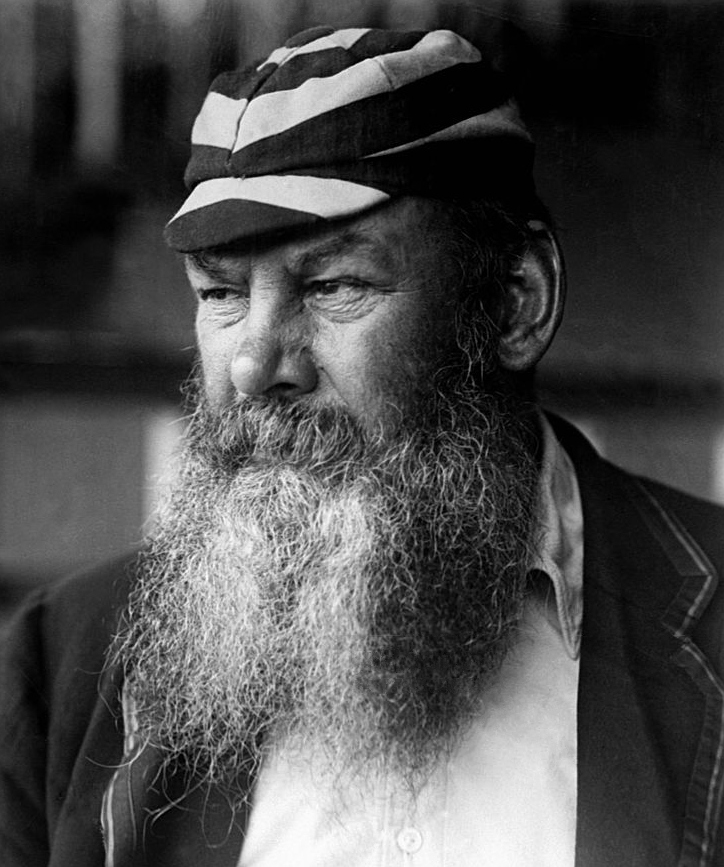
    WG Grace is usually credited with being the first professional cricketer.

    2020 feels like just such another year, and it finds cricket also at a crossroads. Today, if you type the phrase ‘cricket jobs’ into Google, you’ll discover a bewildering array of options – although applying for many them appears to contain the implicit stipulation that the applicant be extraordinarily good at cricket. At time of writing, jobs are already being advertised for player coaches and coaching and talent specialists for the coming season in Australia. Although many of the ads require the applicant to have played at a high level of cricket, most also require significant administrative ability.

    Expansion and growth in the sport has been driven in recent years by the Indian obsession with the sport. Photo credit: By Jms1241 – Own work, CC BY-SA 4.0, https://commons.wikimedia.org/w/index.php?curid=42650055

    In addition, as cricket has become more complex, the number of roles of a purely administrative nature has also increased: ads for operations officers, and brand managers abound. In addition, there’s even an ad for an umpire manager posted by Queensland cricket. The job description explains to applicants that they will need to ‘develop and implement strategies designed to attract and recruit potential umpires across the state’ while also ‘building and overseeing a network of appropriately skilled people who can provide umpire training and assessment.”

    The ads in Australia are a reminder of the international nature of cricket, but they also point to the great hinterland of people who are talented at cricket, but no longer able to consider playing professionally. Or perhaps they never were never in the running. 

    As cricket has resumed, I’ve had a sense that this is a sport peculiarly suited to post-pandemic life. Yes, it’s always been international which rather goes against the grain of our travel-restricted lives this past year. But it’s also one of the remaining sports which are really to do with stasis and patience – qualities which we have been forced to learn during the pandemic. 

    That’s not all. It was John Arlott who in his great book on Jack Hobbs asked himself what made Hobbs great and decided it was his “infallible sympathy with the bowled ball”. When I mentioned this to Jonathan Agnew recently, he looked delighted at the remark, and nodded vigorously: “Yes, yes, I like that. That’s what cricket’s all about – and it’s also why I don’t like football.” 

    Jonathan Agnew is a reminder that many careers exist today beyond the traditional playing routes. Picture credit: By Blnguyen – Own work, CC BY-SA 3.0, https://commons.wikimedia.org/w/index.php?curid=1376670

    This opens up onto the essential civility of cricket. It is what makes it, beyond other sports, relevant to our wider lives – including our careers. We wouldn’t speak of the spirit of football, or tennis, or golf: but we can and do talk of the spirit of cricket. 

    It is, in fact, an essentially democratic sport. For instance, the phrase ‘good cricket’ refers to a passage of play where typically, a good delivery has been bowled, a fine shot made, engendering in return a skilled piece of fielding and wicket-keeping. Usually in such moments, the actual score hasn’t been advanced but something has been achieved by both teams together.

    It’s this civility, and undercurrent of decency, which creates a sense of hiatus from the stress of the world, and therefore makes the sport an ideal way to switch off. Sir David Lidington recalls how the sport sustained John Major in his time in office. “To John, cricket remains a great solace, a place where he can switch off, and cares fall aside for a time,” he tells us. Most famously, Major, having lost the 1997 General Election to Tony Blair, declared he was off to watch the cricket: one could feel his delight.

    Former prime minister John Major enjoying his retirement at a cricket match

    For many of us therefore, cricket has been a dimension almost beyond capitalism, and certainly beyond the cut and thrust of politics. It is this notion of cricket as a protected zone of our lives which accounts for the indignation at the rapid commercialization of the sport, especially by the IPL and The Hundred.

    But perhaps we should be careful about saddling cricket with a Victorian flavour forever. Major himself was no classist as Lidington points out: “What was true about John was his absolute commitment to social mobility and loathing of snobbery.” One cannot imagine Major ever minding, say, Ben Stokes’ tattoos; one can only imagine him delighting in his talent. 

    So now cricket enters a new phase, where an international test championship hopefully heralds the beginning of a new purpose for cricket. It may also be that we’ve been reminded of the importance of the slow. I’ve no doubt my grandfather would have heartily approved. 

  • Zavfit founder Anna Freeman on why we need a new approach to spending

    Zavfit founder Anna Freeman on why we need a new approach to spending

    By Patrick Crowder

    Zavfit is a new tool that is designed to help you spend your money in more productive ways. Unlike other money-saving apps, Zavfit is designed not only to discourage excess spending, but to encourage you to reinvest that money in other more beneficial areas. 

    The full version of the app securely connects to your bank with view-only permission in order to monitor spending. Then, the app will ask you to rate your happiness with each purchase on a sliding scale of satisfaction. This data is used to track your wellbeing as well as to set spending and saving targets based on areas which need improvement.

    It’s all the brainchild of founder and CEO Anna Freeman. Through her background in finance, tech, and sport, Freeman found strong links between financial stability and mental and physical wellbeing.

    “I grew up competing in sport, so I’ve always had a passion for health, wellbeing, and fitness which has only grown over the years,” Freeman says. “What I hadn’t realised when I was in the tech and finance industry was that worrying about money is the global leading cause of mental health issues.”

    As mental health awareness increases, largely due to the pandemic, the finance industry has begun to take financial wellbeing into consideration. While this is an improvement, Anna believes that it needs to go a step further.

    “Most of the solutions in place are focused on the wellbeing of your finances, as opposed to actually addressing that stress and anxiety that people feel with their money,” Freeman continues. “I knew that we needed to create a health tool.”

    Zavfit offers a free “MoneyFitness” quiz, which asks the user how happy they are with various aspects of their day-to-day spending. This includes questions about post-purchase regret, satisfaction in work, social spending, charity, and physical fitness. I took the quiz myself and despite my mediocre score, the questions got me thinking about how I prioritise different aspects of my spending and how to reinvest that money on better things.

    “The stereotype of being good with money is ‘saving is good and spending is bad’, but ‘save, save, save’ doesn’t really recognise the present and taking care of yourself,” Freeman adds.

    In my case, I found that I am probably spending a bit too much on nights out and not paying good enough attention to my physical health. Rather than simply staying in and saving cash, the philosophy behind Zavfit would suggest that I invest the money saved on a fitness class.

    Freeman believes that focusing spending on healthy, fulfilling hobbies and interests can have a big impact on both financial and mental wellbeing. Freeman’s outlets are singing and sport, so she decided to put her resources into those areas.

    “I remember walking down the road in the sunshine one day and thinking, ‘I have stopped spending on anything else’,” Anna said, “and that’s because I had found those things which really took me out of my head and lifted me up.”

    The pandemic has given many people a chance to think about their wellbeing and break the cycle of habit. Freeman sees this as an opportunity to step back and make important changes moving forward. “There’s been a massive reset on everything, particularly on spending. There’s an opportunity here to think about things differently and to think ‘Okay, I’ve set out what’s important to me, I’m aware of my mental health and that it needs looking after’.”

    As the link between health and finance continues to be explored, new ideas like ZavFit can help push the conversation forward to find fresh approaches to the age-old problems of money stress and non-beneficial spending. Breaking bad habits is never easy, but ZavFit proves that this is both achievable and essential to personal wellbeing.

  • Johanna Mitchell on the US families relocating to the UK

    Johanna Mitchell on the US families relocating to the UK

    The global pandemic has sparked an increase in our cousins from over the pond relocating to London. Why?  To access in-person schooling for their children. In the US, in both 2020 and to date in 2021, education provision has been in flux.  When UK schools were re-opening in September of 2020, US schools remained firmly closed, with most operating some form of online learning. 

    With the advent of Covid-19, it dawned on every parent and employer how much their livelihood and sanity depended on institutions placed too often in the background:  the nation’s schools.  

    For parents with flexible workplaces, deep pockets, or those able to open an arm of their existing US-based company in the UK, relocation to London for their offspring’s schooling was a no-brainer. For some families, this will be amount to a sojourn of a year or so, until their US schools are fully open again.  Others will stay longer.  As in the UK, US parents found it tough to juggle home-schooling with the demands of work and career. Families buckled under the strain that online learning had placed on the mental health of their children, and themselves, and a move to London schools was a welcome relief. 

    US families value London’s broad offering of schools and curricula.  Although the American School in London (ASL) in St John’s Wood is the holy grail for many US families, many are opting for British schools or English/ French bilingual schools.  This is particularly true of families with younger children, who are less concerned about changing curriculum and whose children are not close to exam years.  International schools offering the International Baccalaureate (IB) are sought after, not least because the IB has become the go-to curriculum for students on the scholarship route to US universities. All US colleges, including Ivy League, value the IB’s emphasis on research and its multidisciplinary focus. Some US colleges are offering top IB students a fast-track option to skip a year of their course, a huge draw for parents hoping to save a year of prohibitive college fees.  

    As we have a shared language, it is often assumed that the UK and US education systems are similar. This is not the case. The UK has more nationally-assessed exams and the early years approaches are different.  For children from aged four upwards, the US system is more play-based, whereas the mainstream UK system is focused on learning to read and write at a young age. To guard against culture shock, we recently placed the five-year old daughter of a family relocating from Los Angeles in a Montessori school in Hampstead.  The gentler Montessori approach was more aligned with her early years’ US education experience.   

    As I write, the expectation is that all US schools will be opened for the Autumn of 2021.  This current academic year has been inconsistent. Some schools opened, others operated a hybrid model (part in-person teaching, part online), some only offered remote learning. Generally speaking, the more “conservative” states, such as Texas, have been focused on maintaining, or even mandating, in-person instruction, while the more “progressive” states have offered hybrid options and made in-person learning optional. For example, on Long Island, most schools returned to some form of in-person instruction, but it was rarely mandatory and often hybrid with some online component.  

    A year later, the Covid-19 pandemic has changed education in America in lasting ways. Although most US families expect a return to the uniform, in-person teaching model for the coming academic year 2021/2022, some US school districts are developing permanent virtual options in the expectation that, post-pandemic, families will plump for remote-learning – even for their younger elementary/primary school offspring.  

    Relocation to London to access British schools has been the preserve of an élite, well-heeled tranche of US society. But we cannot ignore the reality that Covid-19 has been a tragedy for many students, especially those from disadvantaged backgrounds. Stories of kids who have melted away from education, dropped out of college, or gone hungry abound equally in the UK and US. We have been forced to question the efficacy and relevance of our existing education systems.  The pandemic has unleashed a wave of accelerated change in education. This wave will continue to ripple out and to have a permanent and transformative effect on education systems in both the US and the UK.   

    The writer is the Director of Lumos Education in London.  

  • Opinion – Work-from-home must be an option going forward

    Opinion – Work-from-home must be an option going forward

    By Patrick Crowder

    Now that restrictions are lifting, hopefully for the last time, there are mixed feelings about returning to work. Some are looking forward to it, some are concerned about catching Covid, and others simply don’t see the point. For those who crave the structure that a traditional office provides, that should always remain an option. But for those who dread the idea of getting back to their morning commutes, increased flexibility in the workplace is essential.

    Research from the global workplace specialists at Instant Offices shows that 90 per cent of office workers “want more flexibility in where and when they do their jobs”. That doesn’t come as much of a surprise – who wouldn’t want to choose their own hours and work from anywhere? Now that people have seen that their jobs can be done effectively from home, it will be difficult to return to rigid office hours without good reason.

    According to Instant Offices, 44 per cent of people looking for work are refusing positions that do not offer sufficient flexibility. This means that some workplaces may need to shift to at least a mixed home/office approach in order to employ enough qualified professionals to operate.

    Not everyone is going to want to work from home. It can be particularly difficult for parents of young children to have a distraction-free home office. Space is always an issue, especially in big cities such as London where young professionals often live in smaller accommodation. 

    Others enjoy the structure and feeling of community an office provides and feel that they work better in an environment of like-minded people. Some even enjoy their commutes as the back-and-forth bookends the work day allowing them time to leave their work life at work and home life at home.

    We know that working from home is a more comfortable solution for some people, and happy employees are generally more motivated and productive than one unhappy with their working situation. On top of that, Instant Offices’ research shows that 41 per cent of office workers believe that they are not only as productive, but more productive from home than they are in an office. 

    People will always work to their full potential in different ways, and that’s a good thing. Giving employees the option to work from home if they choose does not mean that nobody will come into the office to run the ship. Instead, companies will be able to reduce the size of their offices saving their employees time and themselves lease money.

    Companies must realise that people are unique in the ways that they get things done, and when everyone is forced to follow the same format, there will be a dip in productivity. Now that working from home has become normalised to a degree, a rigid return to the ways of old will only anger current employees and drive away potential new ones. There will always be a place for the traditional office, but it is time to allow the people who enjoy the WFH life to work to their full potentials.

    For more on the Instant Offices research go to: https://www.instantoffices.com/en/gb 

  • Stuart Thomson: Covid-19 will hit the young hardest – especially in the world of work

    Stuart Thomson: Covid-19 will hit the young hardest – especially in the world of work

    There is no doubt that young people have been hit hard by Covid-19.  Unless businesses and government take immediate and decisive action then the long-term consequences will be enormous.

    The All Party Parliamentary Group on Youth Affairs recently held an inquiry into the economic impact that Covid-19 has had on young people.  It found that young people have felt the impact on their financial, emotional, and vocational wellbeing. The report highlighted the educational disruption and financial pressures alongside an impact on mental health.  Alongside this pretty bleak picture, they provided seven key recommendations including:

    “Provide additional support and opportunities for young people and employers to ensure that they are “work ready” on leaving full time education, and equipped with the skills to manage, training and support new workers”.

    The emphasis may often be placed on schools, colleges and ‘the government’ to help equip people but it should also apply to all types of roles across the public and private sectors. In other words, the problems are being encountered by everyone.  There are no exclusions.

    Some employers may have support systems and mechanisms in place, but they are not always designed with the needs of young people or the types of damage inflicted by Covid-19. Maybe the emphasis on support for younger employers is new.  Financial support is, for instance, often more about pensions and savings and not always totally relevant to new entrants. 

    The APPG report noted that some employers are delivering ‘upskilling’ so there are good examples out there.  It also says: 

    “The Government should pay particular attention on how both educators and businesses can be active partners in providing opportunities for young people.”

    But there is nothing to stop this sort of link-up happening at a local level as well and it may better reflect the needs of the local labour market. Too much emphasis on central government may deflect attention from more effective action. 

    ‘Educators’ should also include universities as well.  The higher education sector is not always viewed favourably by this government.  The 2019 Conservative Manifesto proposed plenty of changes.  If universities are looking for ways to better support their students and improve their reputation with government then the post Covid-19 environment could be ideal.

    There are organisations out there providing support to employers to help rectify the impact on the young of Covid-19.  None has to go it alone which would be completely daunting especially for small businesses. Big businesses often have the teams in place but the wide range of advice and help available will be especially needed by small businesses.  And maybe they are better placed to help post Covid-19 because of the speed at which they can move?

    Government has put schemes in place – traineeships, apprenticeships, and the Kickstart programme – but membership and representative bodies, recruitment consultants, and other groups have come together to help deliver and prepare for work.

    But young people themselves can see where they need help and support as well.  It is not just about getting people into work, although that is critically important, but also about helping them in the workplace.

    Younger employees are going to make sure they don’t lose out as organisations work out what their own new working arrangements are.  On one level it is understandable why organisations will focus on the vast majority of their more established team members.  But they are potentially undermining their futures if they ignore this key group. It would also be counter to the types of support many proclaim loudly so there is a reputation aspect they need to be aware of as well.

    The competition for the best talent could become even more fierce after Covid-19, those best prepared and with the experience that will be even more sought after.  But we also need to ensure that the crisis does not allow some employers to fall back on old discredited behaviours, those of ‘who you know’ or the tendency to exploit when firms themselves are under significant cost pressures.

    We all have a role in helping the young to recover from the impact of Covid-19.

  • Food and drink: The post-pandemic return of the literary lunch

    Food and drink: The post-pandemic return of the literary lunch

    The words ‘literary lunch’ have a certain allure which may not be entirely due to alliteration. As the pandemic continues to retire itself from view, Costeau has seen the invites begin to trickle back – not with the traditional thud on the doormat, but with the ping in the inbox.

    First up was Sir Alan Duncan, whose gossipy diaries have made a stir of late – particularly on account of his late night venting against colleagues when a minister. 

    Costeau turned up at the function at the University Arms, Cambridge to find something like the pre-Covid literary world restored. In fact it was somewhat of a hybrid event: books were on sale, and there was an air of excitement about ‘meeting the author’.

    Costeau recalled all those lunches, pre-pandemic. One such occasion involved those nominated for the TS Eliot Prize, who had been dutifully lined up signing their books, trying not to register queue envy if a fellow author had attracted more fandom. Costeau saw that the line for the late Dannie Abse was a bit shorter than the others and duly deposited himself in front of him. Our conversation was underwhelmingly emblematic of these occasions: “How do you know my work?” Abse said, wearily. “I read some of your poems in the London magazine.” “Oh.” Abse shrugged his shoulders with palpable exhaustion. The poet died soon after, and Costeau has ever afterwards hoped that the event wasn’t the last straw.

    Duncan went at the occasion with considerably more vim – his manner throughout positively thespian. That’s the thing about the literary lunch: it actually best suits a certain kind of Conservative politician. At a similar recent occasion Costeau saw Lord Ed Vaizey, though promoting no book, speak without notes for an hour. He gave the impression which Michael Gove also gives on such occasions, that there is no topic on earth for which he doesn’t have a 20,000 word speech readily to mind.

    The paradox is that the collision of real writers with the public can sometimes be a stilted affair. Costeau recalls the late Christopher Hitchens speaking at a lunch in Oxford University. Having stayed overnight, the polemicist moaned about the quality of the beds: ‘They can’t stop you doing it, but they can certainly make it less fun.” Throughout his talk, he smoked the cigarettes and drank the whiskey which together would kill him, as if they were a lifeline from the tedium of the occasion. 

    On the other hand, mere readings – as opposed to lunches – plainly have their limitations. Attending such occasions can be dispiriting, and the experience is brilliantly satirised by Sam Riviere in his recent debut novel Dead Souls. In that book, everyone in the room offers up dutiful ‘words of praise’ – and this absence of risk kills the occasion without anyone even knowing it. 

    Duncan wasn’t exactly on edge at his lunch. He spoke to the assembled literati with a cheerful eloquence, even taking a moment to lambast a reviewer in The Guardian who had picked the book apart the weekend before. But he knew his audience would be favourable – it’s in the nature of the literary lunch. 

    In literary circles there’s a lot of talk about how readings don’t sell books, because they keep reader and writer at too much of a distance. In Costeau’s experience, literary lunches with their more intimate arrangements, do sell books as there’s a sense of greater connection, and therefore obligation between the relevant parties. Duncan himself wisely circulated the room offering to sign copies, thus engendering a minor guilt among those who hadn’t taken the plunge. 

    The literary lunch shall return, if only because there’s a perennial fascination about writers among people who don’t write. It is, after all, a very unusual and counterintuitive thing to set aside years of one’s life – really one’s whole life – to making marks on paper. The desire to meet and observe these unfortunate creatures is understandable. 

    The phrase itself retains a certain allure, conjuring associations of a Wildean and witty lunch where because other people sparkle, we sparkle as well. It’s essentially an aspirational thing – to do with bettering ourselves. That’s why the comeback, if it happens, shall be welcomed by Costeau: if ever there was a time to sparkle and really enjoy the possibilities of life, it’s now. 

  • Gina Miller: “There’s a new kind of presenteeism in the workplace”

    Gina Miller: “There’s a new kind of presenteeism in the workplace”

    The fact is that after Brexit, we’d been living in lockdown for about three or four years anyway because we’d stopped going out. The attention generated by Miller I and Miller II had meant that life had become pretty restricted. Anyway, we carried on as normal and what changed is that the not so pleasant people we were busy dealing with had their own life and so they let us alone.

    However, it all popped up again with the anniversary of Brexit, and I had forgotten actually how horrible it is to be on the receiving end of this kind of abuse. It doesn’t really get to me – but I had forgotten how nasty it can be.

    But we’ve had a time of reflection, and society is now coming to a point where everybody’s wondering what they’re supposed to do with these supposed new freedoms. Family life has changed. Everybody had got to a place where home was almost an afterthought – even though it costs so much money. The challenge is going to be finding the balance as we move forwards.

    What I find very interesting is that the UK is in a dilemma over remote working, whereas other countries have already decided their approach. For example, in New York, the authorities have that said if you can eat out, you can work out, and so they’re encouraging people to go back to the office. That’s happening across Europe and in Asia as well. It all comes down to productivity, and how you get that up and working from home works better in some sectors than in others.

    I work in wealth management, and I think for professional settings – and I include lawyers, accountants, and bankers in this – there’s so much that you learn by watching people and seeing how they make decisions. It’s also a question of mentoring and asking ourselves how we bring on the juniors. Business-owners will realise that you can’t do that remotely.

    But the reality is that each profession – and each business – is going to have to make up their own minds and I don’t think we’ll see a holistic view of how we work for the future. But it also raises other issues, many of which people aren’t thinking enough about. One of those is pay. For instance, if people are using more of their own energy and electricity and they’re going to be at home, do we need compensation structures for that? Many companies had travel allowances before. Will we now have a home allowance? That needs to be resolved. 

    Then there’s the question of human resources. How do you actually assess progress? The problem is that if progress is going to carry on being measured by outcomes then that could actually create all sorts of other discriminations, as you’ll find output varying a lot according to home circumstances. 

    That opens up onto a topic I’ve become especially concerned about, which is presenteeism at work – that’s to say, people showing up at work and being unable to be productive. For parents – and for women, in particular – it was fantastic during Covid-19 that you could be at home so much. But for professional women we’re beginning to see data that they’re already thinking of going part-time or giving up work. That’s because at home, they’re still the mum and the wife, and they’re having to do an awful lot more. Middle management women, or women in senior management roles, are working late into the night once they finish their domestic day. They’re working until two or three o’clock in the morning, and we shouldn’t be surprised if such people experience burnout.

    So you have a concerning situation whereby presenteeism at the workplace is being replaced by presenteeism at home. It’s disturbing to me that we’ve fought so long to get into the workplace, and to push the diversity agenda, to consider the unintended consequences here: if we’re not careful, we might undo all that work very quickly. 

    We’ve got to look at this business of virtual mansplaining. Do we want a world where women are being left out of team meetings and pitches, and we have male workers go: “Well, we know she’s really busy in the day, they’ll pick it up in the evening?” Of course, not, and we’ve got to be mindful that that’s happening in order to prevent it. 

  • The Puppeteer’s Tale: Little Angel Theatre head Peta Swindall on a difficult pandemic

    The Puppeteer’s Tale: Little Angel Theatre head Peta Swindall on a difficult pandemic

    It’s been a difficult year in the arts with some having fallen through the cracks of government help. Finito World talked to Peta Swindall about her experiences running London’s premier puppet theatre during the pandemic.

    Finito World: Tell us a little about how you got into puppetry – when did you know this was what you wanted to do?

    Peta Swindall: My background isn’t in puppetry, although I did put on puppet shows to my friends when I was a child with my hand puppet skunk ‘Stinky’! I began working in arts administration at the Barbican Centre finance department when I first left university and was finding my feet. The opportunity to work at the Little Angel Theatre was wonderful timing, getting back into work with a young daughter at home, and I am passionate about theatre for young people, particularly as theatre as a creative outlet had a very strong positive effect on me as a child. Since working at Little Angel though, I have developed a real appreciation for puppetry, it’s a beautiful, magical craft, accessible to so many people – a really powerful tool to boost wellbeing and inspire creativity.   

    FW: What did you study at school and university and how have those experiences impacted on your approach to what you do?

    PS: I was into Maths and Science when I was younger, took Engineering at University, then qualified as an accountant (whilst working at the Barbican Centre). But most days after lessons and lectures you would find me backstage painting a set, sewing a costume or calling a show as a DSM (deputy stage manager). I’ve found the perfect combination of those skills and interests now in the Executive Director role, able to be hands on in a theatre, whilst also using my business and strategy skills to ensure the organisations’ sustainability and resilience.

    FW: You seem a very community-minded theatre and you’ve obviously stepped up during the pandemic – tell us about how you’ve approached this difficult time?

    PS: Since the start of the pandemic in March we have been delivering our digital output ‘Watch, Make, Share’, providing a creative outlet for as many children as possible, as well as supporting teachers and parents juggling jobs, home-schooling and potentially facing financial hardship. Our local community has one of the highest instances of child poverty in the UK, and we have continued to work with our partner schools throughout the pandemic, as well as our wider local schools network. We have also adapted our community programme to connect with our most local community digitally, and whenever we are able to in person (socially distanced of course), aware of the constraints of digital poverty on some families – leading craft sessions and facilitating community connections.

    FW: How many people do you employ?

    PS: 18 people, including 2 design interns. We are committed to develop the current pool of puppeteers and puppetry makers, particularly from under-represented groups

    FW: Did you take advantage of the government furlough scheme? 

    PS: Yes, we have where possible, we went down to 6 staff working in the 1st lockdown. This time round we have used the flexible element of the scheme to bring more people back, but on a reduced hours basis while our activity is restricted.

    FW: Is the government approach satisfactory? I’m worried that puppeteering may have fallen through the cracks somewhat, particularly when it comes to the DCMS monies?

    PS: It has been a challenging time, particularly for freelance workers, and puppetry is no exception. Where possible we have tried to support our freelance family, with well over 100 employment opportunities and paid representation on the industry wide Freelance Taskforce, but the scale of the work has been much reduced, with many of those we work with losing their whole roster of work overnight. We are aware of people contemplating a move away from the industry, which would be incredibly damaging for such a specialist skill, and will impede the recovery of the wider industry. It takes time and experience to train as a puppeteer and puppet maker – and so if highly experienced makers and puppeteers leave the industry, it will struggle to get back on its feet. 

    FW: Has your audience become more global during the pandemic as a result of the online work you do?

    PS: Yes! Our digital content, broadcast on our YouTube channel, has been viewed in 89 countries – we have just achieved the incredible milestone of one million views online. Our digital shows have been reviewed in the New York Times and our professional development courses are being attended by people across the world.

    FW: Have you been to the theatre much? How has your immediate locality changed?

    PS: We have been to the building regularly, initially to check the site, but more recently we have created a covid-safe environment to design and make our digital shows. Over the summer we delivered an outdoor festival for families – Puppet Picnic, which was very well received and we are hoping to build on this in 2021. Our location is remarkably tucked away for a London venue, so in some ways there has been little change, although the theatre itself is missing its young audiences. Heading more towards the high street, we were already seeing the impact of the decline of the traditional retail sector before the pandemic hit, and this crisis has added huge pressures to the situation, with many shops now vacant.

    FW: Are you worried about the mental health of people in the arts? 


    PS: This pandemic has turned this industry on its head and many freelancers have slipped through the net in terms of any government support. We know that freelancers are connecting via informal networks, social media and the freelance task force was a huge help – and we are trying as much as possible to continue to connect with our freelancers – but what we really need is to be able to give them the level of work they and stability they had pre-pandemic. This concern extends to our staff and audiences, particularly the impact of this situation on young people, and the importance of creative outlets in supporting well-being and learning.

    FW: What does the future of puppeteering look like? 

    PS: We are working really hard to ensure that this wonderful, adaptive artform is able to thrive as we emerge from this crisis. We have been able to reach so many people during this time, and shown what a valuable and accessible artform it can be. There are so many exciting artists out there experimenting with the form – and we  intend to continue to support and showcase this great work. 

  • Finito mentor Pervin Shaikh gives her advice to international students coming to the UK

    Finito mentor Pervin Shaikh gives her advice to international students coming to the UK

    Finito mentor Pervin Shaikh gives her tips to international students studying in the UK

    Armed with grand ambitions and hopes of new opportunities and success, studying abroad can be a life-changing experience – and for many, this may well be their first time away from home too. However, the reality hits home very quickly, especially during the first month of arrival—many experience a culture shock as they adjust to a new way of living and studying. Over the last four years, I gained many insights whilst working with hundreds of Chinese students who came over to the UK to study. My hope in writing this article is that these insights may be useful to any international student.

    The first thing to say is that cross-cultural communication is a vital thing to learn. Stronger professional and personal bonds get built when there is clear communication between different people from different backgrounds and cultures. Learning to communicate with peers and seniors takes a bit of effort, especially if you’re not confident in speaking with others proactively. It’s ok to disagree, but what’s important is communicating your ideas and thoughts clearly, succinctly and respectfully. 

    It’s also worth noting that many international students are surprised as to how open their UK peers are and can discuss various topics. However, it is important to respect boundaries. Colleagues may not become your friend, and not everyone will be willing to talk openly about their personal lives, so be mindful. That should go hand in hand with adopting a ‘can-do’ attitude. In the UK, it’s essential to proactively find solutions to problems and then communicate the answers to the different stakeholders. It’s also acceptable to reach out to the stakeholders to share your ideas too. This way, you build your team’s trust and become a ‘go to’ person for others as you share your knowledge and expertise.

    In the UK, it’s especially vital to develop a network, both online and offline. My experiences have taught me, for instance, that the Chinese still have a hierarchical culture, and juniors do not approach seniors directly. However, networking in the U.K. is encouraged because it leads to learning, growth and development – but it does need to be be done respectfully and without high expectations. One word of advice when reaching out to people is to be mindful of their time. Remember, the person you’re trying to connect with has different time pressures to you and may not respond immediately – and that’s been especially the case during the Covid-19 pandemic where people are often stretched in ways it might be hard to imagine as you send your email.

    I’d also advise never to underestimate the power of LinkedIn. People are far more likely to read the message if it’s well written, with the proper salutation and tone; otherwise, the message will get ignored 99% of the time. However tempting it might feel to ‘click & connect’, don’t do it. It suggests you couldn’t be bothered to approach properly. I would recommend putting yourself in their shoes and asking yourself: “Why should they even bother to give me their attention in the first place?” But better still, ask yourself what value you can offer them.

    Meanwhile, when it comes to applying for jobs, don’t be put off applying to jobs because you don’t think you’re good enough or don’t think your English is fluent. With practice, you’ll learn to master the technique, especially when working with others online or when faced with video job interviews. You’ll have access to additional support and resources, but it’s your responsibility to organise yourself and figure the best support for you. For example, if you don’t feel confident in public speaking, join a public speaking group. If you have a job interview coming up, try practising on your own or with a group of friends or peers. 

    It’s easy to stay with people you know or in your safe experience zone. However, that’s not where learning takes place. To broaden your knowledge and confidence, try volunteering or participating in extracurricular activities. When you immerse yourself into the British way of life, you’ll better understand the cultural understanding, plus you’ll have something to talk about when you meet new people. This way, you’ll learn to communicate with different people, solve problems, and develop new ways of doing things. It becomes a win/win. 

    All in all, studying and working abroad can be an exciting time for many international students. It’s also an excellent opportunity to build confidence, a global mindset and life long friends and experiences. However, it requires a shift in attitude, effort and determination to make the experience work best for you. You owe it to yourself to use your time well. 

  • Photo essay: Pivoting and life in the new now

    Photo essay: Pivoting and life in the new now

    By Will Purcell

    We live in a time of stolen moments and as human interactions are increasingly restricted and often frowned upon when witnessed, little pockets of old city traditions raise their hands and prosper. The butchers, bakers, greengrocers and fishmongers who have survived the almost all encompassing tentacles of the supermarkets find themselves propelled into the spotlight, shining lone but defiant strip lights on otherwise shuttered streets. 

    The triangle of roads surrounding Electric Avenue in the heart of Brixton bustle with a respectful defiance, flourishing in the celebration of old village style traditions. Surrounding businesses and individuals inspired to adapt and succeed are a refreshing positive during these times of change.

    Part homage, part documentary, these photos hold a candle to the prosperous little pockets of normality where human interaction remains joyful, bartering still exists and wheeled shopping trolleys and reusable bags are yet to be replaced by the delivery vans that lurk in the shadows on residential roads from dawn until nightfall and beyond. 

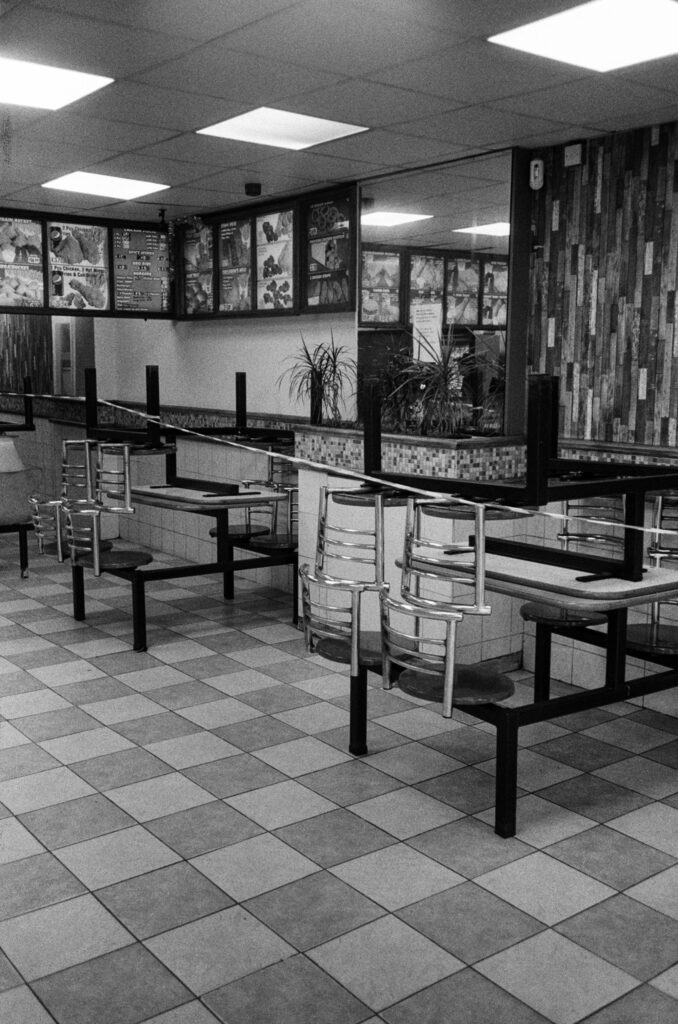
    Whilst a local fishmonger in South London won’t make headlines for continuing to serve the community their thriving independence is reflected in other businesses across other sectors, especially in the hospitality industry. Chicken shops on high streets have taped off their tables to keep the takeaway side of their businesses alive and as larger pubs tied to breweries mothballed their taps and closed their doors, independent owners used the rules to stay open and keep their heads above water. In becoming take away establishments for their neighbourhoods they have created little pockets of considered normality in these abnormal times. 

    Just as businesses have pivoted and changed direction to survive over the last ten months so individuals affected by the pandemic have had to change direction and embrace new adventures and careers.

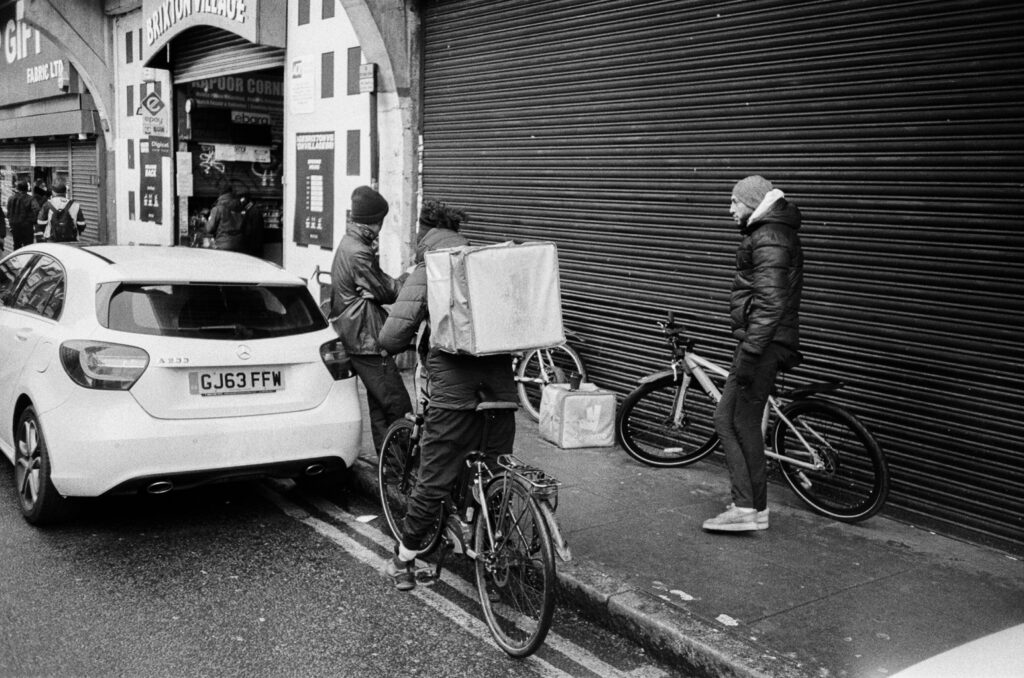
    From becoming Deliveroo drivers instead of going to University, learning new technology to keep previously cash dominated businesses alive to rediscovering local shops and regrowing previously lost relationships with neighbourhood suppliers these portraits also reflect a changing community that has often had to pivot to survive and in some cases now thrive in the new now.

    The images were shot on both 35mm film and a Leica SL modern digital camera. The small unassuming Olympus Mju 35mm film camera I find not only to be a great conversation starter but also much less imposing than a larger digital body and puts more subjects at ease. What is lost in mega pixels I find is more than made up for in warmth and openness.

    A local luggage salesman with his shop half shuttered turns to ‘click and collect’ and uses Whatsapp to confirm sales and stay open during Lockdown 3

    A local greengrocer wearing multiple layers and a face mask during a long shift in mid winter is typical of the current situation we find ourselves in
    Derek’s Tropical Fruit and Veg is a wondrous establishment made up of fruit and veg boxes and a single gazebo that come rain or shine sits proudly in the middle of Electric Avenue 
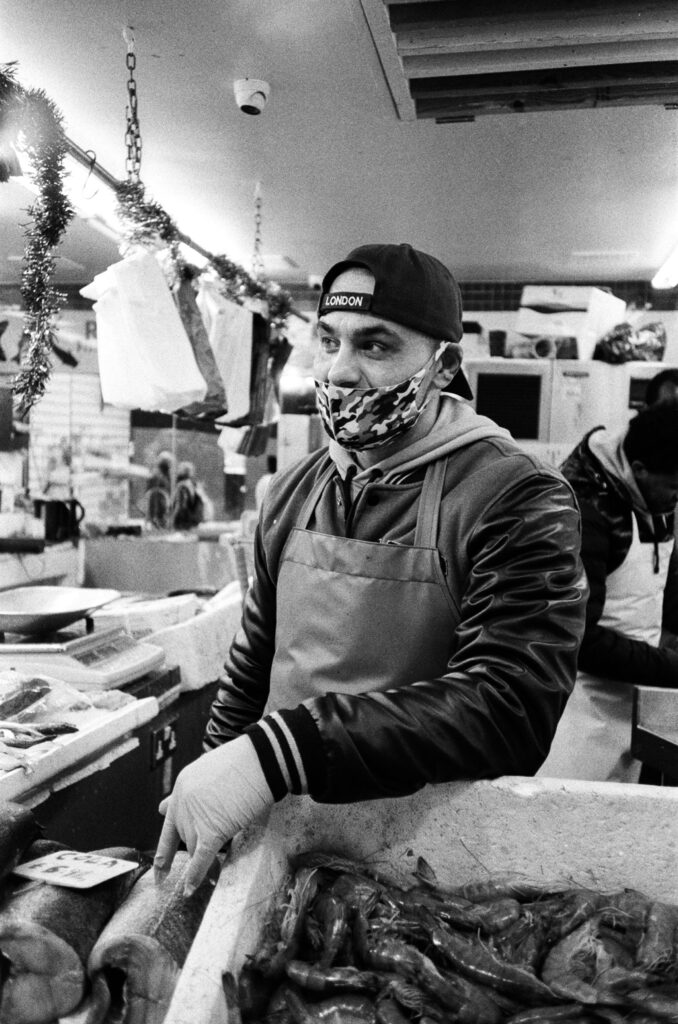
    A local fishmonger wearing his London pride front and centre, wraps up warm against the winter chill. There is a real satisfaction in people taking the wearing of masks and gloves seriously in the food industry, protecting everyone along the chain from supplier to eater.
    A greengrocer uses her phone and a card reader to minimise contact during sales and ensure that previously preferred cash transactions are not lost in this brave new technological world.
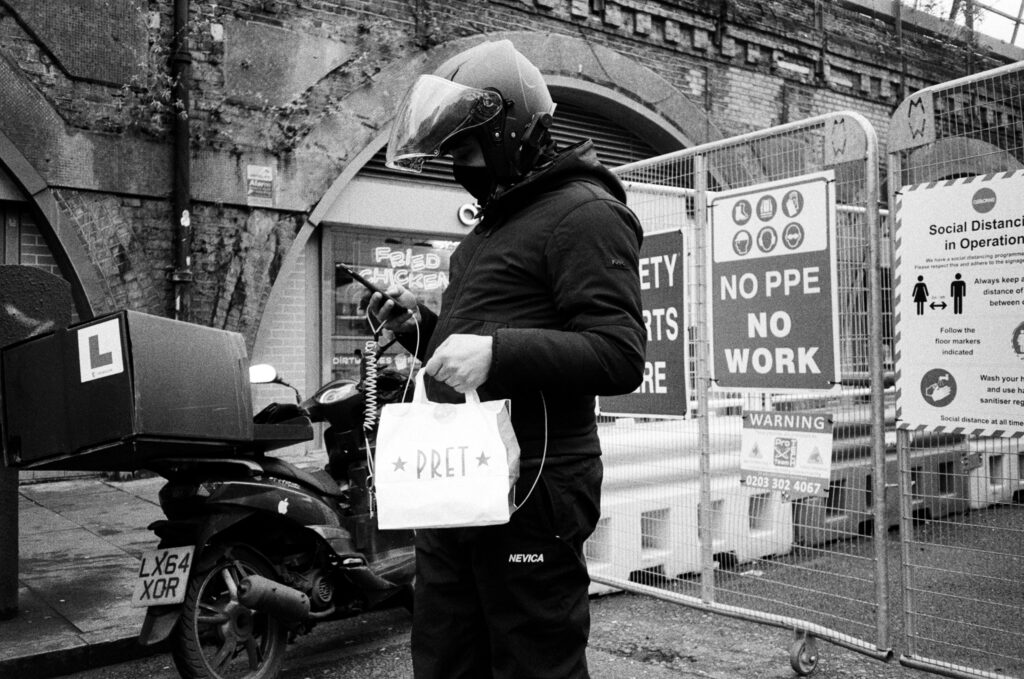
    A Deliveroo driver collects someone’s lunch surrounded by signs of the time
    A group of three Deliveroo drivers grab a break and a chat as they wait for their next order. After finishing education and with traditional job paths curtailed by the pandemic, joining deliveroo has become a good, if slightly longer than intended, stop gap.
    A chicken shop on Brixton Road tapes off the seating area and continues to trade as a takeaway only.