Ronel Lehmann‘s sharp wit wonders if we have the wrong attitude to swearing, whether we have the whole notion of winners and losers wrong, and worries that the BBC may have offended the Queen
Leaks
Our Thames Water bill arrived. It says that we could save on our wastewater fixed charge if all the rainwater from the property drains into a soakaway, stream or river instead of its sewer. Try telling that to residents of properties whose basements flooded recently.
By Royal Command
The news that the BBC is reviewing whether to downplay the wall to wall coverage of future deaths in the Royal Family couldn’t come at a worse moment for HM The Queen. The one Head of State who when her time comes deserves the most respectful tribute, should think about withholding her licence fee.
Sorry! Language Timothy
I don’t normally read The Guardian. A book review entitled “The Right to Sex” caught my eye. It was littered with the word fuckability. I wondered why it is alright to print repeatedly when on terrestrial television, such use is abhorred. Then I read About F-ing time: bloody loses place as Britain’s top swear word.
Feeling Blue
I just had to renew my Passport. Snappy Snaps took the photographs and then lo and behold, I look like a serial killer. When the documents arrived, the graining of my picture behind the bio-metric lessened the impact. I am not so vain, clearly.
Diversity
For years, Labour has been championing diversity, inclusion and more women in politics. Finally, UNITE trade union elects a female Sharon Graham to the top job. Maybe instead of being Sir Kier Starmer’s critic, the new General Secretary will seek to topple the incumbent Leader and replace with the Labour Party’s first Leader of the Opposition. Conservatives 2: Labour 0.
Global milking
Today I read that in a few years, we will not be drinking cow’s milk anymore. As a child, I can still remember the gold, red and silver top bottles left on our doorstep by the milkman. Now, I will have to look forward to plant- based milk with my porridge. No one has mentioned what will happen for special treats of cream in my festive coffee.
Hic
No one likes change. The news that if you want a Gin and Tonic aboard a British Airways flight you are required to pre-order your drinks using an App has caused much offence to long standing passengers. The days of frequent flyer programmes to build loyalty appear to be over. Heaven help if the choice of gin doesn’t include Hendricks with a slice of cucumber.
Loser
Throughout our education, we are conditioned that there are winners and losers. You never want to be a loser. Well this is not always true. We were proud of our football team coming second. When at preparatory school, everyone wins a prize, so as not to disadvantage a contemporary, we’re prepared for the idea that winning is everything. Even when attending a birthday party, we now have the the business of giving going away presents ensures that everyone can celebrate, not just for the birthday. The winner doesn’t always take it all – in fact, perhaps they never do.
Matt Thomas interviews the barrister and climate change advocate on COP 26 about his extraordinary career on the front lines of the great fight of our times
MT: I saw that you first trained as a barrister, how did you end up in the environmental world?
I went to the University of Western Australia, and I did law there. And then I came back to the UK, really only because my mother was terminally ill and I went to University College London to do my undergraduate law degree.
And for all sorts of reasons – only part of it was to do with the course or the university – I didn’t connect with undergraduate law at all and I struggled to perform having been used to doing well in the art subjects, particularly in English literature and other subjects, I found English law really pretty dark.
I just didn’t connect with it so I had a period of time, right at the end of my degree, which was very intense and rather sad, and with the help of friends and then a girlfriend, I somehow managed to get a decent grade. That was largely because in my last year I focused on international law and jurisprudence legal philosophy.
Suddenly I found a way I could understand – partly perhaps because I had grown up in Lebanon and Singapore and Australia. International law seemed to fit more my understanding. I was interested in the cases of international negotiations and the things that international law seemed to be based upon, and I was attracted to the more obvious moral and political case for law that you see in the legal system that’s still forming itself.
And it just seemed to work. I got my first proper job I suppose at the Research Centre for International Law, I became director Studies in Law at one of the colleges and the Chernobyl incident had inspired intense academic conversations about the question of what you do when environmental harm so obviously crosses borders.
The Soviet Union did not inform its neighbours about Chernobyl. They kept it secret, and the world really found out about it because of a private satellite who saw it and followed the clues on the radionuclide cloud. Governments did not bring actions directly against each other in the international court. It seemed to us at the time this was just an example of the legal system not working.
MT: So, the Chernobyl disaster was the ‘lightbulb moment’ I guess in terms your first link to the environment?
Yeah, that was it. It was a graphic example of a trans-boundary environmental harm. And the way the law worked – or didn’t – reveal inadequacies of the international legal system. It needed a fresh approach. And then after that, the climate change issue emerged and had similar more substantial problems to resolve. But the obvious place to be is international law because the problem could not be resolved by individual nation states.
Q: As a ‘friend of COP’ what has been your involvement in the conference?
It’s a day to day, topical question. All the governments who have this role of president form groups of advisors, and they vary. I’ve done a few, they vary in type, but they’re meant to help the president’s function which is to shepherd everybody towards agreement.
Equally, all presidencies have some kind of thematic approach to the climate problem, as well as their principal obligation which is to get agreement on whatever the agenda items are for the year.
The UK Government which obviously has a very substantial and competent civil service doesn’t really need the kind of advisors that other governments have needed. I’ve been a senior advisor to Morocco and to Fiji, where I was really hands on.
Outside of government, I think it is useful to have another circle of advisors who are independent and can say straightforwardly what they think and are worried about the consequences. Even so, it can be frustrating sometimes when you aren’t adequately listened to and anyway. But we have regular calls, as a group, directing into Alok Sharma who is the president of the process. We also have calls with his senior officials on particular topics. And, you know, there are several themes, and each of those themes have subsets of the group and often I happen to be involved, particularly with the nature theme at the moment because that’s part of a project I’m working on. But I also get involved in the finance and because I’d be an experienced negotiator, I’ll talk to the chief negotiator as well about how they’re running the process.
Where you’re going to arrive in terms of negotiations is always contingent on things that have nothing to do with climate change or some other geopolitical issue. Some other pressing immediate concern, something that has to do with a relationship that is central to power in the world.
Success or failure usually turns on the US and China. There are really only 20 other countries that have to come to agreement to make a difference, even though the whole process works by consensus here.
But if you don’t have India, China, US, the EU aligned or capable of coming to agreement then your event fails.
MT: I was going to ask later on about what sort of challenges there are but from what you have mentioned it seems topics like geopolitics seem to actually come before addressing climate change?
They can’t be separated. Every now and again, you see the potential for climate change. As an existential issue, it has the capacity to bind, and it can actually bring people together; it can make people desire cooperation. That remains a hope that I have that at a very elemental level. There is common ground between these big forces in the world who have other reasons for disagreeing. But that might be the idealist in me speaking.’’
MT: On your website you say that, when addressing issues centred on tackling climate change, you are ‘interested in the space between law, policy, finance and technology’. Can you elaborate on what you mean by this?
I’ve decided that’s probably my function. So, for example, if you want to deploy capital to solve the climate change problem you want your money either to have very specific obligations to deal with climate, or, that there is an opportunity for you to compete with incumbent businesses and technologies that may actually be causing the problem but have been there for a while.
So if you want a marketplace for money and technology and other resources, you have to change the rules. So changing the rules means changing the law or changing the application of the law, or changing the public policy interpretation of the law.
Clearly, there’s politics and power politics involved with that but there’s also permanent civil servants who have mandates that are already set. They, on the whole, either make or implement policy depending on where they are in the world. Frequently, the language spoken by all parties is so different, they don’t quite understand each other. And they certainly don’t trust. And then, the world of finance has his own ecosystem, all sorts of different types of finance, they have become quite distinct tribes with their own return expectations. They have their own sense of themselves. Believe me, they really do have their own sense of who’s best.
And sometimes that doesn’t connect with people who create enterprises, entrepreneurs, innovators, people starting out, have no experience of any of these phenomena. They need to be helped, but they also need to have an environment in which they can actually compete where they can thrive.
I like to keep on top of what’s coming through in the world of innovation I want. I have got some experience to offer but I don’t know the answer, so I’m interested in being something of a carrier of ideas, and a connector of people.
MT: It seems to me that there is a strong focus on climate change but the interrelated issue of biodiversity loss gets far less attention. Climate change is just one of the factors behind the destruction of habitats and the degradation of the natural world. How can companies, consumers and policy makers elevate understanding of the impact of biodiversity loss on human societies?
‘Yeah, and they are completely interrelated, which makes it evermore complex to solve. I spent most of the last year, more focused on nature.
I’ve worked a lot on wildlife. I did the International Whaling Convention, the Convention of Endangered Species, illegal trafficking with wild birds and other species.
It’s quite dangerous work too. I work with people who risked their lives trying to reveal what was going on. So this has been there all along but it’s been a relatively minor issue for big politics. It’s an issue for people who care. It’s an issue for people who’ve got a particular concern about a species, and it’s widely felt. People do feel a connection with nature.
Clearly something happened to us psychologically during COVID, where people started to appreciate nature wherever they lived – maybe, particularly if they lived in a city.
The climate issue has highlighted aspects of the decline and threat to nature, but not all of them. It has a tendency to deal with climate as a priority that has sometimes led to people thinking too little about the complexity of natural systems. Planting trees is not a solution a guaranteed solution as planting trees means monoculture, and actually, biodiversity loss, which can happen. And as has happened.
Recently some good research came out of Oxford, on how many 50 degree days there are in a year now. The more you have those a year, the more you suffer economically, but there are things that can be done and relatively quickly to change that and a lot of it is to do with planting trees or creating green surfaces. But we also need to manage rainfall, because we’re getting more intense rainfall which our hard surfaces can’t handle.
Q: Do you expect these conversations around biodiversity to become more mainstream in upcoming years?
I do. And I think that language is important. Biodiversity doesn’t reach people. Nature does. So choosing the right language to communicate, choosing the right messengers, obviously we’ve had the legendary David Attenborough to do a lot of the messaging, and he has made the connection between climate and biodiversity pretty clear. But if you want to do something about it in your own place, you probably need to organise at a community level. And that’s really hard to do, but necessary.’
Q: We touched on it briefly earlier but what do you see as the main barriers to tackling climate change?
I think one of the main barriers is psychological. It’s a problem that feels too big for me as an individual. If I don’t think I’ve got any levers of power to pull, then I want someone else to do it.
And meanwhile, I’ve got something that’s immediately pressing on my concerns that I’ve got to feed children or I’ve got to find shelter, I’ve got something that right now I have that I have to care about. This issue looks literally beyond me – beyond my levers – and has a temporal dimension that encourages you to postpone action.
The other psychological fact is that we all experience is that we all have a kind of status quo bias. I don’t mean that in a political sense I mean, we’d rather not be disruptive.
And, and also, there’s a generational problem here that the generation that benefited from the tremendous growth in the 20th century that was driven by widespread use of fossil fuels, miraculous, use of fossil fuels, the innovation that went into fossil fuels the number of products, God knows. Look around you. Now, how many things in my room right now have a petroleum base or hydrocarbon base. Yeah, staggering.
It’s very hard for that generation, to feel like there was anything wrong, you know, good things came from that place, wealth, and security, and material benefit.
On top of all that, there are cultural connections that are very, very deep. You can see that most clearly in in the kind of mining and mineral cultures of Australia and Canada and the US.
So, you know someone from the soft city comes along and says, all that, all those minerals and oils are there bad thing, they get dismissed because they come from the soft city and they don’t know how hard it is to win this stuff from the earth and create wealth. Those things are hugely important.
But in the last few years that the things have shifted quite markedly. Because there has been some government intervention the barriers are different now. They’re to do with how quickly you can make the transition, and how fairly you can make the transition.
There are several set piece battles, I don’t like to use war language, but what the hell. One of them is that renewables have to beat coal in Asia. And yeah, then you got to ask, “Where’s the money going to come from?” Well, there’s lots of domestic capital in China. Actually, in the end I’m not that worried about China.
There’s a very confused picture, because they’re the largest renewable energy market in the world but they’re also still doing a lot of coal. But Indonesia is crazy. Why on earth are they building more coal plants?
MT: How would you rate progress in the UK in comparison to other mature economies around the world?
‘Very good in parts. Very good in creating the legal frameworks and very good in concentrating expertise in many disciplines, less good on implementation.
Unfortunately, we’ve had some quite mediocre government where people who are more interested in politics as played out in the media.
And that’s not a party political point because it works across the spectrum. It just is the case that too much politics is based on how you appear on a screen and how you are interpreted by the media and not enough with how you govern your department.
Unfortunately, climate change is one of those issues that you need good government. A nice soundbite doesn’t actually solve the problem.’’
Who would you say are the best at implementing right now?
As a structural point, I think it is much easier to implement in smaller states, where there’s a high level of trust in the community. Denmark would be an example of an effective response/
Periodically, the other Scandinavian countries do well and you see elements of progress in Germany and the Netherlands. I mean elements because it’s not perfect by any stretch. And then you see it also in the highly educated and technocratic cultures like Singapore and Korea. So those places have done well.
But nobody has all the answers, and nobody can solve the problem on their own. So, unless you get something like 20 to 25 of the major economies of the world, all doing something broadly similar in terms of effort, then nobody, nobody can protect themselves from all consequences.
People will move. Of course, they will move. You would, I would. If I’m living in a place where I’ve got no water I am going to go somewhere where there’s water. If I’m living in a place where there are 20 days above 50 degrees in a year, I’m taking my family out of there. I want them to survive.’
MT: Are there any specific goals that you and your ecosystem have for the next couple years?
I’m working at the moment on natural capital. I’ve got goals associated with that. And, and they’re largely to do with lining up a big general principle, like, we should value natural capital, and then taking it, drawing that down into the institutions, where they have the power to apply that in practice, and then showing examples of how the principles applied through investment in a real transaction.
These are the kinds of things that are both short and long term because I think we’ve got some momentum on the topic. But then there are others that are just the same as they always were, really: they’re about trying to get agreement to keep as far as humanly possible under or not too far past the 1.5 degree threshold.
I’m constantly scanning for enterprises that I think have a solution that could scale. Now I want to find an institutional capacity to do that routinely so it’s not left to a few individuals around the world, whereby we actually have good well-structured, well-motivated, incentivized institutions, to find the solutions that can be accelerated and deployed, because we’re in a race. Alot of these great ideas will emerge organically over time but we actually need to speed the whole process up.’’
When people ask Zak Johnson why he got into the fashion business, he always tells them that he didn’t. He instead replies: “I got into fixing plastic. I found a problem that I wanted to solve, so I don’t look at what we do as fashion, I look at it as problem solving.”
Johnson, founder and CEO of luxury clothing brand Naeco, is a passionate surfer. Six years ago, whilst working on a contract in Bournemouth, Johnson had ample opportunity to kite surf. Each time he would clear his section of the beach of plastic, putting it in the recycling bin. However, he began to realise that “it felt like I was picking up the same plastic on a weekly basis, I thought at one point, ‘is someone chucking the plastic back in?’, I couldn’t work it out.”
Johnson developed a bugbear and started to look into where plastics go after use. “Six years ago when you started to delve into plastics you’re seen as a little bit strange. It wasn’t as mainstream as it might be now” he explains. In his research Johnson found that 91% of all plastic is incinerated or sent to landfill, and that only 9% is recycled. He was shocked to find that even the plastic that goes into the recycling bin isn’t 100% recycled, it often ends up going into incineration for energy programmes.
Johnson’s decided to come up with a solution that would take waste plastic and reuse it as something in plastic again, “single use is only single use if you use it once” he states. This is where Naeco was born. The name itself, is ocean spelt backwards and represents the sense of reversing the issue.
“I looked at plastic as a commodity, people that are throwing plastic away are looking at it as trash.” says Johnson. The plastic was once manufactured for profit, and bought for a price yet once used is considered to have lost its value. So Johnson went about trying to educate the consumer, that waste plastic still had worth: “it started by looking at it as £10 notes in the ocean rather than looking at it as rubbish.”
Johnson set upon manufacturing sportswear after looking into the process of extrusion, which takes plastic, heats it up and turns it into liquid. From the liquid it can be turned into a pellet, and that’s what virgin plastic looks like. These pellets can then be spun into fibre and yarn, which is where we get polyester. This led Johnson to think “what if I could make a pellet from recycled plastic, and then turn that into fabric?”
In keeping with his new self-confessed, plastics-obsessed eccentric image Johnson set about building an extrusion machine in his spare bedroom. “In the beginning I made tonnes of mistakes because there wasn’t as much research, or at least it wasn’t accessible to the layman at home googling,” but after discovering the need for single waste streams to avoid mixing plastics, the project took off.
Naeco now has industrial machinery that can process 500 kilos of plastic per hour. Once the plastic is recycled into pellets they are sent off to a textile mill and spun into yarn and from there Naeco receives its fabrics.
Making swim shorts was an obvious leap for a fashion business founded in Bournemouth. Johnson envisaged selling them to his friends, who would keep them for around five years, “that then gives a longer lifetime on that plastic and they would value it.” Johnson also recalls how he believed making swimwear would be easy, but not puts this down to naivety. It took 18 months to make fabric, and another year to get to the point of finally making a garment.
Naeco is holistically conscious of its environmental impact, and always seeks to be sustainable in all its practices. Another reason for choosing to design swimwear – and soon outerwear too – was to reduce the microplastics that would return to the ocean through washing. Swimwear and outerwear are among the garments that the consumer will wash the least. Johnson also recommends using a Guppyfriend microfiber bag, to capture micro plastics in the wash. The company also uses natural dyes that are ethical and eco.
“It’s about minimising the washing, and then anything that’s high wash so our jumpers, hoodies, and t-shirts are made from organic cotton or bamboo and they don’t create microplastics.” Naeco takes organic cotton from the cutting room floor of manufacturers who use sustainable fabrics, but Johnson seems most passionate about Bamboo. “It grows super fast, it uses less water, it’s just an efficient powerhouse of a product,” he says “ our t-shirts are so unbelievably soft, nothing feels like bamboo. When you wear a bamboo t-shirt for the first time you don’t want to go back to anything else.”
Naeco started off as a solo venture but now has fourteen employees in the UK, as well as satellite offices in Morocco, the US and Poland with around twenty employees overall. “We’re pretty overworked, which is great” adds Johnson with a laugh, “we’ve definitely grown a lot this year, it’s probably been our biggest growth year.”
This is largely down to Reborn the sustainable corporate workwear arm that Johnson launched two years ago. Reborn creates sustainable workwear for the Jockey Club, Moët Hennessy, Arsenal, Magners and other such brands in that space. The resources for Reborn differ in that “we take plastic from existing waste streams before it enters the ocean” Johnson explains. For example, at the Cheltenham Gold Cup the Jockey Club used a million plastic cups over four days, it was six tonnes of plastic and we converted that plastic back into 30,000 metres of fabric, which created 12,000 garments which actually clothed every single member of staff at Cheltenham Gold Cup.
“That side of our business has exploded this year. I think consumers have become very aware about their sustainability issues.” Johnson puts this down to the lived reality of the current situation: “we’ve seen that what we do to our planet has an impact on our personal lives now. A pandemic like this is just a taster of what we’re in for globally, if we don’t start fixing some of these sustainable areas and tread lightly on the earth.”
This shift in attitude from individuals and corporations has put Naeco in a perfect position for growth. “We don’t add sustainability on to what we do, we truly are sustainable and have been from day one” Johnson explains. Indeed Johnson is now looking to go even further, with the company attempting water recirculation in their factories. Johnson is building new technology to recirculate the water for the manufacturing process, and to reuse the heat from the shredders dissipating it back as energy to reuse in the battery packs. Naeco is its own micro circular economy.
Looking forward, Johnson wants to focus on building more recycling centres. Naeco will have the UK recycling Centre in Buckinghamshire but wants to build one up north and one in the middle of the country. Abroad, the company has an opportunity to expand in Morocco where there are a great deal of textile mills as well as a huge plastic problem.
Johnson is also keen for more collaborations with local authorities and governments. “We’ve seen some states in the US be very receptive to what we’re doing. We’re looking to build recycling centres in the US, where we’re able to take plastic and repurpose 100% of it.”
Despite the relentlessness of plastic production and contamination, Johnson is optimistic about turning the tide. Optimistic is “who we are as a business, if we weren’t I don’t think we’d get out of bed.”I would love us to be in a position where plastic is never, never produced anymore, but ultimately we’re probably going to live in a world for the next 100 years that continues to make plastic. What we need to do is reduce that amount of plastic.
He ends our conversation with a particularly positive prediction “I think in the future all businesses will be sustainable. They won’t just have sustainable principles, they will be entirely sustainable. In 100 years people will say ‘I can’t believe people set up companies that weren’t sustainable from the beginning.’ I think business will evolve and change.”
What’s happened with Covid is that people now realise that the world can change very, very fast. The Green Party has been saying that we need to get to net zero by 2030 and people would always reply that the world doesn’t change that fast and you just have to be patient, and it takes time for business models to turn around and so forth.
But coronavirus changed the world overnight – and changed the world of work too. We now know that speed of change can be a matter of weeks, and also that as a society we have this secret resilience we didn’t know we had.
Of course, on top of that we’re seeing with horrifying weather events all over the world that the climate emergency is here, and that we can’t put our heads in the sand. That’s because we can’t ignore that the way in which we treat the planet is tied to any notions we might have of prosperity: there are no jobs on a dead planet. We’re turning our oceans into a plastic soup, destroying our biodiversity and disrupting the systems which give us life.
There’s talk in the climate community about how the virus has helped focus our minds. That’s true to an extent. Not travelling frees up time and we save money by not going into the office. All this has benefits for our well-being and we know that cutting down on travel time makes the air smell less of diesel fumes. We’re coming to realise that going green is a win-win policy.
But we’ve also got to realise that people tend to find change threatening, and we still have got to address the emotions that the climate question raises. People have been through a difficult time, but those who do react to the climate problem, and seize the initiative are the ones who will be successful, and will lead and be adapted to the new circumstances. In any situation like this, you have the early adopters: society never changes with 100 per cent of society suddenly seeing what we need to do.
Some people still take the approach of what I call ‘business as usual but with added efficiencies’. It’s the idea that we’ll carry on doing things as we did them before, but with a bit more renewable in the mix, and some energy efficiency measures, and some conferences like COP 26.
But the Green Party is talking about wholesale transformation of our society. Take landfill as an example. If you’re producing huge amounts of disposable material then that’s not a sustainable business model; what we want to see instead is a circular economy without that waste pyramid. It stands to reason that you need to reduce the amount of physical material. It’s another reminder that we can’t change just 10 or 20 per cent; we have to change completely.
I think that has to begin with education. I’ve been asking this government questions about taking education outside into the natural world, and even about a GCSE in nature. We’ve been championing that kind of approach; we need education to be for life and not just preparation for exams. We need to look at gardening, and we need to look at cooking as being topics which might join the curriculum.
In respect of the economy, I would regard the Green Party as the natural champion of small independent business. What we want is strong local economies built upon small cooperatives – and I can point to examples up and down the country where Green councillors have helped bring that back.
What we don’t want is an economy dominated by a handful of giant multinationals or hedge funds who own a bit of all them. That means no competition. I’m a fan for instance of the People’s Supermarket in Camden where I used to be a volunteer. That’s a different model of local food supplies which we can all learn from.
The other thing we could learn from is the Finnish education system. I remember once I was on a long distance train in Finland, which purely by chance had a children’s playground on it for up to six or seven year olds. It was this amazing thing, with little slides and so on and families were having a lovely time on their train journey. I tweeted the photo and I don’t think I’ve ever had such a big response. That’s the kind of community-led thinking we need. Let’s hope Covid has brought us round to that mindset.
“Apologies if I’m out of breath when I speak to you,” Lizzie says when I catch her over the phone as she walks to a university lecture. For most students, the act of getting out of bed and actually attending a lecture seems like a small triumph but for Lizzie this is a pretty gigantic triumph. Just a year ago she couldn’t walk anywhere and certainly wasn’t in any state to be concentrating on her geography lectures.
Lizzie, 22, is thought to be one of more than 2 million adults in England to be impacted by long COVID. She caught the virus in July 2020 and wasn’t horrendously ill but as the weeks and months went on she found she wasn’t getting better. In fact, she was getting worse.
Though she was on track to get a first class degree from the University of Bristol, and had been a successful long-distance runner, both those things had suffered. “I did the course online from home but I couldn’t sit there for an hour and concentrate. I just realised it was pointless doing a year,” she recalls. She took the stressful decision to defer a year. While her friends pressed on with the degrees she spent a lot of time asleep.
There are an estimated 106,000 under-25s like Lizzie, whose education is suffering due to the long-term physical impact of the virus. People with long COVID, which is when symptoms persist for longer than 12 weeks, may have to endure extreme tiredness alongside problems with memory and concentration as well as insomnia. Such symptoms are hardly conducive to effective learning.
Thankfully, Lizzie was surrounded by a family and supervisors who supported her decision to focus on getting well. “I know people going through the same thing, and it’s just very frustrating. The longer it goes on, you just think, ‘Surely I must be better now.’ But you’re not and now I have this lingering fear that I’ll have another year of doing nothing. It was such a bizarre experience. Someone at my brother’s university has dropped out, I know another friend of a friend who has had to defer. It’s just exhausting,” she sighs.
Of course on top of the physical impact of long COVID, the pandemic has forced students out of classrooms and the impact of this alone has been stark. The Sutton Trust for example says that 5 per cent of teachers in state schools report that all their students have access to an adequate remote-learning device, compared to 54 per cent at private schools.
Professor Russell Viner, president of the Royal College of Paediatrics and Child Health, recently told the Education Select Committee: “When we close schools, we close their lives.” Viner argues that the pandemic has caused a range of problems for students, from being isolated and lonely to suffering from sleep problems.
Finito World spoke to the head of a department at a sixth form colleague about how they deal with students suffering from the long term impacts of COVID, either physical or emotional. “I encourage them to do their work when they feel at their best and rest when they are not up to it,” she explains. “All lesson PowerPoints and notes are made available on Teams for students to access. I have also added four extra drop-in support classes for students to access. This is intended to help those who missed classes due to COVID or didn’t cope well with online learning,” she explains.
She says that although the situation is tough, students who fall behind will ultimately have the opportunity to get back on track. “We are also running catch-up sessions each week where first year material is being retaught to second year students. All students are welcomed to these sessions and we repeat them on three separate afternoons each week so that a student should be able to fit one in to their timetable.” The teacher, who wished to remain anonymous, says she wishes all schools and university had such catch-up measures in place. “We have about 140 second year students and about 20 are attending these,” she explains.
The schools and universities might be open now but the pandemic is not over and many young people are still enduring the long-term impact of COVID. “No matter how young or healthy you are, it can very, very easily be you who gets affected by the virus. I know it’s always in the news so you forget that. It seems separate,” Lizzie says, urging her fellow students to stay safe and continue using measures to protect themselves from the virus.
Although she started to feel a bit better in February she says she wants to raise awareness about long COVID clinics, which have helped her. “At the beginning GPs didn’t know what to do with me or where to put me but as long COVID clinics have started popping up we need to raise awareness of them. It’d be good if teachers and lecturers knew more about them so they can point pupils in the right direction, if necessary,” Lizzie explains.
After a year out, Lizzie has made a good albeit not full recovery and she hopes that as the pandemic goes on more people will have access to the COVID recovery clinics.
Thankfully, the NHS has set up a specialist young people’s COVID clinic. “I just hope teachers and doctors know about it so they can point people even younger than me in the right direction,” Lizzie says.
The 15 new hubs will draw together experts on common symptoms who can directly treat young people and advise people caring for them and refer them into other specialist services and clinics.
“The boost to dedicated services for young people is part of a package of investment in a range of measures to help young people and adults with long COVID, including a major focus on specialist treatment and rehab services,” an NHS spokesperson explains.
It is estimated that 340,000 people may need support for the condition including 68,000 who will need rehab or other specialist treatment. While the majority of children and young people are not severely affected by COVID, ONS data has shown that 7.4 per cent of children aged 2-11 and 8.2 per cent of those aged 12-16 report continued symptoms. Lizzie adds: “There’s hope. But it’s not over yet.”
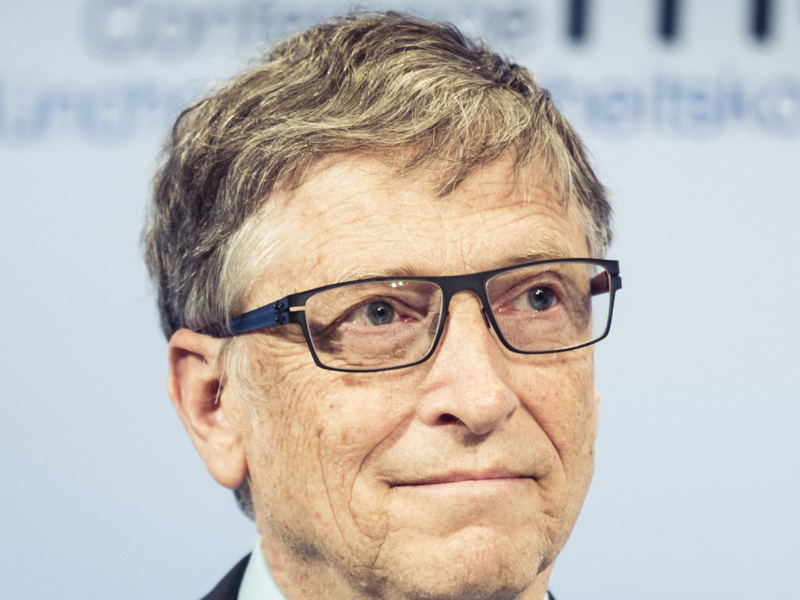
How to Avoid a Climate Disaster: The Solutions We Have and the Breakthroughs We Need by Bill Gates, Penguin, £20.00
A climate disaster is looming and although its impact is mostly invisible in our day-to-day lives, the damage humans have done to the planet already seems dauntingly irreversible. As Bill Gates points out, “fifty-one billion is how many tons of greenhouse gases the world typically adds to the atmosphere every year” and merely aiming to reduce emissions by 2030 is not an adequate target. He explains: “The climate is like a bathtub that’s slowly filling up with water. Even if we slow the flow of water to a trickle, the tub will eventually fill up and water will come spilling out onto the floor. That’s the disaster we have to prevent.” Simply put,“if nothing else changes, the world will keep producing greenhouse gases, climate change will keep getting worse, and the impact on humans will in all likelihood be catastrophic,” Gates says. But How to Avoid a Climate Disaster focuses on the “if” as Gates considers the changes needed and sets out an optimistic road map of how we can divert a climate disaster.
By his own admission, the burger-loving billionaire founder of Microsoft is an unlikely poster boy for saving the environment. “I own big houses and fly in private planes – in fact, I took one to Paris for the climate conference,” he confesses. While Extinction Rebellion seemingly sees anti-capitalism as crucial to the cause of environmentalism with many of its followers protesting by causing disruption in London’s financial district, Bill Gates is proposing a way to reduce greenhouse gases which will be palatable to big businesses. In each chapter he considers the financial implications of his suggestions. He proposes that countries should implement what he calls “green premiums”. He explains: “Most of these zero-carbon solutions are more expensive than their fossil-fuel counterparts. In part, that’s because the prices of fossil fuels don’t reflect the environmental damage they inflict, so they seem cheaper than the alternative.These additional costs are what I call Green Premiums. During every conversation I have about climate change, Green Premiums are in the back of my mind.”
Indeed, Gates is pragmatic in his approach and is constantly aware of the feasibility of his proposals. In the chapter about eating meat for instance, he says although animal consumption causes a lot of environmental damage, it is unrealistic to stop it entirely. He looks at meat alternatives, such as Beyond Meat, a company which he has invested in. He reasons: “Artificial meats come with hefty Green Premiums, however. On average, a ground-beef substitute costs 86 percent more than the real thing. But as sales for these alternatives increase, and as more of them hit the market, I’m optimistic that they’ll eventually be cheaper than animal meat.”
Gate remains optimistic throughout the book and suggests the threat of a climate disaster provides mankind with an opportunity to be innovative. He is always looking for the silver linings. For instance, he says: “I never thought I’d find something to like about malaria. It kills 400,000 people a year, most of them children, and the Gates Foundation is part of a global push to eradicate it. So I was surprised when I learned there is actually one nice thing you can say about malaria: It helped give us air conditioning.” In the most compelling chapter, What each of us can Do, he suggests we should all be hopeful. He says: “It’s easy to feel powerless in the face of a problem as big as climate change. But you’re not powerless. And you don’t have to be a politician or a philanthropist to make a difference.” Of course, we hope he is right. Gates was a coronavirus Cassandra. In a 2015 Ted Talk he warned: “If anything kills over 10 million people in the next few decades, it’s likely to be a highly infectious virus rather than a war.” “We need preparedness,” he demanded. This time, hopefully people will listen.
Photo credit: By Kuhlmann /MSC – https://securityconference.org/en/medialibrary/asset/bill-gates-1523-18-02-2017/, CC BY 3.0 de, https://commons.wikimedia.org/w/index.php?curid=100184908
The Covid-19 pandemic has upended the global economy and shaken public faith in the ability of governments to act decisively in the interests of citizens during a crisis.
Yet the unprecedented, disruptive policy actions taken to lockdown economies and reduce Covid transmission have exposed the unwillingness of politicians to seriously intervene in another looming crisis, from which it is not possible for us to self-isolate. Climate change.
In the absence of swift policy action by national governments to deliver on the promise of the 2015 Paris Agreement, many business leaders are now asking themselves what they can do to prepare their firms and staff for a future increasingly disrupted by climate change.
One of the most powerful levers we have at our disposal to fight global warming is finance. Where we invest today, shapes our future tomorrow – yet most of us currently have little visibility or control over where financial assets like our pension funds are invested. This needs to change.
Some 79% of people polled for Good Money Week 2019 agree that we are responsible as individuals to take action to combat climate change, yet 76.5% of us remain unaware that our pension has an impact on the environment at all.
The disconnect between public attitudes on climate and financial sector investment practice, means consumer pressure is not being applied to decarbonise our pension funds.
An analysis by Telegraph Money of the 10 biggest pension providers’ default funds found that pension fund money had been sleepwalking into stocks that were negatively affecting the climate, with only one of the top-10 funds, Nest, having no fossil-fuel producing firms among its largest investments.
This is one area where business managers can take an active leadership role, creating space for conversations on pension fund investment choices, and ensuring fossil fuel free alternative investment options are made available for staff.
Where company pensions are invested is a top 10 issue workers would like to discuss with their boss – with Good money week polling finding 12.6% of workers wanted to discuss issues such as pension investments in arms, tobacco and fossil fuels and potential alternatives.
Research by Royal London has found 40% of people want to be offered fossil free investments ‘as standard’, but with a strong age gradient – 54% of under 35s support this proposition compared with only 34% of over 55s.
In July 2020, it was announced the Nest pension fund with 9 million UK members would begin divesting from fossil fuels to ensure alignment with the Government Net Zero strategy.
Reducing fossil fuel investments is no longer viewed as an ethical or moral imperative alone. With the energy sector the worst performing sector over the past decade, money managers have a fiduciary duty to manage the investment risk posed by fossil fuel investment in a rapidly changing world, where energy transition continues apace, and future demand for oil, gas and coal is no longer assured.
On the Future was written a few years ago and it was an attempt to summarise all the things I’ve been thinking and talking about regarding the future. Astronomers tend to have a longer term perspective on the future as they also do in relation to the past.
The book is now translated into 20 languages, and for the paperback version I wrote a new preface about Covid-19; previously I had spoken about pandemics in the abstract. Another book is out in the spring called The End of Astronauts, expanding on some other points which concerns the future of humans in space. I argue that as robots get better and more sophisticated, the practical case for sending people into space– at least lower than Low Earth Orbit – gets weaker all the time. That’s because it’s very expensive to support humans on a journey to Mars; you have to provide a year of food, and protect them from all sorts of hazards – whereas robots can be sent more easily and with one-way tickets.
For that reason, if I was an American taxpayer or European taxpayer I wouldn’t support NASA’s or ESA’s programmes for manned space flight. On the other hand, I’m prepared to cheer on the endeavours of Jeff Bezos and Elon Musk in the private sector. Firstly, they’re not using taxpayers’ money, and secondly they can take higher risks than NASA or ESA can when sending civilians into space.
Of course, it’s also important to think of space as being a dangerous environment We should talk about Space Adventure and not Space Tourism, for instance. I’d argue that Branson makes a mistake in talking of tourism as if it would ever be normal; if you take that view the first accident is going to be traumatic. If these private sponsors are prepared to send risk-takers up into space – the Sir Ranulph Fiennes of this world and so forth – I’m prepared to cheer them on.
My prediction is that by the end of the century there will be a few pioneers living in Mars, but they’ll be that kind of person. Elon Musk has said he wants to die in Mars but not on impact. And he’s fifty years old; it’s just about achievable. These pioneers will have a long-term importance, and they’ll be in a very hostile environment. They’ll want to take advantage of all the techniques of genetic engineering and cyborgs and so on. Here on earth we’re going want to regulate and constrain things like genetic modification on both prudential and ethical grounds. These guys will be away from all the regulators anywhere and have a far greater incentive. I imagine a few centuries form now they will have become a new species – secondary intelligent design will be much faster than Darwinian natural selection.
Of course, the money might be better spent on the environment – but if it’s spent by individuals who otherwise would buy a football team or a huge yacht, I’m prepared to support it. Musk, like my late colleague Stephen Hawking, thinks that there should be mass emigration to Mars to escape the problems of the earth. That’s a dangerous delusion. Dealing with climate change is a big challenge, but it’s a doddle compared to terra forming Mars. There isn’t a Planet B for ordinary risk-averse people.
I don’t think we’ve missed the boat on climate change. If we’d acted sooner there’d be less risk. But given where we are now, we’ll need drastic and difficult action to limit further emission of CO2 to a level of minimising really serious tipping points. It’s harder than it would have been if we’d had more forethought.
The problem politically is it’s very hard to get public support to devote resources to something which benefits people in the future by removing a serious threat from them. It’s also more important for people in distant parts of the world than it is for people here. Climate change isn’t going to be catastrophic in England but it will be in Sub-Saharan AFRICA: it’s a global and long-term threats.
Politicians are happy to allocate immediate resources to an immediate crisis like a pandemic, but it’s hard for them to spend money on a long-term insurance policy like an effective climate change policy. I quote in my book, I quote Jean-Claude Juncker: “Politicians know the right thing to do – they just don’t how to get re-elected when they’ve done it.” There’s something in that.
When a team around you changes, it can feel threatening. New people coming in can change established dynamics and ways of working. But instead of worrying, the emphasis should be on grasping the opportunity.
Worries can often be heightened when the change takes place in more senior leadership positions, especially those directly managing you. But instead of worrying about yourself and what the change may mean for you, a more constructive approach is to shift from the inward to the outward. An outward approach considers why the change has happened and what you might, to be frank, be able to gain from it.
The recent Government reshuffle provided a very practical example of the need to understand why teams may need to change; it can have a number of drivers.
Change or adaptation? – the core drivers of an organisation could be changed but often it facilitates a refocusing on them, a coming back to basic principles. For Government, a reshuffle can help refocus on those policies that help get it elected in the first place. Boris Johnson’s government has had to deal with COVID-19 so this latest reshuffle meant it could ‘get back’ to what it really wants to deliver, such as ‘levelling up’.
Unpopular positions can be conveniently jettisoned – new team members, especially leaders, can look again at the way an issue is dealt with and make their own mind up. In brutal terms, a new person could have the ability to make wholesale changes. So for Government, a reshuffle means it could dump reforms least liked by their voters. A reshuffle enables the unpopular aspects of policy to be removed just as unpopular ministers can be removed.
Space for new thinking? – on a much more positive note, a change can open up the space for new ideas. Any new team member wants to make a positive impact and preferably sooner rather than later.
So, a new appointment should be seen as an opportunity for engagement which should be grasped. Rather than waiting to be told what the new arrangements mean, look to proactively engage.
Adopting a positive attitude recognises that a different learning experience has opened up, that new ways of working could be available and the opportunity now exists for learning from different experiences.
In the recent reshuffle, Nadhim Zahawi MP was appointed as the new Secretary of State for Education. There is no doubt that he has many immediate issues to deal with, not least those caused by Covid-19.
But if we found ourselves working with him, or any other new leader, what should our approach be?
Do your homework – find out what you can about them so you make your approach to them relevant. In the case of the new Minister, he was recently featured in Finito World. This type of background is extremely useful.
Immediate engagement – try to get in first, before others. Lots of people should want to engage. The more tailored the engagement, based on your homework, the more likely it is to stand out and be effective.
Have something well considered to say – based on your research, knowledge of your role and experience, be constructive rather than taking just problems to them. Solutions are always going to be received more warmly than just another moan.
Be prepared to ask them questions – the engagement should be about listening to them but that does not mean you can’t shape the discussion. Ask about what their priorities are, what they expect from those around them and it can also be fascinating to find out what their bugbears are so you can avoid them!
Adopting a positive outlook with proactive engagement will put you in the best position to make the most of what might otherwise be a daunting prospect.
The writer is the Head of Public Affairs at BDB Pitmans
Sophia Thakur spoke alongside the sound of a harp on stage at The Ned hotel. In melodious tones she recited memories of dead friends who sleep with soil in their mouths now. She rhymed about the injustice of how black history is taught on the curriculum. She talked about self-love too.
As the 25-year-old poet performed, she made expressive hand gestures and looked graceful in a Cinderella-style blue tulle dress. Her look was almost ethereal, until you clocked her shoes: Bright pink crocs.
Thakur’s outfit that evening captures her poetic style well. She is elegant and polished but undeniably practical and unpretentious.
“I’m on the right side of history with these,” she joked to me backstage, pointing at her shoes. “Already on stage you’ve got the nerves and if you’re wearing heels, you can fall. It’s just not worth it for vanity’s sake. About six people can see my feet so I’m completely fine to wear Crocs,” she said.
Indeed, her poetry is unpretentious. She relies on YouTube as a medium for self-expression and doesn’t think much of those who think being a poet means being a middle class man stuck in a rigid form – or the 18th century for that matter.
“You have your purists who believe poetry is this one thing and has to look like this which is fine and fair – and look, I’m not angry with them for it,” she says. “I think there’s a spectrum and for me it’s so important to identify poetry as just the simple act of communicating.”
In Thakur’s case, this act of communicating has been startlingly successful. Thakur has not only graced the stage at Glastonbury but delivered Ted Talks and appeared regularly on mainstream television. Her debut book Somebody Give This Heart a Pen became a global bestseller before it was even released and on the back of her success she has also worked with creative teams at numerous corporates including Nike, Samsung and MTV.
So did she enjoy her education? Thakur says she did enjoy studying poetry in school but felt the “academic” approach wasn’t necessarily the best way to explore poetry.
“I fell in love with poetry via spoken word. I think in school we took quite an academic approach to something that’s meant to be so emotive and like feeling charged. I didn’t get an avenue to love it, I just got an avenue to learn it in school,” she tells me.
After school Thakur pursued an academic path and did a degree in politics. She’s still very much engaged in political discussions now, particularly when it comes to the national curriculum.
Indeed, her new comic-strip style children’s book Superheroes: Inspiring Stories of Secret Strength, was recently published by Stormzy’s imprint Merky Books. It is a response to the fact she only saw black people in history textbooks “in chains”.
In her poetry she tries to change the narrative that is taught in schools about black lives and Britain’s past. “If the only time we hear about blackness in school and anything black at all is when we’re thinking about slavery or when we’re thinking about liberation, then the only stories we have are Nelson Mandela’s or Rosa Parks’s or whoever else,” she explains, seeming to tail off.
Then she continues: ”We then grow up in a world that perpetuates that narrative where the headlines related to black people are quite negative… It’s just really, really upsetting and I think a lot of these ideologies and ideas do stem from the first seed that is planted in us which is black is weak and lesser and white was dominant and is dominant.”
On people who criticise using modern mediums such as Instagram and YouTube as a way of sharing her poetry and having these kinds of conversations, she says: “It’s really embarrassing because I think art if anything is the truth of the time and the truth of the time is this. This is how we communicate now, this is what poetry is now… oh and TS Elliot would’ve loved Instagram poetry.” And with that, Thakur heads off, Crocs and all, into what I’m sure will be a successful future.