“During my campaign for President I made a commitment that we’d provide student debt relief, and I’m honouring that commitment today,” President Joe Biden announced, in a move which many have waited for since his inauguration day. Alongside the student debt forgiveness, Biden has also extended the pause on federal student loan payments until the end of the year.
Who is eligible?
For a person to qualify for loan forgiveness they must have taken out federal student loans, not private student loans. They must also make under $125,000 (£105,957) per year to qualify for up to $10,000 (£8,476) in student loan forgiveness.
President Biden has made it clear that “No high-income individual or high-income household will benefit from this action. Period.” Despite the restrictions on eligibility, “95% of borrowers can benefit from these actions,” he asserted.
Students from low-income backgrounds who qualified for Federal Pell Grants are eligible to receive up to $20,000 (£16,953) off their student loans.
When Biden talks about receiving “up to” an amount of student loan forgiveness, this does not mean that some students may receive more than others on a case-by-case basis. It simply means that if a student is eligible for the programme but only has, say, $8,000 left to pay off, they will have their loan fully excused and the unused funds ($2,000, or $12,000 in the case of Pell Grant students) will go towards paying off another eligible person’s debt.
What is a Pell Grant?
A Federal Pell Grant is a sum of money offered “only to undergraduate students who display exceptional financial need and have not earned a bachelor’s, graduate, or professional degree” according to the US government’s student aid website. In most cases, unlike loans, Pell Grants never have to be repaid.
The amount of money granted to students in need varies from year to year, but for 2022 through 2023 the maximum award is $6,895 (£5,845).
There are certain circumstances in which Pell Grants must be repaid, which has necessitated the second tier of Biden’s student debt forgiveness plan.
The following circumstances could cause a student to repay all or part of their Pell Grant: If they drop out of the course the grant was awarded for, if their enrolment status has changed (e.g. switching from full to part time), if they receive outside scholarships or grants which are seen to reduce their need, or if they fail to complete the necessary steps to receive a TEACH grant which requires students to maintain academic requirements and serve as a teacher for four years within the eight years following graduation.
Reactions
As expected, some are not happy about the move. Senate Minority Leader Mitch McConnell slammed the programme as “student loan socialism”, calling it “a slap in the face to every family who sacrificed to save for college, every graduate who paid their debt and every American who chose a certain career path or volunteered to serve in our Armed Forces in order to avoid taking on debt”.
Senator Bernie Sanders applauded the move, but wants more steps to be taken in order to ensure that the student debt problem cannot continue. “As someone who’s fought for years to cancel student debt, today’s announcement by the president is an important step forward. But let’s be clear, we’ve got to do more. Education, from pre-school to graduate school, must be a fundamental right for all, not a privilege for the few,” Sanders tweeted.
In a time of rampant inflation, critics are not convinced that the $300 billion plan will earn its money’s worth. Biden pre-empted this criticism in his initial statement.
“When this happens, the whole economy is better off… By resuming student loan payments at the same time as we provide targeted relief, we are taking an economically responsible course. As a consequence, about 50 billion dollars a year will start coming back into the Treasury because of resumption of debt,” Biden said, “Independent experts agree that these actions taken together will provide real benefits for families without meaningful effect on inflation.”
And so we enter yet another doom and gloom period as the cost of living crisis tightens. This follows on from other uncertainties such as Brexit, the Covid pandemic, Vladimir Putin’s invasion of Ukraine and the jockeying for position which always accompanies a Conservative Party Leadership election. All this is probably why I have been thinking about ways to gain some perspective.
Fortunately, help has been at hand. When I attended the 8th annual Global Family Office Conference, it was the guest speaker Sir Anthony Seldon who summed up best what really makes us happy.
Seldon explained that it wasn’t having money but enjoying a purpose in life and good friends which provides the stability we crave during troubled times. It was obvious that his comments resonated with all the guests.
Purpose, of course, can encompass many things – not just job satisfaction, but also passions and interests, and the belief that life has meaning.
Towards the end of his 82 years, Johanna Wolfgang Goethe totted up the pros and cons of life. He found when he had completed his ledger that it was music which tipped the balance in favour of life having been worth it. This point was driven home at the weekend when I went to Wembley Stadium to watch Coldplay live in concert.
As an employability expert, I find Coldplay inspiring. Here are four student friends who studied at UCL, Chris Martin (Greek & Latin), Will Champion (Anthropology), Jonny Buckland (Mathematics) and Guy Berryman (Mechanical Engineering). They followed their passion and love of music.
In my field, we find that many of our students are afraid of what their parents think a sensible career should be. The daughter of a forensic accountant didn’t want to join her parent’s profession but was passionate about teaching. Another wanted a career in the creative arts. Both sets of parents confided in their concerns about what salary their offspring would earn. But there is always more to life than this. What also matters is whether children will be happy or fulfilled.
Had Chris Martin’s parents been a client of my business, would they have shared their salary concerns with me as their son began to take his first steps into the industry? Very likely, they would. But with over 100 million albums sold worldwide, Coldplay are the most successful band of the 21st century and one of the best-selling music acts of all time. He followed his passion.
Of course, the creative arts can be a difficult career, but people forget that prior to Covid, according to the Policy and Evidence Centre, the creative industries contributed £116 billion and grew twice as fast than the UK economy as a whole.
At Wembley, Martin entertained an audience of nearly 100,000 people. As you arrived at the Stadium, you were given a wristband. This is all about audience participation, and we soon discovered that the bands flashed to the beat of the music. It was quite emotional to view all the coloured lights, not to mention confetti, balloons and fireworks.
Popular music is essentially democratic. Coldplay’s music is not reserved for the few. There were audience members straight from work, those who had travelled from overseas, old and young people, a multitude of different cultures, ethnicities and religions, all brought together by music.
Upon my return home, I was honestly happier than I have been in years. I think Anthony Seldon would approve – and thank goodness for those who follow their passions in life. It’s bravery which really drives the economy forward and will get us through.
The ubiquity of the tech giant Amazon has been the melody of the past decade – a thumping tune which industries have had reluctantly to begin playing to. In its infancy, Amazon monopolised the book market, food retailers, clothing stores and homeware shops (or almost anything you can think of which they sell on the website).
Then the company, founded by Jeff Bezos in 1994, began reaching further afield: by 2005, Amazon Prime has drowned out shipping companies and trodden on Hollywood film studios; meanwhile, Amazon Web Services, founded in the early 2000s, is now used by the likes of Netflix, Slack, Dropbox and Pinterest. The corporation also has its own broadband services, home security and prescription-drug distribution. For good measure, it also designs clothes and manufactures hardware.
Amazon has gone far beyond its original vision as an online retailer. It has now become an economic eco-system in its own right, and has in the process made it difficult for smaller companies to have a foothold in their relative markets. It’s a process of business manipulation: independent merchants are forced to sell on Amazon’s platform at competitive prices – competing against Amazon products which are cheap to make and cheap to sell.
In February, Bezos announced that third-party businesses in the US had sold ¢1bn products through Amazon’s marketplace. They currently have around a 50% share in the US Ecommerce market, 350 million products across its marketplace and an annual net revenue of around $400 billion.
It’s actually pretty difficult to think of an area which Amazon hasn’t infiltrated. Perhaps it’s those sectors which haven’t yet been touched by the digital world – such as walk-in shops. But even there, Amazon has set its sights in recent months on grocery stores and have opened up a few in London already. Amazon Go convenience stores are the very definition of contactless: the goods you pick from the shelves are billed directly to your Amazon account without even needing to queue for a till.
But perhaps the most surprising sector which Amazon is edging towards is hairdressing. The tech titan announced the opening of its very first salon in Spitalfields market in east London; at the moment it’s open for use for Amazon employees only, but in the coming weeks customers will be able to enter the tech haven that it promises.
True to its name and nature, the 1,500 sq ft Amazon Salon is a case in technology experimentation: machine-learning will analyse what products customers would prefer, and augmented reality technology will allow them to see what they would look like with different colours or hair styles before the fatal cut. Sensors on products – “point-and-learn” systems – will be able to detect when someone points at an item, and they’ll show example videos on a screen above the shelf. Like the Amazon Go stores, people will be able to order beauty products via a QR code on their phone. And, during the cut, customers are offered entertainment provided by Amazon Fire tablets. It’s the full Amazon experience, you might say. All that’s missing is an Amazon drone taking birds-eye pictures of your hair-do.
Amazon Salon strips away the bespoke element of many independent hairdressers: it’s coupled with Amazon Professional Beauty Store, which gives at “wholesale pricing and invoicing, no minimum order value, fast delivery and more”. Well, we know how that story spins out.
The amalgamation of technology with hairdressing is a curious mix – but one which was, perhaps, inevitable. Yet hairdressing is one of those industries which thrives off human-to-human contact, and the worry may be that it’s a slippery slope from sensors and screens to fully automated hairdressers, which in turn raises ethical questions over what it will do to the industry and the workers in it at large.
But taking a few steps back, the current state of play is that Amazon Salon has partnered with a real-life salon and real-life hairdressers, so these fears may be yet misplaced. What do hairdressers on the ground think about these developments?
Ola Goldsmith, who runs her own salon and hair extension training academy Naked Weave, sees the introduction of the tech giant into the hairdressing space – “which isn’t even their specialist area” – as a “catch-22”.
“It does feel like they are trying to take over,” says Goldsmith. “The technology is obviously really exciting and we all want the industry to develop, but it would be nice if it developed in a way that was accessible to independent businesses.”
For Goldsmith the real “worry” would come if Amazon were to open a franchise and swamp smaller salons who can’t afford to get access to the kinds of technology they were adopting.
Goldsmith is also optimistic, however, that the Amazon Salon won’t spread past being a “tourist attraction” which people visit once (“like the Harry Potter world”) then tick off their bucket-list.
“Hairdressing is a really personal thing,” says Goldsmith. “It’s all about your relationship with your stylist, not the technology. It feels like Amazon are opening up a museum for hair, and I think people will crave that.”
Perhaps then, this is the experiment that might finally show Amazon up to be not quite so invincible. But if the past ten years is anything to go by, there are fears that this Covid-wrecked industry is about to be hit again.
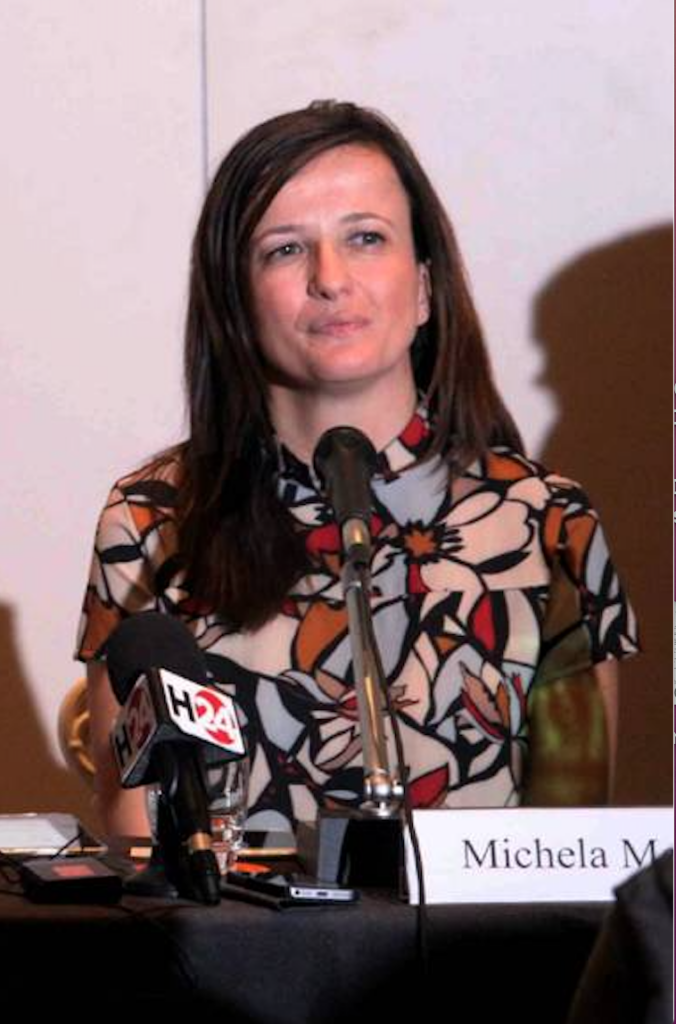
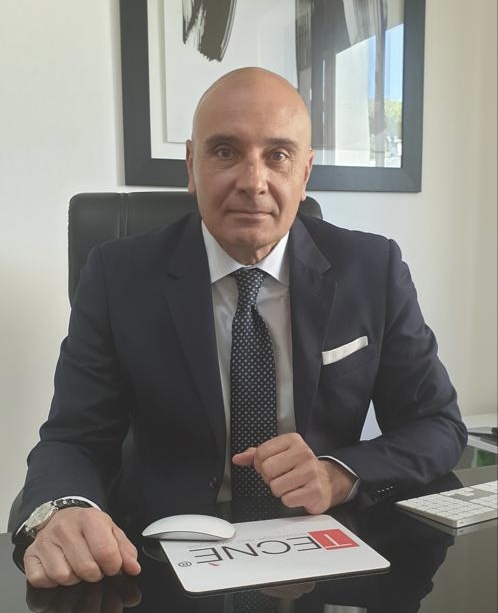
The Italian data analytics, consulting, and public affairs company Techne has opened a new sister company in London. They have been leaders in their field for over 20 years in Italy, producing reports for major clients, including the Italian trade union Confederazione Generale Italiana del Lavoro and the General Labour Union. To find out more about their new UK venture, I had the pleasure of sitting down with Chief Executive Officer Michela Morizzo and Director Carlo Buttaroni.
Michela Morizzo, CEO
“Over the years we’ve gained a great reputation, and at the moment we’re leaders of the market in Italy, so this expansion to London is the next big step in our history,” Morizzo explains. So what is it which sets the firm apart? “We try to transform data into opportunities,” she replies. “We analyse what’s happening at the moment – within a political campaign for example – but we don’t focus on the now, we focus on the future and what will change.”
Predicting that change is the foundation of what Techne does. The company’s basic goal is to make accurate predictions about human behaviour in terms of economics and politics. To accomplish this, the firm is highly expert at combining traditional interviews and surveys with algorithms designed to make sense of the information gained from those surveys. The data is also analysed manually in order to bring in a psychological perspective.
Morizzo also explains the problem with relying solely on people’s responses when making these sorts of complex predictions: “Conducting classic interviews is not enough for us, because the answers will vary depending on what people are thinking on that day. They may tell us that they will behave a certain way in 12 months, but we want to be sure what will really happen.” That’s what sets Techne apart – the ability to see round corners. Morizzo continues: “So we use statistical methods based on the game theory of John Nash [readers might remember Nash as played by Russell Crowe in the 2001 film A Beautiful Mind] to develop a model in order to elaborate on people’s answers and be sure what they will really do in the future. Over the last 20 years we have analysed millions of data points – but if you don’t know what that data means, it is simply a waste of paper.”
Carlo Buttaroni, Director
Meanwhile, Carlo Buttaroni is in charge of ensuring that their data isn’t a waste of paper. Buttaroni is heavily involved in the more technical side of the business, helping to develop the algorithms at the centre of Techne’s data analysis. The game theory that Morizzo mentioned is a study which uses mathematical equations to predict the decisions that individuals within a group of people will take. John Forbes Nash Jr. advanced the science, showing that it could be applied much more widely than originally thought, and also pioneered new theories about behaviour. Buttaroni bases his algorithms on Nash’s interpretations of game theory, and also factors in the ideas set forth by Nobel Prize winning behavioural economist Richard Thaler.
Buttaroni recalls how he got his start in data analysis. “I started 30 years ago in politics, but politics was not enough so I moved over to the scientific side. I specialised in the statistical approach in France before joining Techne. Now, the Nash models that we use are also the basis for the algorithms which attempt to predict the movements of the international stock market.”
All of which means that Techne has 20 years of experience and credibility – but in the beginning the company had to rely on the quality of their predictions and their apolitical, objective approach to achieve a good standing in the data analysis field.
“It was difficult to gain our reputation,” Buttaroni recalls, “but the most important thing was when people started seeing that our predictions were coming true. Now we have a track record, but those early demonstrations of our accuracy were essential to our success. Additionally, research companies are often associated with a political party, but we are outside politics. We can work with parties across the political spectrum because common sense has no flag. Both sides need to have the ability to understand the potential of the analysis we offer.”
TechneUK did not have an easy time starting their fresh venture in February of 2020, but now it is up and running in its new London-based international centre. Morizzo details the motivations behind the launch of their sister company. “We decided in February 2020, just a week before the Italian lockdown, to create our sister company TechneUK,” she recalls. “We have already worked for years with European companies and people in the United States, but we wanted an international hub, and London is the perfect city.” She adds: “It is a strange name, but it has a meaning; ‘Techne’ comes from an ancient Greek word which means having knowledge and skill at completing tasks well. It is also the root of the word ‘technical’.”
While Morizzo, Buttaroni and the rest of the team were attempting to launch TechneUK during the pandemic, they were also trying to predict the effects of the virus. While there is precedent for a widespread virus such as Covid-19, when it came down to the data, Techne had to start from square one. They aimed to predict various social and economic responses to the pandemic, including reactions to vaccine mandates and lockdowns.
“During Covid, we didn’t have any historical data, but we used official data from the statistical institutes of each country – income, social class, professions, and other demographics – to create a picture of the population. We use the data alongside our statistical programmes, then we analyse what comes out to see what considerations there are when making these decisions.”
With their London sister company successfully launched, Techne hopes to expand their unique approach to data analysis and reach a wider market. Morizzo sums up the goal of TechneUK in a brief mission statement which highlights the widespread ambitions of the company:“Today we think there is a need for a global science which combines the individual person with all the world they live in.” This is a company set to make inroads in the UK, and globally.
Whenever someone finds out that you are a writer, one of the first questions you’ll be asked is whether you have an agent. I remember when I first started out asking the historian D.R. Thorpe, who combined his writing with teaching at Charterhouse, what his advice was and he said without missing a beat: “Get an agent.”
For writers, this advice is still regularly proffered though it might be that the business has moved on quicker than people realise. Many publishers I know prefer agentless writers – who are less hassle to deal with – and there are also many writers who prefer to deal directly with publishers themselves.
At the outset of my career, I thought it would be a good idea to do some work experience in a literary agency – I imagined myself a sort of mole, checking out the lay of the land for when my own books landed on their desks. In those days – as today – the focal point of the office was the dreaded slush pile which all writers dread – a pile of manuscripts about a mile high, where soon-to-be-rejected writers queue up to be read.
I was directed to that pile on the first day, and did indeed reject several novels, always trying to offer advice, and always with a heavy heart. It was a strangely moving experience, and testament to the sheer amount of creativity out there.
Of course, to would-be writers the literary agent is invested with the almost awesome power of getting you published or not. But the reality of a typical agency brings you very swiftly down to earth, for this is a profession which is struggling and should only be entered into with care. The business model of taking a cut of authors plainly only works in those small handful of writers – JK Rowling springs to mind – when sales are considerable. But nowadays, with enough space in the public consciousness for a handful of hit books per year, the take home pay isn’t likely to do much more than keep the wolf from the door, and sometimes not even that.
The business has also suffered reputational damage. A few years back, The Times conducted a sting, when it sent out the opening lines of Nobel-winner VS Naipaul’s In A Free State with the character names changed to most of the leading literary agencies and received numerous rejections, with only one of them noticing what had been submitted.
These worries pertain today. The novelist Jayne Watson whose brilliant novel The Anarchist’s Exchange is published by Northside Press in 2022, experienced numerous frustrating knockbacks for her novel: “I’ve got so used to agents’ praise of the writing, the characters…..BUT (fill in as required from the usual responses re ‘didn’t fall IN LOVE with it’/‘not wasn’t PASSIONATE enough about it to offer representation’ and, slightly oddly: ‘I don’t have the right brain for it.) You can feel her frustration hasn’t been entirely alleviated by the fact of being published.
That’s partly because there’s a suspicion that the rejection process isn’t particularly rigorous or fair, and can simply be vaulted by ‘knowing someone’. The literary agent accordingly is a profession that appears to have lost some of its glamour – beyond the more general glamour of being a part of the literary scene, which in any case is increasingly depleted as people read less and less.
One sign of the times is the number of side-hustles which have grown up with the clear purpose of making sure the agencies, even the bigger ones, remaining solvent. There are the writing courses conducted by Curtis Brown, for instance, where the model is take money off would-be writers, usually on the back of advertising (limited) exposure to big name writers on the agency’s list.
Similarly, an agency like Northbank Talent has pursued a hybrid model and is now as much a speaker’s agency as it is a literary agent. This business, invested in by Luke Johnson and run by Diane Banks, has attracted Sir Anthony Seldon and Iain Dale, both friends of this magazine, to its books.
But most of all you just have to visit the offices of these places to feel that it’s not exactly an industry with the wind in its sails. Curtis Brown, for instance, though it has a certain power within the industry, feels like a rundown solicitor’s office. Its star agent, Jonny Geller, who represents the likes of William Boyd and the late John Le Carré, can sometimes give the impression that he, and not Boyd and Le Carré, wrote their respective oeuvres.
The problem we appear to face is that our literary culture is antithetical to the creation of serious literature. This has made the main commercial houses extremely vulnerable to the rise of independents such as Fitzcarraldo Editions, Black Spring Publishing, Galley Beggar and many others. Part of the strength of these lists is that they’ve lost faith in the literary agents’ handling of the slush pile and have sought to cut them out.
And writers are beginning to catch on. The American novelist John Updike famously got by without an agent and there are many writers today who wonder aloud whether the 20% on everything sold is really earned. So while the profession has its attractive aspects – not least the possibility of reading a lot, and spending time with some interesting people – it’s now a profession to be entered into with the utmost caution.
Maison Francois: ‘French without tears’, Ronel Lehmann
I stumbled across Maison Francois quite by chance whilst en route to St James’s Square – but then I never expected to become a publisher either. I wondered when I booked a table whether French cuisine was really coming home during the delayed Euro football championships, and whether the chef would prove a real striker.
The first thing that captivates your view on entering the restaurant is the incredible expanse of space, more Danish in design with high ceilings, minimalist clean lines and bright natural lighting. The receptionist took my coat, I thought to myself he resembled a stricken player, limping and sporting crutches, following an ankle injury.
I had asked for a corner table so that I could hear my colleague properly after the solitude of remote-working during the pandemic. Surprisingly, I was shown to a great quiet table without drama. As I sat down to some sparkling water, I noticed that there was no blaring music. I liked this place already.
My thoughts turned to old friends who had recently departed, including Jeff Katz who once wrote to me: “I read your restaurant reviews over the weekend and I don’t think Jay Rayner has anything to fear.” I also recalled Jonathan Evans who felt crestfallen when I referred to Carol Leonard as “the doyenne of headhunting,” when he felt that this honour was his alone. Jonathan and Jeff will always be doyens to me.
I always like to make my choices quickly, to get on with the business of the day
I could see that my companion had arrived and was liking the ambience and feel of the restaurant. Before we launched into our own agenda, we both declined the breadbasket and wine in favour of remaining healthy and studied the menu. I always like to make my choices quickly, to get on with the business of the day, rather than salivate endlessly over the specials.
Our waitress was extremely attentive and friendly. I remembered Terence Rattigan’s play French Without Tears. The action revolves around a group of male friends who have been sent to a ‘cram school’ in France to help prepare them for their exams. But the boys are more interested in chasing girls than learning French. After a few exchanges and extended pleasantries including about how long the restaurant had been open, she took our orders.
We both elected for celeriac remoulade, served in the traditional style, the tanginess of the Dijon mustard mayonnaise offset by lashings of watercress and capers. Even though I had some cold leftover chicken in my fridge at home, I ordered Poulet Rôti, fines herbes with mashed potato and a salade verde maison. I had a choice between breast or leg and elected for the latter. My guest selected the halibut, haricot blancs, sauce aux moules. Presumably, it was really the best catch of the day, and I did not need to enquire about whether it was enjoyed, as both our plates had been fully devoured.
Puddings were proffered and because we had been good and not taken the bread, both of us felt obliged to at least look. It was a supremely difficult choice between baba au rhum tarte tatin, tarte aux fruits de saison gâteau à la cerise, crème caramel, Paris-Brest aux noisettes, éclair au chocolat, tarte au citron vert et noix de coco, macaron à la vanille et caramel, truffes aux cacahuètes, madeleines à la pistache, dark chocolate shards, so we requested a scoop of sorbet each, white peach and strawberry.
I then asked for an extra scoop of chocolate ice cream with my white peach. I was not being greedy, just seeking contrast in the taste. Three iced bowls arrived on the table; the chocolate scoop was shared.
A small mix up in the coffee order resulted in an expresso being dispensed and then hastily taken away in favour of a filter coffee. I could not fathom a decent excuse to order a glass of Château Villefranche Sauternes, before leaving.
On the way out, we agreed this should be our new meeting place as we bade farewell to the receptionist and hoped that it would not be too long before he is off the bench.
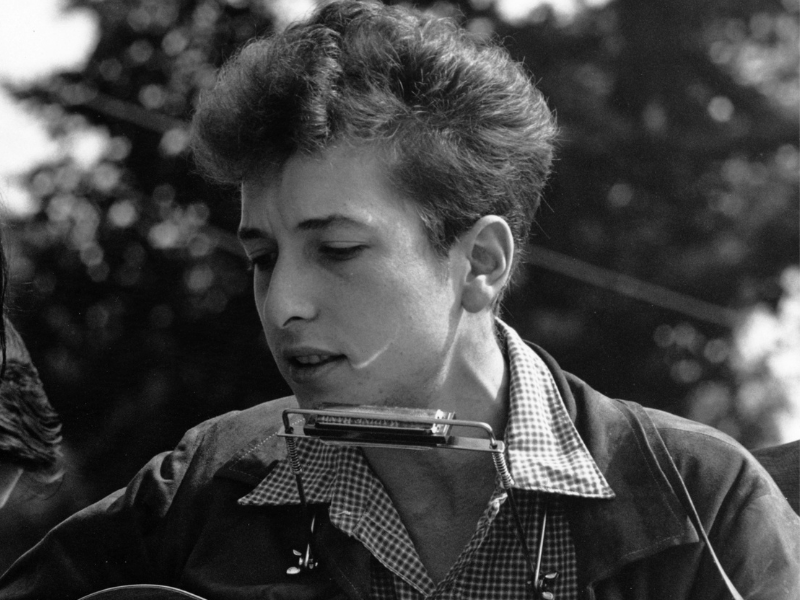
A look back at Bob Dylan’s 80th birthday in 2021, when Robert Golding looked at the career of the Nobel laureate and asked what his life can teach us about making our way in the world
‘Twenty years of schoolin’ and they put you on the day shift.’ So sang Bob Dylan with typical humour and exasperation in his 1965 classic ‘Subterranean Homesick Blues’. It is a line that may resonate with many young people beginning their working life in the Covid-19 era.
Since arriving on the scene in Greenwich Village in 1962, the Nobel Laureate, who turns 80 today, has attracted continual reassessment. The brilliant opaque words, combined with a sense that in Dylan words matter to an unusual degree, have caused an immense critical literature to grow up. It’s difficult to think of a living figure more discussed.
Commentary has tended to focus on Dylan’s extraordinariness, and one can see why: he has achieved remarkable things, all while retaining his aloofness. When I asked singer-songwriter Emma Swift, who recently recorded an album of Dylan covers Blonde on the Tracks (2020), whether Dylan had been in touch about her album, she said: ‘I’m often asked that. But Dylan is to me a mythical figure. I’d be just as surprised if Samuel Taylor Coleridge called.’
Too often then, Dylan is treated as prophet and sage, and not as someone who hustled his way through the world – as we might do too. Our admiration for him might preclude us from seeing what he can teach.
“Dylan to me is a mythical figure. I’d be just as surprised if Samuel Taylor Coleridge called.”
Emma Swift
Get born, keep warm
It helps to remind ourselves that Dylan’s upbringing was distinctly unpromising – so much so that, even at the time, it seems to have struck him as a cruel joke. Raised in Hibbing, Minnesota – a dead-end mining town – he told Martin Scorsese in the film No Direction Home (2005): ‘I felt like I was born to the wrong parents or something.’ We ought not to draw the conclusion from this that it is wise to be contemptuous of one’s elders; one might instead say that we should have the gumption to imagine our way into the life we want – and be brave enough to take steps to secure it.
The Zimmerman family home in Hibbing, Minnesota. Photo credit: Jonathunder
It remains difficult to imagine Dylan in Hibbing. His life is a powerful example of a refusal to be defined by where you’re born: our knowledge of his subsequent success makes it vexing to imagine him ever having been there at all. Hibbing consisted of the typical Main Street, dreary parades, small businesses and shops, all bound up in strict mores: a life Dylan must have found predominantly redundant. But thanks to the invention of the gramophone, another world was able to seep through to the young Dylan. This was the astonishing revelation of rock and roll.
Like so many who go onto achieve great things, one can sense the constraints that early life placed on him – and also that those constraints were lifted rather arbitrarily. Rerun the movie with slightly different conditions and you’d have another narrative.
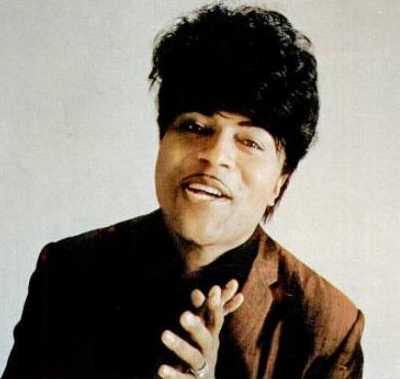
Specifically, Dylan’s life would have been different had he never encountered Little Richard. ‘His was the original spirit that moved me to do everything I would do,’ he would write on May 9th 2020 at the singer’s death. Though Dylan is a hero to many, he is also a man adept at having heroes. He admires people – but only as a way of discovering a way to become himself.
Dylan’s childhood hero Little Richard. “I am so grieved,” Dylan wrote upon the singer’s death on 9th May 2020.
Dylan’s first known performance was in 1958 at the Hibbing High School’s Jacket Jamboree Talent Festival. In Volume 1 of Bob Dylan: Performing Artist Paul Williams, Dylan’s finest biographer, explains how in this performance ‘Dylan followed the rock and roll music to a logical conclusion that was in fact quite alien to the music of the day: play as loud as possible. Not just wild. Not just raucous. Not even just loud, but AS LOUD AS POSSIBLE, preferably in a context that will allow for maximum outrage.’
It is an image of the natural iconoclast. At this young age, Dylan was allied to a true energy; he had made a decision that couldn’t be reversed to devote his life to music, and was already seeking to stand out within his chosen sphere. Soon he would graduate from being the loudest musician to other superlatives: most thoughtful, most literary, most enigmatic, most laurelled.
In the process, he was clearing more obstacles than we perhaps realise, now that we inhabit a world where they were so convincingly traversed. One fact is not the less important for being so widely cited: Bob Dylan wasn’t born Bob Dylan but Robert Zimmerman. Interestingly, a letter recently surfaced where Dylan explains that his decision to change his name was based on fears of anti-Semitism. ‘A lot of people are under the impression that Jews are just money lenders and merchants. A lot of people think that all Jews are like that. Well, they used to be cause that’s all that was open to them. That’s all they were allowed to do.’
“Dylan followed the rock and roll music to a logical conclusion that was in fact quite alien to the music of the day: play as loud as possible.”
Paul Williams
Some, including Joni Mitchell with whom Dylan has had (at least from Mitchell’s side) a somewhat abrasive and competitive relationship, have held up the decision to change his name as a mark of inauthenticity. But the decision might equally remind us of the importance of flexibility and finding a way around obstacles.
Try to be a success
Dylan’s early years exhibit a fearlessness which we might do well to emulate. As a young man, having briefly enrolled in Minnesota University in 1960, he again exhibited that same restlessness which would manifest itself eventually in his celebrated Never Ending Tour.
By this time, he had decided that rock and roll wasn’t enough, and that folk music offered a richer philosophical experience. It was the first of many twists and pivots and reinventions.
In time, he would merge the folk and rock genres – going electric in 1965 to what now looks like a rather quaint indignation from the folk establishment.
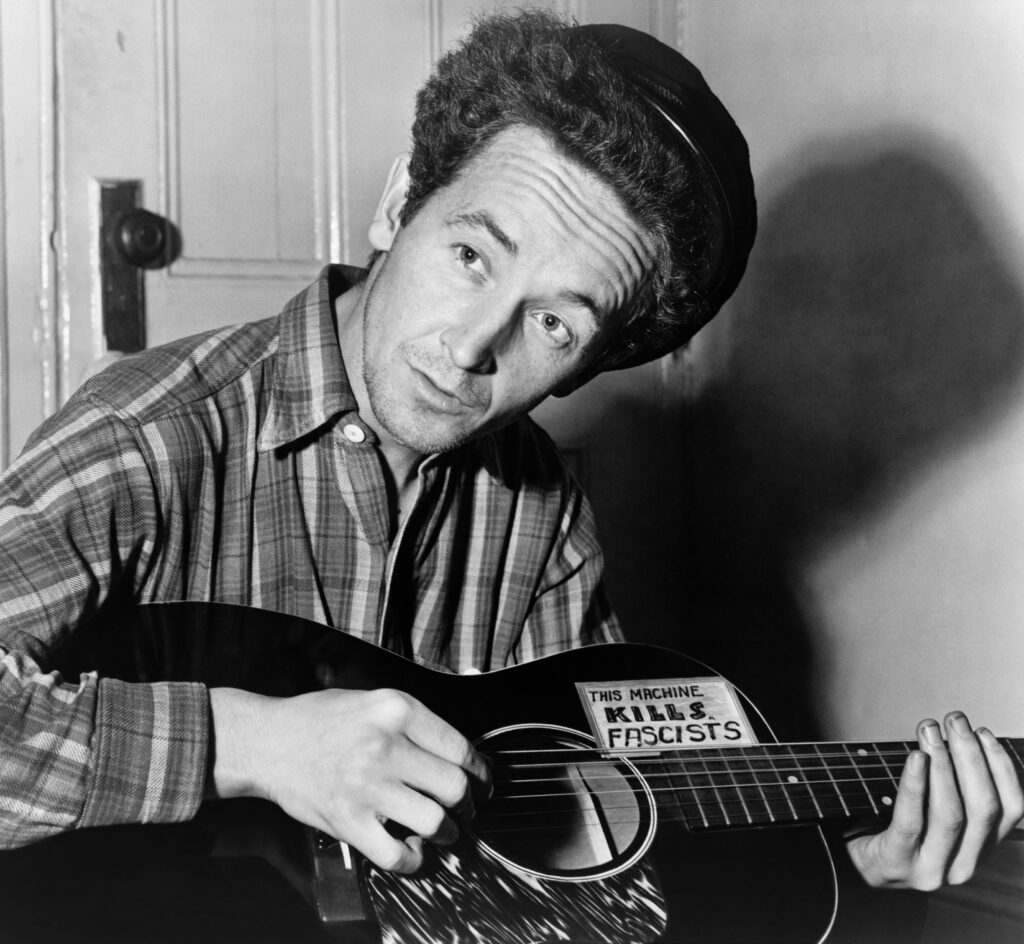
For now, seized with the urgency of the eternally confident, Dylan took a train to New York, intent on meeting his hero the folk singer Woody Guthrie. Guthrie was already suffering from Huntingdon’s Disease, which would eventually kill him in 1967. No matter, Dylan sought him out at his sick-bed in a New Jersey hospital and played him his homage ‘Song to Woody’ one of only two original compositions on what would become his debut album Bob Dylan (1962). A torch had been passed.
Woody Guthrie. Dylan sought his hero at his sick bed in New Jersey. Image credit: United States Library of Congress
It was a deft negotiation of what has been called ‘the anxiety of influence’. Young people will often underestimate the availability and flesh-and-bloodness of those at the top: fear stymies them from exposure to examples of success. By being in close proximity to our heroes – even if the encounter doesn’t go well, and we betray our nerves – we may usefully humanise them and open up the possibility of the heroic in ourselves.
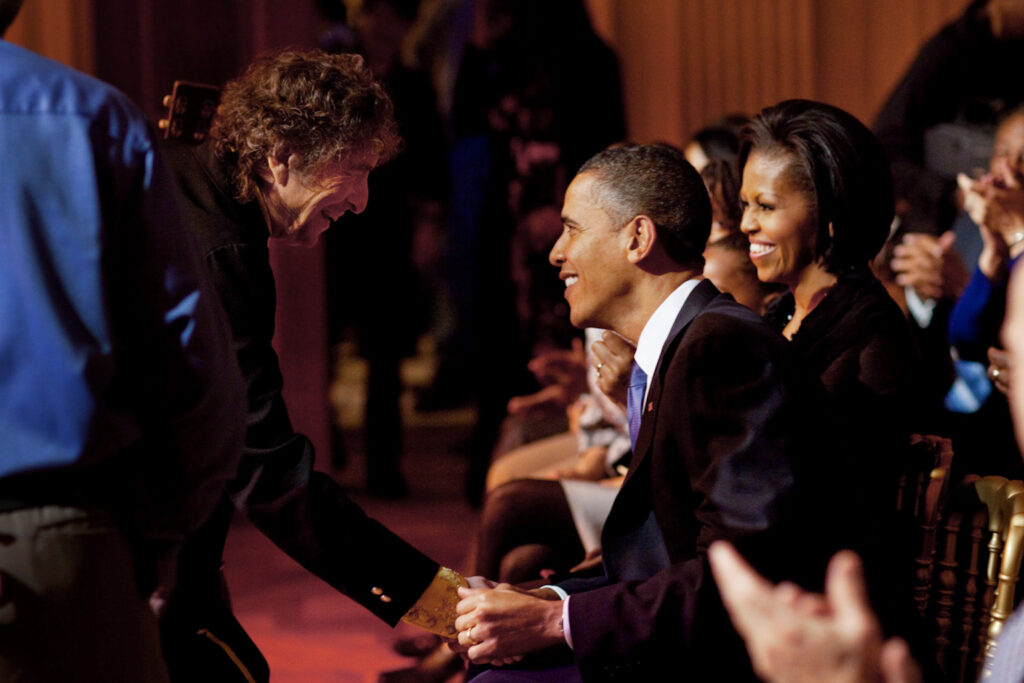
This trait of Dylan’s finds its corollary in a story told by former President Barack Obama in his memoir A Promised Land (2020). When Dylan played at the White House during the Obama administration, at the end of the performance Dylan simply shook the then president’s hand and left, saying nothing. ‘Even the president of the United States sometimes must have to stand naked,’ as he put it in ‘It’s Alright, Ma (I’m Only Bleeding)’. One suspects that Bob Dylan has never been afraid of anyone.
Bob Dylan shakes President Barack Obama’s hand following his performance at the “In Performance At The White House: A Celebration Of Music From The Civil Rights Movement” concert in the East Room of the White House, Feb. 9, 2010. (Official White House Photo by Pete Souza).
The Guthrie story is a reminder that we tend to get to where we need to be by being out in the world and meeting people; we never achieve in a vacuum but by the dint and say-so of others. Music journalist Tom Moon tells me that today ‘the Bob sphere is weird even in “normal” times’ but at the outset of Dylan’s career, when it mattered, the young singer made all the right moves, charming the crowds in Greenwich Village, signing with Columbia Records, and submitting to the aegis of manager Albert Grossman.
“The Bob sphere is weird even in ‘normal’ times”
Rock critic, Tom Moon
In time he would assemble a band whom he could trust and who were inspired to get better over time. His 1975 tour the Rolling Thunder Revue was, among many things, a celebration of friendship. And it’s thanks to his capacity as a bandleader we now have that highly underrated achievement the Never Ending Tour, which began on June 7th 1988 and ended – or paused – with the advent of the Covid-19 pandemic in the early part of 2020.
In reference to his longevity, Emma Swift says: ‘There’s a counter-narrative in our culture that says that music is for young people – that if you haven’t made it as a musician by 13 you should just stop. Dylan’s career runs counter to that and though he was working very much as a young man, he’s continued that throughout his entire life. He makes a very persuasive argument that the time for art is always now.’
From the vantage-point of today, Dylan’s career might seem to be to do with longevity – but longevity must be teed up when young, and it helps to have made the right decisions from a young age.
Emma Swift has recently recorded an album of Dylan covers. “[Dylan] makes a very persuasive argument that the time for art is always now’. Photo: Michael Coghlan
Dylan has never grown bored; his energy remains astonishing. Richard Thomas concurs that Dylan’s career showcases ‘resilience, energy, adaptability, mystique, humour’ – qualities that would not have been sustainable had his original decision in Hibbing to pursue music not been the right one. ‘I’ll know my song well before I start singing,’ as Dylan sings in ‘A Hard Rain’s a-Gonna Fall’ – yes, and to know that singing is what we should be doing in the first place.
In a March 2020 interview, Gina Gershon confirmed Dylan’s boyish love for what he does: “He read me some lyrics he was writing and he was all excited…,” she recalled. “I was thinking, ‘Oh my God, this is so cool.’ You could see why he still loves doing what he does and why he’s excited…”
“He only ever repeats himself valuably, somehow anew, which is not true of the rest of us”
Christopher Ricks, author of Dylan’s Visions of Sin
When I speak to the great Dylan critic, author of Visions of Sin (2004), and former Professor of Poetry at Oxford University Christopher Ricks, he agrees with Swift: ‘He only ever repeats himself valuably, somehow anew, which is not true of the rest of us.’ This remains true in his touring, where Dylan – famously, and sometimes to fans’ perplexity – will never perform a song in the same way twice.
His Back Pages
Throughout this life of performance, of course, Dylan has been compiling the greatest songbook of any American songwriter in the post-war period. It is a vast corpus, where wisdom sits alongside glorious nonsense – and where solemnity and comedy, yearning and rage, all equally have their home.
It must be said that the idea of plucking contemporary jobs tips from the Dylan oeuvre can seem an exceptionally unpromising avenue of enquiry. Dylan himself has sometimes been self-deprecating about the idea of extracting meaning from his songs. As he wrote in ‘Mr. Tambourine Man’, ‘If you hear vague traces of skipping reels of rhyme/it’s just a ragged clown behind.’ Dylan here appears as something like Charlie Chaplin’s Little Tramp: Don’t pay him any mind.
Few have taken him at his word there. More problematically, the songwriter’s reliance on the folk repertoire means that the economy he is describing in his songs tends to predate ours. One might seek in vain in the Dylan canon for direct advice about how to make it in the professions, or hints about how best to make LinkedIn work for you.
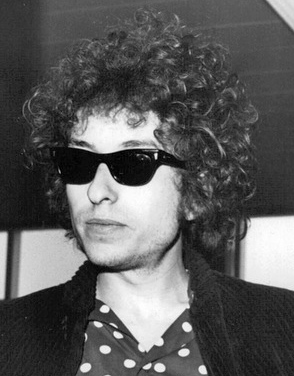
But this leaning so heavily on a rich hinterland of American song, might amount to another lesson. His work shows a remarkable respect for the past – as well as a willingness to question the present. Dylan’s second studio album was called The Freewheelin’ Bob Dylan (1963). Paul Williams once said that Dylan’s songs essentially teach us that when a man learns to be free only then can he be in with a shot of happiness.
Dylan in 1966. Dylan’s oeuvre, according to Paul Williams, teach us that only when a man is free can he begin to be happy. Photo credit: image in the public domain.
But we can only be free in relation to others. As much as he would distance himself from the label ‘protest singer’ over time, Dylan’s repertoire contains songs of high-minded hatred towards the establishment. ‘Masters of War’, ‘Only a Pawn in Their Game’, ‘Pay in Blood’: these songs warn us off a career bereft of a healthy scepticism about the way things are. Dylan’s songs tell us that to question the status quo is a first step towards our finding a place in it.
This freedom is not only something that Dylan exhibits; it is something he bestows on the characters in his songs. Dylan’s is a world of freely moving drifters (‘The Drifter’s Escape’), wronged boxers hurtling unimpeded towards their fates (‘Hurricane’), mafiosi (‘Joey’), and a whole range of po’ boys and girls, who seem almost liberated by their impoverishment. Everything – everyone – is in continual motion: ‘Only one thing I did wrong/stayed in Mississippi a day too long.’ Even William Zantzinger, the murderer in ‘The Lonesome Death of Hattie Carroll’ is defined by his freedom.
“His actual experience is tempered by what the folk tradition, always where much of his songs go back to, dealt with’
Professor Richard F. Thomas
The Harvard professor and author of Why Dylan Matters Professor Richard F. Thomas explains: ‘‘Workingman’s Blues #2’ is in part about working’ but he agrees the middle class doesn’t feature. ‘His actual experience is tempered by what the folk tradition, always where much of his songs go back to, deals with.’
All I Really Want to Do
And yet there are few, if any moments of sloth in Dylan’s life. ‘Lay Down Your Weary Tune’. ‘Watching the River Flow.’ These are songs about pausing, but they are also moments of expression – of activity – for Dylan himself.
While Dylan turns a sceptical eye on ‘the masters of war’ who too often prosper in the present, he teaches an intense respect for the wisdom contained in the folkloric tradition.
This resonates in other professions. Anyone who has spoken to Sir Martin Sorrell will find him as passionate about advertising as it used to be as much as it is now. Likewise, readers of Andrew Marr’s survey of journalism My Trade (2004), will note that secreted in the BBC man adept in a modern medium, is a historian. Success is to do with a sense of how this moment fits into the preceding and those which will come; this can only be achieved by hard study, and utter commitment.
It is apt that while Dylan’s milieu is the past, he has nevertheless managed to prosper within the contemporary moment, and there is no-one alive today whose works seem more assured of a future audience. This fact was especially brought home in late 2020 when Dylan sold his songbook to Universal for a reported figure in the $300 million range.
This respect for tradition is a lesson he bequeaths to his musicians. As Professor Thomas explains: ‘The musicians he has worked with are in awe of him as a teacher of the musical traditions he wants them to be up on.’ So would Dylan have made a good teacher? Thomas says: ‘While I can’t see him in a classroom (“the mongrel dogs who teach” (‘My Back Pages’), though that’s some time ago), I believe he cares deeply about what matters to him, and that is the first ingredient of a good teacher.’
Fleetingly, and perhaps jokingly, Dylan once imagined in an interview with AARP an alternate route for himself: ‘If I had to do it all over again, I’d be a schoolteacher.’ In what subject? ‘Roman history or theology.’
When I Paint My Masterpiece
It might be hard to imagine the Dylan energy contained in a school. In fact, it isn’t even contained within music.
In recent years, Dylan-watchers have become increasingly aware of the scope of their man’s achievement in the visual arts. A recent episode of the HBO drama Billions shows hedge fund billionaire Bobby Axelrod with some of Dylan’s work in his home. During the COVID-19 pandemic – according to insiders at London’s Halcyon Gallery – Dylan was not only commissioned to produce a metalwork sculpture for Ronald Reagan Airport, but delivered some 20 works to the gallery.
Dylan’s brilliant metal sculptures show another side of Dylan’s creativity
The appreciation of Dylan as artist and as sculptor is still in its infancy.
Emma Swift tells me: ‘Dylan has taught me a lot about the interconnectedness of art forms. I used to think about poetry and music and visual art separately. Now I don’t. All the video clips for my Dylan record are animated, so they’re very much a celebration of the visual to go alongside the music.’ Dylan’s career here again emerges as an exercise in creative freedom – both within his own art form and in an interdisciplinary sense.
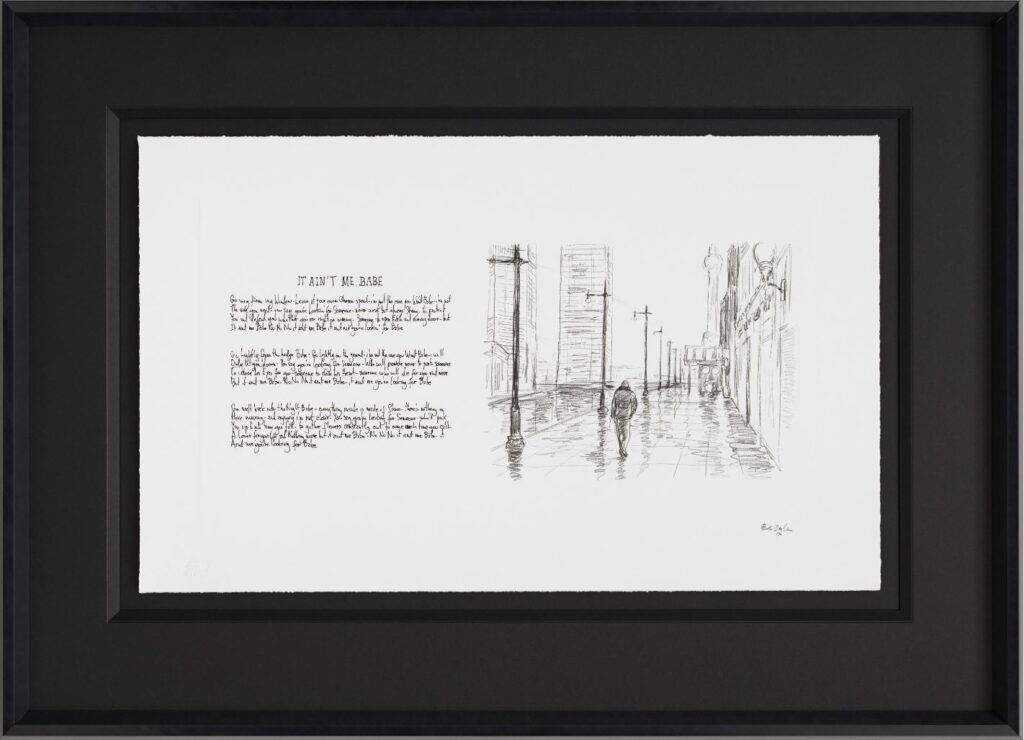
I head up to central London, for a behind-the-scenes tour of the Halcyon’s Bob Dylan Editions show. In many of the pictures, the influence of Edward Hopper is paramount. This is an America which has to some extent lapsed. We find motels and diners, parking-lots, cinemas and burger-joints. It is an image of everyday America, which isn’t meant to feel contemporary. Like his music, these are artefacts of collective memory; the paintings feel like acts of nostalgic preservation.
Most marvellous of all are the metal-sculptures. Upstairs, Georgia Hughes, an art consultant at the Halcyon, shows me a blown-up picture of Dylan in his California studio. Wiry and tough-looking even in old age, he stares eagle-like on his metals, the materials of his art. Hughes explains how Dylan rescues the metals from the scrapyards around California. I quote back at her the lines of ‘When I Paint My Masterpiece’: ‘Well, the streets of Rome are filled with rubble.’ She replies: ‘Dylan’s art has to do with finding what lies near to hand and transforming it.’
One I particularly like is a wall-hanging (see opposite), where the pieces of metal, the discarded spanners and wrenches feel somehow like a sea-creature peculiarly adapted to its environment.
Dylan’s illustrated lyrics with signature now cost £2,000
Dylan’s art career shows us that his is a porous existence where all options are on the table. Whenever one thinks of the successful, they always seem free of the doubts which seem to constrict others. If their lives often feel peculiarly uncompartmentalised, then perhaps it is because they proceed in freedom.
“He does all kinds of things that are kind of shocking, and I think it opens it up for everybody else”
Emma Swift
Money doesn’t talk, it swears
Of course, if we wanted direct lessons about our lives from Dylan then his business interests are there for all to see. Put simply, Dylan has not been afraid to monetise himself.
Bobdylan.com, in addition to providing information about tour dates and the artist’s songbook, is primarily a shop, hawking everything from key rings and hip flasks, to tote bags and his new Heaven’s Door whiskey. In the past he has let Apple, Chrysler, Cadillac and Pepsi use his songs.
Emma Swift gives her reaction: ‘He does all kinds of things that are kind of shocking, and I think it opens it up for everybody else. You know, if Dylan puts his song in an ad…okay, I guess it’s fine.’ Again, there is fearlessness here – he is prepared to risk being labelled a sell-out and happy to let the songs speak for themselves in whatever context they happen to be used.
When I ask Thomas what lessons Dylan’s life ultimately has to teach, he replies: ‘Read, listen, read, enquire, don’t be presentist!’
If one were to ask oneself why Dylan’s work is richer than that of his contemporaries then it has something to do with the range of reference brought to bear in a setting where one might not normally expect it. This is the case even when his work is compared to that of literary contemporaries such as Paul Simon and Joni Mitchell, though there will always be some – the late Clive James among them – who would prefer the poetry of Leonard Cohen.
And not being ‘presentist’? On the face of it, this might not seem to fit Dylan. Joni Mitchell had this to say about him: ‘Bob is not authentic at all. He’s a plagiarist, and his name and voice are fake. Everything about Bob is a deception.’
Harsh as this is, it is a frustration Paul Simon has also aired: ‘One of my deficiencies is my voice sounds sincere. I’ve tried to sound ironic. I don’t. I can’t. Dylan, everything he sings has two meanings. He’s telling you the truth and making fun of you at the same time. I sound sincere every time.’
But one suspects that Dylan would have no audience at all, if there wasn’t truth at the core of his work. It is rather that he has been true to his nature by being opaque. He hasn’t let his desire to tell the truth get in the way of being mysterious – and vice versa. At the Halcyon exhibition there is a wall of magazine covers devoted to Dylan. It doesn’t matter how much we photograph or try to know him; his eyes won’t let us in entirely.
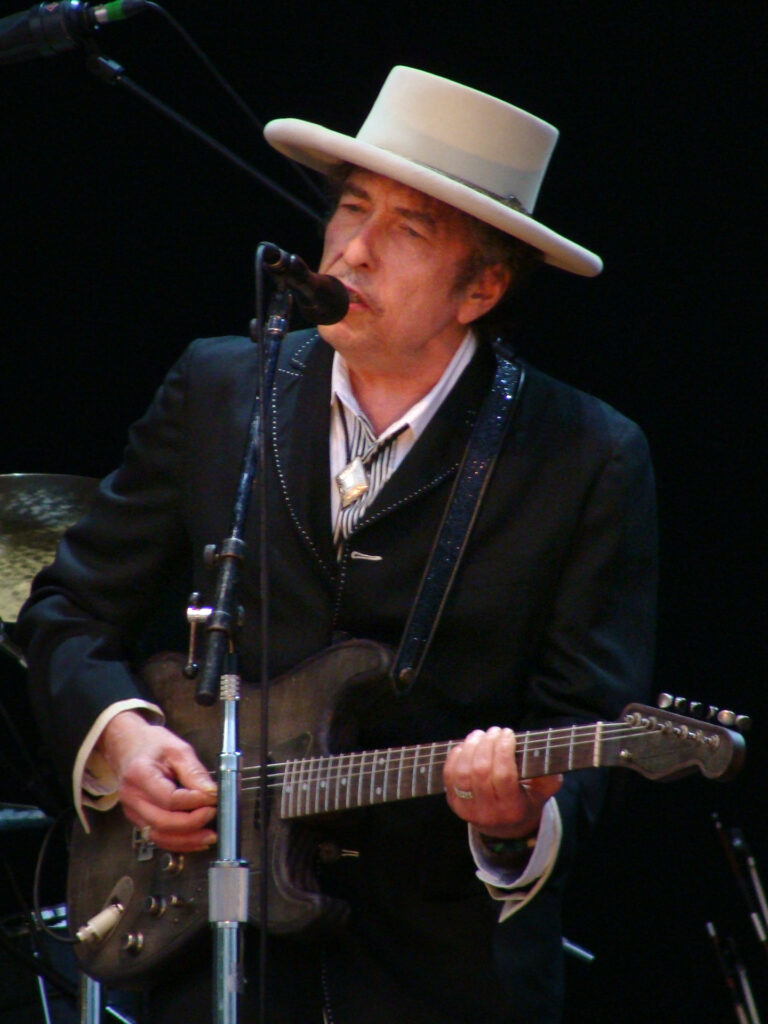
As Dylan enters his ninth decade, he is among those rare American artists who seems to have fulfilled their talent. Photo credit: By Alberto Cabello from Vitoria Gasteiz – Bob Dylan, CC BY 2.0, https://commons.wikimedia.org/w/index.php?curid=11811170
Forever Young
As Dylan enters his ninth decade, there is much his career has to teach those who are embarking on their own lives. It’s true that there is dispute in literary circles about the extent of his literary achievement. But Dylan has been plausibly compared to William Shakespeare and to John Keats. We know far more about Dylan’s life than we do about the Elizabethan, and Dylan has lived out his talent far more than Keats, who died at 26.
In spite of the singularity of his achievement, Dylan continues to repay study. Besides, the man who wrote ‘Don’t follow leaders./Watch your parking meters’, isn’t so much telling us what to do, as inviting us in. Once we accept his invitation, we find we become richer, wiser. There is a generosity somewhere near the core of his art. Dylan once said: ‘Every song tails off with “Good Luck, – I hope you make it.”
He never said where – but he didn’t have to. As often with Dylan, we sort of know what he means, but we have to fill in the gaps ourselves.
When I was growing up, I heard the words, “You can be whatever and whoever you want to be” all the time. But a part of me never truly believed it until the moment Barack Obama won the US election. Here was someone who while highly educated, was not from a particularly wealthy background and had the same colour skin as me, holding the highest office in the United States of America. Some might even say the most powerful position in the world. I was elated. However, my feelings of achievement and pride were coloured by some of the media and social media coverage and commentary at the time.
I watched aghast as he was called a Nazi, a monkey, and depicted as an African witch doctor complete with grass skirt. I remember deactivating my Facebook account to take some time off social media in the wake of his election, because every time I logged in I would see something about the desperate need to pray for America in the hands of Obama and how the country was going to be ruined under his leadership. I got angry at those making the comments and false assertions, but will admit that a part of me was also cross with Obama himself.
“Why isn’t he fighting back?”, I thought. “He has all of this power and all of this reach and access to resources. Why isn’t he using it to quash all these aspersions!”, I grumbled to anyone who would listen. I watched the mudslinging happen again and again across his first term, and a myriad of indignities and injustices unleashed not just against him but against his entire family, and it made me more and more enraged.
Then, during his re-election campaign I remember Michelle Obama saying, “When they go low, we go high”. And I heard her. Because she was right. Going low is easy. It’s what you do when you feel pain and rage and want revenge. Looking back, every time I wished the Obamas would go low, I was coming from a place of fury. I wanted the people taking away my sense of pride and spreading misinformation couched as fact, to be punished. I wasn’t thinking about what the effects of the Obamas unleashing that anger would be in the future and what message it would send. I just wanted someone to pay in that moment, and no good action starts in that space.
The Obamas, I think, knew that while a temporary release of anger in public might feel good in the moment it would overall do more harm than good. They had to think longer-term. In addition, they had the eyes of the world on them. Some, just waiting for a misstep that they could spin and amplify. They also had a generation looking toward them as role-models, just as I was. By taking the high road they maintained their dignity while in office and protected their legacy in a way that still enables them to be seen as exemplars today.Had they gone low it would have just been more fuel to the fire, and they would have played into the trope of the ‘angry black man’ and ‘angry black woman’ that still exists and continues to surface negatively today.
What is important to note is that Michelle Obama never said that taking the high road is easy, and exempts you from the pain and anger that arises when others are hurtful. But she did say that you feel the pain and hurt, and rise above it, which I think is something that we can all continue to learn from.
I’m lucky to possess an attractive vintage edition of On Her Majesty’s Secret Service (1963). Whenever I take it down from the shelf, as I do now, it reminds me that more people should read Ian Fleming. The writer may be best known now for the multimedia phenomenon he has given the world, but he began as a good prose stylist. For instance, this book, the twelfth Bond novel Fleming wrote, begins with a description of a seaside sunset: ‘Then the orange ball would hiss down into the sea and the beach would, for a while, be entirely deserted, until, under cover of darkness, the prowling lovers would come to writhe briefly, grittily in the dark corners.”
This isn’t writing of the first rank. Anyone who’s ever watched a sunset knows that the setting sun doesn’t hiss at all and I don’t think lovers prowl the beach so much as loiter – but if we’re seeing all this through the eyes of Bond, then perhaps they do. In Bond, women are always an aspect of struggle. His weakness for them is the thing most likely to get him killed.
Any discussion of Bond and the question of work must always come back to that crucial fact, also punchily described in the opening pages of OHMSS: ‘Today he was a grown-up, a man with years of dirty, dangerous memories – a spy.’
Empire Broccoli
But before we get to life at MI6 in No Time To Die, it’s worth noting that each time a Bond film comes out, it’s a reminder that we exist just after the greatest shift in human experience since the advent of Guttenberg’s Bible – namely, the move away from print towards the moving image.
It might be that Bond encapsulates this change more vividly than any other character. That’s partly because of the sheer enormity of the franchise. It’s also because someone whom the previous generation got to know through language in Fleming’s books, is now someone we’re acquainted with predominantly as spectacle. Even so, the books remain reasonably near.
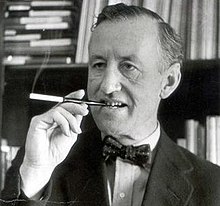
Ian Fleming
And, of course, there are still the books for those who want them. They reliably take up three quarters of a shelf in each outlet of Waterstone’s. But the sheer number of people who see these films is a reminder of their addictive, joyous quality.
Our collective need of Bond on the big screen stretches all the way back to Sean Connery’s debut in Dr No (1962). No Time to Die is the 25th instalment. During that time, the film industry has grown exponentially: this state of affairs is best illustrated by the credits at the end, which denote a bewildering array of jobs in the sector from casting directors, to stunt men, makeup artists, production crew, runners, textile technicians and others. While a film of this scale is being made, it exists as something between a camping site and a corporation.
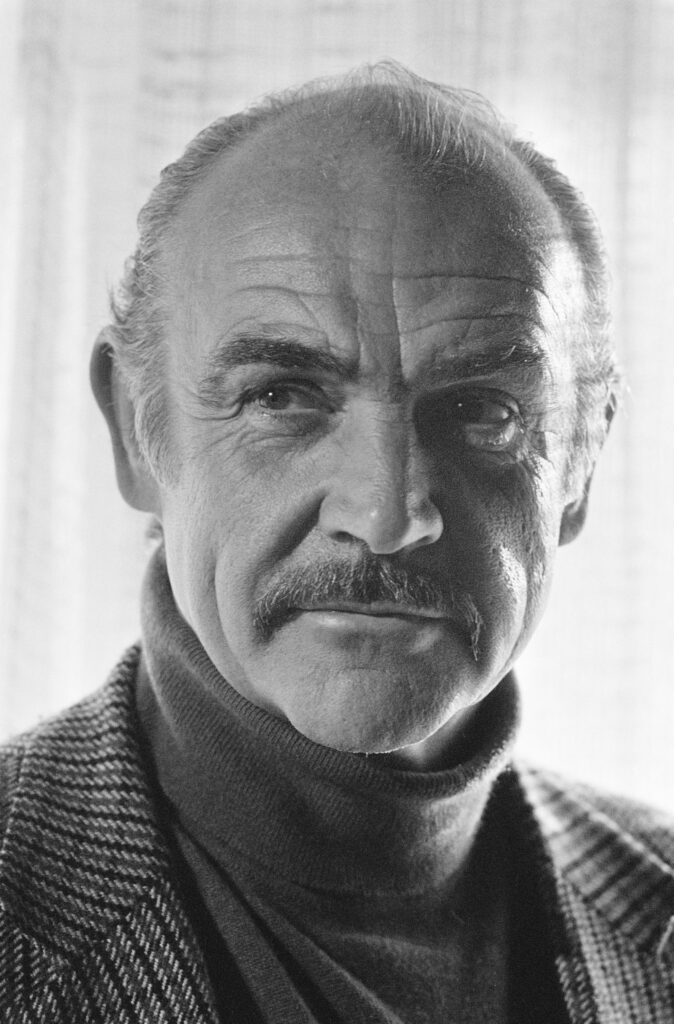
Aankomst Sean Connery op Schiphol *23 november 1983
The figures continues to impress. In 2019, the Department for Culture, Media and Sport estimated that there were 289,000 jobs in the UK film, television, radio and photography sector.
From the Pandemic with Panic
No Time to Die arrives at a time when all these jobs are in flux, and the industry in peril. This is a situation which, one suspects, only James Bond can remove. As punters, we are separated for the most part from the stress of the impact of the pandemic on the film world.
But we do glimpse it occasionally. Earlier this year, audio was leaked of an apoplectic Tom Cruise on the set of the latest Mission Impossible 7 haranguing crew for failing to take proper Covid safety precautions.
If you heard Cruise’s stressed pep-talk, you’ll know that the industry has never needed a good Bond film quite like it needs it now. But the world is in a similar predicament. One thing Covid-19 appears to have wrested from us is a sense of harmless fun. In spite of every attempt to reach for gravitas, Bond cannot help but remain that.
Even so, a desire for seriousness is what has defined the Craig films. This needs to be placed in context. The gritty – and for some unbeatable – performances of Sean Connery kicked off the series. His tenure began with Dr. No and took us through From Russia with Love (1963) – for many purists, the best of them all – Goldfinger (1964), Thunderball (1965) and You Only Live Twice (1967). There then ensued a brief hiatus where George Lazenby, in an underrated film, took over in the filmed version of On Her Majesty’s Secret Service (1969), before handing back to Connery for that notable dud Diamonds Are Forever (1971).
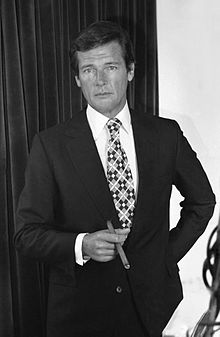
Golden Moore
The advent of Roger Moore changed everything. Moore’s spirited and amusing performances moved the films far from the books, and seemed to bust forever the notion that Bond was a character of any psychological depth. These films, beginning with Live and Let Die (1973), and ending with A View To A Kill (1985), where Moore looks almost elderly as he puffs his way up the Eiffel Tower in pursuit of Grace Jones, are great fun, though not untainted by a casual imperialism and misogyny which wouldn’t pass muster today. Even so, few Bond fans would want to be without them. They are of their time – but more than that, they were undertaken with the understanding that Fleming’s world is predominantly fairytale.
The Moore films have been subject to push back, in some degree or other, by all the actors who have played Bond since. Timothy Dalton, better known as a stage actor, sought inspiration from the Fleming books in License to Kill (1987) and The Living Daylights (1989). Piers Brosnan channelled Moore to some extent, but there were some attempts – especially in the casting of Judi Dench as M – to bring the series up to date. Those films declined precipitously in quality following the credible first showing Goldeneye in 1995.
And so to Daniel Craig, where the seriousness has been amped up throughout, and everything possible done to give Craig the opportunity to explore what it really means to be a spy – and especially a 00 with a famous licence to kill.
Low Morale
Underpinning all the Bond films is the unavoidable fact that our hero is a serial murderer. During the early films, we are permitted to consider him a hero because he is always protecting the free world from the diabolical schemes of Ernst Stavro Blofeld. The more diabolical the scheme, the more comfortable we are with the notion of him as a hero, since we can turn a blind eye to what he is capable of.
Geopolitically, we need to feel that Britain is in some sense ‘good’ for these films to work – otherwise the murder is all for nothing, and we can’t quite cheer on the hero.
The unseen factor on all these films is the parallel success of the books of John Le Carré. For their style alone, Le Carré’s books will go down as some of the finest of the post-War period. Those books work by intrigue, and make particular use of the device of the double agent. This in turn creates a strange world where the excitement is not knowing who to trust – and whether all the sacrifice is worth anything.
For Le Carré, the British Empire was an object of suspicion. These suspicions had their climax in Brexit, and we now know that the novelist died an Irishman. It’s difficult to imagine Fleming as anything other than British.
It could be argued that Bond was never supposed to be Le Carré-esque. Fleming’s stories work on the implicit assumption that democracy is a more desirable thing than communism – and that there is such a thing as good and evil, and right and wrong.
One also wonders whether the biggest mistake was to try to apply Bond to the world which grew up after the fall of the Soviet Union. The decision to do so can seem as absurd as placing the Three Musketeers in a battle against the Taleban in Afghanistan.
At any rate, during the Brosnan-Craig years, something like the Le Carré worldview was appropriated and smuggled into the Bond movies, where it didn’t belong. It was Lord Alfred Tennyson who wrote of the ‘long unlovely street’ referring to almost any street in London – and the Daniel Craig Bond movies show a London just as drizzly and depressing. It is a city hardly worth fighting for. It’s Le Carré’s London – a city to make you want to get an Irish passport.
Faulty Leiter
In No Time to Die, the role of the spy has shifted still further. Craig’s cold eyes are uniquely able to convince us that he kills for a living – but we are not always sure if we should be supporting him. In No Time To Die, Bond himself seems to be afflicted by a peculiar kind of self-loathing – and, as throughout Craig’s tenure, is continually retiring from espionage. It has been said that the power of the name ‘Bond’ has to do with his being in some way wedded to Queen and country. Here that central bond has loosened.
One of the perennial images of Craig’s time in the role – and it arises again in No Time to Die – is of Bond, who must be on slender government provision, retired from active service in five star luxury, somewhere in the Caribbean or the Pacific. He is always questioning the validity of his own job – the series isn’t a particularly good advert for recruitment into MI6, and very misleading as to pension expectations.
A further complexity is the US-UK relationship which, we are told in this film, has strongly declined. The friendship between Felix Leiter and Bond, which wheels about throughout the franchise, is here not wholly believable. In License to Kill, Bond is very close to Leiter and driven to revenge by the villain’s murder of his wife. But by Casino Royale (2006), Bond is only just being introduced to Leiter at the casino after experiencing a defeat by Le Chiffre at poker. Yet by No Time To Die, the pair has somehow reverted to a sort of nostalgic friendship which doesn’t feel to have been quite earned by the intervening films.
The Leiter-Bond relationship is always a yardstick for describing the nature of the US-UK ‘special relationship’. In Casino Royale, when Leiter offers to stand Bond at poker, the moment expresses the benevolent view of America which formed during the Obama administration. In No Time to Die, Bond observes that operational coordination between the two countries has become all too sporadic: “That’s not good,” Bond says grimly.
If we’re being strict about it, this is probably wrong historically, since during the Trump administration, when this film was made, the former president made repeated promises of an imminent trade deal with the UK: cooperation was actually somewhat better than it has subsequently been under President Biden. But the point is that whatever political observation is being made – and it’s not particularly clear – the moment doesn’t work as drama.
Artistic Freefall
This sort of thing wouldn’t matter if the film didn’t continually present itself as high art. This makes one want to nit-pick. The fact is that slips and inconsistencies have beset Craig’s time as Bond, all marked by a slightly cavalier approach to the way the world actually works. There often appear to be logistical difficulties in the villain’s enterprises which are skimmed over. I have sometimes – though I realise I’m not supposed to – wondered about the property ownership situation of the farmhouse at the end of Skyfall (2012). Out of nowhere, Bond reappropriates his childhood home in order to lure Javier Bardem’s villain to it. Inevitably, it is destroyed, and Bond assisted in its defence by Albert Finney, who seems to be a sort of steward of the manor – but who owns it now?
If the film is to end with a meaningful death scene with an actor as good as Judi Dench doing the dying, then this must all be put in context, as it always is in Shakespeare. We are entitled to wonder whose house she’s dying in.
Even so, the films do show the way in which the world – and the workplace – has changed. Diversity and inclusion is now represented by Naomi Harris as Moneypenney and – in No Time to Die – by Lashana Lynch as having taken over Bond’s number 007. The presence of women generally in powerful positions had been addressed by Dench’s six appearances as M, and it is now thought acceptable to revert to Ralph Fiennes. Perhaps this in itself might be a truthful indicator of the sometimes slow progress of equality in the workplace. Whether we like it or not, many CEO positions are still filled by men who resemble Fiennes, and many secretarial roles by women: there’s still a long way to go, and it’s good that the Bond films reflect this.
Meanwhile, a more modern attitude to sexuality is shown by the casting of the tremendous Ben Whishaw as Q, who in this film is shown preparing for a date, and the identity of the date referred to as a ‘him’.
The film contains some references which feel prescient – the central plot, as is also the case in other Bond films, involves the development and possible global dissemination of a deadly toxin which can kill millions. This brings in human touch as an aspect of the plot, and the word ‘quarantine’ features – this has a weight now in our lives which it can’t have had when this film was being made.
But in general this movie entails people being back in a room together. We see crowded bars, and no social distancing – almost as if the whole pandemic had never happened – which is, of course, precisely what we want to feel as Bond returns to our screens.
And so Bond continues to reflect the times, even though there was never any real need for him to do so. Bond was always a creature of the Cold War, and my sense is that this alone is what makes the Connery films superior: they’ve kept Fleming’s context. That might yet turn out well for the franchise. As Vladimir Putin ramps up his attack on the world’s gasoline prices and democracies, Bond may soon be relevant all over again, and sooner than we think.
As the travel industry continues to confront headwinds, James Lohan tells us about what the life of a travel executive is like during a pandemic. First published in February of 2021.
Monday1st February
The overnight dreams that preface my working week are of a world where travel has made a triumphant return (flying, literally) and the pandemic is yesterday’s news. Then I wake, read the actual news on my Kindle, and wish I was still asleep. Turmoil in the US, the NHS at breaking point, flooding across the UK…bleak doesn’t really do it justice. I’ve been lucky enough to have escaped the virus and many of its direst repercussions. But for someone who spends most of his waking (and sleeping) hours either dreaming of or actually in far-off destinations, the enforced domesticity of lockdown is a perverse kind of cruelty.
After digesting much of the daily news cycle, I check the company’s daily booking stats. Unfortunately, these usually confirm that I should have opened that article on Brexit – another car crash that would’ve made for happier reading. Then I’m up and out to walk Ziggy, our working Cocker Spaniel, to clear my mind. Or I consider filling it with yet another inspiring podcast to make me feel like I haven’t achieved enough lately. Gunnersbury park is fine but I’m starting to feel like a lion at Longleat: I want some bigger plains to roam.
After two cups of coffee, a refreshed To-Do list and an inbox clean-up, it’s straight into a “thrilling” ops-board meeting to discuss cancellations, amendments and furlough rotas (again). After that, it’s my direct team catch-up to decide what can get done during their limited flexi furlough hours. Furlough has been a great financial help but it’s hard to run the business when your team is so part-time. Funny how we’ve come to view the scheme: it used to be a dirty word, some colleagues interpreting it like they’d been benched. Others have loved it, seeing it as time to rest and contemplate their futures. By now, though, everyone understands how important it is to help us survive the next few months.
Tuesday 2nd February
Tuesday mornings it’s yoga, 8am, to keep my ageing joints moving in the right direction – even if right now the business isn’t. On this particular Tuesday we’re bracing ourselves for another surprise announcement from No.10 Sesame Street, before which we hold our breath and wonder what Big Bird Boris and Kermit Hancock are going to spring on us next. I have no problem with lockdown – an absolute necessity in response to the crisis. What’s so difficult for us is the lastminute.com nature of the decision-making that’s causing chaos for agents like ourselves who have to pull rabbits out of hats as we yet again cancel or amend our members’ holiday plans – with less than 24 hours’ notice. It’s a nightmare, too, for hoteliers who might be rueing that enormous food order and wondering, for instance, what they’re going to do with 200 turkeys. But while it’s soul-sapping for our team, I’m proud of the way we’re doing our very best as a business to keep our members and hoteliers happy.
Wednesday 3rd February
The thing I do like about working from home is the commute: very convenient indeed. That said, it’s an odd sensation when the day’s big ‘outing’ is a shopping trip to the local greengrocer and butcher in Chiswick – in a mask and at a safe two-metre distance. But cherished time away from my desk it has most certainly become. Wednesday also means a meeting with my main team to discuss sustainability and what we’re doing to integrate such practices throughout the business. We’ll shortly be announcing our efforts in supporting the Blue Marine Foundation and the World Land Trust, two vital conservation charities with goals to protect the earth’s precious assets on land and sea. And we’re adding a more dedicated sustainability section on each page of our 1,400-strong collection to help our members find and book the planet’s most forward-thinking hotels. I’m certain that an important by-product of the pandemic will be people’s greater awareness of the climate crisis and how our travel choices impact it.
Thursday4th February
Yoga day two, where I try to pretend I’m on a beach in Bali doing my downward-facing dog, but the rumbling of the E3 bus keeps breaking my shavasana in our front living room where I’m practicing. It’s nearly the weekend, which as a concept begins to mean less and less – just with fewer meetings and emails. What to do with the kids to keep them off their computers is the weekend challenge, and explaining that we can’t see Grandma and no you can’t have a play-date and yes we will be walking the dog again and yes it will be in the same location as yesterday…it’s tough for them. Home-schooling and even just making three meals a day for us all is not an easy gig. I never thought I’d miss my Pret a Manger lunchtime sandwich so much, which was just a few minutes’ walk from our office in Shepherd’s Bush.
I sit next to my wife (our CEO) in our home office and it’s a constant juggle to agree on who’s speaking or who’s muting during the various online meetings so we don’t create feedback for the other poor Zoomers on our call. We’re both going slightly mad as we’re also forced by proximity to hear each other’s individual calls, and the ‘how’s-Covid-working-out-for-you?’ chat that precursors every conversation nowadays. That said, a couple of very nice new partnership meets means the day has been a success, and all wins – however big or small – are gratefully received right now.
Friday5th February
Thank God: the day of wine. I don’t drink during the week, so Friday has become a celebration of, well, my midweek abstinence. And as I’m drinking a little less, I’m spending a little more on each bottle – and I can’t wait for Friday to come around to pop open my next treat. Work slows on a Friday, too, as so many of the team is on furlough, so it’s a good time to tidy up loose ends so Monday feels a little less daunting. Our flight has just been cancelled for February half term to what would have been our first curation trip / holiday (always mix business with pleasure) in nearly a year. Gutted. It gets to midday and I’m already thinking about cracking open the wine but I still have a couple of meetings left so better hold off.
Friday is also when WhatsApp group texts with mates seem to explode into life, gaining more momentum throughout the day as people clock off one-by-one and begin mixing their G&Ts. How strange that socialising has been reduced to this, although the novelty has very much worn off by now. Tentatively, we all discuss getting together for a group holiday in a villa when lockdown ends and I’m quizzed on predictions for travel opening up again and where best to go. There’s no doubt in my mind that 2021 will eventually end up being a good year; I just wish we could get on with it sooner. Patience has never been the trait of an entrepreneur – so I’ll just have another glass and remind myself: we’ll get there. Cheers.