Author: admin

  • Top finance spots outside London

    Patrick Crowder

    London is known worldwide as a major hub of banking and financial services, but with the current cost of living crisis, many are looking beyond Canary Wharf to start a career in a city where they might one day own a home. While it may seem like London is where all the finance jobs are, there are other good options.

    The trading company CMC Markets has analysed ONS data to find the places outside of London with the best opportunities for a career in finance. The study found that 63% of finance firms in the UK are located outside the capital, so it is definitely worth looking at other options before making the move to the Big Smoke.

    Edinburgh is the best place outside of London to make a living in finance, with 310 firms and a population of 527,620. Not only are the firms numerous, there are also quite a few big names in the Scottish capital including NatWest, HSBC, and Lloyd’s.

    Birmingham comes in second with 265 firms and a population of 1,144,900 residents. Unlike Edinburgh, which has multiple firms employing over 1,000 people each, no Birmingham firm has more than 250 employees.

    Manchester is another good option for finance, with 265 firms and a population of 552,000 people. Despite Leeds’ status as the third largest city in the UK, Manchester boasts 25 more firms despite having only 68% of its population.

    Chief Market Analyst for CMC Markets Michael Hewson believes that the existence of financial hubs outside of the largest UK cities is a good sign for those looking to get into the industry without the bustle of a big-city lifestyle.

    “We were pleased to find out that these finance-friendly places are not necessarily the most populous cities in the UK,” Hewson says, “London is extremely competitive and the lifestyle is not everyone’s cup of tea, so it is refreshing to know where the best places to pursue a career in finance are that are way off the beaten path.”

    On the other hand, Cornwall, Bradford, and Wiltshire are not the places to go if you’re looking for a lucrative finance career. This doesn’t mean that it’s impossible to find a finance job in these places, but it does mean that there are far fewer firms than the other options. However, Michael Hewson is quick to highlight some less likely areas where finance booms.

    “Take Elmbridge and the district of Windsor and Maidenhead, for instance. They are both home to a significantly larger proportion of high earners, creating a striking demand for financial services, compared to other places in the UK,” Hewson says, “Their proximity to London makes them ideal for financial advisors looking to offer a more curated yet competitive approach.”

    If the London lifestyle doesn’t fit well with your lifestyle, have no fear. Finance jobs can be found across the country, not only in the cities listed here – you may just have to look a little bit harder.

  • Stuart Thomson: ‘Universities need to protect and enhance their career offer’

    Stuart Thomson

    There is no doubt that most people’s time at University goes past in a flash.  It is a heady time of friendships, socialising, expanded horizons and, of course, learning.  But the realisation soon dawns that attention has to be turned to getting a job. That’s when things start to get really difficult.

    Universities must sell themselves to prospective students.  Most place an emphasis on the learning and wider life experiences that a student can look forward to when they study there.  There may even be a nod to how successful students are in finding jobs when they leave.  But such numbers are quite blunt and frankly don’t really reveal much about a students’ real job prospects.  What students really need are activist careers services that offer support from Day One.  Careers services are one of the most undervalued parts of university life but ever increasing in importance.

    There is no doubt that the government recognises the value of education.  It is constantly looking to help support students at schools and in further education. It sets standards and makes demands of institutions, not least for careers support.  For a large part higher education is no different but the case is different when it comes to careers services, where universities are left to their own devices.  While higher education institutions are not actually required to provide careers advice, they clearly must because students expect it.

    There is help and support available, so each university does not have to find its own way.  There is also help and support available to students. For instance, the Office for Students has issued a “Graduate Employment and Skills Guide” and has offered a local graduates competition to help graduates into local employment opportunities.

    The government has put in additional investment in the National Careers Service.  The Department for Education in Westminster is working with Universities UK, the Association of Graduate Careers Advisory Services, the Institute of Student Employers, the Office for Students, and others to understand what else they can do to support graduates entering the labour market.

    The Higher Education Careers Services Unit supports the work of careers and employability professionals and their institutions and AGCAS is a membership organisation for higher education student career development and graduate employment professionals.

    But the reality is that the picture remains a mixed one.  When political inquiries are undertaken into the careers support available then the picture that comes back doesn’t always reflect well on the university system.

    The All-Party Parliamentary Group on Social Mobility issued a report in 2017, “The Class Ceiling: Increasing Access to the Leading Professions”, which suggested that: “Universities should ensure careers services are a core part of the university support system and, in particular, target proven interventions at disadvantaged students to improve their awareness of career opportunities.”

    This highlighted the varied quality of careers advice but also suggested that employers needed to be more proactive in working with universities as well.

    There are often arguments about the balance between equipping students for the workplace and seeing education as a widening of horizons.  In other words, it shouldn’t just be about getting a better job.  But the reality, especially given the levels of debt that students come out of university with, is that there is an expectation that the institutions need to help students equip themselves for the world of work.

    Universities must challenge themselves as to the types of job markets they are looking at – local, national, global?  And that will vary between courses as well.  Many educational institutions are focused on the inputs – the courses, the variety of learning, quality of teaching, the research base – but there needs to be an emphasis on the outputs for graduates as well.

    The reality is that as universities come under the glare of government for how they have dealt with teaching during Covid, the money they pay their leadership teams etc, that makes more aspects of their operations open to government diktat.  This government isn’t averse to intervention so there is no reason to believe that the university sector should believe itself to be exempt.

    So, careers services certainly need to empower individuals, offer mentoring, provide online skills for LinkedIn but also help improve personal productivity.

    Universities also have to help students appreciate the importance of their careers service offer as well.  Most students only start thinking about these issues towards the end of their time at university.  The help and support from universities only comes in towards the end as well.  Instead, the careers advice should be built in from the very start.

    The reality is that a student that is ready for the job market has a CV that allows them to stand out.  That means giving it attention throughout university life, not simply looking at it towards of the end of their study.

    It is another pensions problem. One of those issues that we only start thinking about when, in reality, it is already too late.

    Universities need to protect and enhance their careers offer.  They need to ensure that at a time of tight finances, especially post Covid, that careers services are not cut.

    Built and financed properly, engaging with businesses, helping to challenge social mobility, a university’s career service can help to attract students looking to build a career and ensure a return on their investment.


    Read Stuart Thomson’s piece on the importance of a creative working environment

  • Pharmacist Liam Beadman on where a pharmacy degree leads

    Liam Beadman

    When I graduated, nearly 20 years ago from Nottingham University with a Master’s degree in Pharmacy there were only really two settings in which to undertake the requisite pre-registration year and launch my career. These choices were between a large teaching hospital and a chemist shop. Whichever was chosen would heavily influence the path of my career as a pharmacist: on the one hand the clinical, hospital-based route; on the other, the more business-focussed, working in community pharmacy approach.

    In the end, I began working at a large, teaching hospital before moving into community pharmacy after a few years, attracted more by business opportunities than patient-focused work. Today, I find myself working for a Clinical Commissioning Group, more by luck than judgement and in a non-pharmacy role.

    For today’s pharmacy graduates, there are now more options for how they can use the extensive knowledge and experience gained from the four year Master’s degree. The majority of pharmacists begin training to become independent prescribers of medication soon after they complete their pre-registration year. The traditional careers in hospital and community pharmacy still exist, but their scope has been broadened and there are now other opportunities to work with patients in the community and also to get involved with the commissioning of health services at a regional or national level.

    Pharmacists, along with other allied health professionals such as physios and dieticians are being recruited in large numbers to join GP teams working in primary care. These roles often involve the pharmacist taking a special interest in a certain disease area (e.g. diabetes, high blood pressure) and being the main healthcare professional who sees this patient group on an ongoing basis; monitoring the progress of their disease and adjusting and optimising their medication over months and years. A primary care pharmacist will also form an integral part of the multi-disciplinary team of the Primary Care Network or PCN – a collaboration of GP practices, within a local neighbourhood who work closely together.

    The role of the high street chemist has changed dramatically over the last 20 years too. Gone are the days when this role would almost solely involve deciphering the hand-writing of the local GP and dispensing medication to patients. Community pharmacists undertake reviews for people on long term medications, advise on inhaler technique & operate weight management clinics. More people with minor ailments such as coughs, colds, eye infections, back pain and more are being directed to their local pharmacist rather than the GP as a quicker and more convenient way of dealing with these types of issues. Community pharmacies have also been administering the annual flu vaccine for over ten years and have been crucial to the continued successful roll out of the Covid-19 vaccines and supply of lateral flow tests.

    There are also roles that straddle hospital and community work and some primary care pharmacists have roles which involve working in chemist shops as well as the local GP. These links between organisations that were once quite separate is helping to drive the government’s vision for the better integration of care via the creation of Integrated Care Systems.

    My opportunity to work for a Clinical Commissioning Group (CCG) came via the post of prescribing adviser. This office-based job retained some clinical elements from my previous roles, including answering specific medicines queries from local GPs, but also brought in more strategic, commissioning tasks such as setting incentives to improve the quality and effectiveness of prescribing at a borough level, undertaking audits of prescribing, and developing local policies that would benefit the local population. Commissioning roles afford the opportunity to make beneficial changes to whole populations of people rather than at an individual level. There is also exposure to how public resources are allocated and how government policy decisions are translated into something workable on the ground. Joining the CCG has given me opportunities to work in primary care more broadly and opened up avenues to move across to NHS England or the Department of Health & Social Care in the future.

    The career of a pharmacist has changed dramatically over the last ten years, with more varied roles within the traditional hospital or community pharmacy based jobs and a greater array of new positions, both clinical, patient-facing ones and more strategic, office-based jobs. In short, there are more roles for pharmacists now, involving a broader scope of tasks that make better use of the breadth of knowledge acquired during the degree.


  • The funeral of Queen Elizabeth II in pictures

    Patrick Crowder in conversation with Finito photographer Sam Pearce


    At 10:42AM on the 19th of September 2022, the coffin of Queen Elizabeth II left Westminster Abbey. It was the start of a procession which would be seen by over one million people who lined the routes to say a final farewell, and it was the end of an intriguing era in history.

    Finito World’s own Sam Pearce was there at the Abbey to document the momentous occasion, and she has furnished us with the beautiful photographs you see here. I caught up with the experienced photographer after the ceremony in an attempt to vicariously experience the landmark event as it happened on that day.

    “No one knew the protocol. I mean, I didn’t know either, but people did a mix of staying quiet or clapping or cheering. People didn’t know, but it was done respectfully irrespective of how they did it. It was all done with the greatest amount of respect,” Pearce says, “I think people really did feel that it was a story of a lifetime. People were a bit apprehensive and nervous and intrigued, and they were also watching as the events unfolded because no one quite knew what was going to happen. But I know everyone was thinking about the last time there was a state funeral and pictures from that, and how this was going to compare. And, you know, it was just a really interesting atmosphere. The police call it a ‘sterile area’ when they have really high security, and it was a bit sterile because there was no public around. But it was completely fascinating, because the whole procession passed straight by you. With the royal family, the Queen’s coffin, the soldiers, and all of the pageantry, everyone was sort of just watching and waiting quite calmly,” she says.

    Pearce captured the above photograph of a soldier who had to be tended to by paramedics during the ceremony, and when I asked her about that picture, she recalled another soldier who fell ill.

    “There was a young naval officer, a young girl, and she didn’t collapse but she obviously didn’t feel very well. She was supposed to be part of the team of naval officers that pull the coffin up to Wellington arch, but she had to be taken to the paramedics. It often happens in these processions,” Pearce says, “To me it wasn’t a very hot day, but I suppose when you’re dressed in those uniforms, they’re quite heavy, and you’d have to be standing for hours and it can’t be that comfortable. I felt really sorry for her actually, because that was supposed to be a big moment.”

    A lot has changed in the 70 years since Queen Elizabeth II’s coronation, especially surrounding the world of work. It is known that the Queen did not understand or approve of the frequency with which people change jobs today – and that is understandable considering the landscape of work when she was in her 20s. Pearce, too, has seen the way things have changed from when she got her start at Mirror Group Newspapers.

    “I got into photography, because I worked as a PA, to the Managing Editor at Mirror Group Newspapers. I mentioned that I wanted to learn how to use a camera, and my boss at the time organised me to go out and train with the photographers on the Sunday Mirror. So I would go out with the photographers on Saturday. It was all on film, and we all used to have to go to the office at that time. I don’t think anyone goes into an office anymore, but we had to turn up at eight in the morning, and then we’d be assigned jobs, and I would be sent out with another photographer. It was an apprenticeship really, and I would just go out and ask lots of questions. I’m sure they wanted me to go away at points, but the photographers were really nice and quite patient with me,” Pearce says.

    “I think with like any job, including photography, you have to really want to do it, and therefore you’ll go around and take pictures all the time and hope to find where you want to be. There is a lot of competition. Years ago it would be a six-week period before you could actually go in and speak to a picture editor at a newspaper, so I think you just have to keep pushing,” Pearce says.


    More of Sam Pearce’s captivating photos will be featured in the next print edition of Finito World. Read the current edition as a PDF or request a hardcopy here

  • The Impact of New Leaders

    Stuart Thomson


    When a new leader takes over an organisation it can be quite a worrying time. It can often be unclear what the new appointment means both personally and for the organisation. What should you be looking out for and how can you make the most of the appointment?

    It is always reassuring to consider that new leaders come into organisations all the time. It is part of an organisation’s natural life cycle. New appointments can breathe life and ideas into the organisation, but poor appointments can be made as well.

    As a new member of the team, such senior level changes can be quite disconcerting. It can though be interesting to consider the tone of the communication about the appointment. The communication can provide tell-tale signs about the future. If there is little change in tone or approach, then that would indicate ‘business as usual’ but strong messages about the future could indicate a change of approach.

    There are three approaches that a new leader can adopt:

    1)     Operation continuation – little change in approach, which can often be the case when an organisation is performing well. New leaders in such scenarios are often chosen because of their ability to maintain an already established successful course.

    2)     Power to review – a new leader will want to put their fingerprints on an organisation but does not believe that wholesale change is required. Reviews may be undertaken, and these will have strong internal flavour in terms of who is leading them, and the questions posed.

    3)     All change – the new leader believes that radical, wholesale change is needed. This can often happen if it is failing or has recently had to deal with a crisis. There may be a reputation to rebuild. The questions posed in any reviews will be tougher and outside expertise in leading them can be expected. There is also a higher chance of churn, in terms of people as well.

    None of these scenarios should prevent people, at all levels, from expressing their views. New leaders often like to hear from the teams already in place. What works? What could be done better?

    So, always look at the positives and see having a new leader as a chance to impress. There could be formal opportunities for such engagement but grab those informal opportunities as well. The 5-minute introduction and discussion can make a lasting impression. That is especially the case in the office when few have yet returned. Try to grab some time with them, make an impression early and potentially convey your ideas to them.

    All three scenarios also demonstrate the real value there can be in such formal processes as appraisals. Far from being a pointless exercise in administration, a good appraisal can improve personal development and set the objectives that can help stand-out from others. Exactly the sort of qualities new leaders will be looking for.

    Rather than being a time to worry, change at the top should be viewed as an opportunity to grasp but that can only happen if you embrace the change rather than fighting against it.


    Read Stuart Thomson’s take on the role of public affairs here

  • The most common SEO mistakes

    Patrick Crowder

    Search Engine Optimisation is becoming increasingly important for online businesses and publications which want their content to reach a wide audience. The process can be a bit tricky to get the hang of at first, so the SEO evaluation company Rank Tracker has identified the most common mistakes when optimising a webpage.

    A poorly designed webpage will always rank lower than a page with clear design – but it’s not just a matter of making a webpage look good. Oftentimes, websites which attempt to look fancy or exclusive are presented in a style which is difficult for search engines to read, and if a search engine cannot properly read a site’s content then it makes it much more difficult to evaluate and give a positive ranking. To ensure that your optimisation does not go to waste, make sure your web design is clear and easy to read.

    Randomly selected, or even worse, non-existent keywords are another sure-fire way to sink your SEO ranking. When selecting keywords, it is important to think of the user. What are they most likely to search to find your content? Checking what’s trending on your targeted search engine is also essential. Google Trends, for example, can give you an idea of what people are searching for so that you can tailor your keywords to fit changing search patterns.

    To ensure that people stay on your website, make sure that load times are fast. Not only are people much more likely to click away from a slow loading webpage, but some search engines including Google have already started to take page load times into account for their rankings.

    Linking to other trusted websites is good for SEO, but it is important to make the text of the link relevant to what is being linked to. Rather than “click here” style links, use key phrases and make the link a naturally flowing part of the text.

    Using the tried and true “reverse pyramid” technique in your webpage’s code can also help optimisation. By placing the most crucial general information at the top of the page, and your less relevant or more specific information lower, search engines are more likely to pick up on the most useful information.

    On the topic of code, it should be as high quality and clean as possible. Search engines prefer sites which run quickly, and which are easy to comb through without any confusing changes in style.

    It is worth remembering that many of your users will be viewing your website on their mobile devices. The desktop version may look great, but if users have to zoom in or flip their devices to view your content, then the site requires mobile optimisation. Some search engines also factor in mobile optimisation.

    Finally, alt-text must not be forgotten. The text which describes the images on your page should also appear elsewhere on the page to create some consistency and show relevance. It’s even better if you use popular search terms or your SEO keywords.

    Avoiding these common mistakes takes a bit of knowledge but not very much effort, and the results are well worth it. A properly optimised webpage can add a lot of value to a business, driving sales, brand recognition, and engagement – so keep SEO in mind the next time you update your webpage.

  • Hope Amidst Hardship: The Charitable Sector’s Heroic Response to COVID-19

    If you happened to be in Essex on a summer’s day in 1995, watching Maldon Cricket Club’s 10 wicket win against Bury St Edmunds, you could be forgiven for thinking that you were watching not one but two future England cricket captains opening the batting for Maldon. These were Alastair Cook (known to friends as Ali) and David Randall (known as Arkle).

    Both were gifted batsmen; each possessed musical ability (Ali on clarinet; Arkle as a future founder member of Maldon band Soul Attraction) and Cook would later recall of his friend: ‘I will never be embarrassed to say he was the better player.’

    But in reality you would have been right about only one of them. Sir Alistair Cook, as the world knows, would go on to captain England, and score more runs (12,472) than any other England player. Arkle developed cancer and died in July 2012 at the age of 27.

    His death wasn’t the end of his story. Throughout his illness he never complained and continued to do the things he loved. Sue Randall, David’s inspirational mother, picks up the story of David’s last week: ‘David’s big wish was to go to Wimbledon. All the MacMillan Nurses and District Nurses kept telling us that it would not be safe for David to go here and there. But the lovely Willow Foundation had got him tickets.’
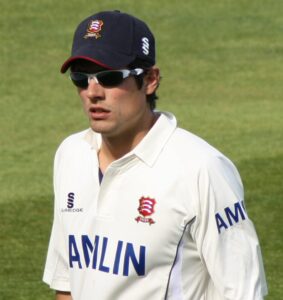
    Sir Alastair Cook is one of many patrons who came to the aid of his charities during Covid-19. Photo credit: By Harrias – Own work, CC BY-SA 3.0, https://commons.wikimedia.org/w/index.php?curid=10180837

    How did Sue react? ‘That was the only time I got angry with anyone. When David was out with his girlfriend, I phoned the nurses and told them that if David did not go to Wimbledon, he would die disappointed and I thought that we should do everything possible to get him there. Worst-case scenario was he died on the way, but at least he would have known he had tried to get there. By that time, he only had weeks to live at best. It was a saga! But he got to Wimbledon, taken by his brother. He went on the Tuesday, was admitted to the hospice on Wed and died on the Friday.’

    It’s a story which takes us to the heart of life’s cruelty. Yet at its centre is something that seems to work against all hardship: David’s optimism, and intense love of life.

    Sue remembered the lesson his boy had taught her, and started the David Randall Foundation which aims to keep his spirit alive. The charity organises Great Days for those with life-limiting conditions. Sir Alastair is its patron. This is a charity with a message for our times that will resonate: as the world seems always to become more morbid, we need the spirit of David Randall like never before.

    An Uncharitable Virus

    We also need the charity sector like never before. Young people might perhaps wonder whether it’s a vulnerable sector, and even whether it’s as worth going into as it was pre-Covid. While it’s true that many charities find themselves financially vulnerable, and have been hastily furloughing like everyone else, in researching this piece we also had a sense of a sector determined to be upbeat where possible.

    Many, of course, were feeling acute financial pressures and it was not uncommon to find confessions that the person who would usually handle our query had just been furloughed. But for those who were still active, Finito World witnessed in some instances an admirable heightening of purpose.

    Variety – the Children’s Charity works predominantly with children with special education needs and disabilities by supplying medical equipment ranging from diabetes monitors to wheelchairs and specialist car seats.

    Captain Sir Tom Moore became the face of charitable endeavour during the Covid-19 pandemic

    Dave King, the charity’s CEO, admits that events in early 2020 caught him by surprise: ‘By the time we became aware of the level of impact it would have, the virus was escalating quickly. This left us little time to get things in place before lockdown began. It was a period of confusion.’ Uncertainty is often a greater strain on a business than definitely dire circumstances. ‘Once the school enclosure had been announced,’ King continues, ‘we found ourselves in a better position. We were able to become more effective in our response once we had clear direction from government about the impact on children’s lives.’

    Variety began refashioning its processes. ‘One of our programmes involves grant-giving for specialist equipment for schools, and equipment for children,’ explains King. ‘We’ve managed to keep that running in spite of supply chains closing down and being temporarily suspended.’

    This is a major achievement especially as it was delivered at a time when the organisation’s income generation fell dramatically, primarily due to the loss of events revenue. ‘You can’t have a gala dinner with just a few people in the room. The atmosphere will be flat and it won’t be worth the outlay,’ King says.

    In sustaining itself, the charity was helped by its active golf society and golf memberships. These benefitted from that sport’s ability to be carried on while social distancing. ‘We’re looking at how we can maximise the use of our golf team and our society and to generate income.’

    As difficult as these times are for generating revenue, there is something that can still pull in the money even over Zoom: stardom.

    Stars in their Eyes

    Variety has been fortunate in its celebrity ambassadors, with Len Goodman and Mark Ramprakash singled out by King for lending particular support to the charity.

    This opens up onto the wider question of celebrity involvement in charities. Dan Corry, the CEO of Think NPC – a charity which supports other charities – argues that while having a well-known patron doesn’t always make a difference ‘it can definitely help. Anything you can do to put yourself in the limelight, and get people to open that email, or look at that tweet.’

    Within the sector, there’s some debate over whether celebrity involvement increases the amount of money going to charities as a whole. Cory asks: ‘Does having a good celebrity or fundraising campaign raise money for your charity instead of one they would have given to? Does it just spread the money differently?’ A relevant example here would be Captain Tom Moore, who walked around his garden for NHS Charities Together. Cory says: ‘Some in the sector felt that people who would have given to a medical health charity gave to that. In aggregate, it’s hard to tell.  Is it the right charity just because there’s a star celeb? It might be a rubbish charity.’

    Even so, the charities Finito World spoke with are deeply grateful for the assistance well-known names had given to their charities.

    Sue Randall says that Alastair Cook always comes through with ‘two tickets for the best seats’ at Lord’s for Great Dayers, adding that he ‘has never let us down.’ She adds: ‘Andy Murray also came up trumps for us last year. We had got a lady with cancer, some tickets for Wimbledon and on the day she was too ill to go. One of our ambassadors got in touch with Sir Andy and he sent her a personal note saying how sad he was she hadn’t been well enough to go, alongside a signed shirt. So he is now a hero to me!’

    Meanwhile, Ed Holloway, Executive Director of Digital and Services at the MS Society, recalls how the charity was able to pivot quickly during coronavirus thanks to celebrity generosity: ‘One of the first virtual fundraisers we did [after the virus hit] was the MS Society Pub Quiz, with the support of our ambassador and BBC Radio 1 DJ Scott Mills, who hosted a virtual pub quiz every Wednesday night, live from his living room. It was an incredible way to bring the community together at what was a very difficult time. Not only did we have thousands of people all playing along for a great cause, we had a lot of fun doing it, Together, we managed to raise an incredible £55,000.’

    In July, I zoom with Gruffalo and Zog illustrator Axel Scheffler who has had longstanding involvement with the National Literacy Trust (NLT), an independent charity committed to improving literacy among disadvantaged groups. When the pandemic came along, he was happy to help.

    He talks to me in his studio, with books ranged behind him, which themselves cede to a bright skylight. Softly spoken and matter-of-fact, it is clear that his charitable work is conducted out of a quiet and laudable sense of duty. ‘I have said yes to almost 95 per cent of what I’ve been asked to do,’ he says, in his careful German accent. ‘There was one job where a big airline company wanted me to design some airline masks and I said no to that one. Overall, it’s a difficult situation and we do what we can. I can afford to do it, and so I do it.’

    Axel Scheffler has been highly active for the National Literacy Trust during the pandemic.


    Early on in the pandemic, Scheffler was asked by the NLT to provide illustrations to an online book Coronavirus intended to educate 5-11 year-olds about the new disease. Published by Nosy Crow, and narrated online by Hugh Bonneville, it was publisher Kate Wilson who persuaded Scheffler to make time for a breakneck production schedule. ‘Her argument was that many children are familiar with my style and work, and that was why I said, “Yes, I’ll do it.” Nosy Crow completed the project from start to finish in 10 days: it was really, really fast.’

    Scheffler explains his motivation: ‘I’ve supported the NLT for a long time, and it’s brilliant what they’re doing. I think it’s sad that a nation like Britain has to have a charity to deal with these matters. It should really be up to schools to get children reading and it’s sad the government is failing the education of children in so many ways.’ It’s hard to disagree but it’s also surely this which makes the charitable sector so exciting.

    ‘Nobody’s poor relation’

    The CEO of the NLT Jonathan Douglas argues that there’s never been a better time to go into the charitable sector: ‘Its vibrancy and its entrepreneurial ability comes from the fact that its funding base is always tenuous.’

    Paradoxically, Douglas explains, it’s been a good time for the sector, in spite of the challenges: ‘The most heartening thing without a doubt has been the organisations that have come through to support shielded people, support children continue learning, and to support the victims of domestic abuse. All those social needs have been met by the charity sector. I don’t think the charity sector could ever have been written off as inconsequential – but after the way it has stepped up in the past three months it’s proved its mettle. We’re no longer anyone’s poor relations.’

    Over at the MS Society, Ed Holloway continues to feel the sector is attractive: ‘Like many charities we are relatively small and we ask a lot of our employees, but this gives them a chance to take on responsibility early in their careers, which stands them in good stead for the rest of their working lives. In return for their hard work and commitment, we work hard to provide a stimulating workplace where everyone can engage with our mission, know their voices are heard, and know they are making a difference to people living with MS.’

    Even so, that doesn’t mean that life is always easy. King says: ‘Most charities are operating on the frontline. The more we’ve got in the bank the less we’re helping kids.’

    Government response

    On April 8th 2020, the Chancellor Rishi Sunak announced a £750 billion package ‘to ensure [charities] can continue their vital work during the coronavirus outbreak’. Figure A shows where the money went. Unfortunately, in many cases it didn’t go far enough.
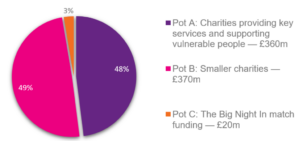
    The picture is complicated by the fact that it is often difficult to tell what sums charities may have received from independent grant-making foundations such as the Esmée Fairburn Foundation and the Lloyds Bank Foundation. In some cases, there will have been overlap, although that can be difficult to unpick. Cory says: ‘When this crisis is over, I hope we realise that we need more data in this sector.’
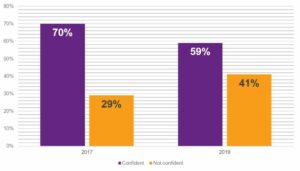
    Here charities were asked whether they were confident they were making the best use of digital. Credit: Think NPC

    King argues that government announcements were ‘targeted at organisations already delivering government services,’ adding, ‘we don’t receive any help whatsoever.’  A few weeks after speaking with King, Finito World heard that he too had been furloughed.

    Large charities like the Family Fund received large injections of cash; other smaller organisations did not. But even at the top end, there is pain. As Dan Cory says: ‘For the big charities, a lot of funding came from big events like the London marathon. Almost all of that has been kyboshed.’ With furlough now about to wind down, many charities including the National Trust, and Cancer Research UK have already talked about redundancies. In some cases, charities that relied on gift shop income have suffered, Cory explains: ‘They have no income. People aren’t rushing to the shops. They’re usually the kind of shops we like rummaging in, but now you’re not meant to touch product.’

    ThinkNPC also argues that the Treasury’s monies – though ‘pretty generous’, according to Cory – even at the high end’ A recent report by the organisation found that 27 of the largest service-delivery charities in the UK faced a ‘£500 million shortfall’. The report also found that ‘charities fulfilling contracts for local and national government are better insulated, whereas charities who rely on public fundraising and charity shop trading are far more exposed to more significant losses.’

    Ed Holloway told us about the gravity of the situation regarding MS: ‘The MS Society faces losing nearly a third of our income this year due to Covid-19, and yet we haven’t received any support from the Treasury’s £750 million funding package for charities.’ What matters here is the centrality of the society’s role in the fight against an awful disease: ‘The MS Society is the UK’s leading not-for-profit funder of MS research, and every year we invest millions in new projects – so sadly MS research is one area that has been affected by this shortfall. With researchers redeployed and labs closed due to social distancing, the pandemic had already affected many of the vital projects we fund. Right now, we’re doing everything we can to keep these going, but this significant loss to our income means planned research must be postponed, and we are unable to fund promising new work that is desperately needed.’

    When we wrote to the Department for Culture, Digital Services, Media and Sport to ask whether some smaller charities were falling through the cracks, we received no reply. Cory says: ‘My guess is medium-sized charities – in the £1-5 million bracket – have been suffering a lot. For the smaller ones, it’s difficult anyway. Typically, at a small charity you have two and half people with volunteers. Quite a lot aren’t going to survive this but it’s always like this down that end of the scale.’

    As grim as this is for many, if one were minded to be optimistic about anything at the moment, it would be about those who work in this difficult but noble sector: Variety which continues to send vital equipment to children; the NLT, which is more committed than ever before to literacy in areas that need it; the MS Society, which is still a beacon of hope for those suffering form an inexplicable diseases; and the David Randall Foundation which remains committed to making people’s last months and weeks memorable.

    In my most recent email from Sue Randall, she tells me: ‘Things are still very slow with DRF. Understandably the people we organise days out for are vulnerable and nervous about going out, but requests have started to trickle in. The trouble is you just start to think it’s Ok to go out and then the government starts bringing in more restrictions, so I am not surprised at people’s reticence.’

    This is a view in miniature of the sector as a whole: a sense of duty overriding anxiety; a sector which has been knocked which remains determined to rebound; and above all an industry with an ethos which values doing things not because they are intrinsically commercial, but because they are inherently important.

    Will it all come back? Cory is cautiously optimistic: ‘Not in the same configuration. But people’s will to do good and get involve in charities to work for them or volunteer is pretty undiminished.’ In these times, we must take the positives where we find them.

  • Tech apprenticeship makes major expansion

    Finito World

    London South Bank University (LSBU) has teamed up with the professional services provider FDM Group to announce a new apprenticeship scheme through the university.

    The apprenticeship offers young people the opportunity to get a foot in the door of the technology industry through a degree-level apprenticeship. Through a combination of on-the-job training and traditional study, candidates will learn to take on key IT roles eventually earning a Bachelor of Science Degree in Digital and Technology.

    With the rising cost of living, many students are turning away from the expensive university route in order to earn money while they complete their training. Young people were hit especially hard by the pandemic, so apprenticeships like this one are becoming more vital as an alternate paths to success. LSBU’s Head of Business Engagement Manjinder Chhokran highlights the importance of apprenticeships in training young people for their future careers.

    “Apprenticeship courses are a vital route for helping people gain the necessary skills to thrive in the technology industry, whilst benefitting from on-the-job training,” Chhokran says, “We are very proud to be working with FDM Group to widen access to these courses, helping support people from disadvantaged and diverse backgrounds to benefit from world-class degree courses.”

    In addition to helping young people in a time of extreme economic instability, LSBU and FDM Group pledge to assist people from underprivileged backgrounds and to maintain a healthy gender balance in an attempt to change the male dominated tech landscape.

    FDM Group’s CEO Rod Flavell explains how the apprenticeship scheme is designed to benefit people from underprivileged backgrounds, allowing anyone who wishes to find a career in the technology industry a chance to learn.

    “This is another very exciting development in our apprenticeship programme, which has been designed to break down barriers that all too often prevent young people from gaining a foothold in the technology industry,” Flavell says, “We’re proud to be working alongside London South Bank University to spread opportunity and access to these critical courses, which have the potential to transform lives and give young people across the whole country access to a fantastic career.”

    Originally the Borough Polytechnic Institute, LSBU specialises in practical education with a heavy focus on employability. The university is located in Elephant and Castle, a stone’s throw from the cultural and business opportunities of Central London. FDM has an existing partnership with Sheffield Hallam University, and more partnerships are expected to follow.

  • A view from Australia: tulips, seaweed farms and investment frenzy

    Ben Murphy

    In the 1630’s and during what is now considered the Dutch Golden Age, contract prices for newly introduced species of Tulips reached astonishing heights that were completely removed from concepts of fundamental or inherent value. The rapid escalation of interest in the fashionable bulbs, however, dramatically collapsed within a few years causing what is believed to be the fall of the first speculative bubble and the start of what is now coined the futures markets.

    Fast forward 400 years, and it appears we are entering into another type of flora-based mania – this time under water – as venture capitalists masquerade to save the planet from carbon dioxide (CO2) and other equivalent molecules.

    Enter into the discussion Algae, one of the most important substances on earth. A complex evolutionary masterpiece, there are approximately 12,000 known Algae species, and which are popularly (if incorrectly) merged into the term Seaweed.

    The Seaweed family contributes more than we could ever understand to life on earth, from sequestering CO2 from the earth’s atmosphere, to supporting the base food source of all marine life, through to cures in modern medicine and the foundation of the skin and beauty industries.

    And Asparagopsis Taxiformis, a red seaweed species, is no exception.  It is marketed as a leading solution to combat methane emissions, and has shown to reduce ruminant enteric methane (CH4) production up to 99%, decrease the carbon footprint of ruminant livestock and potentially increase production efficiency.

    Across Australia, New Zealand and many other parts of the world, the race is on to produce, refine and manufacture this wonder seaweed due to its incredible effects on reducing methane in the ruminants of Cattle, Sheep, Goats and Deer.

    In Australia the market controlled by a joint venture between CSIRO (Federal Government Research Agency), James Cook University and producer owned Meat & Livestock Australia held under the entity ‘Future Feed’. Future Feed licenses companies to grow, harvest and manufacture the seaweed for commercial use in feedlots.

    Large scale investment and government grants have produced seaweed farms across the southern shorelines of Australia and New Zealand with hundreds of millions of investments.  And with the intellectual property seemingly locked up, investors are in a frenzy to lay their claim. And like any bubble, it seems few are pausing to address either the potential harm to humans or impacts on the environment of the associated growing, harvesting, manufacturing and distribution channels.

    It is well understood that the active ingredient in Asparagopsis Taxiformis that reduces methane is the compound Bromoform (CHBr3). The first challenge for proponents and investors of this Seaweed is that in its raw form, Bromoform is a carcinogen. It could have immediate and long-term effects on the nervous system depending on the amount and frequency of exposure. While human data thus far is considered inadequate in providing evidence of cancer by exposure to Bromoform, animal data indicates that long-term oral exposure can cause liver and intestinal tumours.  On the question of whether Bromoform administered to livestock will find its way into the food chain, a recent study from a Dutch University (Wageningen University and Research) concluded that in dairy Cows tested, Bromoform was found in samples of both milk and urine. This concerning transfer and retention of Bromoform has of course been vigorously defended by Future Feed as it pushes the boundaries of production with the few licenses it has granted, creating scarcity, demand and an economic bubble.

    The second challenge is that to materially reduce methane emissions from cattle, the recommended daily dose for cattle is understood to be approximately 0.5% or less of highly bioactive Bromoform.  With 27 million head of cattle in circulation annually in Australia and only 4% in a feed lot environment at any one time, how this dose is efficiently administered is anyone’s guess. Sheep, Goats and Deer are even less controlled.

    The third challenge is the carbon footprint of growing, manufacturing, and distributing this form of seaweed.  By way of example, the Australian company Sea Forest is licensed to grow the seaweed product in a suitable environment off the far south-eastern corner of Tasmania.  The electricity and diesel used to grow and harvest the seaweed from the oceans, coupled with the high electricity output required to freeze dry it and the subsequent distribution to feedlots on mainland Australia (often over 3000km away), are staggering for a commercially unproven and potentially unsafe emissions reduction product.

    As a cautionary tale, in recent times the New Zealand dairy industry was hit with extreme export sanctions from China on the basis of a perceived threshold issue relating to the DCD nitrogen prohibitor in dairy cattle.  This locked NZ out of trading dairy items with China for 12 months, costing the industry and investors heavily.

    Just as tulip traders met with overzealous buyers in smoky taverns in the Netherlands in the mid 1630’s, we are today confronted by frenzied investors and venture capitalist players chasing a potentially harmful and environmentally risky product that may well be better left in the oceans to absorb CO2 naturally and replenish the marine ecosystem.

    Read Ben Murphy’s take on the coal debate here

  • Watch out for these CV ‘red flags’

    Finito World

    If you’re on the hunt for a new job, you’ve probably thought a lot about your CV. According to the online platform CV Maker, the average hiring manager only spends six to eight seconds looking over that much agonised over piece of paper before deciding if it goes in the ‘yes’ or ‘no’ pile. Therefore, it is vital to make sure that there is nothing in your CV which could give a recruiter reason to disregard your application.

    The biggest mistake you can make on a CV is also, thankfully, the easiest to correct. Typos and spelling/grammar errors can show a potential employer that you do not pay attention to detail (and even if you do normally pay attention to detail, a spelling error sends a bad first impression). A minor error shouldn’t get your CV thrown out by any fair recruiter, but if there are many mistakes then you should probably consider re-sending your CV with a brief message explaining the mistake. The best way to prevent this uncomfortable scenario in the first place is to use a spellchecker and have a few trusted friends or family members read your CV before sending it out.

    Another easy correction which can save you all manner of embarrassment has to do with your email address. It is always best to make a new dedicated email address for your job search, rather than relying on an old address. If your email is a bit unprofessional, or at worst outright vulgar, then your chances of landing the job are very low. The standard formats of ‘firstname.lastname@…” or “firstinitial.lastname@…” tend to work well for this purpose.

    A large gap in your employment is more difficult to correct. After all, if you have an employment gap then there’s not much you can do about it now, and it is certainly never a good idea to lie! However, there is a solution; just be honest. Particularly now after the pandemic, employment gaps are not rare and no fair employer should disqualify an applicant solely based on their employment history. If you can effectively explain your employment gap in a cover letter, that will help massively, and you should be prepared to offer a good explanation in an interview setting.

    If you have a number of relatively short, sub-one-year-long roles on your CV, this may raise some red flags with a potential employer. As with employment gaps, if you have a number of short-lived jobs then you can’t change the past, but a good explanation can go a long way. Try to stick to concrete reasons for your departures from previous roles, such as a lack of career advancement or recruitment by another company, rather than vague statements such as ‘needing a change’ which could cause some employers to believe you are unreliable.

    Including too much personal information on a CV can stray into the unprofessional realm, so keep things brief. Showing a bit of personality through your hobbies and interests can be good, but make sure they pertain to the job role in a positive way. Your personality will come through automatically through your accomplishments and the more detailed accounts of your skills, so there’s no need to overdo it.

    There’s a lot to think about when constructing a CV, and it can be overwhelming. However, a bit of proofreading and careful consideration of content can make all the difference when going for that dream role.