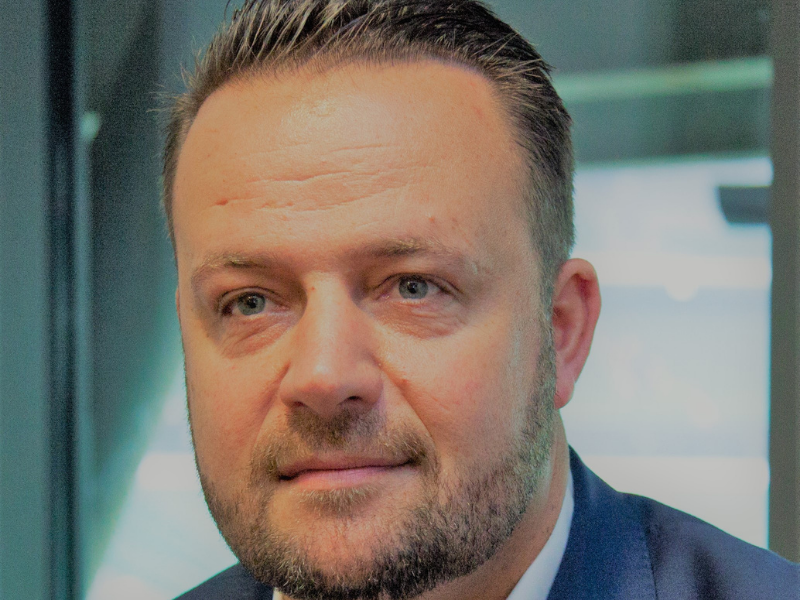
Alice Wright meets Simon Giddins – the man you go to if you have a problem the police can’t fix
“Imagine, someone has just destroyed your life in an instant, you’ve been scammed of your life savings, you’re sat there looking at the computer screen with your bank statement. All you feel is that nausea, that shock, your skin is prickling with cold sweat, you don’t know what to say. You phone the police, expecting a police car to come roaring down your driveway with blue-lights and people with notebooks. But nobody is coming to help you.”
Simon Giddins, a personable but mysterious figure, can only be described as having walked off the set of a TV adaptation of Arthur Conan Doyle’s Sherlock Holmes. However, Giddins sees himself more in J.B Priestley’s Inspector Goole, who he says is ‘the bastion for those without hope, which very much goes to our core values. We see people from all levels of society and try to help – we provide solutions to situations, and as a company, fight their corner.’
To meet him in person Giddins, who is the Managing Director of Blackstone Consultancy, a private intelligence and security consultancy is an exciting mix of anecdotes and vaulted secrets. His clients number among the richest and most powerful people from around the world; a little black book no one will ever get their hands on. When I name a handful of famous figures from billionaires to well-known politicians he’s prepared to play a long a little. ‘Yeah, most of those,’ he smiles.
Giddins holds all the expected credentials, an illustrious career in the armed forces, a degree in Terrorism Studies and a former deputy directorship of special projects for Aegis Defence Services.
So how has business been since the world was swallowed by the pandemic? Business is booming, and Blackstone’s agents were given licence to travel since their clients are ‘part of the critical national infrastructure.’ During the lockdown the company has professionally developed now housing two Chartered Security professionals: to put that number into context, there are only 160 such individuals in the world.
Even though official crime statistics stopped being published in March, Blackstone’s estimates that crime has gone up by 47% with cybercrime in particular having gone through the roof. ‘At the start of the lockdown we were seeing a lot of cybercrime using NHS messaging, asking people to buy tests or give personal data’ says Tom Tahany, an operations manager at Blackstone, who joins us for the interview. Giddins adds that ‘there has been a lot of sexploitation.’
‘Economically’, Giddins continues, ‘we are about to hit a wall, especially when furlough ends’. ‘As always we are ambivalent on political matters, but when furlough ends we will see an influx of business. Especially with the police’s attention diverted elsewhere in enforcing restrictions. Further to this, the more demonstrations we have – for example, anti-lockdown protests – police resources are diverted and crime then spikes.’
I’m interested to know what advice Giddins and Tahany would give to sixth formers or undergraduates that may be interested in a career that does not usually feature at the average university careers fair. Giddins emphasises that the perception is that they would want to recruit big guys with military credentials, but the reality is the needs of the industry and his clients are ‘so vast’ and ‘that’s why organisations like ours look for extra curriculars alongside academic achievement. And ask “how are you adapting those skills?”. Tahany, for example, is a qualified rugby referee, where he learnt to deal with big towering units of men in high intensity situations. While the company is interested in those with academic achievement, the particular field of study is unlikely to be the deciding factor on a candidate’s recruitment.
Blackstone’s are also advocates for diversity in the industry, particularly with regards to gender and background. Tahany, who joined as an analyst – but is now an operations manager – is from neither a police nor a military background. Giddins says: ‘For me as the business owner, I don’t subscribe to only recruiting from ex-military or ex-police because then you only have those ex-military or ex-police views.’ ‘The security industry is a bit monolithic,’ he continues ‘populated by fat, old white men who do have gender bias. We, however, don’t gender classify.’
Although this may not sound particularly progressive by the standards of some sectors, in this industry it’s a revolutionary approach. ‘Attitudes towards women in society particularly concern me,’ continues Giddins. ‘One in three women are harassed or stalked in their life. They have unwanted attention or are placed in situations where they feel uncomfortable.’
And when Giddins discusses diversity it’s more than mere talk. The Company is committed to young individuals seeing this as a viable career option. Giddins himself mentors two young individuals around the ages of 18-20 from underprivileged backgrounds each year.
Tahany, a popular figure from Channel 4’s Hunted, has been at Blackstone’s for two and a half years. He credits his practical experience on the show as well as his educational background as having led him to such an exciting profession. Shortly after joining, he found himself running surveillance teams in the Baltic nations. He tells me being an analyst is varied work, including conducting due diligence and background work on an individual globally, conducting data scrapes of an individual’s online footprint and advising them about where they are over-exposed or perhaps looking into the current risk situation of an individual travelling to Singapore or Hong Kong.
So it’s varied work? ‘We are involved in everything’, Giddins agrees, ‘from finding very unique items that are taken, such as unique jewels, to cars. Recently we investigated the theft of a £780,000 car – it was recovered. We also help small businesses, entrepreneurs and family-run companies. With these, we’re seeing a growth of ‘insider’ threats, theft from employers, lots of low-level fraud, even disgruntled household staff posting embarrassing images of client homes, causing reputational damage.’
The insider threat has increased since the first lockdown, as people have been working from home. People working for large organizations in their remote offices are having their information stolen by competitors. ‘But it goes beyond this,’ Giddins warns, ‘to the national level: rogue nation states, the Russians, the Chinese. It’s in their interest for them to sidle into organisations, and commit commercial espionage.’ This is happening in medical research, pharmaceutical organisations, universities and future tech companies. ‘It’s really exposed out there at the minute, and we’re very vulnerable. We have this view that the government will somehow protect us, but they won’t.’
Tahany agrees ‘Everything you’ve ever said, everything you’ve ever done, is becoming more and more exposed.’ The analysts, the more junior members of a team, will explain to second-generation multi-millionaires the risks they take with social media. Although he doesn’t think it’s credible to ask young people to not use social media, he advises that ‘it’s just about being sensible, about being mindful of what you’re posting and where. From a retrospective reputation perspective, but also to protect yourself from malicious actors such as fixated individuals.’
So should we be learning more future-facing skills like coding and data scraping rather than Pythagoras? Giddins isn’t about to take a swipe at the education system, ‘I would be very reticent to comment on what people should teach because it’s part of a very established syllabus.’ For Giddins it is about the act of learning itself, and how you apply knowledge.
—
Simon Giddins is the Managing Director of Blackstone Consultancy, a private intelligence and security consultancy. He read Terrorism Studies at the University of St Andrews, spent 15 years in the British Army and worked as deputy director of special projects for Aegis Defence Services, managing private and government clients internationally. He is a member and advocate of the Security Institute and was awarded the Freedom of the City of London in October 2015.
Tom Tahany studied Modern History at UAE before gaining his Masters in Intelligence and International Security from King’s College London. He has a background in private intelligence and investigations as well as featuring on the Channel 4 programme ‘Hunted’. Tom is also a qualified rugby referee, and continues to referee matches for England Rugby.
To say it’s Vincent Van Gogh season in London might be to overstate the case: it always is. Every day people come from all over the world to see Sunflowers in the National Gallery – that great tour de force which reinvents the colour yellow for all time.
The artist’s fame would have seemed odd to his contemporaries, especially those who knew his eccentric habits in Arles, in southern France towards the end of his life. There was a time when Vincent Van Gogh couldn’t get anyone to look at his paintings. Today, it’s hard to get in front of one long enough to have a proper look without a tourist straying in to spoil the view.
But great fame is often reductive: in loving his pictures so much, we’ve tended to simplify him. We attribute his current reputation to ‘madness’ – as if Starry Night were primarily an expression of insanity. It’s true that Vincent struggled all his life with what we would probably label today ‘bipolar disorder’, but the truth is that Vincent was always sane when he was painting, and that painting was in fact his best method of staving off episodes which occurred throughout his life. These were frequent and he was heartbreakingly honest about them in letters to his brother Theo: “It appears that I grab dirt from the ground and eat it, although my memories of these bad moments are vague,” he once confided.
It is an arresting image: the great painter literally eating the earth. It might even serve as a metaphor of his achievement: Vincent was always imbibing real life, insisting on it to an unusual extent. His is a world of peasants and down-and-outs: he might be the only great painter in history whom it’s impossible to imagine as a courtier.
If you look at the popular image of the artist, you could almost imagine that Vincent is a completely separate case, someone we can’t expect to learn from at all, because we are not mad and he was. But his greatness cannot in the end be assigned to insanity, but instead to skill, vision and application. This means that we have more to learn from Vincent and his methods than we might think: this is true if we want to work creatively, but true also no matter what we wish to do with our working lives.
The first thing we mustn’t do is think him a uniquely hopeless case as a man in order to consider him a uniquely remarkable artist. As the pandemic has brought into focus, the world is always liberally stocked with mental ill-health. We might be deluding ourselves if we consider ourselves well, and Vincent not. It may even be that the reverse is the case more than we might realise or wish.
Secondly, we mustn’t forget how much hard work underpins Van Gogh’s achievement. The popular caricature of Vincent’s life still seems to invite us to imagine the world binary, divided between the sane and the insane. In actual fact, his life increasingly makes me think that we are instead divided between those who are committed and those who are not.
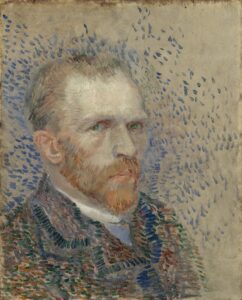
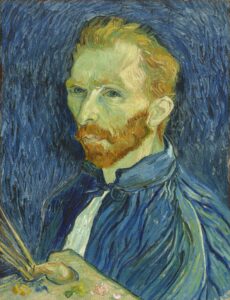
With all this in mind, I have come to the Courtauld Institute to see a remarkable exhibition housing 27 Vincent self-portraits collected together across two rooms. The Institute has spent a fortune renovating itself, and emerged on the other side of £57 million in expenditure looking almost identical to what it looked like before.
Anyone who wishes to get upset about this financially alarming decision however, can seek solace in being restored to one of the great collections of the world. Among them is Vincent’s famous Self-portrait with Bandaged Ear, which he made after the terrible and incomprehensible incident in Arles which most people know about: after experiencing increasing tension in his friendship with Paul Gauguin, he cut off his own ear and delivered it to a prostitute with a cryptic note attached.
The exhibition may be said to build towards this picture as towards a crisis. But there is another way of looking at it: here, spanning over a decade of helter-skelter work, is a celebration of the joy of discovery. We might be disinclined to cut off our own ear, but we should certainly leave open the possibility that there is an activity waiting for us in life which we can grow into over time: a room we might walk into without ceilings or impediments where we might become more and more richly ourselves. By that measure this exhibition is extraordinarily valuable: it shows the sheerness of Van Gogh’s application to the art of painting and might even unlock something within ourselves.
The early pictures, drawn in his native Holland, are sombre affairs compared to what he would later produce. As such, they are a very precise measure of how far he would develop. By the vigour and the colour they lack, these pictures imply both an openness to doing things in a different way and also state an uncompromising desire to make his craft secure before he did branch out. The dominant influence here is Rembrandt. Here again there is a lesson which might apply to other disciplines: seek the best in what you wish to do, learn from it respectfully, and only then stake out new territory.
There’s another lesson, stemming from the fact that so many self-portraits exist. Vincent was a little unnerving as company, partly due to his physical appearance which was by no means prepossessing, and partly because of his unpredictability. As a result, throughout his short life, he found it difficult to find models willing to sit for him. The only model always willing to do so was himself.
This points to his resourcefulness and to his determination. In his letters to Theo – some of the loveliest documents in the history of art – we get a lot of detail about materials Vincent is buying. Here again, he is always sensible with money, frugal with what he’s able to afford, and a fortunate beneficiary of his brother’s generosity. Unfortunately, because Theo’s letters weren’t kept, and Vincent’s were, we rarely get a sense of Theo’s view of Vincent, though what we do know points to fraternal adulation. But this absence further augments the sense of Vincent as a man alone.
The Courtauld exhibition shows that Vincent always left himself free to experiment, without ever losing the intensity of work ethic which always marks out his pictures. He studied his own face from every angle. He told us his every mood. By the end of this exhibition, we feel we know him. It’s this intimacy – together with the perennial simplicity of his signature – which makes us comfortable (think Don Maclean’s song of the same name) enough just to call him ‘Vincent’. We do not call Cezanne ‘Paul’ or still less Monet ‘Claude’. Vincent is touching in a way few great artists are. One of his virtues was always humility. It’s this which has brought him so many posthumous champions. Knowing what it was to be despised, he never despised anyone. He is always in the trenches of life with us. It is difficult to think of another artist who cared so much for the downtrodden and the outcast.
In these self-portraits we see always the same determined mouth, the slightly watery eyes, the hooked and even austere nose, and the receding hairline. But this is where the similarities between each picture end. Given that the same subject recurs throughout, it is an exhibition so various in its mood and techniques as to cause astonishment.
The main reason for this versatility is that Van Gogh had made himself open to the gigantic discovery of the age, Impressionism, and then moved swiftly forward, making out of it a unique and wholly personal achievement.
But here again we must be careful. The truth is that in a pre-Internet age, Vincent never could have discovered Impressionism without having been immersed in the art world through Theo’s work as an art dealer. He couldn’t google Seurat; he had to meet Seurat.
In actual fact, if we might look at the matter objectively Vincent made all the right moves, which makes his achievement no accident at all. In fact, he often foresaw in his letters that his victory would have to be posthumous. There was a worldly, even calculating side to him at odds with the stock image of the freewheeling madman.
Other lessons can be found in his life. He moved away from a career in the priesthood to which he was unsuited, though he took what he had learned there – the importance of the numinous in life – and applied it to his art. Nothing was ever wasted. He then applied himself with rigorous dedication to painting, and connected himself in that world, making sure that he was working not according to some outdated understanding of his craft but to its latest developments.
As he carried out all this he was frugal, careful, and utterly committed. He also had an unfailing instinct for the next subject, and was prepared to subject himself to upheaval in order to pursue those instincts to their logical conclusion. The most famous example of this is his decision to leave Paris and move down to Arles in southern France.
He did so because he craved another light. It was a masterstroke – when what Vincent calls that ‘high yellow note’ has entered his pictures, we feel he has come home somehow. It looks like something which had to happen. But this again is an illusion: he made it happen. Again, because his life ended tragically, we forget that he was possessed of exceptional self-reliance to have got as far as he did.
Of course, a more organised person would have found somewhere less depressing than Arles to settle. It’s true that it had a few places going for it – the old Roman amphitheatre and some decent museums in towns nearby. But one senses that almost anyone else would have pressed on to Italy – or to Tahiti, as Gauguin did and follow their decision to relocate to its logical conclusion and find their way to a more appealing town.
It was his hyperactive fascination with what he saw which made him stay. The fields, the café, his chair, his room: these were enough for him, because he realised that just by going to Arles he had learned to see things in a way which nobody before him had been able to do.
No-one has seen like that since – and it must be that no artist has communicated to so many people with such immediacy. In fact, his work has the immediate comprehensibility of photographs: it is mass art in the way in which magazines are. And yet it stands up.
This is abundantly clear at the blockbuster Vincent Van Gogh: the Immersive Experience now touring the world where huge crowds, including children, experience Vincent ‘interactively’. At times the exhibition – as in its roomful of sunflowers – feels somewhat gimmicky, but sometimes it astonishes.
The centrepiece of the exhibition is a vast, almost cubist cinematic experience, where we see the familiar story of Vincent’s life written in subtitles while music contemporary to Vincent’s life plays and his paintings are shown in detail on large screens. The fascination of the show is that it’s impossible to see all of it at one go, and we’re reminded of what a complicated thing a life is, and especially a creative life like Vincent’s.
But the principal reflection is this: it’s very hard to imagine a show on this scale for any other artist dead or alive. Picasso, perhaps. Hockney, just maybe. But in each case, I doubt that their work and life has the deep appeal of Vincent. Picasso is at heart too grotesque and misogynistic; Hockney’s work is probably not quite good enough, especially in the last 20 years or so.
What accounts for this? It is that Vincent truly loved the world and truly loved all people. In his life, he imagined creating an artists’ colony alongside Gauguin and others where the world would be righted. Sometimes, Vincent had little self-awareness: he had neither the organisational skills, nor the money, nor really the personal magnetism, to make such a thing happen.
But it happens today at any Vincent exhibition where people gather in a kind of loose arrangement of fascination, seeing the world again through his eyes. Of course that arrangement dissolves swifter than Vincent had in mind when he imagined a colony of artists. But it is something – more than something.
And with every passing year we need to understand that Vincent’s popularity isn’t a quirk of madness. It was because his life in its way was exemplary, and there is much we can learn from him.
Van Gogh. Self Portraits runs at the Courtauld Institute until 8th May 2022
The freelance life is longed for my many, achieved by some, and not desired at all by others. If you like structure, stability, and clearly set tasks, then freelancing is probably not for you. However, if you wish to benefit from the creative freedom, variable schedule, and healthy work-life balance that freelancing can provide, then it is important to know what opportunities await you around the world.
The financial tech company Tide has drawn up a list of the top ten countries for freelancers based on a variety of factors: cost and speed of broadband, legal rights for freelancers, cost of living, gender pay gap data, searches for freelance work and availability of co-working spaces per 100,000 people, and the happiness index.
Singapore won the top spot on the list due to fast, affordable internet and numerous co-working spaces, though it leaves a bit to be desired in the cost of living and happiness index departments. New Zealand came in a very close second, with its advantages being strong legal protections for workers, a good happiness index score, and equality of pay.
In third place, Spain is much more affordable than the other top countries and has a low gender pay gap. However, it may not have the same breadth of opportunity in the freelance sector as other countries.
The rest of the list is fairly close-matched, with the main deterministic points being cost of living and searches for freelance jobs. In order, Australia, Denmark, Canada, Switzerland, Lithuania, Sweden, and Ireland make up the remaining seven spots.
Tide also found the worst countries for freelancing. Japan had the lowest score due to few legal protections for workers, low interest in freelancing, and a problematic gender pay gap in many industries. China was named second-worst due to a poor happiness index score and little interest in freelance work, though it is affordable. Italy was next, primarily due to slow internet speeds and weak legal protections in the country.
The Netherlands showed the highest interest in freelancing, with 1,305 searches made for freelance workers per 100,000 people. Denmark took the top spot on the happiness index, and India was first for affordability.
Wherever you choose to work in the world, freelancing is never free of its faults, but for many, the freedoms afforded to freelancers outweigh the instability that they can sometimes face. Additionally, one of the lower-ranked countries on this list could end up being the perfect fit for you depending on your field and preferred style of living and working. Therefore, take this as a guide to assist in your research, not determine your future home. By recognising the advantages and disadvantages of each location and comparing them to what your personal preferences and expectations are, you may be able to find your dream freelance destination.
Read about how Georgia Heneage navigated the world of freelancing during the pandemic here
Patrick Crowder talks work/life balance, homesickness, mentorship, and education with the champion Australian snooker player.
How do you normally prepare for a match?
Generally I don’t really like eating that much before I play, and it’s always been like that throughout my career. I actually try to eat anything I can really, because the worst thing is when you’re playing and you get hungry because maybe you didn’t eat enough before the match. My go-to is a peanut butter and banana sandwich because I find that really easy to eat, and it kind of fills me up for quite some time. Before I play a night session, like a final, I mean the worst thing you can do is eat a proper full meal and then all of the sudden you’re getting ready to go out and play and you feel like you’re ready to check out for the night, sit on the couch, and just watch some TV. Generally I always try to get down to the venue around 35 minutes before I play, and I think 15 minutes on the practice table is perfect. Some players like getting to the venue 45 minutes before, but then you’re waiting around and using a lot of nervous energy.
What is your proudest moment in snooker?
Probably being the first overseas player to win the Triple Crown – that’s winning the World Championship, the Masters, and the UK Championship. I did that in 2013, and to be the first player to do that is pretty cool. It’s certainly something I never thought was possible when I first came over to this country, not in a million years. Also, I guess I’m proud of how long I’ve been able to be successful, coming over from Australia. A lot of great players who have come from overseas will sort of go pro for ten years and then they’ve had enough and they go back home, whereas I’ve been able to sustain it for 20 years now living over here. I’ve been able to win a tournament every year since 2006, so that’s also right up there, I’m proud of being able to keep that winning streak going.
How did you adjust when you first moved to the UK?
In the 2001-2002 season when I was only 19, I was living in Leicester and I didn’t enjoy living there at all. It was completely different to Melbourne, so I really struggled. It was different back then as well, there wasn’t any sort of internet where I lived so it was difficult to keep in touch with the people back home. It always seemed like I’d have to walk an hour in the rain to get to this one internet café, and I just thought ‘this is depressing really’, so that was when I was questioning if I really wanted to commit to snooker and live in this country. I took a year off the tour, and I came back in 2003 with a few friends from Australia and we moved to Cambridge, which was a completely different world. From then on I settled in really quick.
How do you manage your work/life balance, especially with two young children?
My daughter is turning three tomorrow, and my son is eleven and he’s really into his football, so I tend to pick and choose my tournaments a little bit more these days. I can’t really commit to an absolute full season because if I do that then I’ll hardly see my family. I’ve sort of achieved everything I’ve wanted to achieve in my career ten-fold, so now if there are some smaller events on the calendar I’ll choose to miss a few of those and be home for the week instead. I take my son to all of his football training and his matches, and I get a really big buzz off of that. I think it’s important to strike that balance, and I think what’s led me to have good longevity in the sport is that when I’m playing in tournaments I really want to play. I don’t feel like I’m getting burned out and like ‘oh jeez, I’ve been playing too much’, so when you see me at events you’re seeing me when I’m very determined to do well.
How do you like to unwind when you’re not playing snooker?
Before lockdown I used to play in Warhammer tournaments, but I haven’t really been able to get back into it the same way that I was. Ever since my son has been doing really well in football I’ve not been able to participate in any of the tournaments, so I haven’t really been painting as much either. I do still love it, and I will get back around to it, I mean I used to spend 30 hours on a miniature and do really well in painting competitions. I also chill out a bit with some of my friends playing a bit of World of Warcraft. When you’re in a hotel room it’s nice to have a laptop or something to chill out and unwind. And that probably helped me get through when we were in the bubbles in the hotel. Some of the guys who I know started to lose the plot after three or four days in the hotel room, so it’s always good to have things outside of snooker.
It sounds like you’re really involved in your son’s football, do you find that your experiences in sport allows you to help him better?
I never played when I was younger – back in Australia everyone played cricket or Australian football – so I don’t really coach him as such, but I do analyse a lot and I try to help him out with experiences I’ve had through snooker about improving and being patient with yourself. It can be frustrating when you’re trying to do something and it’s not quite coming off, so he’ll be practicing in the garden and I’ll tell him the importance of learning patience, sticking to it, and putting in the hard work. I just basically try to let him do it himself as well, I don’t want to push him too much, I want to let him enjoy the sport. But I do like to try and implement the things that I know work for me and see if he can take those on board. Throughout your career have you ever had a mentor to help you through? Have you been that mentor for another player?
Yeah, Joe Perry has been fantastic. I think one of the luckiest things that happened to me is that when I moved to Cambridge in 2003, he was changing clubs from where he lived to the club that we were going to. So he put his professional table in there, and we were lucky that we had someone like Joe to learn off. We could watch him every day to see how he goes about things, Joe’s been fantastic about those sorts of things and he’s always been great for advice. If I were to get into coaching it would be as a mentor – maybe to someone who has a lot of potential and plays the way I did when I was younger so that the things I learned to become a winner could help them make that transition as well.
You left school at 15, right? What would you say to someone with a lot of potential trying to choose between further education and following their dreams in sport?
Oh, stay in school! My son and his friends will be talking while playing footie in the garden or something and I’ll hear one of his friends go ‘I hate school, I can’t wait to leave’, and I’ll say ‘Hey, hey, boys, you’ve definitely got to stay in school’, then of course I’ll get the ‘Well yeah, but you left school at fifteen!” So I have to kind of really say “Look, you don’t understand, I’m a one in a billion story, this just doesn’t happen normally”. So I always say, at worst get a good basic education where you can always go back. At least complete your high school and get that done. Because especially with today, you can do courses online and stuff, you have to get a solid education. The chances of making it in sport and getting to the point where you actually earn a proper income is so rare. In the Premiere League it’s something like .002%, and you can’t pin your hopes on that. It was pretty tough on my mom when I left school, because no one from Australia had ever made a living in snooker, and I had to move to the UK, and there was no guarantee that I could do that. So definitely stay in school, there’s always time. You can still do your studies and practice whatever it is you’re passionate about. You don’t need to leave school to be a professional sportsman, it’s just not true.
If you had another job within the snooker industry, what would it be?
I’d be doing studio work (commentary) for sure, I’ve done that quite a few times and the feedback has been fantastic. It’s very easy to do as an ex-player, you’re talking about stuff that you know. So it’s very straightforward and enjoyable, really, getting to see what other players do, so I quite like doing that and it’s probably something that I’ll transition into quite well.
Were there any times of doubt?
Yeah, it’d be when I was 21. I was playing back home and I was off the tour, I wasn’t professional at the time. I didn’t have an education, so it was really hard to get a job, and my brother and I had this tiny flat. I had to go to the job centre, which is where you go to get what’s called the dole in Australia (Jobseeker’s Allowance, or unemployment). It was a dreaded moment to get in the queue for that, because when I went to the UK when I was 15 I figured by 21 I’d never have to do anything like that. In front of me there was a guy who was absolutely kicking off. I think he forged some signatures or whatever and they weren’t going to pay him, and he just started swearing at everyone and it was really awkward. I was just thinking “Oh God, is this my life?” and I went out and started having a real good think about things. I wasn’t really practicing much at the time either, I had kind of lost hope. Then I decided to practice a bit more, and I got a call from Mike Peachey who was the head of the Australian Billiards and Snooker Council. He told me that the world under-21s was going to be held in New Zealand, and that he would help with the expenses. To cut a long story short, I performed really well at the world under-21s and won it, and that got me back on the tour card, and the rest is history. So that was a really massive turning point in my career.
I could not put the book down from the moment that I began reading, despite its author for a time crossing the road when he saw me approach. As an Honorary Trustee, I was fundraising for Noah’s Ark Children’s Hospice capital appeal and Peter was inundated with similar requests. He did contribute for which we will always be incredibly grateful. It set the scene for what was a remarkable journey From Milkman to Mayfair.
Unlike many business leader autobiographies, this was not ghost written but penned by the great man himself. Whilst reading you can hear his tone of voice during an extraordinary voyage right to the top.
The son of a meat market porter and an office cleaner, Peter left Shoreditch Comprehensive School at the age of fifteen with no qualifications and a part time job as a milkman. Today he’s Lord Cruddas of Shoreditch, the founder of a £1.5 billion financial trading company and a distinguished philanthropist, giving to over two hundred charities through his foundation which helps young people from disadvantaged backgrounds.
Fed up with Labours economic management, Peter began his foray into politics, becoming a key Conservative Party donor. But after being elevated to Treasurer in 2011, he fell victim to a Sunday Times sting which he was falsely accused of breaking the law on party donations. With unflinching honesty, he reveals the full story of his successful libel battle and opens of Pandora’s box of profound wider questions about newspaper dark arts and the power of the British press over the judicial system.
Refusing to be scared off from the political world, Peter co-founded the winning Vote Leave campaign. Here, he gives a detailed insider view of the real reasons behind the victory and contemplates how Britain can now thrive outside the EU.
Filled with heartbreak and elations, this is the extraordinary story of Peter’s epic rise from an east London council estate to a Mayfair mansion – and includes plenty of tips for budding billionaires, not to mention the importance of giving back.
Honestly, I cannot wait for his sequel, and so will you.
Passport to Success is published by Biteback Publishing at £20
It’s a cold rainy day in November in London and I keep telling myself how could I forget my brolly today, it’s London after all. Yes it’s London but the forecast said cloudy with only a 20% chance of rain. The winter has just begun to make an entrance and I know exactly what will cheer me up, a lovely glass of Bordeaux.
I enter a London restaurant for the second time in my life and the receptionist greets me with a warm smile and remembers my name, whilst saying that she will gift me an umbrella when I leave. I am already smiling before being shown to my table. Equally impressive is the Manager who had only met me once before and who remembers not only my name but also when I last came and where I was sat. Physiognomist or lucky shot? Either way, I’m delighted because he remembers me and every guest feels special when the staff remember them. The Chef patron wows me by knowing who I am before I have even uttered the words wine o’clock, highlighting what a tight knit industry this is.
Remembering a guest goes further than just knowing his or her name. It involves knowing his or her favourite wines, any allergies and dietary requirements as well as those of his or her guests and knowing what occasion if any is being celebrated.
I touched upon wine and how remembering some of my favourite wines is a definite bonus. I often get asked what makes a great sommelier? Some may think great knowledge and exams. But before all of that, a great sommelier to me is one who listens. “Would you like a rosé or a light white wine?” are words that are often uttered to me by sommeliers and it has become a bit of a joke within my circle of friends to see how many sommeliers will ask me this. Is it because I’m a young woman? Don’t assume every young woman likes only rosé. In fact, I love red Bordeaux with power and body and white Burgundy with oak and creaminess. The best sommelier will remember this whilst challenging me by taking me on a journey and making me discover other wines in that range that he or she thinks I will really enjoy.
Vintage is key and there have been occasions where a different vintage has been brought to me. I was once brought a 2007 Château Talbot instead of the 2005 listed on the wine list. Luckily, it didn’t take long for the sommelier to see I really wanted 2005 so he rectified this and surprised me with a Rauzlan Ségla 2005 that had just arrived. Stock shortages can happen, although I think it’s always important to notify the guest of this to enable them to make an informed decision.
I recently caught up with Angelo Altobelli, the Beverage Director and Head Sommelier of Dinings SW3. I know I am always in great hands when Angelo is there. With his Italian flair and charisma, Angelo knows what it takes to make his guests feel welcome and happy. He knows my love of Bordeaux as opposed to Malbec, and for Burgundy as opposed to Riesling and won’t even dream of recommending orange wine as he knows it makes the vein on my forehead pop! He also understands my obsession for decanting all my wines as well as my love of perfectly chilled champagne (who else hates champagne at room temperature?).
I started by asking Angelo why it is so difficult to find sommeliers in the UK? Angelo explains to me that after Brexit, many people decided to leave the UK. This was very reinforced after the many lockdowns. Wine is not as present in this country as in Spain, France and Italy as a profession. Most of the sommeliers in the UK are not British. Angelo mentions that in Italy, there is even a school where you study hospitality and wine whereas in the UK this is not so common, apart from Le Cordon Bleu.
I’m curious to know what Angelo thinks makes a great sommelier. He says they need to be able to adapt to the guest’s needs, whilst still making it fun based on their palette. Some sommeliers make it a bit too academic he says. I couldn’t agree more as we just want to be taken on a journey allowing us to discover different wines. What I perhaps like best about Angelo is that he listens to the guest. He knows my love for full-bodied wine so he avoids recommending me any Pinot Noir. Angelo also adds that a great sommelier has a good understanding of business so they know what sales and profit margins they need to achieve. Whilst we may be quick to complain about high wine prices, Angelo explains that a lot of research goes into what wine to put on his list, focusing on the producer and the vintage. It has taken him 9 months to get the Dinings SW3 wine list where it is now and he is not even half way there yet.
The industry is clearly struggling and we are likely to see many restaurants shutting their doors which is heartbreaking. Angelo admits that he is a little bit scared about the situation. Demand for sommeliers is high at a time when there is a real shortage, meaning this may lead restaurants to have to recruit people who are either not sommeliers or not passionate about the trade. We talked about how the government needs to be doing more to help the hospitality sector, with a key priority being easier access for people to come work in the UK. Four years ago, it would not be uncommon to see a starting sommelier position advertised at under £25k. Today, you will struggle to advertise for that position under £30k, with some restaurants offering even more.
Angelo has plenty of funny wine stories. Perhaps my favourite one is where a guest said to him, “can you recommend a good white wine?” When Angelo asked the guest what she normally drinks, she said everything but that she hated Chardonnay. He then went on to recommend a Riesling, yet she insisted on having a Chablis! My eyebrows are raised at this stage and I ask him if he told her that Chablis is a Chardonnay grape variety. He opted for diplomacy and just smiled I bet he was giggling inside…
Perhaps what we don’t talk about so much is how much time sommeliers dedicate to their exams known as the Court of Master Sommeliers. The first of these exams took place in London in 1969. The aim of these exams is to encourage the quality standards for beverage service in the hospitality industry. The first of these exams is called Introductory, then comes Certified, followed by Advanced and ending with the most prestigious and highly coveted of all, the Master sommelier exam. On average, the pass rate for the Master Sommelier is about 5% and there are only 273 worldwide which shows how difficult it is to achieve. More than a decade can pass between the first exam and the Master Sommelier exam which involves a blind tasting of 3 red wines and 3 white wines, as well as an evaluation on service and a theory-based exam. So why put yourself through such intense studying? Well, on one level it’s the pride of the achievement but as well as this, it does demonstrate to a potential employer that the candidate is among the most qualified in the industry and can also lead to better progression and a higher salary within the industry.
Historically, one could argue that sommeliers were not paid very well, given all their hard work and the long hours they spend in the restaurant. Before covid, it was not uncommon to see a starting sommelier salary between £24k-£25k. Now this is closer to £30k although it will depend on the restaurant of course. This is something positive though as the lack of supply has also highlighted the need to reward talented and passionate people. A Head Sommelier will of course be on more, typically this would start at around £40-£45k in London although it could be more depending on the person’s experience. As for Master Sommeliers, it is not unusual to expect them to be on £80k-£90k in London. The title is one of the most prestigious ones in the wine world so it is understandable that restaurants are proud to be able to say they have a Master Sommelier in their team.
Investment in wine has become an interest of many wine lovers as it is an alternative way to make some money from something people are passionate about. It can get quite complex so having an advisor for this in the industry is very helpful. It all depends on how you buy the wine. The key is buying the wine En Primeur which means you are buying the wine before it has been bottled straight from the producer. This ensures you will make good revenue on your investments. You could expect to buy a bottle of Guiberteau 2 years ago for between £20-£25 that would now sell for between £35 and £40 per bottle. Both Burgundy and Bordeaux wines are great investments and 2 that I always turn to. Burgundy gets mature quicker so the return will come sooner, usually in about 5-6 years whilst Bordeaux can take up to 10 years. It is all dependent on the producer and the vintage also plays a part. The top 2 wines I would recommend for investment are Domaine Romanée Conti (known as DRC), although getting an allocation is a challenge in itself. A case of 3 bottles about 5 years ago was £900, whilst today it is up to £4,000. DRC is so attractive as it can generate returns of up to 200%. For Bordeaux, I would turn to Château Lafite. As an example, a bottle of 2018 Château Lafite was £2,300 en Primeur whereas now it is selling for £3,500. The key with wine investment is patience and a careful selection by someone who understands the market.
When it comes to hospitality, consistency is key and being made to feel welcome will make me coming back for more. My dad used to say, “this restaurant is my home away from home”. Nothing beats sharing a bottle of wine in good company. Warm treatment of your guests will make them a walking advertisement and they will not only become regulars but also spread the word to their network. True hospitality is achieved when people leave feeling better not about you but about themselves. Psychology plays a huge part in hospitality so understanding your guests is really key and the sooner this is achieved, the better, so keep the orange wine away from me and get your decanter out because it’s wine o’clock!
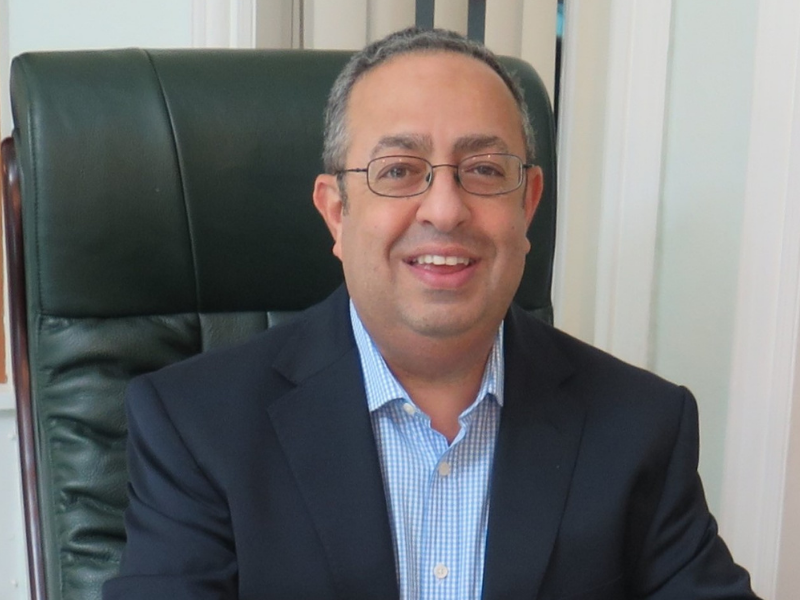
After 35 years as a dentist in practice and a clinical academic at UCL, Professor Andrew Eder reflects on his personal journey from wanting to be a motorbike policeman to being a dentist and now a Finito mentor
When reflecting on the Covid-19 experience, it is impossible to do so without saluting all those working in healthcare. Whether clinicians caring for patients on the frontline, public health colleagues determining new pathways or scientists developing vaccines, all have played a key role and we thank each and every one of them for their commitment. Despite the tremendous challenges they may have faced, higher education application data suggests that increasing numbers of young people wish to follow their lead and enter the healthcare professions, with doctors, dentists, nurses and scientists being just some examples of the many career options.
My journey
It is at these challenging times that I feel blessed and humbled to have worked alongside so many dedicated colleagues for so many years. Let me briefly share my story. I graduated from King’s College London as a dentist in 1986. I have since worked in NHS, Private and Specialist Practice alongside a parallel career as a clinical academic at the UCL Eastman Dental Institute.
But the early journey was bumpy to say the least. At 12 years old, I wanted to be a motorbike policeman – my life was all planned! But by 14, and after two years of pretty intense orthodontic treatment under the care of an inspirational orthodontist, everything changed. I had a complete about-turn and now wanted to be a dentist, this time my life really was sorted and my parents were ecstatic. I had a plan and knew what I needed to do.
I enjoyed a privileged school education – a preparatory school in North West London followed by a scholarship entry route to St Paul’s. All seemed to be going well with good friends and success at O-levels. However, I soon started to struggle with aspects of the sciences despite working hard. But then, at A-level, my whole world came crashing down. With the simplest of actions, the opening of an envelope, my life-plan seemed to have slipped away with A-levels results far short of my offers for entry to Dental School.
Off I went with my father to see the Careers Head at St Paul’s to be told that I would never get into Dental School and needed to consider other options. I recall so very clearly my father looking straight into my eyes and asking whether I still wanted to be a dentist. Without hesitation, I responded positively. So, the question was no longer when but how this ambition could be achieved, if at all.
My father marched me out of St Paul’s as they could do no more for me and I was enrolled in a crammer sixth form college in Kensington on the very next day. I still wanted to be a dentist and there was no time to lose. I spent a year reinforcing key knowledge and, more importantly, learning how to apply this knowledge by doing hundreds and hundreds of practice questions. Not a fun year by any stretch of the imagination, but a means to an end. A year later, I got three As in my A-levels and even an S-level. My place at Dental School was secured and I have truly enjoyed the past 35 years without ever looking back.
Careers advice
The younger generation are our future and I am grateful for the opportunity to give several careers talks each year. It is also a particular pleasure to regularly host work experience students in my practice. My message about dentistry, healthcare, or any other area of career interest for that matter, is simple: explore your interests broadly, always have options, work hard, enjoy life and, most importantly, always live your dream.
Where now
As an experienced clinical academic working as a Professor and Consultant at UCL and also as a Specialist in my own practice in central London’s Wimpole Street, my professional life has focused on excellence and innovation in clinical dentistry and dental education. Throughout a career spanning more than three decades, I provide high-quality care for patients with complex oral health needs and contribute to the training of dentists, postgraduates and NHS trainees.
Working in healthcare
Working as a clinician is hard but rewarding. And it is not just about the hours or working within a heavily regulated profession but also the emotional drain of clinical situations. But there are so many positives. For me, looking after so many wonderful patients for over three decades has allowed me to see them grow, just as I have grown. Along the way, we may discuss family events and work challenges as well as good and more difficult experiences. If patients are blessed with children and grandchildren, we might share pictures. For some families, I have the pleasure of looking after several generations.
Deciding on what to become or what degree course to take, and where, is challenging to say the least. Historically, there were plans to have a single-entry Bachelor of Science degree for medicine, dentistry and veterinary science as one may not always be absolutely certain of a preferred career path, particularly at a young age. After a couple of years at university, and for those who have been the most successful in their studies, a decision on a future direction of travel can be taken. Sadly, this plan never took off and, as a result, teenagers are faced with deciding on a specific professional trajectory at a young age.
Diversification
For some, making such a life-determining career decision works well as it did for me. For others, less so and sometimes changes have to be made along the way. However, most interesting is the tremendously broad range of options available within healthcare, even on a part-time basis. For me, I have always enjoyed a parallel clinical and academic career, with each supporting the other. For others, communicating with people may not turn out to be a strength and they may not enjoy patient contact and prefer to be in the laboratory or behind a microscope. Others may enjoy writing and I have found this a superb way to share clinical knowledge and experience with colleagues whilst also being able to educate the general public.
Tooth wear
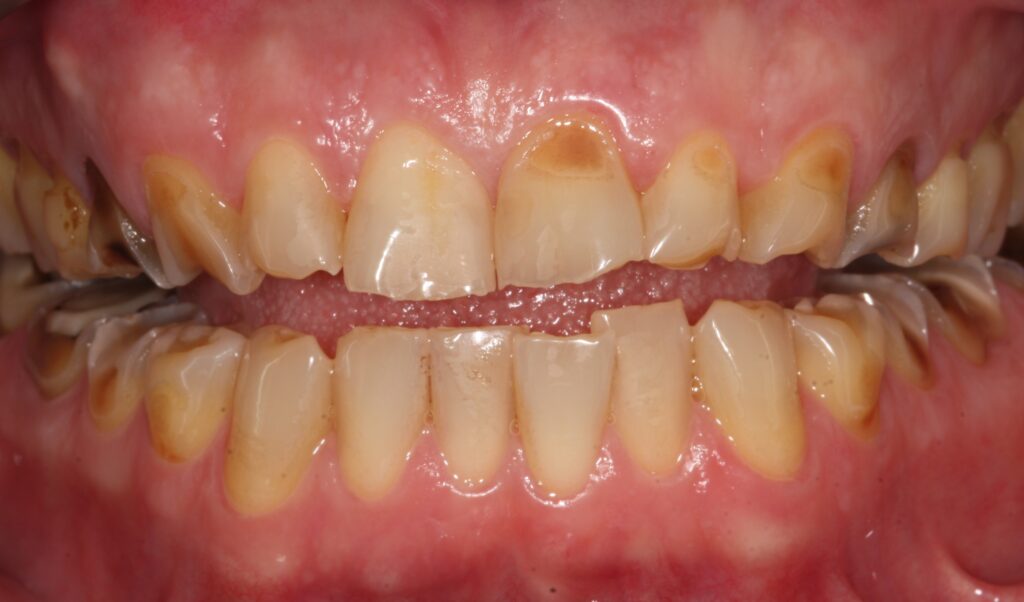
Within a very diversified career, I have developed a particular interest in one aspect of dentistry. As we live longer and keep our teeth for longer as we learn how to manage tooth decay and gum disease, our teeth wear due perhaps to acidic foods and drinks in our diets or from grinding and clenching at night in response to stress (fig. 1). Having reached out to colleagues across Europe, we have written a multi-authored textbook for all members of the dental team, including dental students. The first edition was released in 2000, updated in 2008 and a completely revised edition is in press. I suppose this is my legacy piece to thank my own teachers and my colleagues for their support, to educate younger dentists and to ultimately benefit patient care.
What next
My family have always been my priority with my wife, Rosina, being my best friend who is always there to listen and offer sound and practical advice. After 35 years as a dentist working with patients in practice and students in academia, I have made positive decisions about my future career. Health permitting, I intend to continue caring for patients for the foreseeable future. I have, however, recently retired from my academic role but still continue to teach, examine and supervise research as an Emeritus Professor at UCL. This has intentionally freed up some time across a previously very busy week to instead build a part-time portfolio career, one important part of which will be to support and guide future younger colleagues in my role as a Finito mentor, and to spend a little more quality time with my wife, our children and our grandchildren.
Professor Andrew Eder has been in Private Practice since qualifying from King’s College London in 1986. He is also Emeritus Professor at the UCL Eastman Dental Institute and formerly Consultant at UCLH and Pro-Vice-Provost at UCL.
I’d say that three things define an aptitude for elected politics. The first is fascination with human beings and what makes them tick, and how power is exercised. It’s difficult to imagine anyone getting far in politics without those interests.
Secondly, regardless of left, right, centre, almost everyone I’ve met in politics starts with a commitment about changing things for the betterer in their country. The motivation is always there.
The third thing which separates the natural politician from the civil servant is a certain zest for the theatre. It’s that willingness to take the risk and stand on the stage and at the end you don’t know you’ll have a standing ovation or a bag of rotten tomatoes slung at you. The natural civil servants shy away from that. What’s interesting, of course, is that you sometimes see a politician who’s really a civil servant – and vice versa, a mandarin who’s really a politician, and the thespian is striving to get out there.
Asquith complained that you bring to the prime ministership what you know at the time of assuming office, because there’s not enough time once you do to learn anything new. I think it’s hugely interesting that Asquith complained about that in the days when parliaments went into recess for quite a long time in the summer, you didn’t have rolling news media or twitter. In those days, when something embarrassing was going to happen you had all the editors in to say let’s keep this quiet – as in fact happened when Winston Churchill had his stroke.
The question in high office is how you manage to find space to time and think. Different prime ministers approach that in different ways. Mrs Thatcher was a complete Stakhanovite whereby Dennis would force her to go on holiday and she really would sit there reading the Planning Inspectors’ Report into nuclear power stations. She’d sit up into the small hours mastering the small detail and I don’t think she really recovered any sense of normality outside of No. 10 when she was forced to resign in 1990.
John Major was different. To John, cricket and sport remains a great solace to him, and it’s a time when he can really switch off and cares fall aside for a time. For Tony Blair it was having a young family – as well as football and music to some extent. Blair, like Cameron with his young family, used Chequers an awful lot. They used to go there most weekends with the family and it provided privacy, as well as easy reach of London in an emergency. It’s that physical space to kick off your shoes and for the children to run around and not feel het up and bored! And Asquith didn’t have Chequers of course – Lloyd George was the first to have that.
Gordon Brown, I’d say, was also a bit of a Thatcher – though perhaps he might not like the comparison. David Cameron, though he was mocked by the media for the date nights and chillaxing – that was a way of keeping sane. Theresa May – again, she worked herself incredibly hard, and had a profound sense of public duty. For her home was a sanctuary and her marriage to Philip May was critical in providing that stability and that source of strength and renewal.
As for Boris, it must be difficult. When you’re in high office, your time is not your own in that you have to fight to block off time . That’s true for any senior ministerial job. It’s backbreakingly busy as everything happen simultaneously. You can’t say as prime minister – well, we’ll fix Brexit this week, then China the next, then after that handle schools. It doesn’t quite work like that!
Read about how workplace stress can lead to burnout here
Robert Goldingreports on David Cameron’s post-premiership and what it can teach us about the meaning of success
It’s not quite clear if David Cameron is taller than you might expect, or whether you’ve given him extra height just by paying him more attention. It is as if fame has its own laws of perspective.
But the word ‘fame’ doesn’t quite encompass the experience of conversing with a former prime minister. In the first place, power is a very specific subset of fame. A David Cameron or a Tony Blair didn’t rise to our notice through artistic popularity or some kind of scientific or commercial ingenuity. In fact, if we are being mindful of our democratic inheritance, we might feel a certain sense of ownership over the likes of Cameron: after all, we put him there.
That fact makes us feel all sorts of thing we don’t necessarily feel with, say Elton John or Timothy Berners-Lee. It is possible – perhaps it is even quite likely – for a UK prime minister to achieve considerable sway over our lives and at the same time for him not to have done a single thing we cherish. Even Cameron’s achievements – with the possible exception of civil partnerships – aren’t necessarily loved.
But it’s the quirk of democracies that you often find that British people reserve their right to moan about a prime minister behind their back but to be in awe of them when in their company. A prime minister is therefore the recipient of mixed messages which might amount almost to gaslighting: respect and ridicule dovetail through their lives upon assuming the position, and the oddity of it all won’t let up once they’ve left office. It takes a death to exit the weirdness of Cameron’s level of fame.
We caught up with Cameron at a Grapevine event in Oxfordshire where Cameron was discussing his post-premiership priority – Alzheimer’s Research – with Lord Finkelstein. So whatever made him think he’d be a good prime minister? “Very good question. I was elected in 2001. From 1997 to 2000 we’d made virtually no progress at all. We were just in a terrible position. And so I think everyone was asking themselves, what is it the Conservative Party and what does it need to do? I took the more radical end of things and said, ‘Well actually, we’ve got to change a hell of a lot of things’. And the more I looked at the other people who were putting themselves forward, I didn’t think any of them were radical enough in saying what needed to change.”
What he means by this is really cultural change – a shift in the party’s attitude to gay marriage would lead to the Civil Partnerships Act 2004, and Cameron notes that his ‘hug a huskie’ stance on the environment continues to resonate today. “It’s fantastic that we have had COP 26 in Glasgow, and a Conservative Prime Minister who’s seen as one of the world leaders on the environment. That’s a great thing, and it’s because the Conservative Party decided it was a proper topic for us.”
As I listen to Cameron speak, I find myself thinking of the sheer strangeness of the role of prime minister – and then the even greater oddity of being a retired prime minister. The role itself – recently described by Sir Anthony Seldon as The Impossible Office – is unique. Let us toss partisanship to one side for one moment and admit that you have to be intelligent to secure the role in the first place. Once you have done that, an unusual array of interesting experience and information comes your way and you have to develop ways to sift and sort that information.
To hear Cameron talk is not just to be reminded of Tony Blair – as has always been the case, sometimes to the distress of people who would suspect Cameron of not being a true Conservative – but of Gordon Brown and Theresa May too. It’s a sense that they know how the world works and this lends their opinion on anything unusual credence – more so than a former Cabinet minister, or even than a former permanent secretary.
Members of the Royal Family meanwhile, though they might develop lengthier experience at the top, may experience a shielded version of reality which keeps from them the real difficulties which lie at the base of decision-making. Prime ministers are the people who have climbed, in Disraeli’s words, ‘to the top the greasy pole’. Princes – for all the respect they sometimes engender – are merely placed in palaces.
So what sort of skills does a prime minister develop – and how can they be deployed to solve problems once the individual has left Downing Street? Cameron is thoughtful in his reply: “I would say the first is the experience you gain in chairing a Cabinet, when you have quite a lot of people who support you and quite a lot of people who don’t support you, and you’re trying to corral people in the same direction – that is a useful skill.”
These skills, developed at the highest level, are, one suspects, somewhat wasted in chairing the comparatively small operation of a private office once one departs. But Cameron has done much more than that, and is throwing himself particularly now into his role as President of Alzheimer’s Research UK.
Cameron continues: “Furthermore, all the connections that you make, in terms of life sciences, business, philanthropy make a difference. We’ve got Bill Gates now involved in the fight against Alzheimer’s: he’s funding the early detection project. His father had Alzheimer’s, and he’s bringing billions to play into it. So I think all those things bring people together.”
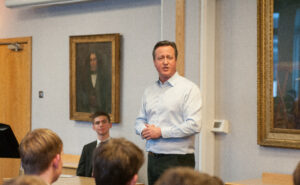
David Cameron, former Prime Minister of the United Kingdom, speaking at City of London Schoo.. 13.2.2020 Photographer Sam Pearce / www.square-image.co.uk
Cameron adds that as Prime Minister, you get used to figuring out ways to actually get things done: “Now, I’m not a scientist myself: I was forbidden from doing physics and chemistry because I wasn’t good enough. But one of the reasons I got interested in this was because when I was in government, I got my science team around the table and asked them what were the most promising avenues for a big breakthrough in terms of science. They pointed me to the 100,000 Genomes Project, which has been hugely important in cracking Covid-19. They also pointed me towards Alzheimer’s because of the costs of the disease on the UK economy. Those sorts of skills – money raising, bashing heads together, getting things done – all help.”
Whatever you think of Cameron’s premiership, or his decision to grant the European referendum which made that premiership unravel with such dramatic swiftness in 2016, this is plainly a formidable set of skills.
And it turns out I’m not the only one to think they’re not being put to good use. Sam Gyimah held a range of ministerial posts under Cameron, and remains close to the former prime minister. He laments this sense that departing prime ministers are, in effect, put out to pasture: “Very few people have that unique experience and perspective but we don’t use them properly once they leave office,” he tells me.
I remind Gyimah of Bill Clinton’s lament that he felt he was leaving just as he had learned how to do the job. Blair, after 10 years, sometimes gave the same impression. But Gyimah, who now works in the corporate sector in many roles including as a non-executive director at Goldman Sachs International, is philosophical. “My life now is all about turning ideas into reality and I particularly like ideas where there’s a positive social impact. It’s not politics – but some of the things which attracted me to politics still apply. It’s just that I’m dealing with an investment response instead of a government response to problems. If you can unlock capital at scale then it can do wonderful things.”
So there is life after politics – but still, the life after politics for a prime minister can seem strangely limited and truncated. Surrounded by their security teams, with just the past for company, they must sometimes feel a strange mixture of solitude and frustrated irrelevance. It reminds me of a story once told to me by the photographer Graham Flack who remembers going to photograph David Cameron in respect of the famous writing-shed Cameron had installed in his garden at his Oxfordshire home. He and the journalist in question were early and waited for a while in a layby down the road from Cameron’s residence. When they arrived, they mentioned this to Cameron’s protection unit who replied: “Yes, we know, we were watching you.” The photograph itself had to be shot and reshot because one particular tree made the team worry that a viewer of the photograph would be able to locate Cameron’s house.
It doesn’t sound like much of a life – and yet perhaps these limits are a small hardship for the enormous privilege of having been caught up in history. During the on-stage Q&A, Finkelstein asks Cameron whether being Prime Minister has altered his perspective on great historical figures? Cameron relishes the question: “I think it makes you realise how the little decisions you’re making aren’t black and white. It’s not presented every day as “Here’s an important issue Prime Minister, but here’s the right decision and here are two wrong decisions. When are you going to make the right decision?” Cameron continues: “Many of the decisions you make are degrees of bad, and you’re trying to avoid the worst – and some of them you will get wrong. I think you do feel a greater sympathy for people who make the wrong decisions. What that does is give an enormous respect for those prime ministers who have the very biggest decisions to make. When you think of what Churchill did in May 1940, specifically the decision to fight on against Hitler, you’re more aware of the enormity of those really big decisions. Today, we’ll look back and think: “Well, of course we should do that”. But at the time, Churchill was surrounded by people saying, “No, we’ll get destroyed, the British Empire will be lost, we’ll never hold out.””
And yet those people who make the really big choices nowadays leave office with plenty to offer – and yet there seems to be little by way of structure once they do depart. Is the UK missing an opportunity here? Might it be that we should have some kind of Council of Elders, consisting of former prime ministers who might advise the sitting prime minister, as a sort of version of the weekly audience with the Queen?
When Cameron is asked about those weekly meetings with the Queen he is effusive: “One of the best things was going to see the Queen. It was an enormous treat, because you’re literally spending an hour with the world’s greatest public servant. I remember when I was at Eton, the Queen used to come to the carol service. The first year she came, I read the lesson. I got to the podium and forgot to say: “Thanks be to God at the end”. I looked at the podium and at the Queen and said: “Oh shit.” So I had the unique position 30 years’ later to ask the Queen: “Do you remember me saying that?” While I can’t reveal any of that conversation, my head stayed on my shoulders.”
One can easily imagine regular contact with previous prime ministers having a similar effect: surely it is salutary to have contact with your predecessors, as both a source of empathy, but also as a sort of memento mori, that your time in the spotlight shall recede swifter than you expect?
So has Cameron been back since? “Not very often. But we did have a very entertaining dinner for the 2001 intake, where Sir Bill Wiggin and I tripped off to London. It’s interesting going around the office and seeing people who worked with me and people I remember from around the building. And actually the mood was good. You felt like there was someone in the job who really enjoys it – but there’s no point in doing the job if you can’t relish the challenges.”
Cameron also remembers the humour of the job: “I had Nicolas Sarkozy in – actually the first person who visited me at 10 Downing Street. And obviously he brought his beautiful wife Carla Bruni. I remember this particularly well, because my private secretary was with me as they were driving up Downing Street. I said to my private secretary: “I shake his hand. Do I kiss Carla?” He said: “Yes, I think you should kiss Carla, she’s French.” I said: “How many times should I kiss Carla?” My private secretary: “As many times as you can get away with!”
Amused by this, I decide to catch up with Sir Bill Wiggin and ask him about his friendship with Cameron, and what the proper place is for a prime minister after their premiership is over.
“They should all go to the House of Lords,” Wiggin says, without missing a beat. “That is the right place for them and this trend to not go there is really worrying.”
Wiggin also points to the uniqueness of prime ministers: “They’ve all held the nuclear codes. When they talk about nuclear weapons, they’ve thought about it really hard. These guys have a hideous responsibility. They also get exposed to huge amounts of information from the best experts.”
So what’s the history of this? Wiggin explains: “If you’ve been Prime Minister, you are entitled to an earldom, and Clement Atlee was the last to take it. I’d like to see that change.”
Wiggin – who recently received his own knighthood – also links the case of Cameron and others to a wider need for House of Lords reform: “The House of Lords is really important, and we currently have the wrong people in there. We need to stop placing Olympic champions in the Upper Chamber. If you’ve won a gold medal, you’ve already been rewarded and it makes the honours system superfluous. Our system should focus on public service and delivery.”
Of course, there is other provision in place. According to the Public Service Act 2013, a former prime minister is entitled to an annual pension ‘equal to one half of their final salary when they left that office, regardless of age or length of service.’ Cameron actually waived this upon departure from office in 2016, unlike Tony Blair who didn’t.
Of course, this decision – gallant as it appeared at the time – didn’t necessarily end well, as all those who followed the Greensill Capital affair know. This episode, which for many has tarnished Cameron’s legacy, is symptomatic of a broader problem: there is still an abiding sense that prime ministers don’t know what to do with themselves. In fact, the happiest of the living former prime ministers seems to be Theresa May, who retains the parliamentary structures of life by remaining an MP – a job she is manifestly good at.
Is there anything to be learned from the American system? In the first place you have the great fandango surrounding presidential libraries which appears to keep former presidents busy, while also regenerating an area economically. Likewise, the big bucks memoir – though it probably has a Churchillian origin – has a sort of American tint to it these days. Cameron’s For the Record is rather a good one, and better than either Brown’s or Blair’s. May’s we still await.
But there is also another abiding image of former presidents gathering together for photo ops to work on cross-party hurricane relief for the good of the country. This occurred during the Hurricane Katrina in 2006 when the world was informed of the friendship between Bill Clinton and George H.W. Bush.
Is this something the UK should emulate? If Cameron were to be given some kind of government Alzheimer’s portfolio only the most timorous betting man would think he would be unable to achieve results. Cameron explains the problem: “Dementia is caused by diseases of the brain of which Alzheimer’s is the most significant. Just as we’re cracking diseases like cancer or heart disease, we should be focusing on this. When I was premier, I became more and more convinced that this was an area that needed proper government attention for scientific tests, for more research. It was way behind cancer research, so that became quite a priority of mine as prime minister.”
Cameron’s role now as President of Alzheimer’s Research UK includes raising money for the organisation as well as chairing the Board of our Early Detection of Neurodegenerative Diseases Initiative, an ambitious project which seeks to develop a digital tool to help detect the diseases that cause dementia years before the symptoms start.
Even so, Cameron still remembers his time in Number 10 fondly: “One of the great things about being Prime Minister is you can really put your shoulder to the wheel on some sort of slightly second order issue, and you can move things really quickly, really rapidly. The fact that a prime minister decides to make dementia a priority with the G8 really does make a big difference because the rest of the world goes “Oh well, we all want to think about that”.
And yet how frustrating to have had that power, to have achieved the knowledge of how to utilise it, and then, over an unrelated referendum to be deprived of the ability to solve those problems. Of course, this is democracy, but it still feels as though an opportunity is being missed somehow.
So what did Cameron most learn while in Number 10? “When you think of Number 10 you think it must be this enormous power. Actually, I think the greatest surprise about it is not how much power you have – but how little.” How so? Cameron explains: “The other departments you’re dealing with are ten times the size of 10 Downing Street, and they often quite literally don’t do what they’re told. Anyone in business reading this will be familiar with the idea that your finance manager didn’t respond to your command, and that does regularly happen. As a tiny example, I wanted to empty our prisons of Jamaican offenders by using a budget to build a prison in Jamaica. It was agreed we were going to do it, and spend the money. Six months later, I asked “How’s my Jamaican prison?” Literally nothing had happened. So you have to remember that in Number 10 you lead by building a team and making it work with you and for you.”
And, of course, we all need to do that. Prime ministers are unique in having been placed so severely under the microscope. But they teach us about human flaw and potential in equal measure. In particular, studying the lives of former prime ministers has something to tell us all about what we really want, and what success ultimately means for each of us.
If you’re on the search for a new job then you most likely have a method to cut through the madness, but it is important to double check your approach for common errors and missed opportunities.
Employability skills are essential to landing a job, but the approach you take to applications and interviews is equally vital. The office furniture company Furniture At Work has spoken to career experts to find out the most important things to do, and what not to do, to give yourself the best possible shot at your dream role.
Never Lie
An obvious yet often disregarded rule is to be honest, both on your CV and in your interview. Sure, exaggerating your skills or experience may give you a slight edge, but if you are found out then your credibility could be gone forever. A key trait of employable people is honesty, so as career coach Matt Somers explains, lying really isn’t worth it.
“Just don’t do it. Ever,” Somers says, “Rather than wonder if you can get away with a small lie on this CV or that online application, just resolve never to lie. That way you’re never under pressure at an interview to remember what you lied about. Interviews are stressful enough as it is!”
Don’t insult your former employer
Just as you wouldn’t talk about an ex-partner on a first date, you also shouldn’t insult your former employers in an interview. Not only could that cause a potential employer to worry about how you will talk about them, it adds unnecessary negative energy to the conversation which could reflect badly on you. If you had a serious issue with a former employer which you feel must be brought up, then do your best to lay out the situation dispassionately and professionally.
Don’t undervalue your employable skills
An important thing to remember about a ‘dream job’ is that often, to those in the field, it’s just a job. This means that there is no need to act like they are doing you a favour by considering you for a role. If you’re qualified and confident, then why present yourself as lesser than what you are? Simon Roderick, Managing Director of Fram Search, explains why confidence is key.
“The first thing about applying for your dream job, is to actually apply instead of holding yourself back and worrying! Have the confidence to think ‘If not me, then who?’ Back yourself and you may be surprised at the outcome,” Roderick says.
So, we know that lying, smack-talking old bosses, and letting nerves take over are never conducive to landing a job, but what should we do?
Personalise your CV
Amanda Augustine, career expert at TopCV, believes that personalising your CV to the target role is paramount. Not only does it show that you’ve done the research to find out what the role requires, but it allows a potential employer to see only relevant information. Imagine you’re going through CVs – aren’t you more likely to interview an applicant who has already made your job easier? Augustine also emphasises that a good referral can make all the difference.
“You’re 10 times more likely to land the job when your application is accompanied by a referral,” Augustine says, “Use your personal and professional connections and social media platforms such as LinkedIn to find and connect with people in your target field and industry.”
If your personalised CV with a solid referral are enough to land an interview, it is important to prepare. Friends and family can help you run a mock interview, and they may ask a question that you don’t have a ready answer to. There’s no denying that ‘winging it’ can work, but why take the chance?
Send a follow-up
If all has gone well, the interview is complete, and you’re playing the waiting game, there is still work to be done. Always send a follow-up email after an interview. Don’t spam them of course, but a quick email thanking them for their time and expressing your enthusiasm can’t hurt.
Advice can be extremely useful, but when all is said and done, it comes down to you. You write your CV, you apply online, and you sit in the interview chair. Therefore, have some confidence when applying. Don’t just skim your CV but read it and look at all you have accomplished. And why not go for that dream job? After all, you’ve made it this far.
Read more about how the world of recruitment is changing here: