Author: admin

  • Building Success: The Importance of Role Models

    Stuart Thomson

    In the ever-evolving world of work, navigating the complexities of one’s career path can often feel like a daunting journey into uncharted territory. However, there exists a guiding light that can illuminate the path and offer invaluable wisdom – look for a workplace role model.

    These role models can be found within your current organisation or beyond its boundaries.

    There may be an obvious person that you can immediately see. Others, you may see more from a distance, learning about them through friends or seeing their activity and presence online.

    A good role model can play a vital role in shaping your professional growth, offering insights, and providing a vision for the future.

    Why Seek a Role Model?

    At the heart of the quest for a role model is the simple truth that we all learn better when we have examples to follow.

    A role model could be useful when looking for a future path but also when seeking help with dealing with a particular challenge. They demonstrate what can be achieved and how.

    You need to seek a role model that allows you to:

    1. Learn from experience: Consider role models that possess a wealth of experience. All the experiences that they have gathered – positive and negative – can offer valuable lessons to you. By considering the choices they made and the consequences that followed, you gain insight that you can consider applying to your own challenges.
    2. Expand skills: Role models can broaden your horizons by introducing new perspectives, approaches, and new skills. You may need specific support in developing these skills through, for instance, training.
    3. Be motivated and inspired: Simply being a witness to the success of others can be a powerful motivator, especially when you can see how they deserve that success. A role model shows you what you can achieve and what new horizons await you.

    Role models can be ‘in person’ or can be ‘silent.’ An ‘in person’ role model would be someone you can engage with. This would be helpful when it comes to building a network. They can introduce you to others in their professional circles. But even a ‘silent’ role model can be of use. This may be someone you follow online, for instance, on LinkedIn to learn from posts, see who they are inspired by, and take note of recommendations they make.

    Where to Find a Role Model

    Identifying a role model can be a challenge in itself. Consider the following steps:

    1. What are your immediate goals? Look for a role model whose career is in line with what you want to achieve. Are you all about a career? Are you looking for balance? Do you have caring or parenting needs? Look for those who have been on a similar path.
    2. What do you stand for? Do you hold specific values? If so, make sure the role model is aligned with them.
    3. Are they available? If you are looking for ‘in-person’ support, then you need to be able to make contact, and they need to have some capacity to offer help and assistance.
    4. Do you need more than one? There is no harm in having more than one role model. It is unlikely that any one person will be able to offer all the help you will need. Those needs can change over time, so the role model/s may need to change as well. You can have multiple role models.

    If you can secure a role model, then just think about the learning benefits and also the confidence it instils, along with a greater sense of self-worth. There may even be emotional support available to you from someone who really understands what you are going through.

    A role model can provide clarity of direction that may otherwise be missing in a workplace or career. The mix of wisdom, guidance, and inspiration offered by a role model will put you on the right path. Seek yours out now.

  • China Restricts, India Attracts

    Dinesh Dhamija

    China’s leaders, faced with an economic slowdown, have gone on the offensive.

    In the latest development, international law firm Dentons, with 10,000 lawyers worldwide, announced that it is dissolving its Chinese business thanks to restrictive new laws on data privacy, cyber security and capital control.

    The global response to these restrictions is growing.

    US president Biden this week announced new measures to limit American investments in China, citing national security concerns, placing new barriers to investment by private equity and venture capital firms in high-tech sectors.

    Similar tensions are developing between India and China, with the Jack Ma-founded Ant Group divesting more than $600 million from India’s Paytm in response to Indian investigations of Chinese companies.

    By contrast, India has taken a series of steps in recent months to attract ever more investment from the West.

    In March, long-anticipated changes to India’s legal framework allowed overseas legal firms to open offices in the country, “giving foreign lawyers a foothold in one of the biggest legal markets in the world,” as the Financial Times reported.

    Legal giants including DLA Piper, Herbert Smith Freehills and Baker McKenzie are all considering opening offices in India, having so far operated out of Singapore and Hong Kong when dealing with Indian-related business. Baker McKenzie says that it already has 300 lawyers in more than 40 countries working on mandates connected with India, helping companies raise investment or advising those wanting to buy businesses in India.

    Once they decide to commit to India, the major firms are likely to open offices in the country’s financial centre Mumbai, its technology centre Bengaluru and its political heartland of Delhi. Managing partner at one of India’s biggest law firms, Cyril Shroff at Cyril Amarchand Mangalas, is in favour of more international legal firms coming in.

    “The status quo has to change,” he says. “I think there will be an initial wave of those who have been waiting for a long time who will open at the first opportunity. I think the others will kind of wait and watch to see how it’s going.” It would be overall a positive development, he believes: “It will align with the India story of more global investment coming to take India to the next level, so there’ll be more quality work. I think fee levels will go up because, at the moment, there is a race to the bottom. I think this will change that dynamic, and there will be a greater focus on more modernisation of law firms.”

    Once international law firms gain a foothold in India, we can expect a further wave of investment into the country, as an ever wider circle of investors – including pension funds, private equity and venture capital – gain reassurance that their money is in safe hands, or at least that they have a strong chance of legal redress in case of difficulties.

    The economic momentum shift from China to India continues apace.

    Dinesh Dhamija founded, built and sold online travel agency ebookers, before serving as a Member of the European Parliament. His latest book, The Indian Century, will be published later this year.


  • Handwriting expert Emma Bache on Shakespeare, Rishi Sunak – and Obama’s unexpected trait

    Christopher Jackson


    Emma Bache is one of the leading graphologists in the UK, but she didn’t have an early interest in handwriting. “I’ll be honest – I’m interested in people and in their personalities. Handwriting is merely a vehicle to find out something about someone you wouldn’t normally know if you met them.”

    So how did she come to make it her profession? “I fell into this by accident. I was working for a financial institution in my very early twenties. A friend of mine said she was going to do a graphology workshop in Wapping. I knew what it was, but I had a very limited amount of knowledge. I went along with her.”

    After that she joined the British Institute of Graphology. “I was married to a photographer at the time who worked with a lot of events agencies so I joined with them and began doing events. In the late eighties, I got picked up and began writing for them and I’ve always worked for banks in terms of recruitment.”

    Bache says that graphology was widely accepted in Europe long before it was accepted in the UK. “The Europeans have always been into graphology – they’re more interested in people and psychology. The Germans, Austrians, Italians and French – even the Americans. We’re sceptical as a nation. We see analysis as criticism.”

    So what role does graphology play in recruitment? “In this era, it’s becoming more and more important to make the right choice, especially in finance and the legal profession. It’s costly to make a mistake. You’ve spent money needlessly and may have to pay money out to get rid of someone. What I do is merely another tool in the toolbox to make sure you make the right decision. It’s not just about employing the right person to do a job, it’s about thinking about the team. Often I’m asked to analyse the whole team; otherwise I’d be analysing individual handwriting when that individual invariably won’t be working alone.”

    Banks remain a core client basis, but Bache also does a lot of forensic work which she didn’t do initially. “That will include analysis in relation to criminality. But I also look at forgeries of signatures where I’m often asked for my professional opinion.”

    Bache’s career has straddled the increased use of laptops, but it hasn’t impacted on her workflow. “Funnily enough, in the younger generation, journaling is very much on the increase. The younger generation are writing more and more. Especially in the creative industries they know the correlation between holding a pen and putting your thoughts on paper. That’s more creative than typing.”

    So how does her workload stack up today? “I’m probably doing some helping with recruitment every day as I’m on retainers with various companies so that’s a certainty. I would also expect to get two or three forensic jobs per week, and then media work whether it’s King Charles or whoever it might be. Events are back on the scene too; Zoom events really didn’t work during the pandemic. It’s a bit quieter now due to the economic issues.”

    Bache is often asked about historical figures or celebrities. “I do a lot of historical documents. A new documentary came out recently called Becoming Ian Brady, and I am in that as he was a prolific letter writer. He committed his murders in the 1960s. We have a preset opinion of what we think he’s like – he’s horrific. I saw the original letters. It was quite chilling. He was highly intelligent and quite philosophical. I saw obsessive-compulsive disorder, and narcissism. I didn’t actually see a psychopath tendency. He was a deeply unpleasant man, who did have empathy for some things in his life.”

    And people in power? “I do prime ministers and presidents all the time. We think of Trump as a psychopath and maybe Boris Johnson; neither are. Trump is a control freak and a narcissist but not a psychopath. Boris Johnson is a more complex character; he’s just careless and spoilt. He also has no filter.”

    Then Bache says something astonishing: “Certainly Obama is a psychopath. That’s not to say he does evil acts, but he has a lack of empathy and a lot of charm. He’s not exactly dangerous but scores highly when it comes to psychopathy.” Bache explains she’s not being anti-Democratic in saying this: “He has an enormous amount of superficial charm, which Trump doesn’t have. If you study Obama talking to people, from a body language point of view he doesn’t go onto his next soundbite without checking that he has won everybody over.”

    This makes me want to know more about historical figures. What about Abraham Lincoln? Bache looks up his handwriting on her phone as she’s talking to me. “A very strong right hand and a lot of charm – a lot of needing to be liked by other people. It’s incredibly regular; the filled-in ovals suggest someone very sensual. Very well-balanced, determined, and ambitious and takes his time over things. All this has to be balanced with the fashions of the time.”

    And what about the current PM, Rishi Sunak? “Bit of a loner, very heavy pressure, gets quite stressed about things, a little bit of a temper there which he probably keeps under control. Not really a team player.”

    I try to press Bache to Shakespeare, who I’ve always been interested in. “Unlike Rishi, all his words are really close together so very much a team-player and so needed the approval and interest of other people, which you’d expect as a playwright. Very long loopy lower zone so very creative but also caring about other people. He’s not very well-organised so I don’t know how practical he would have been.”

    Mention of Shakespeare leads us onto a contemporary equivalent who many find mysterious: Bob Dylan. She looks at some handwritten lyrics written in 1962, when Dylan would have been 22: “He’d be on drugs or alcohol then – which makes it difficult.” But the typical signature on his artworks leads to some interesting reflections: “He has really long ‘y’ stroke, meaning he’s quite aggressive. There’s heavy pressure, but there’s charm there and he’s very stubborn and quite difficult – quite money-oriented.” This last point is interesting. It was recently revealed that Dylan hadn’t in fact personally signed copies of his most recent book The Philosophy of Modern Song, instead getting a machine to do it for him – but still charging loyal fans as if they had been signed.

    Another interesting subject, Bache says, is Rupert Murdoch: “We all think we have a view about Murdoch, whether you like his political views. You have to remember his father was a newspaper magnate as well. Actually he’s a very nice man. Very intelligent an strong-willed but he’s not psychopathic – he has all these failed marriages. It’s interesting that someone so determined and successful falls in love very easily.”


    Reading Between the Lines: What Your Handwriting Says About You is published by Quercus Books, priced £18.99

  • Sir Rocco Forte: Rishi Sunak needs to think again on the Tourist Tax

    Sir Rocco Forte


    THE Conservative Party likes to claim to be the party of business – and in the past, when they have demonstrated this, I have supported them as a donor.

    But under Rishi Sunak, the party seems to have completely lost touch with what business leaders and entrepreneurs want to see.

    For a start, the tax burden is far too high – and there is no better demonstration of this than the decision in 2021 to scrap the traditional tax rebate scheme for foreign tourists, which had been in place for 60 years.

    Some of us warned at the time that taking this step when every single country remaining in the EU continues to offer tax-free shopping was bound to end in tears, but we were ignored.

    It is now sadly apparent that the decision taken by Mr Sunak when he was Chancellor has turned into the most appalling economic own goal.

    My hotel group has properties across Europe and tourists are simply not returning in the same numbers to the UK as they are elsewhere. Milan, Paris and Berlin can’t believe their luck.

    When challenged on the issue, Mr Sunak likes to claim that the £2bn a year tax break became unaffordable and only benefited a few luxury outlets in London’s West End.

    This is completely wrong – and hard to understand from a man who grew up seeing his parents build a small pharmaceutical business so should understand how business works. It is completely short-sighted to look narrowly at the cost of the VAT rebate.

    Instead, you should consider the broader economic benefits that tourists bring to our whole economy – their spending in hotels like mine, restaurants, bars, tourist attractions, museums, galleries, theatres, on public transport and so on.

    Analysis we commissioned from the Centre for Economics and Business Research concluded that the tourist tax is costing the UK £10.7 billion in lost GDP and deterring two million extra foreign visitors a year who would otherwise be here spending money throughout the economy. For every £1 refunded in sales tax to foreign tourists, the exchequer would gain £1.56 in other taxes thanks to the dynamic economic effects of tourist expenditure.

    I have organised an open letter to the Chancellor calling for what we have branded ‘the tourist tax’ to be scrapped. So far, 350 business leaders have signed – ranging from Harvey Nichols to Marks & Spencer to Primark. Other signatories include British Airways, Burberry, Heathrow, Gatwick, Glasgow, Edinburgh and Aberdeen Airports, Jigsaw, Victoria Beckham, the Royal Opera House, British Fashion Council, Fenwick, Charlotte Tilbury, UKinbound, Tate, The Really Useful Group, Shakespeare’s Globe, Southbank Centre and Bicester Village. This goes way beyond London and is affecting every high street.

    The chorus of criticism has become deafening – and Mr Sunak cannot responsibly go on ignoring it. If he does, I and other business leaders will conclude that while he occasionally appears interested in the concerns of his hedge fund friends, his understanding of entrepreneurship and how the economy works is sadly lacking.

    If you are a business leader wanting to sign Sir Rocco’s open letter to the Chancellor, please contact jamesc@j-hcommunications.com
     

  • Blur and the Narcissism of the Entertainment Sector

    Christopher Jackson

    There is a moment in the Beatles’ catalogue of which I’m particularly fond. It comes on the album Sergeant Pepper’s Lonely Hearts Club Band when Paul McCartney, ever the panting optimist, sings: “It’s getting better all the time.” Lennon improvises back: “It couldn’t get much worse.”

    The essentially dual spirit of the Beatles is encapsulated in that – and, of course, it’s the want of instances like it which, one feels, diminishes their respective solo careers. It’s one of those moments which charts the ideal of ‘being in a band’ whereby two contrasting personalities lay aside competitiveness, and work together for the creation of something grander, more expansive, and stranger than their individual selves could muster.

    A writer of manuals for office etiquette might call this ‘teamwork’. Musicians and listeners alike know it’s something far more magical: human difference overcome in the name of art.

    I remembered this moment when, on a sunny morning in May, I placed Blur’s new single ‘The Narcissist’ onto iTunes, and in the joy of the moment, on a wide and deserted road, almost went above the stipulated 20mph speed limit, risking a £100 fine.

    What does the new song sound like? For one thing, your summer suddenly has its soundtrack. What is it that makes a summer tune? When the intricate growth of spring gives way to the lazy months of July and August, we want our summer songs to mimic that: they should eschew detail and fiddly chord changes in favour of a languorous unfolding, leading with no particular hurry to anthemic choruses, simplicities learnable even in the heat. A summer anthem must speak to the most passive version of ourselves.

    ‘The Narcissist’ easily ticks all these boxes: the chord sequence turns out to be a straightforward exploration of the possibilities of E, C sharp and A, with various bouncings off the Asus11 and a cunning shift to the augmented chord of E in the chorus. An augmented chord, by the way, is a very good way of separating the amateur musician from the pro: an amateur will peer at its notation with a narrowing sceptical frown, myopically mortified at a difficulty. A true musician will instinctively see the progression, and intuit its justice, fingers manoeuvring knowledgeably.

    The song possesses a pattern of ingenious simplicity. This is frontman Damon Albarn taking it easy, and telling us it’s okay to relax. Next up, the singer’s regal and essentially inexplicable cockney imitations enter, immediately recognisable to any Brit between the age of 40 and 50:


    Looked in the mirror

    So many people standing there

    I walked towards them

    Into the floodlights


    The lyrical and the musical theme are perfectly intertwined. Not only this, but it’s the right thing for Blur to be singing about in this age of TikTok, Instagram live feeds, disposable memes, and Holly and Phil.

    Let’s consider the narcissism of the music industry. It is sui generis. Theatre, which might otherwise have given the sector a run for its money, lacks the turbocharger of a huge audience; if narcissism is ever attained it happens in a comparative vacuum, with insufficient adoration to feed off. Meanwhile film, though also a contender with its ludicrous red carpet set pieces and softball promotional interviews, seems to have its saving grace in the dull slog of a working environment which ostentatiously lacks glamour.

    The music industry by comparison is a cauldron of narcissism. Firstly, the musical skills required to make a ‘hit’ are relatively limited. You can get a long way in pop with an affinity for G, D, C and A minor. Most sentient adults can be taught to play ‘Knockin’ on Heaven’s Door’ from scratch in an hour (though it goes without saying only Dylan could write it). Of course some – the members of Blur among them – become gifted musicians, but I don’t think any of them would say they were to begin with.

    Pop music is a question of conveying an appealing mood. The offshoot of this is that, if successful, just as one is being lavished with money and sexual attention, one’s intellect is likely being overpraised. These things taken together make narcissism all but inevitable. And once arrived at as a condition, it appears irreversible: witness Pete Docherty’s adolescent ramblings, still ongoing now at the age of 44; Liam Gallagher’s tweets, the work of a 50 year old; and even Dylan’s plain weirdness, undertaken at the age of 82.

    You can add to that the demographic certainty that pop stars are not made in middle age: my own experience tells me that the young are reasonably narcissistic even if they don’t have a hit with ‘There’s No Other Way’.

    Incidentally, what would the music industry do if someone in, say, their mid-50s suddenly wrote a string of brilliant pop songs? This intellectual feat would not necessarily be difficult for anyone with musical training: its equivalent happens all the time in literature and art. But there is simply no precedent for sudden middle-aged achievement in this art form, meaning that there can be no economic migration from other sectors. When you turn on the radio you are almost certainly hearing the thoughts of the under-40’s, and usually the under-30’s – and if you’re not you’re probably hearing someone whose identity was frozen in place around then: we are hearing Narnias bereft of Aslans.

    Is Damon Albarn a narcissist? Some of the signs have always been bad. Even his defenders must concede the knowing inauthenticity of his East End vocals. There was the Damien Hirst-directed video to ‘Country House’ in 1995, Albarn in a bubble bath surrounded by Page Three models. One never recalls without baffled solemnity his initial willingness to submit to the extraordinary dullness of the Blur v Oasis spat, an esoteric competition he only soured on when it seemed to be going against him. And always in these narratives there is the bland submission to drugs and alcohol, the back and forth of addiction and rehab, leading to other yawns: fallouts with bandmates and rivals; dewy-eyed ‘hurt’ at the tenor of press coverage; all leading to a generalised and moneyed whingeing, and its inevitable offshoot, rubbish music.

    Blur went through this phase with 13 – though note that even their low point contained ‘Tender’, perhaps their masterpiece. Despite all this, Blur has given the impression it knows what it’s doing, that it’s able to conduct the rituals of hedonism with a degree of ironic distance. Alex James, the band’s likeably louche bassist, is on record as saying: “Food is one of life’s really great pleasures. My 20th birthday party was all about booze, my 30th birthday was about drugs, and now I realise that my 40s are about food. It’s something you appreciate more and more as you get older.” This is a pleasing progression. By the way, where James says ‘food’ he predominantly means ‘cheese’.

    Blur are reminiscent again of the Beatles in that their ‘third’ member also turns out to be a highly interesting person in his own right, just as George Harrison was. For some reason it is pleasing to me to know when listening to Blur that a major cheese-farmer is playing bass, and that the band’s drums player Dave Rowntree is also a minor Labour politician and former Kingsley Napley solicitor. Blur have jobs – they have experience.

    Happily, that initial – and let’s face it, narcissistic – immersion in fame had its second act, consisting of a surprisingly mature resolution of the routine jeopardy of the pop star ‘predicament’. Albarn found salvation in the Hell of fame by discovering within himself an astonishing work ethic; he always seems to have five projects on the go, and all are ambitious. This might be why, in 2023, he feels able to tackle the question of narcissism and the entertainment industry: he’s traversed it.

    For the record, I don’t know how sane Albarn is. For all I know, he may possess all the usual madnesses of pop stars: the unwillingness to begin any sentence without the word ‘I’; the childish need to have a pool of secretaries, bouncers and admin staff to conduct the basics of daily administration; a powerful lack of interest in philanthropy of any kind, especially if any outlay doesn’t get in the press with their own name attached to it.

    But I think his work is sane: in his solo career, his Gorillaz albums, his musicals, and now in ‘The Narcissist’, he seems always to be using music to arrange the world, and make sense of it. In doing that for himself, he does it also for us. His artistry, and the endeavour required to produce it, breaks the typical cycle of narcissism.

    As ‘The Narcissist’ enters its second verse, we are reminded how happy he is when he’s in Blur. It’s an ‘It’s Getting Better’ moment:


    I heard no echo (no echo)

    There was distortion everywhere (everywhere)
    I found my ego (my ego)
    I felt rebuttal standing there


    The parentheses are sung by his old friend, Graham Coxon – and of course perfectly fit the theme of the song. At time of writing, it’s not clear whether Albarn sings ‘rubato’ or ‘rebuttal’ in that last line of this second quatrain. I think I prefer ‘rebuttal’, but with all due respect to Albarn, I don’t think he is quite sufficient a poet for it to matter, the way it might matter with Leonard Cohen or Bob Dylan.

    That’s because Albarn is very good at displaying generalised intelligence: the listener will likely feel at this point that he is simply using a word which we don’t normally hear in pop songs, bestowing a sense of non-specific sophistication. We don’t actually mind which word he’s using so long as it’s an interesting one. It has been said that some writers (Stoppard, Wilde) have the kind of intelligence which flatters the audience, and makes you feel more intelligent than you actually are. Others (Nabokov, Joyce) possess the intelligence which bludgeons you a bit, lets you know that you’re their inferior. There is another category, the highest of all – in Tolstoy, for instance – where you stop minding about the question of intelligence altogether and just take in a work of art as a chunk of life.

    Anyway, Albarn is in the first category: we can partake of his intelligence without feeling overwhelmed. As tertiary gifts go, it’s a fine one to have. But the most important aspect of the stanza is in the call and response. Really when we talk of Blur as distinct from any other Damon Albarn project, we’re discussing the relationship between him and Coxon, singer and guitarist – songwriter and interpreter.

    In the annals of Britpop, there were probably two ‘great’ guitar players: Jonny Greenwood in Radiohead, and Coxon. In neither instance are we discussing guitarists in the ilk of Slash from Guns N’ Roses – the purveyor of the note-riddled mountaintop solo. We are instead discussing something far more embedded.

    Coxon is seemingly able to do almost anything with a guitar: he can make it scythe unobtrusively through a landscape of disco (‘Girls and Boys’); imitate the sound of a fly bumping again and again into the frustrating transparency of a windowpane (‘Beetlebum’); or give it a loose twangy mid-American verandah ranginess, which seems to let a song walk on a sort of leash (‘Tender’). He can make a guitar riot (‘Parklife’); mourn (‘Badhead’); headbang (‘Song 2’); and yearn (‘Under the Westway’). His limitlessness is entire – in Blur. But that’s his limitation; he needs Albarn to realise his own greatness.

    But more notable than all this is what Coxon chooses not to do. Every Coxon contribution to Blur is generous not just to the listener, but to his bandmates: humility is implied in all he does. This is especially in evidence in ‘The Narcissist’. The chorus passes off agreeably (‘I’ll shine a light in your eyes/you’ll probably shine it back on me’), and then the interlude reverts to four straightforward notes by Coxon which I am sure I could teach my six-year-old to play. But a lesser guitarist would have sought to play forty. Such a solo would have been more complicated to play. There’s no doubt that Coxon can play it, or anything you put in front of him: but such a performance would have been obtrusive and spoiled all our summers.

    Ever since Paul McCartney’s Liverpool Symphony was booed and mocked by the classical music fraternity at its premiere, there has been the question of how good at music you have to be to be a pop musician. It is a complicated question: on the one hand, there is no evidence yet of McCartney being able to play Scriabin on the piano. Equally, none of his tormentors has yet had the wherewithal to write ‘Penny Lane’. My allegiance is probably – just – with McCartney, as I’d always rather have the thing itself than the interpretation of the thing. But I also know I don’t need to take a side if I don’t want to. And I don’t.

    Yet the question seems to matter if we’re considering whether the 21st century finds us in some kind of musical decline – and perhaps therefore in some broader societal decay. One thought experiment is to imagine your way into Beethoven listening to Coxon’s guitar-playing. It’s possible to go round the houses on this. Sometimes I imagine Beethoven sternly wanting to educate Coxon on classical progressions; at others I imagine him going quiet, knowing the game is up, then meekly asking Coxon if he might borrow his guitar.

    A good summer song should be like a good summer’s day: it shouldn’t go anywhere. ‘The Narcissist’ makes good on this. I’m not sure if lyrically it says much more than: “I’ve been a narcissist in the past but now I’ll not be.” If we were strict about it, it’s probably a minor song, but something in its beguiling expansiveness makes me want not to be strict about it. Besides, it’s minor status only really makes sense if you take it out of context as a record and as a release.

    So what does Blur mean now in 2023? Initially, Blur could be pegged as an act nostalgic for the music of the 1960s – this was because Albarn looked to Ray Davies as a way of navigating the shallowness of the 1990s. In relistening to songs like ‘Lola’, ‘Days’ and ‘Autumn Almanac’, Albarn found a useful crutch because the country hadn’t really changed all that much since the Jenkins reforms of the 1960s. But the band was always more than that. For instance, Albarn also leaned on Martin Amis’ comic novels. Just as Amis gave us John Self, Keith Talent – and later, his most hilarious name of all, Clint Smoker – Albarn created Tracy Jacks, Dan Abnormal, the Charmless Man, the rural escapee who lives in the country house ‘reading Balzac, and knocking back Prozac’ and a myriad others. Even when he was caught up in the satire moment, Albarn took care to have a range of satirical influences.

    But he was always omnivorous: amid all the satires in Parklife, there was nothing satirical about ‘To The End’, or ‘This is a Low’. It’s immensely to Albarn’s credit that he knew satire wasn’t enough. He had to go on seeking, until he became a kind of search. Through the digressions of Gorillaz, The Good, the Bad and the Queen, Mali Music, and his musicals (themselves astonishingly diverse in influence and intent), he has amassed a body of work which you would only underestimate if your main image is of the blonde boy singing ‘Parklife’ in front of an ice cream van. Unfortunately, that accounts for almost all of us.

    But I don’t think Albarn minds this. In fact, we can now see that his fame gave him useful cover for his essential seriousness – not to mention an ongoing audience. As a result, he has smuggled into the mainstream so much that’s interesting that he has come to merit extended study while belonging to an industry that all balanced people try to ignore.

    It amounts to a remarkably generous corpus, of which Blur will always be the cornerstone, as ‘The Narcissist’ reminds us. It’s a marvellous thing that Albarn has again made time to return to his old friends, in one fell swoop continuing a conversation which we all love to hear, and eschewing the cliché of the spat that turns into an everlasting split. Each Blur record now has the wisdom of the renewal of old friendship attached to it.

    From Amy Winehouse to Jim Morrison and Jimi Hendrix and all the others, musical careers often seem to end in tragedy – and the tragedy is always the tragedy of narcissism. Blur have gone a different route: this isn’t tragedy but a sort of romance, as in Shakespeare’s The Winter’s Tale when the statue of Hermione starts moving, and suddenly all the altered world is singing again.

  • Andrew Lloyd Webber: “If I were in the House of Lords today, I’d resign the Conservative whip”

    Emily Prescott catches up with the impresario at the reopening of the London Palladium after a major renovation, and finds him in bullish mood

    What’s the best night you’ve had in this theatre?

    I’ve never had a show on at the Palladium. It would be nice at one point – it’s one of the few where I haven’t.

    Any shows which you particularly remember when you were growing up?

    When I was a child I saw John Gielgud in The Tempest and I remember it started with a lantern swinging. It was very clever – the magic of that.  That was followed by My Fair Lady. It was a memorable production because John Gielgud on the last night broke Prospero’s staff and said: “This theatre will be lost forever to musicals!”

    And did that prove the case?

    Well, I’m going to prove him wrong. There’s a lot of emphasis on Shakespeare here. He’s in pole position as you come in and you have those really exciting pictures that Maria Crane has done. I just thought: “Wouldn’t it be great to have something modern, something contemporary?”

    It’s also an interesting space. What sort of potential does it have?

    This theatre is very flexible. You don’t have to just play in the conventional shape but in the round, which is very exciting. Architecture is my greatest love, and this is the finest space I now. I just want this to be open and for people to be enjoying it and see this. By the way, despite the fact that this is the biggest restoration of an historic building, there’s no support from anybody in government.

    I’ve heard that you have a photographic memory for music? Is that true.

    Not really no. Though there are certain things in theatre one does remember!

    How do you feel about all the stop-starts to theatre this past year?

    I’m feeling pretty devastated – we’ve had to cancel four weeks of sold out houses for Cinderella. For a Conservative government to ignore this sort of thing and also not to realise the economic importance of theatre is beyond belief. I just don’t think anybody in the Treasury could have really gone through what the figures are.

    Can you talk us through those?

    Well, the most successful movie of all time is Avatar – that’s in pure money terms. It grossed $2.8 billion. But The Lion King – which is the most successful musical of all time – grossed $9.1 billion – and that’s not including the film. The Phantom of the Opera is $8 billion. The combined gross of Cameron Mackintosh’s productions is ten times the gross of Avatar – yet films get insurance and theatre is sometimes considered this bolt-on nice-to-have inessential thing. I might add that The Lion King in the theatre has outgrossed the entire Harry Potter franchise.

    So you’re not thrilled with the government?

    They’re either economically illiterate or Philistines – probably both. I retired three years ago from the House of Lords, but if I were still there I would resign the Conservative whip.

  • From passion project to profession: the rapidly growing gaming industry

    From passion project to profession: the rapidly growing gaming industry

    Georgia Heneage

    As the world of entertainment unfolds and venues across the world resurrect, in a corner of Tokyo a fledgling new gym is opening its doors for the very first time.

    On 19 May, a new Esports ‘gym’ will offer amateur and professional gamers the chance to up their skills via on-site coaches. Price of membership varies from £36.20 per month, which allows you to use the kit and get help from gaming staff, to £80, which gets you two lessons a month with a professional gamer.

    It’s a hugely lucrative and burgeoning industry: the market value of the gym is predicted to reach $1.9 billion by 2022, and across the globe the gaming world is worth a staggering $154 billion, and in the UK alone £5.3 billion. During the pandemic, the online gaming industry witnessed a huge boom (for fairly self-evident reasons).  According to the industry body UKIE, the market reached a record £7 billion in 2020; the value of the sector soared by nearly 30 per cent and is expected to grow exponentially from here on.

    In the UK, gaming houses have begun centralising the efforts of a growing number of professional gamers. The UK-based organisation Excel Esports opened a facility in Twickenham last year which offers expert gaming hardware, sports psychologists and even on-site chefs to those training for the League of Legends gaming championships. Excel Esports MD Kieran Holmes-Darby said that by building the facility, the company wanted to provide a “clear separation in where the players live and where they work” to maximise the “mentality” of their players and their “well-being”.

    It also signals the fast transition of the gaming world from a nascent hobby at the turn of the century, which existed on the internet’s fringes and played out in the dark depths of boys’ bedrooms, into the fully-fledged, professionalized and competitive world of gaming that exists today.

    Esports (electronic sports) have exploded in popularity: huge tournaments take place all over the world and attract tens of thousands of fans every year. The Olympics committee has even announced that it will begin incorporating online games in its repertoire. The Olympics Virtual Series will “mobilise virtual sports, esports and gaming enthusiasts all around the world in order to reach new Olympics audiences” in line with its new ‘agenda’.

    A whole stream of incredibly skilled gamers are contracted every year and have made careers out of it. Sports clubs are beginning to sponsor esports players, and there’s now a worldwide organisation called World E-Sports Association, which runs a bit like Fifa.

    One such organisation is London Esports which, according to CEO Alfie Wright, already has a number of professional players on their books who take part in competitions with “some of the best teams in the world”, the biggest of which is League of Legends, a kind of fantasy team-based game.

    The industry, he says, is worth almost more than music, TV and film combined. It saw a boom during the pandemic, he explains, because it offered a very real social distraction. “There was no other way to go and speak to friends, and I think people are starting to see that that’s where gaming can be really helpful.”


    And alongside the professionalization of a bedroom hobby has come a piqued interest in gaming as a potential career choice for thousands across the UK. Wright says universities across the country are starting to introduce esports courses, and soon they might be an option at secondary school.

    Roehampton university, for instance, offers a full esports scholarship from January this year – including a new Women in Esports scholarship, where students have full access to the university’s esports facilities and the chance to “learn new skills”. Even so, we have some catching up to do: in the US, you can choose from over 10 university courses in the area nation-wide. The real challenge, says Wright, is ensuring that there are enough experienced experts to teach, since it’s such a young industry.

    Despite the positive social and educational implications, the rise in gaming as a digital trend has, of course, had its negatives: many experts believe that the rise in violent games, such as Call of Duty, has had a knock-on effect on violence in the real world, an extreme case being the 2019 mass shooting in New Zealand.

    One article in Wired last year revealed the huge physical and mental toll gaming is taking on professionals, such as 20 year-old gamer Julia Wright – a wizard in the Overwatch League – who developed a serious wrist injury after 16-hour days spent tensely gripping her remote.

    The mental and physical issues facing young competitors range from “hand, neck and back pain that sometimes requires surgery, to poor nutrition, bouts of insomnia and mental health issues including anxiety, depression and burnout.” According to some experts, there’s little information or guidance, given the fact that these are fledgling careers. The help that is available to professional gamers is spread thinly amongst the highest-ranked, and given that this is a career spent in relative solitude, it’s a difficult one to monitor closely.

    Yet this is also a profession which, like other areas of entertainment, almost always begins with genuine passion. Most pro gamers started their journey with a love for a hobby, and turned that into a career. It’s a utopian vision of work that most people strive for.

    This is the feeling I got when I interviewed two pro “sim racing” drivers (virtual motoracing), whose deeply-felt and long-standing fervor for what they do is apparent even over the dark interface of the ‘Discord’ app we speak through (the most common centralised software to chat and game with other players). Both are part of the Zansho Simsport team, started and headed up by Ed Trevelyan-Johnson and co-managed by Mike Yau. The team has already won some £10,000 in prize money and has an ever-growing team of 50 players operating at a very high level.

    Sim racing, says Trevelyan-Johnson, is still a pretty “niche” esport and not as developed as others. But it’s taking shape rapidly, and since the pandemic, the gap between the world of real racing and online racing is narrowing. And though it is still a fledgling esport, Trevelyan-Johnson says sim racing is one of the most hyper-realistic simulations you can get in the world of games. “Unlike football, for instance, you are replicating pretty much everything you get with racing, except for the G force.”


    Credit: Lewis McGlade

    This is perhaps why so many Formula 1 pros are flocking to the trend: world-renowned racing car drivers used to use the software to practice ahead of big races, and since the pandemic more are getting a taste for it – including Jenson Button, who has been involved with the Zansho team. “There’s a pretty symbiotic relationship between motor sports and sim racing. When Covid-19 hit they intersected even more because motor sports shut down and Formula 1 drivers bought cock pits for their homes and race organisers did virtual events.”

    At the same time, a host of amateurs have begun using the virtual form to build both a career and nurture a hobby – usually both. According to Trevelyan-Johnson, many players begin their virtual journeys taking part in motor sports in the ‘real world’, but find that it’s not a financially viable option, or that they have a physical impediment to racing.

    Devin Braune is one of the fastest sim drivers on certain cars in the world. He discovered he was too tall for motor sport (being 6’7) and so channeled the love he found for the sport at a young age into sim racing instead.

    “When I was about three,” says Braune, who grew up in Germany, “we got a PlayStation with a Formula 1 game. I loved playing it and eventually I wanted to do it in real life. My parents took me carting, which was quite dangerous at that age, but I got hooked immediately. I then joined a club and did real racing until 2017.”

    But Braune soon found that real racing was “incredibly expensive” and required “a lot of preparation”, which meant that he wasn’t able to get onto the tracks for months on end. “A couple of years after I started carting, I realized that games can simulate the real experience – so I started driving with some equipment I bought and I thought it was just as fun. I never looked back.” He started doing full time competing, won event after event, and then got picked up by various sim racing teams.

    “While it isn’t technically my job, it’s a way to get money. My main job is developing the software players use. On the weekdays I write code for rFactor 2 (a sim racing computer game) and on weekends I race. I’m in quite a unique position, I guess.” Braune currently practices around two or three times a week – five hours at a time – and says that he effectively taught himself.

    For Braune, the possibilities which sim racing opens up are almost endless. “It’s not a replacement for real racing, but it’s about as close to the real sport as any simulated sport can ever get. And if I decide I want to race, I’m on the track in five minutes.”

    Does he think that sim racing, and esports at large, will start to replace traditional sports? “I think they’ll coexist. In the end going to the track and seeing people race has its charm, and I don’t think that’s ever going to disappear,” he says.

    Jarl Teien, a Norweigan professional driver for MB Racing Esport, spends up to six hours training every day. He says he doesn’t like going over that limit because then you “can get easily distracted and doesn’t get any effective training.” Teien has been offered a contract and full yearly salary, and says he’s in discussions about increasing it twofold- which would take it to around £4000 per month. Part of his contract, says Teien, is taking part in lots of competitions worldwide, and even gearing up to potentially represent Norway in the virtual Olympics.

    Does Teien, like Braune, learn from other professionals? It’s a kind of process of osmosis, where he watches replays of other sim drivers from outside the game, or watches their “line” on Discord, and learns from that. But, for the most part, he teaches himself.

    Before getting into sim racing, Teien played other esports competitively, like Counter Strike-a shooting game played on a PC using a mouse. Though he was “borderline semi-pro”, he chose to devote all his time to sim racing because he absolutely loved it.

    “I haven’t gotten a single point where I’ve burnt out, and I think that’s the important thing. I just love the idea of a ton of people spending a lot of time together online, and I love the idea of all those people trying to achieve the same goal, and only one can come on top.”

    Teien says he’d love to drive in real life as well, and that the exhilaration of racing and of winning is the same. “At the sim racing center award, loads of professionals say they’re more nervous for a sim drive than their drive in real life. I would say once you once you get into the car, you feel the same pressure.”

    Other than esports competitors, the ever-evolving world of online gaming is building jobs in other areas, too. Charlie Hoare has built a writing career out of a passion for the virtual format. Alongside opinion pieces, he reviews some of the most popular games from best to worst, and is particularly interested in the artistry – the intricate stories and unique characterisations behind each game. His work is a definitive reminder that gaming is not just a competitive, sporting form – but also an artistic one. And the discussion around gaming, he says, has created a massive online culture quite apart from those who actually engage in the form.

    “I think part of the reason why gaming is such a big industry is that people love to further the conversation,” says Hoare. “Because it’s not just the technology that’s getting better, but it’s also the opportunities to tell better stories.”

    Hoare points out that, unlike other entertainment mediums, games can develop depending on what the consumer wants – so it’s forever evolving. And the connection between what consumers love and what game makers create is extremely close. “I think the best games are just made by people who make something that they know they would enjoy – it’s something personal to them.”

    Like Braun and Teien, Hoare started his career as a “passion project” from his bedroom aged 17, making “YouTube videos” about games he was genuinely fascinated in. This hobby and “fun creative outlet” quickly turned into a proper job, which he absolutely loves.

    And, like other professional esports players, Hoare’s career developed entirely off his own back. “It’s interesting because writing about games was something that I was passionate about, but also something I had no experience in. I was offered a position of writing for this website after somebody saw my video and liked the way I structured my reviews and opinion pieces.”

    The world of gaming seems to offer a unique brand of employability: one which begins, almost exclusively, with a fledgling hobby and unadulterated love for a quickly-developing artistic form, and turns into a career- usually self-taught- with the possibility for huge growth.

    If the past decade has seen a gradual institutionalization of the trend, in the next we are likely to witness an even greater professionalization of the industry – one which filters down to the level of school curriculum right up to the top tier of the virtual Olympics.

  • Stop Rishi-bashing over India trade deal

    Dinesh Dhamija

    Reports that Rishi Sunak ‘faces a new conflict of interest row’ ahead of the G20 summit on the grounds that his wife could benefit from a UK-India trade deal are fuelled – I would say – by the realisation that a major trade win for the Conservative government could dent Labour’s election prospects.

    Much of the noise is coming from the Labour benches, who ostensibly support a trade deal, but would much rather not have Sunak claiming the glory and making an economically struggling nation feel better about itself.

    To me, the issue is too similar to some other ‘rows’ over India, including the BBC documentary on Narendra Modi and Suella Braverman’s remark about Indians outstaying their visas. They ignore Britain’s greater self-interest in reaching a historic deal in favour of petty point-scoring, with a vaguely xenophobic undertone.

    A UK-India trade deal would be absolutely fantastic news for the UK economy, for the Indian economy and for all those of us who have worked tirelessly to promote such a deal for many years.

    As a Member of the European Parliament in 2019 and 2020, closer links with India was one of my principal objectives: I chaired the EU India committee. In this role, I had to counter various MEPs asserting that Europe should not do business with India, on grounds of its supposed intolerance or anti-democratic bias. By marshalling the facts and winning over allies, I managed to convince my fellow MEPs that we should pursue deals rather than shun the world’s largest democracy and fastest-growing major economy.

    Rishi Sunak must now do the same, and not be cowed by those who seek to destabilise negotiations. If Akshata Murthy (aka Mrs Sunak) stands to benefit from a trade deal, good for her! So will hundreds of thousands of British workers, whose jobs will be funded by the additional economic activity.

    If Rishi gains politically, well good for him too! His predecessor but one, Boris Johnson, went out on several limbs to achieve a deal and couldn’t get it over the line. If Rishi succeeds where Boris failed, we should applaud his careful diplomacy, his personable style and wise analysis, rather than nit-picking over his wife’s share portfolio.

    Much as I opposed Brexit and all it stood for, I am equally determined to see Britain thrive in the fast-evolving post-Brexit world, where global powers including US and China have become more isolationist in a backlash against the globalisation of the late 20th and early 21st centuries. An India-UK trade deal would be a welcome signal that new partnerships and trade alliances are still possible, especially between countries with such close historic ties.

    I’m sure Rishi Sunak needs no advice from me, but just in case: stick to your guns, Rishi. There’s no need to ‘recuse’ yourself from the negotiations, as papers such as the Observer ridiculously suggest. Go out and sign the deal. We’ll all thank you in the end.

    Dinesh Dhamija founded, built and sold online travel agency ebookers, before serving as a Member of the European Parliament. His latest book, The Indian Century, will be published in the Autumn.


  • The Baroness and the Mujahideen: the remarkable tale of Marefat school in Afghanistan

    Christopher Jackson


    Vladimir Putin’s Russia launched a special operation against Ukraine on 24th February. This episode had the appalling ramifications which we have been seeing all year: appalling casualties, displaced peoples and incalculable economic damage. But it also had another effect. It made us forget the people of Afghanistan.

    Our lives are both cosy and frenetic. These two things can feel interlinked. We note the latest crisis but, too busy with our gym memberships and our latest Netflix addiction, there is the suspicion that we can’t quite enter into the distant misfortunes of others as we should. We are lucky, but luck by definition cannot really comprehend the unfortunate. And so we move swiftly onto the next thing, expressing our heartache for the Ukrainians, but suddenly without room to mind too much about what’s happening in Kabul.

    It goes without saying that this isn’t how it should be. But every now and then, things snap back into place and we understand that history is about nothing if it can’t take into account the long haul.

    Last year I was meeting with Lord Dennis Stevenson, the former chair of HBOS and now a cross-bencher in the House of Lords, who began telling me about a school in Afghanistan which he had been involved in. The school, he said, was called Marefat. I don’t think I caught the name at the time, and wouldn’t learn the word’s meaning until much later: Marefat roughly translates as ‘knowledge’ or ‘wisdom’. It is a kind of sacred word. This is fitting: this is a sacred story.


    To the House of Lords


    Stevenson outlined the story for me. The school, he said, had been the most astonishing success and, during the period of American occupation, provided a beacon for Afghan girls when it came to education. I asked about the prospects of the school now that the Americans had left.

    Stevenson was surprisingly optimistic. “The coverage in the media is appallingly simplistic,” he told me. “The Taleban is deeply divided and we want to see if something can still be salvaged.”

    I asked him if he would wish to talk more deeply about it. “Well, for that you need to talk to Baroness D’Souza. She’s the one who really knows about it.”

    That’s why a few months later I find myself entering the miniature airport security of the House of Lords, to be greeted by Frances D’Souza, who served as Speaker of the House of Lords until August 2016.

    Armed with rather good parliamentary coffee in the House of Lords canteen, we begin talking about Marefat, and how it came to be. “I’ve had a long love affair with Afghanistan,” D’Souza explains. “It’s a very extraordinary country. If you look at the topography, it’s not possible to think of it being controlled by a central government. That was demonstrated amply by the Russian occupation, when the Soviets in all their mighty power had to fight province by province and valley by valley.”

    D’Souza was familiar with the country even before she visited it. She had produced a study in the early 1980s on the threat of famine in Afghanistan. Once the Twin Towers came down on September 11th 2001 – an event which, post-Covid, suddenly seems a long time ago – the country was open to visitors.

    For D’Souza, it wasn’t an opportunity to pass up. Having entered the House of Lords as a Lord Temporal in 2004, she was ideally placed to do so. She recalls: “It was once again considered a safe place to be, and loads of refugees returned from Afghanistan and Iran. I was then a governor of the Westminster Foundation for Democracy, which was an All-Party Parliamentary Group looking at political funding. We went out to Afghanistan to see what we could do.”

    This is how the world changes – by fortunate coincidence, yes, but also because good people also tend to be curious. If you fast forward 20 years it is possible to see thousands of girls who have been transformed by this decision.

    But if Frances D’Souza had simply gone to Afghanistan, the world would not have been nudged so decisively in the direction it was. Instead, she had the good luck to encounter Aziz Royesh. By their ensuing encounter a generation of girls have found their way into that most valuable thing of all: a first-rate education.

    “I was introduced to him in Kabul, in Shahr-e Naw, close to the presidential palace,” D’Souza recalls. I note now a special note in her voice – something encompassing awe, affection and deep respect. I begin to sense I am about to hear about someone I need to hear about – that we all should hear about. “He was an extraordinary man,” D’Souza continues. “About five feet tall but a force of nature. Sometimes you come across people who are born leaders. It was clear to me immediately that he was.”

    So what was Royesh’s story? “He and his few friends and brothers had started some sort of school when they lived as refugees in Pakistan, which had the simple aim to teach children to read and write. But before that Aziz’d been a Mujahid during the Soviet occupation. He had arrived back into Afghanistan, essentially into a desert. It looked like Berlin after the war, and it was completely razed to the ground.”
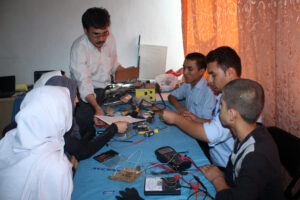
    Aziz’s situation was complicated by the fact that he is a Hazara, meaning that he is part of the Shia minority rather than the Sunni majority. In the complex world of the Middle East this created obstacles for Aziz: “The Hazara affinity is predominantly to Iran, which is a Shiite country. The Taleban war in the 1990s – a really vicious war – ran right through the Hazara area.”

    A Momentous Meeting

    The scene was set for what D’Souza describes as a ‘momentous day’. The pair of them talked all night: “Aziz had taken over one building, and put a tarpaulin over the top in April. It was still very cold, although the snows were beginning to melt. There were no windows and it was a tiny hut divided in two with a sheet.” So how was Aziz structuring the educational process? “He and his colleagues had two classes, and three shifts where they could take 12 students at a time. There was basically no space, no blackboard. But Aziz’s passion in life was to educate girls.”

    Aziz couldn’t have met anyone more likely to appreciate his project than D’Souza. “Having come from a development background, I firmly believe that the magic bullet of development is this: if you educate girls you get development,” D’Souza explains. “He started talking to me, and though his English wasn’t that good, we talked all night – about philosophy and feminism. I was very impressed with him. He had girls who were doing weaving in his rundown flat – that was the only income refugees could earn. So he had little seven-year-old girls doing carpet-weaving. Meanwhile, middle-aged women wanted to learn geometry so they could divide up their land.”

    This was education in a raw and exciting form. In its urgency and its authenticity, it wasn’t the sort of encounter you could push to one aside.
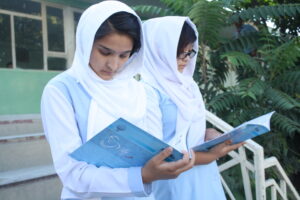
    When D’Souza returned to the UK, she leapt into action. “I thought the best thing I could do was raise money for him – because I trusted him. But I also thought that a lot of money at that time would be the kiss of death so I tried to raise small amounts and see what he did with it. I wrote to 30 friends and colleagues and said: ‘Would you be prepared to give £30 a month for six months?’ People did. Dennis was the only one who came back to me and said, ‘That’s fine, but wouldn’t you like more?’. I said: ‘No’.”

    So what did Royesh do with the money? “He selected one of the larger buildings in this bombed-out patch of land and he put a roof on, windows in – and, really importantly, he put a heater in. That meant that by the time autumn came round, and all the firewood had gone, it was the only place for miles around which had heating. And so everyone came. It was an opportunity for Aziz to explain to mothers and fathers what he was trying to do, educating the girls and persuade them that it was safe.”

    And the notion of education being unsafe was, of course, an inheritance of the Taleban. “When girls went to school they had been whipped in the street by the Taleban. They needed quite a lot of persuading,” D’Souza says.
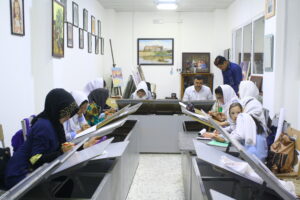
    But Royesh, it turns out, was persuasive. “Over the years, it grew,” recalls D’Souza. “I started raising money. We had fundraising events, and Aziz set up a model school where teachers and students got training simultaneously. They also had vocational training. They taught mechanics and engineering and tailoring so that those who left at 14 or 15 could go and have jobs.”

    In spite of this, Royesh’s interest remained academic. “Aziz had had a very impoverished background with virtually no education. He’s one of these people who reveres education so he reveres those who have education.” It is a precious insight into how valuable that commodity is. And it was this passion which drove the expansion of Marefat.

    Over the years, D’Souza made repeated visits. “I went to Afghanistan with these brown paper bags. He asked me to bring English copies of Bertrand Russell’s books which I did.” Again, the detail is significant. A true passion for education is often irrationally omnivorous – we feel the doors of the world fling open and want to rush in and grab everything we can, often in no particular order.

    But always it was the girls who Aziz was prioritising. “His focus was on getting the girls into twelfth grade and then onto tertiary education,” says D’Souza. “As an example of what he managed, the school got up to nearly 4,000 students.” As astonishing as this achievement was, what really mattered was the quality of the education. “The Asian University for Women, a renowned university in Bangladesh, offered 15 scholarships every two years and girls applied from India, Bangladesh, Sri Lanka, Pakistan and Nepal. Our girls won 11 of them.”
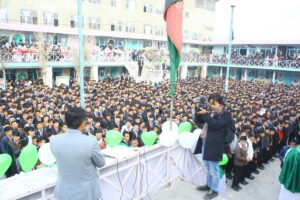
    It seemed that nothing could stop their success. Marefat had become an educational phenomenon: “We went on raising, and Aziz eventually built a whole new building, and an auditorium. To this day, I remain so proud he named that after me. The school became the St Paul’s of Kabul.”

    I am so swept up in the success of the story that for some reason – though I know what happened in 2021 – I am unprepared for D’Souza’s next sentence: “It was a thriving school, and then August 15th came.”


    Force of Nature


    Yes, August 15th – the day of the Americans’ botched withdrawal.

    Aziz was in a very difficult position. He had dedicated his life to a project which had achieved success beyond his wildest imaginings, and yet he was in undeniable danger. D’Souza outlines the severity of Aziz’s predicament: “Aziz, by virtue of the fact that he’s Hazara and educates girls, was particularly vulnerable to the Taleban and had had brushes with them before. He felt he had to get out: he had a son in California. So we got him to America.”

    I realise I need to meet Aziz. A few days later I’m on a Zoom call looking at a kindly man beaming back at me. He explains that it’s his habit to wake at four in the morning – a detail which conveys his separateness from Western rhythms, linking him to the desert somehow. It is a reminder too that you can leave Afghanistan in person but never depart it in spirit.

    Of course, Aziz’s story is like D’Souza’s but seen in reverse perspective – it is like an education version of Kurosawa’s Rashomon, where all the participants remember something different about key events.

    For instance, Royesh gives his version first meeting with D’Souza, and recalls his views on education as they were communicated to her at that time. This time around you can hear the quiet and authentic adamance which swayed Frances all those years ago: “The core of the problem in Afghanistan was this patrimonial vision that you have – of a male-dominated vision of the community. Just educating the male members of the community cannot change everything: there will be a vacuum as you’re missing the vision of half of that community – the female side.”

    Aziz also makes an interesting distinction: “I never felt the need to march on the slogans of woman rights: I just wanted to go with education, because this by itself can bring all these other developments. I think it was that which really sparked Frances’ interest.”

    Royesh also recalls Frances D’Souza entering Marefat for the first time – meaning that I get to see her through his eyes. Even at this distance Royesh is moved by the memory of D’Souza’s first entrance into the life of the school: “One of my first impressions of Frances D’Souza is that she was the first to come in. She entered that murky corridor and in the midst of that darkness, she saw these beautiful well-dressed girls that had blue, you know, shirts and they had white scarves. And they stood to greet her and suddenly she ran out and shouted: “How beautiful they are!”

    It is a moving image – these girls standing there in all their potential, suddenly confronted by the person who really will help them. Perhaps it even has a dreamlike quality.

    Royesh also remembers what it was like when D’Souza’s first money came in – and again there are some telling details: “I received a call from an Afghan friend of mine. This person said that he had come from the UK and he had some gifts for me. I went downtown, and saw that there was an envelope with Frances’ beautiful handwriting. I opened that and there was £2000 which had been raised by her ‘Evening for Marefat’ fundraiser at her home. I remember all those notes, in fives, tens, twenties and hundreds. Next year, she visited again and had brought £6500. She insisted that we should go and buy a plot as she said it would give prestige to the school, and boost its credibility.”

    With that money Aziz was able to afford a site in the desert. It wasn’t immediately promising as a location. But then an amazing thing happened: “We went there and started laying the foundations,” Royesh recalls. “We laid the cornerstone and began building the mud walls. This ignited a kind of interest among the community. Suddenly, people came and kept buying the plots around that and building their houses.”

    I also hadn’t realised until I spoke with Aziz what heights D’Souza’s fundraising eventually obtained. In 2010 alone, D’Souza raised £253,000. Aziz recalls: “She sent that money and we used it for the building, and we established a very big auditorium that later was named after Frances. When she visited the school in 2016-17 she was known to the students as ‘Auntie d’Souza’. “At the beginning, the families, the students, and especially the girls, were in love with her.”

    As it happens I have seen this auditorium in a recording of a Zoom call, which took place earlier this year. It is a large, airy space, and the children are ranged obediently in it. I see kindly teachers compering the call, while D’Souza takes notes in her study, and Aziz stands before a white wall, peering down at his creation – and also in some way at his past.

    Sat here in London, it is difficult to imagine how it would look in its architectural context. But I imagine it must soar and be visible for miles around. It ought to fill the heart of every person in that area with hope. But no doubt, it also infuriates the Taleban.


    Abroad Thoughts from Home


    So what does the astonishing story of Marefat have to tell us about education? Royesh’s methods are, in their essence, simple. This in turn opens up onto the possibility that here in the UK, we have made the simple complicated – to our own detriment. It might be, for instance, that we have prioritised pouring money into the schools system over promoting Marefat-style effective educational methods.

    Royesh tells me: “If you want transformational education, you don’t need many facilities. You just need a good way to talk to the people and to help them perceive something and customize that with their own real life. We didn’t wait for the professional faculty. We didn’t wait for the equipment – and we didn’t wait for the infrastructure. We just started.”

    And if you get that right, the effects can be catching. “For around five years or six years, we were the only private school in Afghanistan mainly with civic and girls-catered education. In 2021, there were more than 163 private schools just in these three districts of Western Kabul. Education had become a norm and communities were changed. There were hundreds of cultural centres, art centres, sports clubs. People embraced the idea, they stepped forward. The children were 95 per cent illiterate in early 2002. By 2021, 95 per cent of the population had become literate. Violence, especially violence against women had eradicated in the entire Hazara community. Street harassment was not seen in the Dashti Barchi area of western Kabul. Furthermore, not a single member of the clergy talked against democracy, human rights or girls’ education. It seemed that an entire community of seven million people had been transformed.”

    This was a mass grassroots movement without parallel. It should give heart to anyone who feels change happens too slowly. Sometimes perhaps we are lobbying for the wrong kind of change, and have forgotten to bring our activism back to first principles, as Aziz did.

    And yet, of course, we cannot avoid the tragic aspects of the story. Aziz tells me that the events of 2021 didn’t come out of the blue. In 2009, Marefat experienced the first backlash from the fanatical clergy. Pupils from Marefat had protested publicly against legislation which had violated numerous women’s rights, and their prominence as protestors led to terrifying scenes at the school. These now seem in retrospect like precursors of the still more tragic events of 2021.
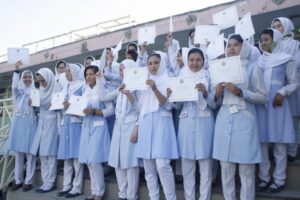
    Royesh recalls: “The clergy attacked; they sent their mob supporters. We had just sat down to class and they stormed the school. They were shouting, and raising slogans against me as a person, saying that they would execute me as an infidel. They said I was preaching Christianity, or that I was preaching secularism and liberalism. They charged the school with being a centre of espionage and prostitution.”

    The school sustained physical damage. “They broke the glass of the school, and they called for its destruction. They called for the execution of the administrators and the faculty and especially myself. That was really a harsh thing.”

    Royesh has a way with understatement. It sounds terrifying beyond contemplation – but then we inhabit cosy lives and Aziz is hardened to the sterner realities of life under the Taleban.

    But in that awful instance again, an astonishing thing happened: “We had just one gate. So the students came and they made a human chain behind it – and they closed the gate, so the mobs couldn’t enter the yard. Thousands of people gathered around the school, most of them the parents of the students who were worried about their children or those who had shown up just to watch.”

    Eventually a special force from the Ministry of Interior relieved them. Royesh continues the story: “The attack was on Wednesday. The school remained closed on Thursday. On Saturday, we reopened the school, just with the hope that if 15 per cent of the students returned it would be a victory for us. But surprisingly, more than 95 per cent of the students returned back hand-in-hand with their parents. That was really a very emotional moment for us. They came, and they showed their support for the school. They were the parents of more than 3,500 students.”

    If anybody doubts that education is a spiritual right which people will defend with their lives, then they need to hear this story.


    2021 and all that


    Sadly, even this superb victory came to have a temporary feel in 2021 when the Americans left, and things really did unravel. D’Souza takes up the story: “It was incredibly difficult for him. If you’re a Hazara and the Taleban are after you…” her voice trails off, as if unable to imagine how that must be.

    She continues: “I don’t blame Aziz for going at all. There are individuals at risk and we shouldn’t discount that. The school closed. My immediate concern then was for my daughter [the journalist Christa D’Souza] to try to evacuate the girls. They got over 200 of them out, and got a deal with the Canadian government. They then got another 207 out who have been waiting in Islamabad since October, languishing in a hostel. We’ve raised enough to get them visas through the government.”

    And Marefat today? “Dennis and I are interested to see what we can do to enable Marefat and its unique educational experience to continue. We think we can’t do that until we go. Once we’ve got most of our girls out, our priority should be to get the school going again.”

    And Aziz? He is currently writing his History of Marefat, and is vague about future plans. D’Souza has her suspicions: “It’s clear to me that Aziz has very high political ambitions, and wants to be the leader of the Hazaras – and maybe of the Afghan people as a previous Hazara man was in times past. He was also extremely close to Ashraf Ghani during the presidential elections, and even wrote Ghani’s manifesto. Ghani, though is a very curious fellow, and once he won the presidency, completely ditched Aziz, he treated him very badly.”

    A Royesh presidency? Every presidency is a long shot before it happens – but just to imagine it is to realise that hope remains.

    But what about the girls? Here D’Souza is understandably emotional: “The brightest and the best have left the country, which is a huge responsibility which we all feel. The only thing which is a mitigating factor is that it’s quite common with Afghans to return to their country, so I think a lot of them will. One thing one shouldn’t underestimate is that for 20 years we had this flawed but democratic process: a huge number of people became accustomed to it. They’re unlikely to give that up in a hurry.”

    If you want a measure of what was achieved at Marefat then you have to hear the girls themselves. Their security is paramount and so we will not be revealing any names or locations. But here are some voices, translated from the Persian by Aziz, of girls talking on a recent Zoom call. This is the authentic sound of education, but also of liberation.

    One girl says: “We study. We continue our education. Because we know that interrupting the course of education means our death and I am not ready to die now.”

    An optimist might say that a girl who has learned to talk like that can never die: it is the voice of irreversible enlightenment. Here is another: “We understand the Taliban. Most of them have not lived in the city and they are not familiar with the characteristics of urban life. I hope they understand us too. We will continue our education and I am sure that we will eventually introduce the Taliban with the urban life and culture too.”

    There is a note of defiance here which is utterly at odds with what we think we know about Afghan women – bowed down by the patriarchy, and almost without agency. It makes us realise that Royesh, D’Souza and Stevenson have created a new kind of educated woman.

    A third girl adds: “We call our resistance a ‘constructive resilience’. We not only resist, but also think about the constructive aspect of our resistance. We think that in ten years or twenty years from now, we will make our culture better and more humane, and our politics better and more democratic. This is the purpose of our education.”

    This is in fact always the purpose of education – and sometimes it takes someone who knows education’s value to tell you that. That will almost always be someone who until recently was deprived of it.

    This, then, is the story of Marefat. There isn’t another story like it, and it’s one we at Finito World will continue to follow. It tells us that education is sacred, and reminds us that it changes lives.
  • Stephen Fry on the need to relax

    Rebecca Walker

    Despite his success, one sometimes feels a little sorry for Stephen Fry: for some, he is the celebrity everybody used to love, his popularity dimmed by Twitter spats and overexposure. Yet if you take his finest achievements: the first seasons of A Bit of Fry and Laurie (1987-1995), his early books The Liar (1991), The Hippopotamus (1994) and his memoir Moab is My Washpot (1997), his brave documentary The Secret Life of The Manic Depressive (2006), as well as his lead role in Wilde (1997), and even alongside his erstwhile colleague Hugh Laurie in TV’s Jeeves and Wooster, it is a body of work remarkable in its brio and its breadth.

    It all serves to prove that few people work harder than Stephen Fry – and not just in the entertainment industry. In fact, his ubiquity amounts almost to absurdity. It sometimes seems that what we’re witnessing is the work ethic of Margaret Thatcher relocated to an apparently more leisurely sector.

    It can seem as if every awards ceremony, supporting role and quiz show on earth seems to be dominated by Fry. His outspokenness on politics, religion and other things isn’t always matched by knowledge: Peter Hitchens famously referred to him as ‘the stupid person’s idea of an intelligent man’.

    But these gaps are offset by the perception that it’s been fun along the way – and so Finito World feels no compunction about asking him about his views on how to relax and wind down. ‘Work is so much more fun than fun,’ as Noel Coward put it. It is a line which might have been Fry’s mantra.

    When we caught up at the sweaty launch of Paul Feig’s Artingstall’s gin, we asked Fry about the need to offset work with relaxation. So, does he drink these days? “Not much, but I love a good cocktail,” came the kindly reply. And what is his favourite cocktail?  “When I’m hot like I am now, I find a John Collins – gin, lemon juice, soda – really refreshing.” And are there any drinks he stays away from? “I’m not a great one for really sweet, sticky drinks. I like them to refresh you. But I do make a good negroni!”

    It’s good to see him out and about. Fry, of course, hasn’t been well having been diagnosed with prostate cancer in 2018; the disease is now thought to be in remission, and he has spoken out publicly at his good fortune at catching the disease early.

    Nevertheless, there has to come a time when everyone slows down and thinks about resting on their laurels. So will we ever see Fry host the BAFTAs again: “Oh, I don’t know. I think twelve is probably enough – it’s a good number and I’m very happy.”

    Our conversation soon turns back to drink and what role it should play in our lives. “Whisky provokes violence more than gin,” says Fry. “Gin provokes tears. If you’ve had a lot of gin you just start crying.”  Here Fry, ever the actor, performed an immense howl. “I’ve had a few friends who had a lot of whisky and it’s really unpleasant.”

    Fry is also illuminating on national differences. “I think we should learn from European Football. Whenever there was a match in Belgium there was violence afterwards, because in Belgium you drink beer and get pissed. Whenever they played in the Netherlands, there was no violence, because they were smoking, because cannabis is legal in the Netherlands, so that’s what we should learn really! We’d be better off, someone should be creating some exquisite hash brownies.”

    Fry is a global citizen though when I ask him about it, I get an interesting response. “This is a very Mayfair event, isn’t it? I feel like an out-of-towner, somehow everybody looks as though they belong here.”

    If even the famous feel perpetually out of place perhaps this give us permission to feel nervous for that first job interview.

    Even so, Fry is an emblem of what can be achieved if you set yourself to work across disciplines and refuse to heed boundaries. You get the impression that Fry knew his gifts from the start but that he has been surprised how far they have taken him.

    Does he have any anonymity in London? “If you walk fast enough and you look as if you’re in a hurry, people are very good, they leave you alone.”

    And with that he’s gone – and probably gone back to work.