Author: admin

  • An interview with legendary barrister Khawar Qureshi KC

    Christopher Jackson

    Of all the things that can happen to you career-wise, to be born with the suspicion that you’d like to be a lawyer is one of the more benign developments imaginable. Salary expectations are good – and if you’re interested in legal problem-solving the work has the potential to be reliably interesting.

    There are other boons: for instance, there are reliable entry routes thanks to a highly regulated profession; later on there will be clear career progression – whether it be through to QC if you select the barrister route, or through to partner if you opt to be a solicitor.

    But a legal career also . Many students suspect the legal profession might be for them, but can’t initially decide whether they would prefer the essentially theatrical life of a barrister in court, or the weaving behind the scenes which tends to be the lot of the solicitor. Then once you decide that, there’s the further question of which areas to specialise in.

    Kuawar Qureshi is, without doubt, one of the world’s leading advocates, and therefore well-placed to answer questions Finito World readers will have about this area. In person he has a powerful quality – a sense of intellectual strength hits you rightaway – and there is also a sort of physical robustness, a leonine nimbleness, suggestive of someone who has been on their feet for much of their career. In this respect, barristers resemble orchestra conductors.

    The advocate has had a busy year, and now opened the London office of McNair International in Lincoln’s Inn Fields. The launch of this was a fine event, including a lecture by the revered Judge Abdulqawi Yusuf, a Judge of the International Court of Justice and its former President until 2021 on ‘Why International Law Matters’.

    So what does Qureshi most think is required to be a success in court? Qureshi doesn’t miss a beat: “In all walks of life where we assume responsibility for others, there must always be clarity and conviction to do the very best.” And what does this mean when it comes to the reality of being an advocate? “As an advocate this means being able to assimilate information rapidly and assessing how best to convey the same to the specific audience – whether it be the International Court of Justice, millions of people watching a live broadcast of a politically charged case, an arbitral tribunal determining a multi-billion dollar claim by a commercial entity against a State, or a domestic Court dealing with sensitive intelligence information. It has been an honour and privilege for me over the course of my career to undertake hundreds of case for parties all over the world- including these types of matters.”

    So what does Qureshi have to say to young people on the perennial question of solicitor or barrister? “In essence, the Barrister who wishes to excel as an advocate must be highly self-reliant, be prepared to work exceptionally hard, enjoy and be stimulated by the prospect of unravelling complex factual and legal issues, so as to convey a case clearly and persuasively,” explains Qureshi. He adds: “No Barrister can work effectively without an effective team and trust based approach with Solicitors who they work with. Solicitors work in firms and receive salaries, equity partners receiving profits from the firm. Barristers work from case to case.”

    Qureshi’s case load is extraordinary: to talk with him is to be given numerous asides about matters which have just left his desk, or which are currently being dealt with. These matters all have in common, you sense, their enviability if one were a barrister, and their likely bewildering complexity if you’re not. To be in Qureshi’s company is to get a glimpse onto an expertise whose enormity you can’t fathom: it’s like being in the company of a grandmaster chess player.

    So what has he learned from dealing with governments worldwide? “I have acted for the UK Government  on hundreds of complex and sensitive matters as an “A” Panel Treasury Counsel from 1999-2006 before taking Silk. I have also represented the USA, the Russian Federation, India as well as states such as Kazakhstan, Zambia  and been involved in matters for or against around 70 States in total. Advising and representing any Government is a great honour but comes with considerably more responsibility, as there is always a significant political element and the practical litigation insight available to sophisticated commercial parties may not always be present.”

    For someone as gifted as Qureshi one might have assumed that he would consider a judicial career, but in fact he isn’t presently considering it. “I enjoy advocacy in complex and challenging cases first and foremost. I enjoy the diversity of work that I am able to undertake for States and clients from all over the world embracing International Law, Arbitration, Commercial Litigation and Fraud/Regulatory matters. Just recently, I have undertaken a case before the High Court of Kenya for the DPP of Kenya against the Deputy Chief Justice of Kenya – the first time an English Silk was instructed to appear before the Courts of Kenya since independence in 1963. I had previously acted for a foreign investor against Kenya.”

    So what in his opinion makes a good judge? Qureshi says: “A good Judge is open-minded, fair and possessed of sound judgment, expertise, integrity and intellect as required to determine difficult issues – all to ensure that justice is done and the rule of law is always upheld.”

    So what is it ultimately which drives him in his career. Qureshi, who is plainly possessed of an unusually omnivorous intellect, talks about the way in which information’s flow has changed during the course of his  “Whereas when I started, hard copy books were the norm, it is a  rare treat (unfortunately) to visit a law library. There is now so much more information available through high-speed internet. The challenge is to be able to filter what is credible and relevant.”

    In which direction does he think the law is currently headed? “Unfortunately, as legal practice has become more “business-like” due to influences that have seeped in, it is sadly increasingly rare to see “justice” and “the rule of law” as the touchstones for legal work (save, some might say, when lip service is being paid to them or for “optics”). This is a very unfortunate trend which universities, the legal profession, Judges and politicians have a responsibility to address. Legal practice is not a business in the conventional sense which it seems to be increasingly conforming to. Legal practice should always serve to promote human existence and interaction in a manner which protects the weak and vulnerable, not rewarding or being blind to the transgressions of  the strong and powerful. Society at large will be much the worse if this trend is not arrested.”

    It’s impossible not to be inspired by Qureshi’s new venture. So what’s the story behind the new venture? “I strongly believe that International Commercial lawyers who are like minded and share a passion for Law, Justice and enjoy undertaking challenging as well as stimulating work derive greater strength when they come together. McNair International exists to serve that purpose – for individuals from all over the world. I am delighted to have been given the responsibility to continue to take McNair International forward.” And meeting him, you’re left in no doubt that he will.


  • Eduardo Greghi of The Kusnacht Practice: “I never thought of myself as losing money in my business; I was reinvesting”

    Eduardo Greghi of The Kusnacht Practice: “I never thought of myself as losing money in my business; I was reinvesting”

    The remarkable Chairman and CEO of The Kusnacht Practice talks about the pandemic and his business philosophy

    It was the French philosopher Jean-Jacques Rousseau who said that anyone peering into the heart of man would want to travel down in life, not up. In crude terms what he meant was that to be successful you have to make accommodations, and become in some way unpleasant. 

    I’ve often wondered whether he had it exactly wrong. He should, for instance, have talked to the immensely successful CEO and Chairman of The Kusnacht Practice Eduardo Greghi. 

    Brazil-born Greghi is one of those people in life who emanate goodness – and he reminds you that the kind can prosper, and that you don’t have to be Machiavellean to get on in life. He explains right from the outset his admirable business ethos, and is all bonhomie and transparent openness: “I want to display to the world, and to my clients, exactly what they will get. I only ever take money from clients if they’re benefitting from our treatment.”

    The Kusnacht Practice is at the high end, but then for people whose lives have come to a very difficult crossroads, the price tag is definitely worth it. At The Kusnacht Practice, confidentiality is paramount, but Greghi gives me an example: “We had a couple come in. They’d got married and had two children straight away, one after the other. Immediately, everything changed for them. Hormones had changed, they weren’t sleeping and they’d gained weight. And what happens then? Anxiety kicks in, and then depression. As a couple you start to argue and have relationship issues – even if you’re wealthy. They came to me and said: ‘We want to reset. We need help’.”


    At The Kusnacht Practice all needs are met so that clients can focus on their well-meaning

    This makes you realise what’s at stake for the families which The Kusnacht Practice treats: it’s nothing less than your whole life. At that point, the practice brings about a complete change. “They come with the children and the nannies, and we organise everything. They have individual treatments and couple treatments – whatever they need.” 

    When Greghi says everything, he means it: “I reinvest continuously in the quality of the client experience. This year, I’ve added three properties that are on another level. One of them is five times bigger than our largest property before. It’s modern and beautiful and well-located.” 

    You can feel that his enthusiasm isn’t to do with any crass delight in luxury for its own sake: this is all about how a suitably comfortable environment can help the client improve and eventually recover. Greghi continues: “For this latest one, we went with an Art Deco theme, so we have 1920s furniture. We’re not just going to put Ikea furniture in the rooms and hope it’s okay.” 

    Of course, what the luxury environment does is to make room for the client to focus on their treatment. It’s an aspect of what really sets The Kusnacht Practice apart: Greghi’s commitment to helping each individual in a tailored way.

    Prior to the March 2020 global lockdown, Greghi would travel a lot. “I had been in England and then I was coming back to Switzerland. I had plans to go to Russia, Kazakhstan and then several countries in the Middle East. These trips were all cancelled because of Covid.”


    Greghi continues to refine the client experience and makes sure everything is state of the art.

    In this, you glimpse the international nature of the practice – and Greghi, who is multilingual in English, Italian, Brazilian Portuguese, German and Spanish, is the ideal front man for such an organisation. But it also takes you back in time. The Kusnacht Practice has ended up having a good pandemic, but it wasn’t clear in March 2020 how things would pan out.

    Greghi takes me back to the situation, and is obviously moved by the way in which the staff pulled together. “Immediately, I decided that if I wasn’t going to be able to have clients for a few months I wouldn’t think of that as losing money. I would think of it as reinvesting. That’s what I did.” 

    Like many people in his position, he realised that he was responsible for the livelihoods of 100 people and their families. How did react? “My first thought was: ‘Wow, we really had a good thing going here’. I remember that time well. My brother had a business and it had to close down – and some of my entrepreneur friends, their businesses were wiped out completely.”

    The injustice of the situation also hit him: “We’re not in this position out of bad management or because of lack of resilience, love, care, dedication, integrity or competence – just because of this virus.” The situation was complicated by the fact that though the businesses could offer emergency services under the new Covid regulations, a lot of the work which The Kusnacht Practice carries out doesn’t quite fall into that category. As it turned out, the team was able to secure special permissions from the government and conduct quarantined treatment as the pandemic wore on. 

    As things went by, Greghi showed extraordinary leadership skills: “I thought, ‘If we go down, we go down together. I’m the leader of this business, and I was really heartened by the way everybody was cracking positive jokes together – it helped keep people calm.” In addition to thinking of himself as a re-investor in his business at a difficult time, he also began telling his staff: “A good farmer doesn’t eat his seed corns”. 

    Greghi’s emotion is palpable and you realise that his paternalistic approach to his workforce is deeply felt. “Luckily, you know, I saved the seeds. I get emotional about it because I love this team.” 

    One suspects though that luck didn’t have much to do with it: Greghi had worked himself into a strong market position, and like other businesses who have done well during the pandemic, therefore had flexibility to use the time to improve The Kusnacht Practice client experience. “I told everyone that when a tsunami comes, all the plants get affected in the same way, but it’s the ones with strong roots which come back. So I brought forward renovations which we had scheduled for earlier in the year and I continued with the hiring I had planned before the pandemic.”

    It’s this awareness and profound respect for other people which, I suspect, makes Greghi a cut above most business owners. “I’m the leader, you know, but I cannot achieve anything by myself,” he recalls. “But everybody rolled up their sleeves. If they had wanted to kick me, that would have been the moment, but we all stood behind each other.”

    Did this whole experience deepen his connection to the under pressure CEOs who form a part of his customer base? I strongly suspect so, but Greghi gives a different answer: “I come from very humble beginnings. I grew up in a house without windows. I arrived in England in 2002 with £50 in my pocket. My family is very humble, very loving, and very hardworking. As a business-owner and as an entrepreneur, I’m used to holding risk. You have to be fearless but at the same time be loving and caring towards your team. Actually there’s only stress if you care.”

    Of course, CEOs often talk up their team like this – but there can sometimes be a sense that mere lip-service is being paid. Things are different with Greghi. If you speak to some of his employees – whether it be Dean Gustar or Melissa Nobile – they display similar qualities of kindness and commitment to high quality.  They have plainly been inspired by him.

    Greghi, like Gustar and Nobile, exhibits a profound understanding of the condition of the wealthy. “You always have lots of things going on as a business leader,” he tells me. “You always have lots of problems to solve and decisions to make, and that causes insomnia, stress –burnout. Then some people start to self-medicate with drugs, alcohol, prescription drugs, or overeating. Then, you’ll start to have conflicts in your private life with your spouse, or with your relatives and it downward-spirals from there.”

    What Greghi is describing is fast becoming the story of our times. Part of the pleasure of talking to him is to know that somewhere there are people who know how to address problems which are now so rife in our society. 


    Greghi says: “I believe if you keep the highest levels of quality, and the best client experience, people will get value from their treatment.”

    At one point, he tilts his computer to show me the view out of his window, and I see a beautiful vista, including a lake, trees, and attractive houses. It immediately makes me feel calmer, as patients no doubt do when they check in. 

    At the centre of what the clinic offers are The Kusnacht Practice Standards, which have been so successful as to spark imitation from other competitors in the space. One of Greghi’s insights is that group therapy, though it can be successful for some, isn’t sufficiently tailored to the individual’s needs really to work in many instances. Greghi explains: “I believe that if you keep the highest levels of quality, and the best client experience, people will get the value for their treatment and they will come back when they need you or they’ll refer you further. As long as you keep these two things and you keep listening to your client, you find out what they need, and you give it to them.”

    That sounds simple, but it’s hard to deliver – and in any event there’s more to it than that. Discretion is important, as are the facilities on offer, but really everything keeps coming back to his staff. “They’re extremely altruistic. We’ll talk to a client at 1am, or go to their house to help them. It’s not a job – it’s a passion, a mission, a calling.”

    Given this, I’m fascinated to know about Greghi’s hiring processes. Greghi feels like a man who goes with his gut, and I can’t really imagine the sort of AI algorithm-driven processes one sometimes sees on the FTSE 100 at The Kusnacht Practice. 

    That turns out to be the case, and Greghi places great onus on trust, but he also emphasises the professional nature of the HR operation he’s developed, particularly in the last two years. “Nowadays, I don’t interview everybody, thanks to the growth we’ve seen,” he says. “Obviously if you need, let’s say, a chauffeur, he needs to have a driving licence. That’s going to make a lot of sense.  And we have to check their background, as our clients are in sensitive situations and we don’t want anyone who could do harm, or might have a history of doing dishonest things. But beyond that basic criteria what I’m looking for is whether they have the heart, and will fit the culture. The reality is that if somebody comes here with just like a nine-to-five mentality, they will not survive.”

    Greghi’s has been astonishing journey from his humble upbringing in Brazil to where he is today and he brings experience both in the property sectors (‘I love good hospitality and we’ve perfected it here’) and the financial sectors. This second thing obviously helps him, but again he is keen to stress the broader depth of talent at his business: “My finance team are a lot better than me.”

    Greghi is a remarkable man, and for a while I find it difficult to pin down what makes him such an infectious personality. At one point, he says something telling: “If I was asked to clean this table, no matter whether I was being paid or not, I will do the best I can.”

    There are few people I’ve met who deserve their success more. So what’s his advice to those who are struggling in today’s society? His reply has the feel of hard-earned wisdom: “I say to clients: ‘I cannot work with you if you die. You have to use everything in your control to improve. You have to look at your lifestyle. You look at your family life. Your diet’.” Then he pauses, and hits on it: “You know, you should just try and do one thing better today than you did yesterday. And also don’t do anything that will make it worse – that’s the best beginning. Then we try one little thing – maybe it’s only five minutes in a day. And then we go from there.”

    With that, he’s called away. People need him – and they’re lucky to have him.

    Eduardo Greghi was talking to Christopher Jackson. Go to kusnachtpractice.com

    Photo credits: Johann Sauty

  • The Dinosaur’s Last Ride: Paul Joyce on why he’s still a petrolhead in the age of electric cars

    Paul Joyce


    Yes, that’s me, I’m the dinosaur. Surrounded by exhortations and ads for electric vehicles, all at what seem like heavily inflated prices, and unable to even afford to glance at a Lexus, I have to declare that I am an unabashed petrolhead. From the moment I clambered into a £25 pre-war, three forward geared Austin, I was hooked. No matter that when the £1.50 clutch plate failed, the car had to be jacked up and the gearbox removed to replace the thirty-bob part: that was all part and parcel of the fun. But the blindness of even the greatest manufacturers such as Land Rover can lead to extremely costly mistakes. Take my current vehicle which I am about to, reluctantly, part with: a 2010 Range Rover Sport. It boasts a fantastic three-litre diesel engine, capable of driving you to the moon and back with scarcely a drop of additional oil needed.

    But those clever lads at LR did not think about any kind of major engine failure; so they positioned one of the most important aspects, namely the injectors (10 or 12 of them) in a location under the rear bonnet housing which makes them nigh impossible to service, and certainly not replaceable without recourse to heavy plant equipment. Thus, a hundred pound job swiftly morphs into a grand of anyone’s money. Buyer and driver be aware that expensive cars are like, at least as I am informed, all water-going vessels, namely an invitation to open your wallet over the nearest storm drain.

    Clearly in an ideal world we should all be driving Teslas, and probably would be if they cost 15 rather then 50 thousand. But the race to obtain the plug-in option seems to me to be gathering pace at an alarming speed; this combined with an element of panic fuelled by successive government pronouncements about the damage we are all doing, consciously or unconsciously, to our precious environment.

    Contemplating the fag end of a five decade long vehicular list which, amongst others, comprised an original Mini, countless Morris Minors, Ford 5 cwt vans, something before Nissan became Nissan, a Ford Mondeo (rapidly sold due to a child’s upchuck) and pride of place, Stanley Kubrick’s ex -Mercedes S Class, should it be electric, Hybrid, diesel or petrol? Well I think by now you have probably guessed, I am way too old to change and fiddle around in crowded waystations with disconnecting APPS waiting to top up a depleted set of ridiculously cumbersome batteries. For me still the smell of petrol and the inevitable dribble of fuel onto one’s toecap any day!

    So, petrol or diesel is the likeliest option, with a brief flirtation with the notion of a hybrid, but 20k plus soon put that idea firmly to bed. Fortunately, near to where I live in High Wycombe, lies a farmhouse on the edge of town where the outbuildings seem to all be devoted to the dead, dying and damned of generations of Land Rovers: V and G Agricultural.  Standing firmly in charge of this battlefield of ancient armour, reminiscent of Napoleon at Austerlitz, stands James, a man of few well-chosen words, and his partner the loquacious Mick, thus forming a formidable double-act.

    So, with some trepidation I approach James and ask about which vehicle I should consider as my (pen)ultimate vehicle?  “Freelander 2” comes the immediate reply followed by the epithet, “bullet-proof!  That’s the kind of vehicle we like, the ones we rarely see as they are so reliable. Or rather we don’t like as we are in the repair business.”  So I ask him to perhaps look out for a replacement for my Range Rover Sports, one that will not have me tearing my hair out over replacement injector prices, or inconvenient recalls like some I am still waiting on (exploding rear windscreen housings, for example, what the main Land Rover agent says is a four day job, whilst James says “four hours more like”.)  Good enough for me, Freelander it is.

    When I was growing up in a post World War Two south London, I could tell almost every car on the road, domestic or foreign. Now I have absolutely no idea which is what, as they all seem to be following the same pursuit of slitty-eyed SUVs. Not only do they all look alike, they are alike. For example, Volkswagen own Skoda, Seat and Cupra; Suzuki and Toyota are joined at the hip; the latest Rolls Royce and the BMWX8 are basically the same underlying vehicle; Hyundai and Kia are interchangeable and Nissan own Mitsubishi and Renault.

    Once, when out for a drive in my father’s cherished Morris Minor with my childhood friend, Dennis we were overtaken at unnecessary speed by the wholly unremarkable Vauxhall Viva. Dennis quickly quipped “he’s only going that fast to try and prove that he hasn’t actually bought a piece of shit!”. But these days, buying a new vehicle is like engaging in a lucky dip, with decisions based on (probably misplaced ) brand loyalty or marginal difference in price structures. This together with the fact that many are made in China, still the world’s greatest planet polluter.

    I’m only too aware that I represent the past in all this, but I have serious concerns about the impact of digging for precious metals such as lithium on the environment.  Already tracts of Native American territory in Nevada are likely to turn into dustbowls after mighty corporations extract all they can, as soon as they can.  Our Earth can stand a little pollution but not the wholesale extraction of its basic elements. Such philosophy forms the basis of my decision to stay with an old-fashioned but proven technology, allowing me, and it, to gradually fade away in a discreet puff of smoke from a sturdy (bullet-proof) Land Rover.

  • Long Read: What exactly does success mean?

    Christopher Jackson


    As the world in 2023 bumps and stalls and falters, I find myself considering the question of Gore Vidal the internationally famous writer and Darius Campbell Danesh, the not all that famous pop star. When life gets difficult – as it has done for so many this year – the question of ultimate purpose has a curious way of resurfacing and clarifying itself.

    Darius Campbell Danesh died in August 2022 – another of those celebrity deaths which come out of leftfield, as wrong – as strange. We’ve become used to thinking: drugs. Or we think: alcohol. And we sigh: fame. A little fame seems to be as bad for the soul as a lot of it: you get that taste for the hedonistic life, learn how to boomerang into rehab and back out again – and by that point you’re more than up-and-running as a candidate for an early death. The paparazzi increases its attention on your dramatic arc, sharpening its intensity, until the curve is hastened.

    The young body turns out not to be strong at all when faced with the rote rigors of stardom.

    But in the case of Darius, who died in a Minnesota clinic from inhalation of chloroethane and an undiagnosed heart condition, a different force was at work: pure bad luck. His death, though it looked like misadventure at first, turned out to be a tragedy without the moral dimension of crack-up we’re used to. He was simply very unlucky. A car accident led to pain, leading to painkiller addiction, leading to his sad end.

    It is the fate of some pop stars to cross over into the arid but peaceful world of never-being-interviewed. Darius made it there: after Pop Idol, where he secured a degree of fame in that banner year when Will Young and Gareth Gates led the competition, he prospered for a while. Refusing with a certain cool clear-headedness the offer of a music contract by Simon Cowell, Darius went on to write his own songs before gaining five Top 10 singles. He then had a successful career on the stage playing leading roles in Broadway and in the West End. It was a quietly successful life.

    By the time of his death, Darius was still well-known enough for his untimely end to register in the mainstream media. He had, in fact, got to the point where an interview might be given by the trainee trends writer of The Daily Record, fail to be published, and then resurface after his death.

    It’s this interview which caught my eye for its quiet wisdom, and humility. Not knowing that he is destined to be speaking posthumously, Campbell nevertheless sounds valedictory at the start of the article: “I’ve been really blessed. I’ve been really lucky to have had an amazing life,” he says.

    Probed further, he explains his desire to move back to Scotland: “I’m looking to form a new relationship with a country that I love coming back to, an extraordinary gem of a country that has contributed more to science and the arts and inventions than many countries could ever dream of. I’m coming back to give back and to establish a base in Scotland.”
    This is the note of patriotism and authentic pride. Campbell goes on to add: “When you get to the peak of achievement, of doing all the things that you love, it’s all about giving back.”

    I like this very much. It’s simplicity shouldn’t blind us to its wisdom. Campbell is talking about what really matters. He is talking about life at the apex.


    What the Dictionaries Say


    The apex. The word is an interesting one, and dates from about 1600. It means, the summit, the peak, the tip, the top, the extreme end. It originally denoted part of a headdress worn by priests in ancient Rome. Etymologists say that it’s possible that it is related to the Latin verb ‘apere’ – to fasten or to fix. It has to do then with being attached to the top of things – on top of the world, as the song goes, looking down on creation. But with the possible connotation that you might be unfastened – one day, you’ll possibly need to come back down again.

    It therefore needs to be distinguished from the notion of the ‘establishment’, which has to do with the old French root establiss, and the even older Latin root stabilire: to ‘make stable’. There is something cosier one feels about the establishment than there is about the apex. One senses that once you’re in the establishment, you’re in unless you do something really stupid. Sometimes, you can even murder and remain in it: ask Lord Lucan.

    The apex feels less certain – a place you have to struggle to arrive at, and then struggle to stay in. Nothing’s certain at the apex except your own fragile eminence.

    So who’s at the apex? A down-at-heel aristocrat is usually in the establishment but can hardly be a serious candidate for the apex. A prime minister or Cabinet minister may moonlight at the apex, but depending on their beliefs and performance, may never really be admitted into the establishment: think Liz Truss, or even in certain ways Tony Blair. A rags-to-riches businessman will get to the apex by making enough money; if they want to join the establishment they might consider donating to the Prince’s Trust.

    A writer will be at the apex if they sell a lot of books but only in the establishment if they chair, or are elected to, the Royal Society of Arts. It is the goal for many of us in our careers to taste the heady crosswinds of the apex, and while we’d like to feel stable there, by 2023 it feels as though experience has bitten off another chunk of innocence: nowadays there’s very little stability in our society.

    And if you want an image of the apex, what would that be? To know that you need to visit the Amalfi Coast.


    Here Among Swallows


    Two questions. What’s the most beautiful house in the world? What’s the best house a writer has ever lived in?

    The answer to these two questions happens to be the same: La Rondinaia. The name means Swallows’ Nest, but such associations hardly do justice to the beauty of the building, a sprawl of delicate marble somehow sprinkled down the cliffside near Ravello in Italy, presiding celestially over the Mediterranean.

    Now a luxury hotel, it is most famous for having been the home of the American writer Gore Vidal from 1971 to 2006. Vidal was both an outsider and an insider – but very definitely knew what life was like at the apex. It’s not entirely clear that he didn’t invent the apex; he certainly clarified the language of the apex. There remains the suspicion that you’ve not hit the heights unless you’ve stood on the balcony here, having just signed the transfer of deeds documentation, and raised a glass with the toast: “To my new house”.

    Vidal was born into the purple of American life. His biography comes up against an irremediable fact in the birth ward: he loathed his mother steadfastly, without any chink of light. It’s possible to happen upon interviews where she is described variously as: “atrocious” “a terror” “everybody hated her” – all within the space of a few suavely embittered lines.

    In this case, hatred of his mother meant closeness to the grandfather – the blind senator for Oklahoma Thomas P. Gore. Furthermore, when Vidal’s mother divorced his father – not untypically in the Vidal narrative, Eugene was an aviation star, and great friends with Amelia Eckhart – she remarried into the Auchincloss family, meaning that Vidal became distantly related to Jackie Kennedy, the wife of JFK. ‘It is always a matter of delicacy when a friend or acquaintance becomes president,’ he would later say, sounding as he always did, like a creature of the apex.

    We can now say that post-war America churned up about seven ‘great’ writers, usually considered by their surnames: Mailer, Bellow, Updike, Heller, Vonnegut, Roth – Vidal. The Vidal opus is vast, containing a host of novels, plays, essays, short stories – and interviews usually conducted at La Rondinaia. The act was well-known. Vidal would recall famous friends, and waspishly dispatch his enemies: Truman Capote, William Buckley Jr., Norman Mailer. (When the novelist Mailer once went up to Vidal at a party and smacked Vidal in the mouth, the wit replied: “Once again, words fail Norman Mailer.’) In interview, Vidal would roll his eyes at the folly of America; he would remind everyone that he didn’t care what they thought of him; he would give an account of what life is like once you are free of concern and duly elevated. Some thought he’d gone to a lot of effort to convey his own calm detachment. Martin Amis, having observed Vidal in situ at La Rondinaia, wrote: “He has removed pain from his own life, or narrowed it down to manageable areas; and it is one thing he cannot convincingly recreate in his own fiction. But his deeply competitive nature is still reassured to know that there is plenty of pain about.”

    How had his fame become so great? As the recent play Best of Enemies by James Graham shows, Vidal’s celebrity grew particularly as a result of his head-to-head debates on ABC with the Conservative thinker William Buckley Jr in 1968. These debates occurred while protests about the American war in Vietnam raged outside the television studios. They represented – as Graham’s excellent play depicts – the moment when head-to-head TV debate created a sort of bifurcation in American society. From now on the question would be: Are you left or right? Are you Republican or Democrat? Are you Buckley or Vidal?

    The debates to some extent marked the end of the era of the floating floater: by a quirk of television, two extremely nuanced thinkers ended up, by accident, retiring the public space for nuance. Millions of people watched the culminating exchange. During a discussion about Vietnam, Buckley labelled opponents of the war Nazi appeasers. Vidal, who knew that the important thing in television is to retain one’s self-possession no matter what, retorted:


    Vidal:                  The only pro- or crypto-Nazi I can think of is yourself…

    Buckley:              Now listen you queer, quit calling me a crypto-Nazi or I’ll sock you in the goddamn face and you’ll stay    plastered.


    In short, Buckley lost his cool and Vidal didn’t, meaning that Vidal won. At various times since, it has looked like each man won the far more crucial aftermath: the battle for the eventual direction of America. During the Reagan years, Buckley seemed to be winning; but, in the 1990s, Vidal befriended the Clintons, Hilary being a famous visitor to La Rondinaia. Despite the election of Barack Obama in 2008, Vidal went to his grave thoroughly disillusioned by the state of America – as an isolationist well might do when his country has a military presence across the earth. One of the perennial themes of the debates themselves was always that  – in the same way that Darius Campbell Danesh cared about Scotland – Buckley cared about America more deeply because he was rooted to the country. Meanwhile, Vidal, in exile in the Amalfi Coast and Rome, is to Buckley a sort of gilded visitor to the US. Further, as a gay man, you always feel that Buckley thinks – though can’t quite say – that Vidal has an insufficient sense of the building block of the family and so isn’t invested in America’s future. Here is an excerpt from Best of Enemies, during debate prep, when the Buckleys are wondering aloud about the slipperiness of their antagonist:


    Patricia Buckley: Not only that. He doesn’t even go by his real name. His

    Christian name is Eugene. Gore isn’t even a Christian name, it’s a surname he just

    took it and gave it to himself.


    William Buckley: …My God. He doesn’t even exist does he. Nothing about him

    is real, permanent. He has no roots. He doesn’t come from anywhere. He has no

    regular family. He is incapable of committing to a relationship as much as he is a

    country to reside in.


    By 1968, Vidal’s novel Julian was a best-seller: he had found his metier in the shape of the erudite historical novel – history handed down from on high. Vidal didn’t go to university but was prepared to mock those ‘priests of academe’ or ‘scholar-squirrels’ who might query his version of events. Being a creature of the apex, he could also claim personal knowledge, via his famous grandfather, of the gossip of history which is denied the staffers at universities.

    Vidal didn’t have it all his own way: he had to fight. His early novel The City and the Pillar, with its frank exploration of homosexuality, was banned by The New York Times – a sign that Vidal, while patrician, was never quite of the establishment.

    It’s not clear yet to what extent he shall speak to the next generation. After a death, fame can recede with a rapidity which would probably scandalise the famous were they to be made aware of it: it’s as if the world pauses, mulling the contribution, deciding whether to issue a posthumous acceptance or rejection letter.

    In terms of his novels, his lasting influence is likely to be with Julian and Burr (1973). These books feel lastingly readable in a way in which his success de scandal Myra Breckinridge (1968) doesn’t. That book, with its transgender themes, could easily be taken up today and become a hit for some trillion-dollar streaming company.

    The fact that Vidal was homosexual (an adjective he despised) in a time when that wasn’t yet acceptable, meaning that he had to shoot for the apex and not the establishment. The cosy structures of the American aristocracy could never quite be for him: The New York Times refused to review his books in the 1960s (at a time when that newspaper could make or break a book), meaning he had to turn to screenwriting to make a living.

    He was successful at that too. As he was known to boast, he always had more money than his competitors. Soon bestsellerdom and – like Shakespeare – a canny eye for property, removed financial concern. He lived with the advertising professional Howard Austen for many years – a platonic friendship whose secret, as Vidal would explain, was its refusal of sex.

    I don’t yet know which letter Vidal has received in the great atrium of the skies. The early signs are good: his quotability outstrips his competitors, and the life is reliably gilded and interesting. Saul Bellow looks too verbose and baggy now; John Updike somehow weightlessly gifted; Norman Mailer, too macho and maybe a little mad; Kurt Vonnegut too arch. Vidal’s only serious rival among his contemporaries in terms of the creation of pure laughter – that quality which turns out to have far more posthumous value than people realise in the present – is Joseph Heller. Catch-22 isn’t going anywhere; it was always here to stay.

    So are Vidal’s great lines. ‘Every time someone else succeeds, a little part of me dies’. ‘A narcissist is someone better looking that you are.” “I never pass up the opportunity to have sex or appear on television.” This is the sort of stuff that turns out to last as people can’t – shouldn’t – wean themselves off wit.

    Cynicism can be addictive; Vidal’s certainly was. Sincerity, like Darius Danesh Campbell’s, turns out to be harder to sustain. The real reason for this juxtaposition is that cynicism can be funny and sincerity can’t. And we all need a laugh.


    Whiskey Sour


    And yet, if we dig a little deeper, we start to wonder if Vidal’s life was all it was cracked up to be. Vidal took a predictably lordly stance against the counterculture of the 1960s, loathing the Beatles and Bob Dylan and all the rest. I wonder how he would feel if told that he had something to learn from Darius Campbell Dinesh, someone far further down the pop food chain. It’s difficult to imagine him being pleased.

    Over the years, life went sour for Vidal: Buckley’s admonition that he would ‘stay plastered’ had a sort of punning afterlife. Late period Vidal was indeed all about staying plastered – in the sense of consuming epic amounts of booze. At a certain point, it seems always to have been cocktail hour at La Rondinaia.

    The novelist Tim Robinson – author of Hatham Hall – recalls hearing direct from the writer Kevin Jackson about his interview experience with Vidal: “Kevin was an enormous fan, and went to interview Gore Vidal for a TV programme,” Robinson recalls. “By that time, Vidal was no longer the beautiful man of his youth but somewhat bloated – on account of a very high daily consumption of, I think, Jack Daniels.”

    So what happened? “While Kevin interviewed him, both got steadily drunker and it was clear that Vidal’s memory was no longer what it once was. Fortunately, Jackson – who was younger – also had a younger, less addled mind and having memorised all Vidal’s best anecdotes, whenever Vidal had to stop mid-story, Vidal would wave his glass at Kevin who would repeat the first few words of the story which then triggered Vidal’s memory for the next five minutes until it was time for the next glass of Jack Daniels and another prompt. He was by then a wind-up drunken anecdote machine.”

    Vidal’s death came in July 2012, as if he were unable to contemplate living through that November’s presidential elections. Insodoing, he deprived himself of the opportunity to be indignant about the many things which have since had the ill grace to happen: the rise to the presidency of a certain Donald Trump Jr.; the global pandemic; the war in Ukraine, to name a few.

    Life at the apex, then, doesn’t inoculate you from the currents of life. In fact, it can merely mean you have an audience for your own tribulations.


    Mr. Burr, Sir


    What do they talk about at the apex? One’s hunch is that it’s mainly art and politics, with a particular emphasis on the latter. (Scientists are too distracted to mind about the apex or the establishment). Being in the apex means that you’ve taken care of your own needs. You’ve got to parade your interest in the planet. And on this topic, Gore Vidal is at his best.

    50 years ago Burr was published, and it can’t be said the newspapers brim with reminiscences about this fact. Even so, in Burr, and in the other books which form his Narratives of Empire series, Vidal hands down from on high a beautifully wrought (and selective) fiction about what America really is, and perhaps more importantly, what it has failed to become. We may not wish to emulate Gore Vidal’s life, but as America spins alarmingly on, into a Trumpian election year, we need more than ever to know what he thought.

    If you’ve ever been to see Hamilton, then you’ll know of Aaron Burr, and be well-aware of the many words it can rhyme with. 40 years before Lin-Manuel Miranda was reimagining the Founding Fathers, Vidal had already posed in fiction every kind of blasphemous question, probing the pieties and complacencies which still continue to dog America.

    Aaron Burr has been called by Miranda ‘the Richard III of American history’. This is partly because he killed Alexander Hamilton, the founder of the American financial system, in a duel, and also because Thomas Jefferson charged him with treason in circumstances very different to unravel. Vidal takes the opposite view: that Burr was, in many respects, a maligned hero. It follows from this that the people we see staring out at us from the dollar bills were imperfect.

    So we witness first-hand George Washington’s ‘large derriere’ (a typically derogatory Vidalian detail), Jefferson’s slave-owning guile, Hamilton’s alarming fervency. This becomes a leitmotif throughout Vidal’s books: to question received wisdom. In Julian, Christ is referred to throughout as the Galilean (‘compared to Plato he is a child’). This novel works well as it’s possible to imagine the historical Julian thinking precisely this; but sometimes polemic crosses over into impertinence as in Live from Golgotha (1992) where Vidal – among many other things – invents a weight problem for Jesus of Nazareth, specifically in order to mock it. The problem with such jokes is that it opens up onto the idea that nothing is sacred – apart from perhaps the amour-propre of a certain G. Vidal of La Rondinaia on the Amalfi Coast.

    But more broadly, there is much to learn. Vidal shows us what you see when you enter (Lin-Manuel Miranda again) ‘the room where it happens’. What you see turns out to be, in one sense, people less intelligent and less qualified to be president than Gore Vidal. “I am at heart, a tiresome nag complacently positive that there is no human problem which could not be solved if people would simply do as I advise.” But by asking whether American history is really what it says on the tin, Vidal shows us how to think for ourselves – his books are ultimately freeing and allow us to breathe his rarefied air alongside him. Our tendency to create saints ends up limiting us in the present time; the worship of false idols, or the aggrandisement of the imperfect, maroons us in a contemporary inertia. Sometimes this can be a little overdone. Perhaps the novel Lincoln has too many references to Lincoln’s constipation – a bodily embarrassment designed to remind us again and again that Lincoln was mortal. But the book is very powerful when it lasers in on the core psychological question: “Why, in fact, was Lincoln so pro the Union, and what was it about that concept – an essentially abstract one – which enabled him to countenance so many thousands of deaths?”

    For Vidal the answer is ambition, which Lincoln gave voice to once when very young, and it’s probably as a good an explanation as any. But in asking the question, we start to wonder about what is really wise and what is not. These are insights only the apex can give; only someone like Vidal has the intellect, the money, the time – and, often forgotten, the sheer luck – to be able to give voice to all this, to pick apart everything we’ve received and say: “Is this true?” And even more than that, to say: “You’ve got it all wrong. All of you, without exception, are cataclysmically mistaken – and let me show you why.”


    Hedgehog and Fox


    By comparison, of course, we can be relatively sure of the artistic afterlife of Darius Campbell Dinesh.

    I am watching the video to the 2012 hit ‘Colour Blind’, released in the year Gore Vidal died. If Vidal couldn’t accept the 1960s, then I doubt he’d get far with this. As per pop convention, Darius is inexplicably singing and playing his acoustic guitar in a desert; an attractive woman is standing with similar strangeness on top of a random car. The message is: ‘Beautiful people appear in the video to this song and so you should listen to this song. Perhaps then you might almost be beautiful.” Darius is soon ticking off the colours he’s experiencing – he’s blue, because he’s sad; he’s green because he’s jealous. Less self-evidently, he’s yellow because he’s feeling confused, but because we need a rhyme, he’s also mellow. But the loved one casts a light on him – and the colours scatter, and he’s colour blind.

    It’s a goodish pop song, but partakes of every pop convention. And convention, once the reasons for its existence lapse from memory, won’t prop up any song for the long term.

    Yet, there’s no real reason to doubt that the song isn’t heartfelt, and there’s no point begrudging it the fact that it has come to mean something to plenty of people. Gore Vidal says: “I can understand marriage. I can understand bought sex in the afternoon. I cannot understand the love affair.” Darius says: “Nobody told me you’d feel so good/Nobody said you’d be so beautiful/Nobody warned me about your smile.” The first line is hilarious, intelligent – but as a position to take it is surely insane. The second is banal, but it relates to universal experience, and it opens up onto a world where other people genuinely matter.

    Vidal’s mind, when it was at its best, was one of the most beautiful things of the 21st century: erudite but memorable, poised but ranging, both amusingly flippant and genuinely wise. Dinesh, coming from the world of performance and pop song-writing, was a man who began as a figure of fun, and who to some extent remained one. But however he might have been belittled by the press, and however much he looks small next to Vidal – and Vidal was the sort of man who lived for making others feel small – he knew things Vidal did not.

    He knew for instance that the apex of life is doing what you love, and using that as a way of helping others. Not for Darius the destruction of all competitors. He had no Capote or Mailer equivalents. Instead, he looked forward at the time of his death to a Pop Idol reunion.

    In short, about the essential fact of what life is really about, what its purpose is, Darius is right and Gore is vastly, even horribly, wrong. Had Darius lived it seems likely that he would have dedicated himself to Scotland and to philanthropy. Vidal never did that. To my knowledge, there is no Gore Vidal hospital wing, or Gore Vidal Prize for young upcoming essayists, no Gore Vidal Foundation for historical novelists. Darius’ death marooned him in a series of unrealised intentions, but I see no reason to doubt he would have seen them through. Such things never occurred to Gore: he was always lonely – or rather, apart.

    But we mustn’t grumble – not least because we can have the best of both worlds. We have Gore Vidal’s marvellous books, and these give enormous clarity about the people who always will rule over us, and make the decisions which, for better or worse, define our lives. We must also empathise with him, even if empathy is something almost wholly absent in his life. Writing is difficult: it takes an enormous amount of time and energy, and sacrifice. And a large part of philanthropy is to become embroiled in administration, and writers will always shy away from that: it might deprive their latest book of its best paragraph. Writing is selfishness on a scale grander than any non-writer can begin to contemplate. And none I think was more selfish than Vidal.

    The theme of the hedgehog and the fox dates back to Archilochus. It was given recent expression by the philosopher Isaiah Berlin (1909-1997). Berlin divided writers into those who knew one thing and whose careers can be boiled down to that thing., and those with a broader  He gave as examples of the first Plato, Dostoyevsky, and Pascal. Darius, in his unheralded way, is classic hedgehog. He knows quite simply the following: other people matter, and therefore what I’ll do is show them that I know that. Vidal is classic fox. He knows a lot;  in fact, he can sometimes appear to know everything. But omniscience turns out to be valueless if it cannot cohere into insight. It’s a pose, and its effect is to scatter the good things of the world in favour of a self-satisfied egoism.

    In 2023, we need Vidal. We need him to understand literature, Trump, Biden, inflation, empire, war. We can read Lincoln to understand the Civil War. We can read the essays to know how to think for yourself. We can consult Creation to understand the origins of religion.

    But you can do all that, and still remember the man who died far too young – almost forgotten far from home, but dreaming of home.

  • Why India’s Space Programme is Worth Every Rupee

    Dinesh Dhamija


    “Why should Britain send aid to India when it has a space programme?” is a complaint you often hear in the UK.

    Well, here’s my answer.

    First, what some people call ‘aid’ is actually business development. Both the Indian High Commission and the British Foreign, Commonwealth and Development Office (FCDO) insist that aid from the UK to India stopped years ago.

    “Since 2015 the UK has given no financial aid to the government of India,” said the FCDO recently. “Most of our funding now is focused on business investments which help create new markets and jobs for the UK, as well as India.”

    In any case, you could ask the same questions about any country’s space programme. Why does Britain fund a Space Agency when the NHS is in crisis and its schools are collapsing?

    Second, India’s programme is not new, it began in the 1960s, shortly after US President Kennedy challenged his countrymen to land on the moon during that decade. Since then, it has steadily grown, bringing untold benefits to India: satellite technology to monitor crops and survey natural disasters; telemedicine and telecommunication for remote communities; employment for thousands of people; funding for high-tech businesses.

    This all helps India to feed, educate and employ its people. It’s not a vanity scheme, it’s a crucial part of the country’s development story. As Martin Barstow, professor of astrophysics at the University of Leicester points out: “The money you spend in space isn’t really spent in space. It is spent on the ground.”

    When India became the first country to land a spacecraft on the south pole of the moon in August this year, it gave Indians across the nation a tremendous sense of pride. Behind the scenes, it was a triumph on many levels. India spends just $1.3 billion per year on its space programme, compared with NASA’s annual budget of more than $20 billion.

    The contrast of India’s successful landing with Russia’s disastrous mission a few days earlier (supposedly a far richer and more advanced space programme) was stark.

    Business finance in India is part of the soft power the UK employs to further its own goals, including the trade agreement which promises to deliver such dividends to both the UK and India. Withdrawing the yearly £33.4 million that the Foreign Office sends to India would be a false economy, set against the potential rewards of a deal.

    Historically, India was an astronomical pioneer, with roots going back 3500 years to the Vedas of the Indus Valley civilisation. The 6th century work the Aryabhatiya was the pinnacle of astronomical knowledge of its time.

    So it shouldn’t be any surprise that, as India regains its confidence and international prestige, it is once more guiding the world’s understanding of the heavens.

    This is yet another thing to be applauded about modern day India. It will benefit mankind, whether or not the UK withdraws its modest financial contribution.

    Dinesh Dhamija founded, built and sold online travel agency ebookers, before serving as a Member of the European Parliament. His latest book, The Indian Century, will be published in the Autumn.

  • Book review: Ronel Lehmann reviews Dame Esther Rantzen’s Older and Bolder

    Ronel Lehmann


    I often remind our student candidates that it is normal to be nervous before an interview. At their age, I was so very fortunate to shadow Esther Rantzen from her green room to live broadcast on BBC That’s Life and Hearts of Gold. The minute before she waited to walk on to receive rapturous live audience applause, you could see stage fright kick in and the shear look of terror on her face. Of course, it was all gone as quick as it arrived once the programme titles started rolling. It is good that in her golden years, she is still inspiring the next generation with her wisdom.

    Her sixth book Over entitled “Older & Bolder” is crammed with advice, gleaned from her own experience, what she has learned as a journalist, author and broadcaster, and from what she has been told on the rare occasions when she has actually listened to somebody else who turned out to be worth hearing.

    This energising book charts her time travels through her most significant memories, from meeting Princess Diana to creating a national outrage with a mischievous short film about a driving dog and reflects with candour and humour on the life lessons she has learned, revealing the hints, hacks and personal philosophies that have been her secrets to surviving almost everything.

    We may not all achieve what Dame Esther has, but here we can soak up her wisdom, laughter and learn from her, embracing the passing years and march boldly on.

    Over a career spanning five decades Dame Esther Rantzen has appeared in more than 2,000 television broadcasts, in her regular contributions to political and news programmes, including The One Show, she especially advocates protecting vulnerable people and growing old ungracefully. She is also a reality TV favourite with appearances on Strictly Come Dancing, First Dates, and I’m a Celebrity. As a journalist, she writes for the Daily mail, the Guardian, the Telegraph and The Times.

    She was awarded a DBE in 2015 for her services to children and older people, through her pioneering work as founder of Childline and The Silver Line.

    I am still in touch with Dame Esther today. Sadly, she was recently diagnosed with stage 4 lung cancer. Her quote “Remember that history is written by the survivors, be bolder as you grow older and make sure you float above any challenges that threaten to overwhelm you,” will resonate with all those who have had the privilege of meeting or working with her and the audiences of tens of millions who avidly placed their trust in her during a career spanning five decades.

    Her generosity of spirit to others less fortunate will always live on.

    Older and Bolder: My A-Z of Surviving Almost Everything is out now from Penguin Books

  • Hamish Jenkinson on the Hard Truth About Entrepreneurialism

    Life as an entrepreneur isn’t always straightforward, writes Hamish Jenkinson, the CEO of leading immersive agency The Department


    What does it really mean to be an entrepreneur?

    A question I often ask myself, as I sit in my home office while simultaneously answering calls and tending to my two young kids.

    Maybe it’s being able to wear multiple hats at once? Maybe it’s dealing with chaos on a day-to-day basis? Or maybe it’s what we tend to see on social media: the ultimate escape from a ‘mundane’ lifestyle…

    Every day I meet and connect with fellow entrepreneurs across various platforms, and I see a variety of success stories. But online, you only see 3 narratives: The “nothing to something”, the “how I became rich”, and the “become your own boss”.

    What I see far less of is the story of how they got there – the real truth behind entrepreneurship.

    At just the click of a button we can search, chat, stream, and publish until our fingers turn blue. But are we only sharing the things that we think others want to see?

    I’d like to share my journey in the hope that it will shed some light on what it’s really like to be an entrepreneur.

    They say never go into business with family or friends. Naturally, I didn’t listen to that piece of advice…

    I co-founded my first company, Golden Monkey Productions (GMP) in 2003 with my school friend, Jonny Grant. The same Jonny Grant who co-founded The Department and is now ECD of our latest venture, Dept. Studios. A business partner for over 20 years, it’s safe to say we’re still friends.  (Shout out to Jonny, you’re great).

    Though GMP didn’t turn over any revenue, we did get chased by HMRC for failing to file dormant accounts (more on HMRC later). Those fines were small – but symbolic.

    Lesson 1: There’s a hell of a lot more to starting a business than just winning work and clients, you need to be on top of everything behind the scenes to retain customers and drive quality.

    Luckily, England is one of the easiest places in the world to start a company – pay £200 to Companies House and you’re away…

    And that’s how my career as a Director began. No shareholder’s agreement, no articles of association. The classic case of running before I could walk.

    On the 8th of December 2006, I found myself as the director of MINI Partners ltd. Fast forward 7 years, the directors and I had appointed a voluntary liquidator. Not an easy decision, but the right one. It was profitable and I learned a hell of a lot, but it wasn’t scalable. So, we took the profits and ran.

    Next up: The Old Vic Tunnels. We had 6-figure revenue and it became a cult immersive sensation, just below London Waterloo. The space was just shy of 90,000,000 sq ft of dormant tunnels and we hosted events such as Banksy’s UK Premiere of Exit through the Gift Shop and Bill Clinton’s fundraiser with the Reuben Foundation in May 2012. The next thing we knew, the venue “was not a core focus for the Old Vic Theatre Trust” and that door closed in March 2013.

                                                                  Hamish Jenkins at the Old Vic Tunnels

    It broke my heart, as I quickly realised I’d have to make 18 incredible people redundant in one day. I felt for all of them and watched helplessly as they looked at me in utter disarray. This was the first gut-wrenching process I had to go through as director.  Sadly, it wasn’t the last.

    Lesson 2: Being an entrepreneur means making difficult decisions.

    My next venture Lights of Soho followed a similar trajectory, but not before becoming the most Instagrammable venue in London and even making it onto the front cover of GQ magazine soon after we opened. That grand space was a different kind of cultural highlight for London.

    Like many entrepreneurs, I never received a salary at that time. While we paid the wages of the bar staff and security; our exchange was to come when the venture would expand and, of course, be (successfully) acquired. Our payoff came in the form of unbelievable nights at the venue that made it entirely worth it. But it didn’t last forever, and when the landlords hiked the rent, staying at the Soho venue was impossible. And so again, I had to make some great team members redundant. Followed by an unpaid bill to HMRC and a rap on the knuckles.

    Still reading? Great.

    On 17th May 2013, Jonny and I established our next venture: The Department. We made a strategic hire, Jessica, who quickly proved her worth and became a co-founder and an equal shareholder. For years, The Department grew and grew. Our team of 30 staff gained some amazing opportunities with incredible clients such as FIFA, Toyota, Adidas, Lexus, Asics, and Facebook to name a few.

    Once again, the founders were not the highest-paid – far from it. But we were prepared to pay ourselves in dividends when we would (eventually) gain profit. It was all moving in that direction, but this time it was the pandemic that meant I had to make more tough decisions.

    March 16th, 2020. Ten members of staff were called into the board room together to be told their services could no longer be needed. If the company was going to have any chance of survival, this was an extremely painful, but necessary, step. Furlough was announced about two weeks later and the remaining staff were furloughed while we crunched numbers and counted the days of cash left.

    But it’s not just the hiring and firing decisions that take their toll. Each of these endeavours took years of my life to build. I poured my sweat, blood, and tears into every business, sacrificing time and money as time went on. I’ve lost friends and business partners, but I’ve always tried to focus on the highest quality experience to ensure that what we do inspires people. Yet I’ve still not reached the point of living on ‘passive income’, sipping margaritas all day long – far from it… (if you have any tips let me know).

    Lesson 3: The truth is being an entrepreneur is full of challenges, and more downs than ups.

    It’s so much more than the glimpses we’re shown on the internet. It’s not the easy life people portray it to be and many of us do not accomplish success overnight; I know people who’ve spent over a decade on a business that turns over no more than £50K a year.

    So, if you are to be an entrepreneur, you need to stick it through the good AND the bad. Believe me, without the lows, I would never be where I am today. I’ve learnt (the hard way) that nothing is certain – and you can’t be successful without failure.

    As Arianna Huffington says: “Failure is not the opposite of success, it’s part of it.”

    If you’re going to do it – buckle up, hold on tight but don’t close your eyes – you’re in for a tough ride.

    Go to: https://www.the-department.co.uk/ 

  • Dinesh Dhamija: Is sport in India about to explode?

    Dinesh Dhamija


    Now that the eyes of the cricket-loving world are turned to the country, as it hosts the World Cup – the biggest event in the sport’s calendar – there’s a new and different story to tell. This tournament is great, but it’s also more of the same. India has co-hosted the Cricket World Cup on three previous occasions (in 1987, 1996 and 2011) and is doing a great job this time around. This weekend India will play Pakistan for the first time on home soil for seven years in front of an estimated TV audience of half a billion people – that’s five times the Super Bowl!


    These are phenomenal figures, but what interests me is the potential for a huge uplift outside cricket. With 1.45 billion people, it’s an anomaly that India produces so few sportspeople. Where are the athletes, the soccer players, the golfers, the swimmers, the cyclists, the boxers and the tennis players? India lacks both the centralised political system that drives millions of Chinese into sport and the wealth of funding available to young sporting Americans and Europeans. Change could be on its way: two pieces of news came to my attention this week that offer hope for the future.

    First, the International Olympic Committee is about to hold a conference in India. The choice of venue is always important: It shows that the IOC is taking India’s bid for the 2036 Olympics seriously. All the other summer games up to 2032 are already taken. If India wins the games, this would be truly transformative. Massive amounts of funding would be channelled into developing India’s sportspeople over the next 13 years, bringing untold opportunities to those hundreds of millions of Indians who adore sport, but have so far lacked facilities and access. Narendra Modi is firmly behind the bid, just as he has supported the rapid and dramatic expansion of cricket in India. He recognises the multiple benefits in terms of health, community cohesion and national pride. I really hope it happens.

    Second, my colleague David Nicholson, who helped research my latest book The Indian Century, competed in a triathlon in Goa last weekend. Triathlon is a relative novelty in India – Ironman 70.3 Goa only began in 2019 – but it attracted more than a thousand athletes. Goan Chief Minister Pramod Sawant sent the competitors on their way at 7am to swim 1.9km in the Arabian Sea, cycle 90km through the Goan countryside then run a half-marathon in the blazing heat next to Miramar beach in the state capital Panjim.

    The race prompted both state and national press coverage, including an article on David and his son Samuel, who also took part, with David winning an award for coming second in his age group. “There was a fantastic buzz about the race,” David tells me from Goa. “The streets were filled with supporters, alongside reporters and press photographers. It was a carnival of sport, with athletes from more than 30 countries competing.”

    I would love to see more events like this, as India takes its place among the world’s great sporting nations.

    Dinesh Dhamija founded, built and sold online travel agency ebookers, before serving as a Member of the European Parliament. His latest book, The Indian Century, will be published in the Autumn.

  • Armando Iannucci’s Pandemonium: “quite funny – but only quite”

    Christopher Jackson


    Say, heaving Muse, what catalogue of restraints

    And luckless lockdowns fell upon th’unwilling world

    Accompanied by pain and stifled shouts of family grief

    Till the world’s wisest company of brethren

    In stately halls and candelabra’d chambers flush

    At their desks with freshest data

    Brought an end to that wailing noise

    And comfort to those begging for release.

    So begins Armando Iannucci’s mock-epic poem about the pandemic. This book deserves to be read as a companion piece – or perhaps antidote – to Hancock’s Pandemic Diaries. Iannucci has by this stage of his career earned our attention no matter what he does.

    It might be noted that his satire has always touched on people in jobs when they have no real business being there. From Alan Partridge’s ludicrous claims to television stardom, to the spads who stalk the corridors of Whitehall in The Thick of It and In the Loop, he has always specialised in showing up people who have an unwarranted sense of belonging in roles to which they aren’t suited. The joke about Partridge isn’t just that he’s a bad television presenter; it’s that there’s not decent reason for him to be on television at all. Likewise, Malcom Tucker is a bully in Whitehall, but he would be a bully in a law firm too: his moral being infects everyone around him: he has no business being anywhere near the decision-making process.

    One might say of Iannucci what Hazlitt said of Shakespeare: that in one sense he is no moralist, but that in another sense he is one of the greatest of moralists. He will show you the most disgusting and corrupt people out there – but by showing them to you he’ll convert that disgust to laughter and a better world. Iannucci is one of the most important civilising forces in our world today.

    My sense is that Pandemonium is destined to be a minor work however. You can see from the passage quoted above that while Iannucci is a student of Milton – and throughout this poem shows himself to be familiar with Alexander Pope’s Dunciad – that mock poetry simply isn’t as effective a tool as television as a means of satire.

    This is because the form itself (the poetry) is a distraction from the subject matter (the pandemic). With good television, of course, we hardly consider the medium at all, which is its strength. In Pandemonium, the matter would be helped if the lines were in an even meter but the first line beginning ‘Say, heaving Muse’ is a very ugly alexandrine leading to a tetrameter in line six with ‘At their desks with freshest data’. This last line also happens to be the strongest line in the passage, making me think that a rhyming tetrameter would have been a better choice of form. Coincidentally, this was the meter used by Pushkin in Eugene Onegin – the last poem to really pull this sort of thing off.

    Having said that, over time you get used to Iannucci’s verse and there is a lot to enjoy about the book once you do. We meet a cast of characters every bit as unfit for their role in the political firmament as the cast of The Thick of It. We meet Boris Johnson as ‘Orbis Rex’ (or ‘World King’) – with the poet pointing out that Orbis also happened to be an anagram of ‘Boris’.

    Say how this hero Boris, seeming felled

    By the evil mite, coughed back up

    His gleaming soul renewed and rode out to fight

    Sadness with mirth…


    The idea of Boris Johnson as an immortal being is quite funny – but perhaps only quite. Its limitations come from the fact that the trope comes from ancient poetry and that the joke – like many of the jokes in the book – lack the immediacy of television and so can’t really make us laugh in the same way.

    Compare, for instance, the immortal episode of The Thick of It, about the enquiry into the death of Mr. Tickel. There, at every point, the minutiae of language serves to show the idiocy of many of the characters who made up Blairite Westminster. Then compare it with the scene here where Matt Hancock goes to meet the Circle of Friends, Iannucci’s vivid monster which is intended to mock the class of party donors about whom we heard a lot in relation to PPE and other aspects of policy-making during the pandemic:


    So these Friends coagulated around themselves,

    Each one bait for another, bait upon bait,

    Knowing one another and each one known,

    Till they knew themselves inside out,

    Arses eaten by faces, faeces dropped on eyes,

    Arms reaching into guts, lips retching hands out whole,

    Bodies intimate and knotted like a dungy braid.

    This is meant to be a metaphor for the sort of friendships which happen in and around the donor classes of the Conservative Party. I’m not sure how successful it is. I suspect from Iannucci’s perspective, all these people are drawn to one another since they all hang around power, but without any particular reasons for being there other than the wish to be close to power. If that were the case then their real predicament is not to know each other, except incidentally. My suspicion is that Iannucci isn’t used to building poetic images and so misses the real opportunity to satire.

    The book therefore, though it is written by someone who is an undoubted master in his usual field, has the feel of a first draft at some points. It also contains illustrations which seem to serve the purpose of padding out a short manuscript to book length.

    That said, this is still an enjoyable read, which enlarges your sense of Iannucci as an artist. It feels like a pandemic-specific project – the work of someone severed by Covid from the day job.


    Pandemonium by Armando Iannucci is published by Lighthouse, priced at £9.99

  • Sarah Cobden-Ramsay on her ground-breaking jewellery charity Rhino Tears

    Sarah Cobden-Ramsay

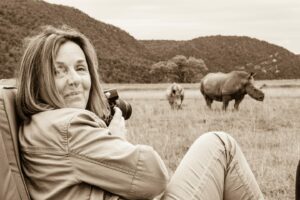
    It was during a visit to the Kariega Game Reserve in South Africa in 2016 that I encountered a remarkable rhino called Thandi. This was not just a wildlife sighting; for me it was a life-altering event.

    Thandi was a living testament to survival. She had suffered a horrendous poaching attack, her face had been savagely disfigured to extract her horn. Despite the physical trauma, her indomitable spirit shone through. Not only did she survive this gruesome assault, Thandi has become a symbol of resilience, mothering five calves – Thembi, Colin, Mthetho, Siya and Zolani. The horribly scarred, yet serene Thandi, grazing quietly with her first, 18 month year old calf, Thembi, was a turning point for me. I had to contribute, even if in some small way, to help fight this dark canvas of brutal poaching and support the incredible work so many do in rhino conservation.

    I had several years of experience as a jeweller, a skill honed under the tutelage of Jinks McGrath in her Sussex workshop. With Thandi as my inspiration and my passion for jewellery, I embarked on the journey of creating ‘Rhino Tears’, firstly designing a unique piece of jewellery Thandi’s honour and hopefully a way in raising awareness and those all-important anti-poaching funds.

    Each piece is designed as a delicate solid gold, or silver tear, and carries an engraved hallmark on the back – a triangle with a ‘T’, in homage to Thandi. For me, for every sale, it becomes more than just a piece of jewellery; it becomes a tangible symbol of strength, survival, and hope.

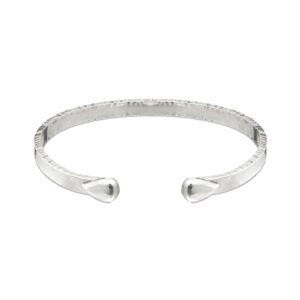
    Happily, my charity Rhino Tears, has gone from strength to strength, the product has evolved to include earrings, cuffs and bracelets and particular commissions with diamond inlay in both silver and gold, pendants and earring across the range.

    This has resulted over the years, in considerable donations to a few carefully chosen charities. Importantly for me, these game reserves in South Africa and Kenya are passionate about the conservation of rhinos in their natural habitat, as well as raising awareness and enabling local communities in supporting their heritage for the future.

    The monies raised have gone to help in several areas, primarily anti-poaching units, the purchasing and training of tracking dogs, tracking collars, cameras, the sad but essential de-horning of rhinos and the successful rewilding of orphans. Rhino Tears has also been able to proudly fund eight local interns through a year’s training in wildlife conservation and protection. They are now full- fledged rangers at the Kariega Game Reserve. Although most of my sales are done online, due to popular demand, I have been thrilled to provide Rhino Tears’ jewellery to several outlets, including the Curio Shop at Kariega, Ant’s Nest in the Waterberg and Auckland Zoo.

    My journey from the plains of Kariega Game Reserve and a jewellery workshop in Sussex, I hope will inspire, and show that we can all find a small part to play in preserving our planet’s rich biodiversity and ensure the rhinos may roam freely and safely on the plains of Africa.


    Go to rhinotears.org