Author: admin

  • Friday poem: Arrogance by Omar Sabbagh

    The Arrogance


    Even the motes of dust he petitions

    to be friendly faces.  And the undulance

    of his desire, the dancing of the waves that mint

    the rhythm of his workaday experience,

    was always to be seen and viewed smaller

    than the truth, the world at large, like the horror

    that inhabits it – its beastly denizen – told taller.


    Even the motes of dust seem to suit him

    and the sparse girth of his calling, the drum

    of each moment in his mind the drum

    of the page that whitens as it blackens

    before him.  In short, the sum of his arrogance

    might be found in a space between dance and sense

    and sound; a poet, after all, is only a man

    in the mirror, making sense of what he can’t.

    -Omar Sabbagh

  • Opinion: Why Solar Power is the Answer

    Dinesh Dhamija

    The world is hotter than ever. Climate-related disasters occur with terrifying regularity.

    “Fossil fuel emissions are already causing climate chaos which is devastating lives and livelihoods,” said UN secretary general António Guterres this week, ahead of the COP28 climate change summit in Dubai that starts on 30 November.

    And what do the world’s leading economies do? They ‘double down’ on fossil fuel production, cowed by the oil and gas lobbies and by short-term political expedience.

    The US, Saudi Arabia and Russia will produce twice as much fossil fuel by 2030 as the UN says is required to restrict global warming to 1.5 degrees above pre-industrial levels.

    These nations, and many others, complain that there is no viable alternative to fossil fuels and that cutting them out would lead to ‘energy chaos’.

    I don’t agree.

    Against this backdrop of superpower intransigence and looming catastrophe, India is quietly building a community of nations dedicated to solving the climate problem rather than pretending it doesn’t exist.

    The International Solar Alliance was created in 2015 by India and France to promote investment in and access to solar energy. It now has 116 signatories and 95 full members – Chile joined in early November – and is headquartered in New Delhi.

    For all kinds of reasons, I think that the world needs to get behind solar energy. It’s clean, free, reliable and widely available, not only to corporations but to small businesses and individuals, in most regions of the world.

    Narendra Modi made solar a central part of India’s energy strategy, developing ambitious schemes as chief minister of Gujarat and then accelerating progress as Prime Minister. India is now the world’s 5th-largest solar energy producer with 62 GW of installed capacity and a force for solar adoption throughout the developing world.

    Solar fits Modi’s vision of empowering individuals and communities: you can install solar panels on your roof, whereas you can’t drill for oil or gas. It takes away countries’ reliance upon expensive and politically-fraught energy imports. In the same way, Modi’s digital finance initiatives have given millions of Indian citizens access to life-changing opportunities.

    In my own modest way, I’ve tried to contribute to the growth of solar energy, developing a project in Romania which will produce enough electricity to serve a town of 250,000 people. See https://www.romania-insider.com/dinesh-dhamija-solar-park-project-romania-2023 Through this, I’ve seen how solar can transform the energy equation, producing both green electricity and hydrogen, which also has enormous potential to reduce CO2 emissions.


    Dinesh Dhamija founded, built and sold online travel agency ebookers, before serving as a Member of the European Parliament. His latest book, The Indian Century, will be published in the Autumn.


  • Larry David v Dave Chappelle: the Battle for the Soul of America

    Christopher Jackson


    All the talk of the 21st century belonging to the Chinese isn’t likely to have been reduced by the spectacle of the Biden administration foreign policy in both Afghanistan and Ukraine.

    But there is no doubt that the ‘demise of America’ narrative can be overblown. According to the Global Power Index, America remains ahead of all other countries on account of its economic, cultural and military power. It is too soon to announce its irrelevance, even if the image of an elderly president sometimes struggling to grasp the detail of problems does make one think inevitably of a decline straight out of the works of Edward Gibbon.

    The truth is that America still matters, even if – and perhaps especially if – it can sometimes seem notable by its absence. Its economic policy continues to influence ours if only because it accounts for 14.7 per cent of all exports (as of 2021), including everything from boilers and nuclear equipment ($10.5 billion in 2021), vehicles ($8.19 billion), and pharmaceuticals ($5.10 billion).

    As important as these statistics are, they feel limited as they can’t take into account the enormous impact of our cultural relationship. Not only is there the raw economics, but the back and forth of entertainment. The best statistic here is the number of streaming subscribers in the UK of channels dominated by an American understanding of the world. At the end of 2021, the number of Netflix subscribers stood at 14 million, a slight dip of 750,000 on the previous year. This is due to an increase of subscribers to Amazon which now has around 12.3 million and Disney which has swiftly taken considerable market share at 4.7 million. Is it any wonder that one often encounters people in the UK who speak with a slight New York or Californian accent, or that ‘wokeness’, a term coined in the US civil rights movement in the 1960s, should now be such a live issue within British society and in the British workplace?


    Larry v Dave


    NowTV meanwhile stands at 2.2 million. In the context, that might not be worth mentioning, except for one important point: it is probably the best way to watch Larry David’s Curb Your Enthusiasm (2000-) – henceforth Curb as it is known to its fans.

    Meanwhile, over on Netflix you can find the majority of the output of Dave Chappelle, a comedian whose worldview might on first inspection seem similar to David’s. This however turns out to be an illusion. Both Larry and Dave might be interviewed by David Letterman from time to time; each has starred on Jerry Seinfeld’s entertaining but slightly toe-curlingly chummy Comedians in Cars Getting Coffee (2012-); and both, of course, can make you laugh. To Brits, they are equally gigantic figures, sitting astride a huge economy: unfathomably rich spokespeople. They are creatures of power – and they probably don’t know from their American citadels how international their influence is, and might not care if they did. Even our own countrymen, Stewart Lee and Russell Howard do not seem to have comparable influence on our lives. Meanwhile, those who are of comparable importance such as Ricky Gervais and Steve Coogan have either moved to America (Gervais) or conquered the American market (Coogan). Both have paid court to David but not, so far as I’m aware, to Chappelle.

     

    But if you watch each show, and follow through the implications of each laugh, you begin to realise that not only do Chappelle and David inhabit different worlds, but their worlds appear to be drifting further apart in a way which seems to say more about modern America than any statistic could.


    Biographical clues


    The clues are there when you look at the biographies of the two comedians. There have long been two Americas – the Conservative heartlands and the liberal coastlines.

    The first of these is a predominantly rural world where the blue collar worker retains roots to the past. These states continually vote Republican and have pockets of Confederate sympathy. Here, gun ownership is an aspect of an immemorial tradition which dates back to the civil war and beyond, and where conservative social attitudes – especially opposition to abortion and a queasiness about the gains of the so-called LGBTQ movement – still dominate society.

    The second is an urban counterpart: a place of crime, yes, but also of tolerance, of wealth, of kale milkshakes and sneakers – and above all, tech. In these places modernity reliably reigns. This has its political ramifications. At each presidential election, Democrats do well in the big cities, and among minorities – especially African Americans, and to a lesser extent, Latinos. The Republicans meanwhile have tended to do well in the south. All this is the legacy of Nixon’s controversial southern strategy, which was intended to cement the white vote, arguably by driving a racial wedge through the electorate.

    The above is a simplification in many respects which is explored in different ways by both David and Chappelle. And yet it remains broadly useful: it is an aspect of American life which occurs too often to be discarded. It is also, as we see in the result of the 2016 EU referendum in Britain and in the recent French elections, an aspect of many modern societies.


    Life of Larry


    Larry David comes from the second of these Americans. He is a predominantly urban creature. He grew up in New York; one amusing leitmotif of his comedy is to parody his own distance from nature (though this hasn’t stopped him advocating for strong climate change policies). He once joked about his upbringing: “I grew up in Brooklyn. Of all the wonders and pleasures that Mother Earth has bestowed upon us, none of them could be found in Brooklyn.”

    David continues: “There was nothing in nature we appreciated. Sunsets were mocked. The moon, in particular, held no fascination for anyone. I don’t think I ever heard anyone even use it in a sentence. Nobody ever said, “Hey, check out the moon!” We never gazed at it. We didn’t do any gazing.”

    In Curb Your Enthusiasm, David’s long-suffering wife Cheryl, persuades Larry to go to the beach. He gesticulates at the sea and says, “I don’t get this fascination that people have with the ocean.” Cheryl replies: “Doesn’t it make you feel calm?” “No, it makes me feel aggravated that I don’t get something which other people are getting.” The perennial image of David is of someone schlepping through LA in the brilliant sunshine, amused by the quirks of the social code as it arises in cities.

    Sometimes an aspect of rural America will intrude on his life. In Season 11 – which aired at the end of 2021 – Larry bumps into a Klu Klux Klan member and accidentally spills coffee over his outfit. The comedy of the situation is that Larry then bends over backwards to make sure he rectifies that wrong by taking it upon himself to do his laundry. This in turn leads to an encounter with a cow on a farm: a rare moment in Curb when we leave the streets of LA.

    The Larry character in Curb doesn’t need to work since he is based on a counterpart of David’s own self who has long ago achieved unimaginable wealth thanks to the syndication of Seinfeld episodes. He has infinite leisure to follow up on any quirk of modern morality – to question an urban society which constantly seems to him to be filled with surreptitious selfishness, or contradiction.

    It can make for remarkably rich comedy. But sometimes it reveals its limits unknowingly. There was a story recently of Larry David at Martha’s Vineyard bumping into Alan Dershowitz. Dershowitz, a constitutional lawyer best known today for having spent much more time with Jeffrey Epstein than most would think acceptable, was astonished to be accosted by David who began to quiz Dershowitz about his ties to the Trump administration.

    According to reports, Dershowitz told David, “We can still talk, Larry.” David replied, “No. No. We really can’t. I saw you. I saw you with your arm around [former Trump Secretary of State Mike] Pompeo! It’s disgusting!”

    We might very well disapprove of the Trump administration, but there is just a whiff here of censorship, of the inability to understand why someone should wish to hold a certain viewpoint – and therefore seek to suppress that viewpoint at the same time.

    Dershowitz later summarised his views about the encounter: “Larry is a knee-jerk radical. He takes his politics from Hollywood. He doesn’t read a lot. He doesn’t think a lot,” adding, “It’s typical of what happens now on the Vineyard… People won’t talk to each other if they don’t agree with their politics.”

    As it turns out, David was in Martha’s Vineyard in the first place to celebrate that notably hypocritical gathering, former President Barack Obama’s 60th birthday party. This unmasked affair showed all too clearly the real feelings of powerful people on the left about pandemic era restrictions: that they could be jettisoned when they felt like it.
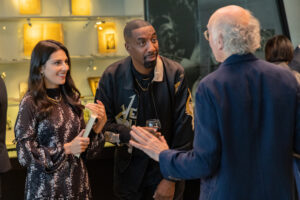
     

    Curb Your Enthusiasm itself sometimes displays something like this narrowness. In a recent episode David goes to pitch his latest comedy to Hulu and has some easy banter with the TV studio types. David points to three executives on the couch: ‘Did they like it?’ Then, mindful of the way in which pronouns are changing, he points to one of them: “Are you a ‘they’?” She says: “I’m only a they when I’m with other people.” David points to the next person and says: “Are you a they?” “No, I’m gay.”

    This is fine in all respects except a crucial one: it isn’t funny. In many other situations in Curb, David will double down on an absurdity like this; he will probe and examine behaviour and say the hitherto unsayable. An equivalent scene might involve David questioning woke orthodoxy. But instead here, he laughs and waves it away. He can’t imagine a society where gender fluidity is challengeable and therefore a potential subject of humour. In reneging on a real joke here, he shows his acceptance of a particular kind of leftist politics. Powerful as he is, he can’t go up against it – it would leave him friendless in the cities – New York and LA – where he has his home.


    Sense of Community


    By contrast, Dave Chappelle grew up in Ohio and despite acquiring great fame and riches, returned there. His comedy is shot through with a profound sense of community – both in respect of the locality, Yellow Springs, where he has spent his life, and in respect of his commitment to understand the African-American experience.

    In Larry David’s world, community is occasionally glanced off – for instance, there is one episode based around a man with a toupée’s apparent treachery against the bald community. But more generally, David’s sense of allegiance is to Hollywood. This is the case both in respect of those narratives which revisit his friendships with Julia Louis Dreyfus, Jason Alexander and Jerry Seinfeld and in the almost endless stream of celebrity cameos.

    His allegiance to the Jewish community is, of course, implicit throughout although it is interesting that this is constantly subverted. For instance, in an early episode he insists on the right to sing a passage from Wagner’s beautiful instrumental Siegfried Idyll. When someone overhears him and calls him ‘a self-hating Jew’, Larry retorts: ‘I may hate myself but it has nothing to do with being Jewish’. This is a brilliant episode, which asserts an essentially secular narrative whereby Wagner’s anti-Semitism isn’t sufficient reason to ignore the magnificent music he was able to compose.


    David’s Jewishness is primarily tied to his justified sense of belonging to a long list of brilliant Jewish comedians, through Mel Brooks, who has appeared in Curb, and Woody Allen who hasn’t. (David though did appear in Allen’s 2009 flop Whatever Works). He belongs to his fellow comedians. As so often happens when people become famous, they prefer to be around people who have gone through similarly surreal experiences, of becoming known and talked about, photographed and idolised, and misunderstood – and deemed immortal when mortality remains their lot.

    There is a world of difference in others words between David’s essentially secular relationship with Judaism, and Chappelle’s profound exploration in his comedy of the African-American experience. Both are funny comedians, but Chappelle is the braver. Chappelle has what George Orwell, though never the funniest of men, called in relation to his own polemical talent, ‘a power of facing unpleasant facts.’
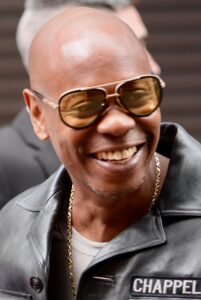
    Chappelle won fame and riches with Chappelle’s Show, buy decided to tear down the show rather than not be true to himself. In one standup show, around the time when he was considering departure, Chappelle found himself interrupted by members of the audience yelling a catchphrase from the show “I’m Rick James, bitch.” Chappelle left the stage and when he returned said: “This show is ruining my life.”

    Precisely what triggered his eventual departure – which did him immense short-term financial damage – is still a mystery although we know a little more now after an interview with David Letterman on Netflix’s slightly embarrassingly named My Next Guest Needs No Introduction. Here, Chappelle talks of a laugh having been too easily won – enough to make him queasy about the whole nature of the comedy he was practising at that time. He said: “I was doing sketches that were funny but socially irresponsible. I felt I was deliberately being encouraged and I was overwhelmed.” On another occasion, he said: “The hardest thing is to be true to yourself, especially when everybody’s watching.”

    Comedy is here deemed to be of the utmost importance; Chappelle is proclaiming that it matters at the level of the soul. I can’t see that anybody else has spoken about comedy in this way before.

    Being true to himself meant returning to the circuit, and playing comedy clubs. He would rebuild his art. Insodoing, he has made sure that he has done more than anyone alive to ensure it merits this noun. He has done so by making sure he isn’t only funny. He is also thought-provoking.

    The Chappelle art can be seen on Netflix in a series of specials: Equanimity (2017), The Bird Revelation (2017), Sticks and Stones (2019) and most recently The Closer (2021).
    All these have been to some extent maligned by the transgender community, but there has been a sense of mounting rage since The Closer, which caused a good deal of disquiet at Netflix, leading to a showdown where some employees walked out.

    This particular special needs to be watched rather than pontificated about.

    In the first place, what is it saying? Chappelle is predominantly motivated in his comedy by community, and by a desire to not let the black American experience of marginalisation be backgrounded by another marginalisation – that of the trans people. He doesn’t say that ‘wokeness’ or the plight of the LGBTQ movement is a symptom of white privilege – but he does categorically reserve his rights to make jokes about that possibility. He is saying that it is not off limits, and he’s right about that. In truth, sensitivity is often funny as it hints at insecurity; this in turn suggests some kind of incompleteness within society, meaning that a joke in that direction contains the possibility of catharsis. This is what Nietzsche meant when he wrote that a joke is an epitaph on the death of a feeling. Sensitivities deserve to be laughed away if they are ultimately groundless. This is different to mocking what is sacred. In fact, true sacredness can stand to be mocked since it will have a secure basis in fact.

    In Chappelle’s case, he is surely right that we must resist the temptation to say: ‘I am persecuted’ – especially if you will then be upset to hear the retort, ‘No you’re not.’ And what makes him able to say this? It is the whole gigantic inheritance of slavery, an experience which really was appalling, and which really does take some getting over. He is insisting on his right to check whether trans persecution is definitely persecution seen by the harsh light of the African-American experience. Insodoing he is speaking up for the freedoms people already have, so that they cannot be better protected.

    At times, Chappelle’s humour automatically aligns him with those feminists who have been prepared to affirm the primacy of gender in their own experience, most famously JK Rowling. Here is Chappelle’s most shocking joke in The Closer, with apologies to the faint-hearted for the bad language: “Gender is a fact. Every human being in this room, every human being on Earth, had to pass through the legs of a woman to be on Earth. That is a fact. Now, I am not saying that to say trans women aren’t women, I am just saying that those pussies that they got … you know what I mean? I’m not saying it’s not pussy, but it’s Beyond Pussy or Impossible Pussy. It tastes like pussy, but that’s not quite what it is, is it? That’s not blood, that’s beet juice.”

    One must first note the compression: it took JK Rowling thousands of words to say this on her blog – and there were no laughs, and so no Nietzschean catharsis. Her seriousness has left her far more vulnerable to attack than Chappelle. When the LGBTQ community reacted to this, there was talk of Chappelle attending a meeting with campaigners within Netflix.
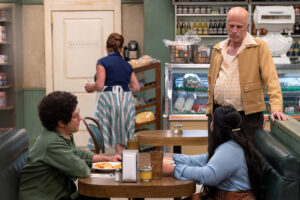
    Chappelle’s statement was typically robust: “I said what I said, and boy, I heard what you said. My God, how could I not? You said you want a safe working environment at Netflix. It seems like I’m the only one that can’t go to the office anymore.”

    In the special itself, Chappelle also details the beautiful story of Chappelle’s friendship with Daphne Doran, a trans woman comedian. In the special Chappelle recalls Doran saying: “I don’t need you to understand me. I just need you to believe I’m having a human experience.”

    In actual fact, nothing could be more affirming about Doran’s experience than Chappelle’s brilliant set. As Andrew Sullivan put it in The Weekly Dish: “And, through the jokes, that’s what Chappelle is celebrating: the individual human, never defined entirely by any single “identity,” or any “intersectional” variant thereof. An individual with enough agency to be able to laugh at herself, at others, at the world, an individual acutely aware of the tension between body and soul, feelings and facts, in a trans life, as well as other kinds of life.”

    And so there’s a paradox here: that Chappelle’s understanding of community is built on the freedom of the individual, not on herd mentality.

    If this is compared to the scene with Larry David in the Hulu office, we can see how far apart the two are: David’s sense of community is too cosy, it’s to do with leaving those alone who might cancel you, because that would be very tiring.

    It is difficult to imagine anyone at any streaming service walking out after seeing a Larry David special. He’s not near enough the edge for that anymore, though he once was.

    Inflexible politics always works against comedy. David’s sense of self is to do with being a Democrat – and specifically, a donor to the Democratic Party. As Dershowitz points out, Larry David is probably in the last analysis not particularly interested in politics, and it’s this which makes him vulnerable to being political since he’s unable to see, for instance, the flaws in the Democratic Party, or really how similar the two main parties are in the United States.


    All the Presidents’ Men


    There is a scene in the tenth episode of the fourth season of Curb called ‘Opening Night’ where David is finally about to hook up with Cady Hauffman. As they are kissing, David spies a portrait of George W. Bush on her dressing-room wall and breaks off the embrace. “Are you – a Republican?” Hauffman rolls her eyes: “Yes, Larry.”

    It’s a funny scene because it highlights Larry’s own dogmatism: it satirises the polarisation of America. Larry David the Democrat can’t let go his dislike of the 43rd President just for a moment, or even explore whether that dislike of Bush is relevant enough at that point to suspend a possible romance. But at the same time, the question remains: “Does David know enough about politics to be sure the joke is as funny as he thinks it is?” Christopher Meyer recently noted in Iain Dale’s The Presidents that George W. Bush was intelligent on first meeting: this is not information that can co-exist with this scene.

    David recently gave an interview at the ‘Netflix is a Joke’ festival where he was asked why he hadn’t been cancelled yet. “It’s a very good question. I don’t know why. I don’t like to think about it too much.” The answer is that he has challenged every orthodoxy apart from Democratic-Hollywood orthodoxy. David famously appeared on Saturday Night Live in the lead-up to Trump’s election and called him a racist. The appearance had a staged feel and probably only served to normalise Trump on national television. But it showed that David’s thought is often reductive: Bush is stupid, Trump is a racist. A man who is unparalleled at reading nuance in the situations people get themselves into, can’t apply those gifts to high politics.

    It’s for this reason that it’s impossible to imagine David being rugby-tackled by someone on stage as happened to Dave Chappelle recently. Chappelle’s political comedy is more nuanced. In Equanimity, he describes Trump supporters as ‘decent folk’ adding that he ‘felt sorry for them’. Chappelle continues in that hypnotic voice of his: ‘I saw some angry faces and some determined faces, but they felt like decent folk… I know the game now. I know that rich white people call poor white people ‘trash.’ And the only reason I know that is because I made so much money last year, the rich whites told me they say it at a cocktail party.’

    In this we see how both Chappelle – and David – might be termed rich outsiders. Both play on this. But what is crucial is where you end up living once you become famous. David is one of LA’s most famous residents. As the commentator Dr Randall Heather recently told me: “The thing to know about California is it’s really another planet”.

    It’s Chappelle who has retained that sense of place – enough to attend a 2022 council meeting around a housing proposal in Yellow Springs, Ohio – and who therefore has his ear to the ground. Insofar as he can be, Chappelle is accessible. In the Trump passage I quoted above, he is to some extent alongside his fellow people, as is shown in the punchline: “I stood with them in line like all Americans are required to do in a democracy – nobody skips the line to vote – and I listened to them. I listened to them say naive poor white people things,” he said. “Man, Donald Trump’s gonna go to Washington and he’s gonna fight for us”.  “I’m standing there thinking in my mind, ‘You dumb motherfucker. … You are poor. He’s fighting for me.”


    The Unforgiven


    Chappelle’s is a new kind of comedy: it is incantatory. Whole passages can pass without a joke – and his jokes when they come are never predictable. It is a highwire act.  We watch him delving the truth, yes, but sometimes the experience can be more uncomfortable than that: it can be as if he is probing you, the viewer. You emerge on the other side of his sets changed – as Chappelle no doubt did too in the writing of them. Larry David’s comedy contains marvellous moments – if you don’t know David’s comedy, just google ‘Palestinian chicken’. But his comedy, rooted in Hollywood mores and assumptions, doesn’t seem to work quite so well in the post-woke landscape since it cannot, without alienating his audience, address the question at all.

    This means that David will, more and more, have to resort to slapstick comedy which is the opposite of the incantatory humour of Chappelle. This isn’t necessarily terminal as David is good at this kind of comedy: one of the abiding images of Curb is of David grimacing as he looks back while someone ridiculously chases him down the sunny streets of California. In another episode The Bare Midriff, the episode ends with David hilariously hanging off a building, clutching at a girl’s tummy. I’ve always thought that this episode showed David at his best: like Tom Stoppard does in After Magritte, it was as if he had worked backwards from a preposterous image to figure out how we got there. It is gloriously silly. Comedy should always have room to be that. It might even be said that Chappelle doesn’t have David’s range, not least because he is working in the monologue form and David has successfully updated the comedy drama.

    But it is Chappelle’s comedy that is for this time – however uncomfortable that might make some of us feel, and however difficult that might be for all of us to say. The eleventh season of Curb finally showed David running out of invention, adrift in 2021, whereas Chappelle is very much of it.

    But we need both of them, because both are revolutionaries. The great sitcoms of the UK function on the basis of the predicament of the man in the middle of society, who must both suck up but is also able to punch down. Basil Fawlty has Manuel to berate, but must placate his wife and his guests. Alan Partridge has Lynne to do his bidding, but longs to please the TV bosses who might return him to fame. David Brent has Gareth beneath him, but head office, in the shape of Neil, above him, and so on and so forth.

    David’s achievement is to create a comedy around someone who is financially impregnable and feels no need whatsoever to impress anyone. If Seinfeld was, famously, a show about nothing, then Curb, is a show about someone who cares about nothing. Perhaps it is even the first true atheistic comedy, in that the protagonist feels no existential anxiety whatsoever: this liberates Larry, the character, to oppose what he views as absurd in the people around him.

    Chappelle’s comedy is to an extent few have realised religious comedy, albeit delivered in a secular setting. Chappelle is a Muslim convert, but he has also been called by Christianity Today, the ‘cultural pastor we need’.

    He has said: “I don’t normally talk about my religion publicly because I don’t want people to associate me and my flaws with this beautiful thing. And I believe it is beautiful if you learn it the right way.” When Chappelle talks about this side of his life more elaborately to David Letterman, we are left with a sense of man for whom comedy has a profound moral purpose. It is a comedy which looks to transcend spiritual anxiety.


    Sorry Seems to be the Hardest Word


    And so we are left with two comedians who represent two Americas which are becoming increasingly separate from one another – as we see every time an election rolls around. The question arises as to whether these two versions of America can be reconciled with one another.

    It would be foolish to place limits on what is possible, especially in America, that most dynamic of places. But one interesting leitmotif in both comedians is apology. Larry’s character is always saying sorry: “I’m apologising all day!” as he says in one episode. But it is always a sorry which is done out of expediency: he will be saying sorry again tomorrow. Again, David’s is not a comedy which leads to discovery, but which instead orbits a set of received truths.

    Chappelle, too, has his stubborn streak. As he put it in his famous statement following the furore at Netflix over The Closer: “I am more than willing to give you an audience, but you will not summon me. I am not bending to anybody’s demands.” My sense is that these two Americas will never in the end apologise to one another, just as Trump won’t admit defeat in the 2020 elections.

    Is comedy ever forgiving? You have to go quite a long way back for that. Since the satire boom of the 1960s, where comedy was aimed specifically at authority, the very notion of comedy has drifted free of its original meaning.

    In its essence a comedy is a story where the characters come to a prosperous conclusion. That is why Dante could write so much about Hell and still call his book a Commedia – because the protagonist ends up in Heaven. Likewise in Shakespeare’s comedies, as in Dickens’ novels, there is always a certain sorting at the end where the good end well, and the evil are punished. Marriages happen; it’s forgotten that there’s such a thing as funerals. David has done more than anyone since Dickens to restore the word to its original meaning. His LA really can seem a place of no death. If we take moral evil as the only death we should really fear, then we can see that Chapelle’s comedy wishes to defeat death.

    Whether reconciliation is possible for the United States of America remains to be seen. But the country is plainly large enough to admit almost any paradox: it is kind and cruel, beautiful and ugly, funny and serious and so on. It evolves and alters, and has always been a place of unusual hope – and forgiveness can be catching when it does spring up. But for now, it is clearly in a state of acute tension. To see that, all you have to do is go to Now TV or Netflix and press play.



  • Dinesh Dhamija: ‘Raise a Glass to Indian Whiskey’

    Dinesh Dhamija


    Alongside its population and GDP milestones, this year India celebrated another world first: it is now the largest global market for Scotch whisky, its consumers buying 219 million 700ml bottles in 2022 compared with France in second place, at 205 million bottles.

    That in itself is big news. It demonstrates a sharp rise in disposable income among India’s middle class, now able to afford the 150 per cent tariff on imported Scotch.

    What’s astonishing is that India’s huge imports comprise just 2 per cent of the whisky bought in the country each year, a market now worth around $18 billion.

    Seven of the top 10 global whisky brands, by volume, are now Indian. They include Officer’s Choice, Royal Stag and McDowell’s, while premium brands such as Rampur, a single malt distilled in Uttar Pradesh and selling for the equivalent of £62.50 and Amrut’s Single Malt Whisky, distilled in Bangalore and selling for £50.25, are quickly gaining market share.

    Single malts now make up a third of the whisky market in India, more than double the level of 2017. “Until just a couple of decades ago, alcohol was still a taboo subject in India,” says publisher Vikram Achanta. “Indian spirits, and bar culture, has really taken off in the past few years.”

    Gujarat, home state of Prime Minister Narendra Modi (and Mahatma Gandhi) completely forbids the sale of alcohol, as does Bihar, Mizoram and Nagaland in northeast India. In fact illegal alcohol sale risks the death penalty in Gujarat. Other states such as Punjab impose a 25-year minimum age for drinking. Yet overall, drinking culture is becoming more popular.

    Locally distilled spirits have a strong competitive advantage over Scotch, given the high tariffs. They’ve had to overcome initial prejudice among Indian consumers, who felt that imported Scotch was inevitably of a higher quality. That bias is fading fast. “There is a reverse underlying notion of Indian products being at par or even better than global products,” says Vinod Giri, head of the main Indian drinks trade organisation.

    Four or five new single malt distilleries are in development, as companies rush to capitalise on changing tastes. As one Indian whisky connoisseur puts it: “When you get a single malt that’s as good or better [than imported Scotch], at less than half the price, it’s an offer you can’t refuse.”

    A UK-India free trade deal would level the playing field for imported Scotch, potentially denting the upward momentum of local distilleries. But with the astronomical growth in the market and increasing international acceptance of Indian whisky as a premium product, there should be plenty of takers for wee Indian drams.

    Dinesh Dhamija founded, built and sold online travel agency ebookers, before serving as a Member of the European Parliament. His latest book, The Indian Century, will be published in the Autumn.


  • Review: Hotel Principe di Savoia in Milan

    Christopher Jackson


    Milan is a famous city, but it’s also in a catchment area where we find cities at their most beautiful and competitive: Italy. Within a relatively short distance, your other options include Rome, Bologna, Florence, and Venice, four of the greatest cities anywhere on earth. So that while it doesn’t quite qualify as a hidden gem, it might be that it still needs its cheerleaders – people to remind you that it’s more than just a place to watch football.

    Fortunately, help is at hand in the shape of this article. Milan is the wealthiest city in Italy, and trails only Paris and Madrid when it comes to being the richest city in the EU. To list its strengths in industries is to seem to list all industries: from fashion and art, to finance, law, chemicals and art, it might be that if it’s ever been your instinct to move to Italy to work abroad, that you’re more likely to work in Milan than any of the other great cities.

    But Milan’s a tourist location too – not just for its proximity to Lake Como and Cinque Terre, but also because of its own attractions. Venice is more beautiful; Florence has more art; Rome has more history; Bologna has better food – but Milan has something of each, and if you can look at what’s here rather than dream on what’s not, then you can find yourself enriched.

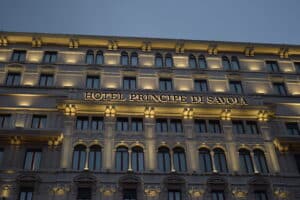
    You’ll be helped by this if you opt for the Principe di Savoia. The hotel, designed by the Milanese architect Cesare Tenca, opened in 1927, in a location near to the central station and Teatro alla Scala Theatre, one of the most famous opera houses in the world with long associations with everyone from Paganini, Verdi, Toscanini and Barenboim. This proximity is flagged by the hotel in many of the rooms which features pictures of scores by the great composers. It is a reminder that if you’re staying in an excellent hotel, you ought to be inspired.

    But you also ought to relax. On the top floor is one of the finest urban spas imaginable – a gym and pool with spa, steam room, jacuzzi, and so forth. That spa neighbours the famous presidential suite where Queen Elizabeth II and the Duke of Edinburgh have stayed, as well as people somewhat less admired than they perhaps once were: Woody Allen and Vladimir Putin.

    The feel throughout is of a modern city, where you’ll find the latest fashion and probably do well to look as presentable as possible. But it’s not quite so simple as that on inspection. The Duomo itself is deservedly famous, a building of almost unfathomable detail even when standing a hundred yards away from it. It is one of those works whose greatness is in its busyness. It was Voltaire who said that great works of art require quiet patches. Milan Cathedral from the outside at least appears to be a refutation of that: it is a thing so teeming that you wonder why it doesn’t seem too much. If you look closely at the sculptures along the east and west walls, you’ll find that the rhythms of the figures is subtly done so as to allow for cohesion – a miraculous given how many of them there are.

    Inside, things are different – the doctrine of detail is traded in for a echoic vastness where the forests of pillars give way to sculptures.

    If you want to know about the origins of the city, you can discover much in the crypt at the Duomo, where you see excavations which tell of the early baptistery founded by Ambrose, and which gives you a sense of just how old everything is deep down while everybody rushes around above you thinking of football, cars and fashion.

    Milan Cathedral also the option to go up and walk on the roof. Gardiner once said of Bach that his music is tragically good, insofar as they were better than they strictly needed to be for a regional capellmeister. Milan cathedral up here is the same: in the days before the invention of the lift, very few can have had the opportunity to come up into the skies and see these superb sculptures, so detailed and complex. They were done for their own sake: one of the best examples I can think of the importance of a true work ethic: to do things well because that is how they should be done regardless of reward.

    Of course, Milan has had its pull, and the names have kept coming here. In the Castello Sforzeca you can see a room which Leonardo da Vinci was working on; The Last Supper is also on view in an underwhelming refectory on the other side of town. It’s a reminder of that other person who upended things here: Napoleon Bonaparte. It’s Bonaparte who we have to thank for the poor state of the Last Supper, since the place was requisitioned as a stable.

    The Castle feels as large as the Louvre, and just as labyrinthine, involving a vast traipse around armouries and collections of porcelain which it would take a lifetime to assimilate. Here also is Michelangelo’s famous – and marvellous – La Rondinaia, one of those unfinished works of his where you can see the figure miraculously emerging from the marble.

    Getting about Milan is a straightforward matter: in truth there’s enough here to do to keep you busy for a week, but the city is large and so the metro demands to be mastered: a straightforward task as it turns out, tapping one’s card exactly as if this were Piccadilly.

    Beyond Milan, your easiest train journey is Bologna – that red-bricked foodie haven, which sometimes loses out to Florence, but which is in many respects its equal. It’s undeniable that some magic happens on the train from Milan down to Bologna: a sort of Tuscanisation of the landscape, where the light becomes warmer, and the gorgeous tracery of blue hills begins to weave its way about the sky.

    The train itself is very fast – beginning in Turin, it aims to get all the way to Naples in six hours, stopping at Florence, Rome and other places. Sometimes, remembering winter in the United Kingdom one envies one’s fellow travellers, whose lives can seem to have a superior flavour by virtue of carrying them out in a superior location.

    But it’s worth all the life envy to get to Bologna. The beautiful frescoes by Giovanni di Modena in the Bolognini Chapel in  San Petronio: an Inferno which would have terrified Dante, and a beautiful series of six pictures of The Journey of the Magi. Bologna has a magic about it; an iteration of Italy which I’ll not forget.

    But there is another side to Italy – it can be overwhelming. The beauties are so many, and so many are in the past that it can be sometimes you long for some straightforward escapism from the noteworthy and the sublime.

    This is where the Principe di Savoia comes into its own: I’ll not forget a morning I spent, attempting to teach my six-year-old son to swim in the pool on the roof. Sometimes, it’s best not to go to Lake Como, but instead to attend a spa.

  • Time Management: The Key to Success or Failure?

    Christopher Jackson


    Recently, Finito Education held a fascinating mentoring roundtable at a major bank in the City. Around the table for the discussion were 20 or so very bright young things, all the children of clients of the firm, as well as former Universities minister Sam Gyimah. It was an impressive discussion where young people aired their dreams and their doubts.

    Afterwards I was approached by a young man who wasn’t sure whether he wished to do postgraduate studies at Edinburgh or to go straight into employment. It was a very interesting conversation, but I could see also that whatever this person decided to do he would likely be successful: this was because he was asking all the right questions, and ready to hoover up any new information I might be able to offer up.

    Soon the conversation turned to my journalism career and the people I have been lucky enough to interview during its course. Due the nature of the roles I’ve been lucky enough to have I’ve interviewed people from the world of business (Sir Martin Sorrell, Sir Richard Branson, Lord Cruddas), sport (Andre Agassi, Jonathan Agnew), entertainment (Sir David Attenborough, Sting, Simon Callow, Guy Ritchie), literature (Sir Tom Stoppard, William Boyd) and across many other sectors.

    This intelligent young man asked me what he felt it was that had united all these people. Once you stripped away the inessential, the question was a very simple one. What causes success?

    I must admit I’d never given the matter huge thought before that moment – except in the general way in which one is always trying to gauge what excellence is on the off-chance of emulating it in one’s own life. Even so I found myself – almost to my own surprise – offering up the unhesitating reply: time management.

    But these two words tend to be bandied about a bit and are arguably bland; accordingly, I found myself enlarging on the point. All these successful people, in their different sectors, show a constant – even obsessive – awareness of the absolute value of time. All of them, even the wealthy ones, value it more than money.

    This awareness takes many forms, but the impression is always of time as being the medium by which – and through which – success is going to happen, a realisation which in these people generates the utmost care when it comes to organising their days. I remember talking once to the financier Andrew Law about an interview we wished to do with him about the late Ian Taylor. He wondered whether a few lines would be suitable, but when I suggested he write a bit more, he said: “I see, so I’m going to have to devote time to this.” I loved the intonation on the word ‘time’: it told you all you needed to know.

    Sometimes of course, it shows itself as impatience for the interview to be over and done with – something which journalists of every stripe must get used to and accept. I remember interviewing Attenborough during the pandemic, and feeling at the other end of the phone the need to get on to the next thing, which, in his case, in his mid-90s and with a planet to save, one could excuse, though I still wish he had been slightly less rude.

    Often though, a successful person has ordered their lives with such impeccable care that they appear to give you their time almost infinitely once it is secured. One such was William Boyd who I spoke to for some three hours in his Chelsea home. He was so convivial and generous that at one point I wondered aloud whether he didn’t want me out of his hair. “It’s okay, Chris,” he said, “I’ve set aside this time.” Again, I was aware of time as a valuable commodity, and one could easily imagine that the morning taken up with me would cede to a productive afternoon of work.

    Organising our time well can often turn out to be in some sense a moral boon for ourselves and others. It was CS Lewis who observed that a true Christian – in our secular world, we might think instead in terms of a highly successful person – will seem to have more time than other people. It is always an impressive thing to hear of those very busy and important people who make time for others – time which, we might have assumed, they didn’t have.

    In fact, we always have it. As we make our choices in our careers, we may face any number of forks in the road, and sometimes we cannot control those outcomes. But here is something we can control – and the sooner we learn to master it the better.

  • Matthew Perry: 1969-2023

    Christopher Jackson

    There is a scene in Matthew Perry’s memoir Friends, Lovers and The Big, Terrible Thing which it is impossible to read without sadness over the past few days.

    In it, Perry recalls the period before the first episode of Friends aired. It was a heady time. The internal data from the television studio showed with certainty that the show would be the gigantic hit which it became. Some sensible producer observed that as a result all six of the main cast – Jennifer Aniston, Courtney Cox, Lisa Kudrow, Matt Le Blanc, David Schwimmer and Perry himself – would soon become very famous indeed. It was therefore suggested that the cast go out for a night out on the tiles – a last stab at the anonymity which they were about to surrender for good.

    What makes the scene interesting is Perry’s evident nostalgia for that time before his name became so known. It was President Obama who during an appearance on Jerry Seinfeld’s Comedians in Cars Getting Coffee opined that he hadn’t considered the value of anonymity before becoming famous. Seinfeld replies: “It wasn’t that great.” Perry would agree with Obama that something almost beyond price is lost at the point of transitioning away from obscurity into its moneyed opposite.

    As the reader, we have mixed feelings reading about this strange night out before gigantic celebrity is bestowed. On the one hand, if Perry’s fame was what it took for us to be able to know Chandler Bing over the ten astonishingly successful seasons of Friends perhaps the pain which came to him as a celebrity was in some way a necessary sacrifice at the altar of light entertainment.

    On the other hand, seeing his evident unhappiness down the years, and his essential inability to function in the spotlight, one wishes him out of it altogether. Perry as a failed actor would surely have been a happier man; one even wonders whether someone else could have played Chandler who might actually have enjoyed the experience and not felt the pressure of it all so acutely.

    But really there never was any need for such dichotomy: there should never have been any either/or about Matthew Perry’s predicament. Was Perry always going to suffer mental health issues or were they a biproduct of fame? It seems likely that the latter had a huge role to play.

    It would be better if we were able to inhabit a society where television is just one of a thousand other professions and not elevated to such a crazy extent by the paraphernalia of stardom. We are a society of the famous and the not-famous-at-all: it quickens the pulse of most people to be see a celebrity in the flesh. Fame messes with the head, as Martin Amis, also famous and also one of those to die in 2023, frankly put it in his own memoir Experience.

    Similarly, Perry’s life reminds us that the discussion around mental health is still very much in its infancy, though it was accelerated hugely during the pandemic when all of us felt alarmed at the unnaturalness of the situation. The options aren’t always sufficient even if you have the money to fight the problem: Perry spent $9 million dollars fighting his afflictions and one sometimes wonders whether even high-end provision in this area is enough to really move the dial if someone has gone far enough down the path of self-destruction.

    Yet despite all this, we have Perry’s work and this reminds us that there was for a while something marvellous about Friends especially in those first few seasons. We have also forgotten at this point – especially since the others went on to have more successful and stable careers than Perry – how much the show really revolved around Chandler/Perry.

    This was because while Ross, played by David Schwimmer, had the funniest slapstick moments, Chandler always had the best lines. It was Seinfeld again who identified that the final stage of comedy is to have people talking like you because it’s so much fun. Perry alone of the Friends cast reached that level: “Could I be wearing any more clothes.”

    That intonation on the word ‘be’ can summon back for me the whole of the 1990s. Chandler’s wit was a way of staving off the eternal anxiety of youth – the sort of anxiety which is meant to have been dispatched by the age Perry was when he was playing the role. This is why the show is so popular among teenagers; at that age we identify with Chandler.

    Sadly in Chandler Perry had left an autobiography of sorts of a perennially nervous man who must joke in order to function. Nietzsche wrote that a joke is an epitaph on the death of a feeling, but these were feelings which could not die with Perry. A sense of inadequacy, perhaps arising out of his parents’ divorce, pursued him and was always going to be more successful in that pursuit once Perry was made vulnerable by fame.

    In one famous scene, Chandler says: “I’m not great at advice. Can I interest you in a sarcastic comment?” He always could interest us in that, but it was his fate to end up dispensing advice: don’t be like me.

    Yet in our world today we all want to emulate the famous if only to have infinite money and opportunity. His death is a moment to mourn the loss of a kind man and magnificent comic talent, but also to consider a fundamental recalibration in our relationship with fame.

  • Photo essay: Architecture in the Time of Covid

    Photo essay: Architecture in the Time of Covid

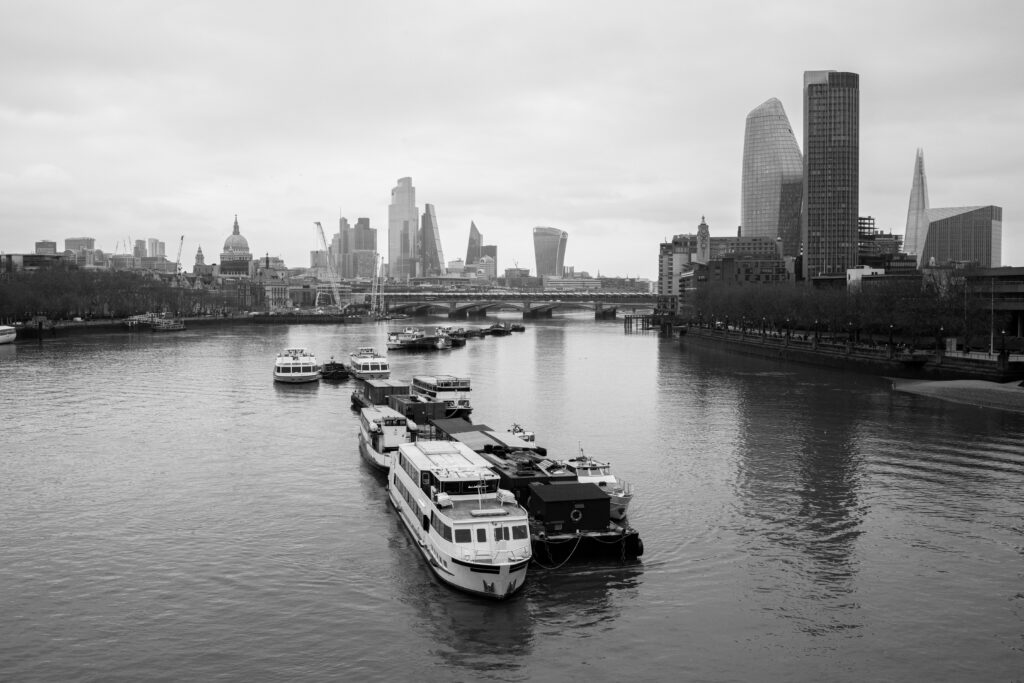
    During the pandemic, we published Will Purcell’s fantastic photographic essay on architecture during the pandemic. With the streets full of people once again, it’s interesting to look back.


    Will Purcell  

    While it is easy to wallow in the emptiness of this pandemic there is a lot to celebrate in the architecture of the city and its surrounding suburbs. One long year ago, silent buildings were normally associated with being readied for demolition or redevelopment. Now silence can mean only one thing: the virus.

    It’s fascinating how architecture designed for people stands up when the footfall is removed. The City of London certainly looms ominously in the quiet with tall glass structures, curved and reflective, towering over the old London banking lanes and largely empty passageways.  

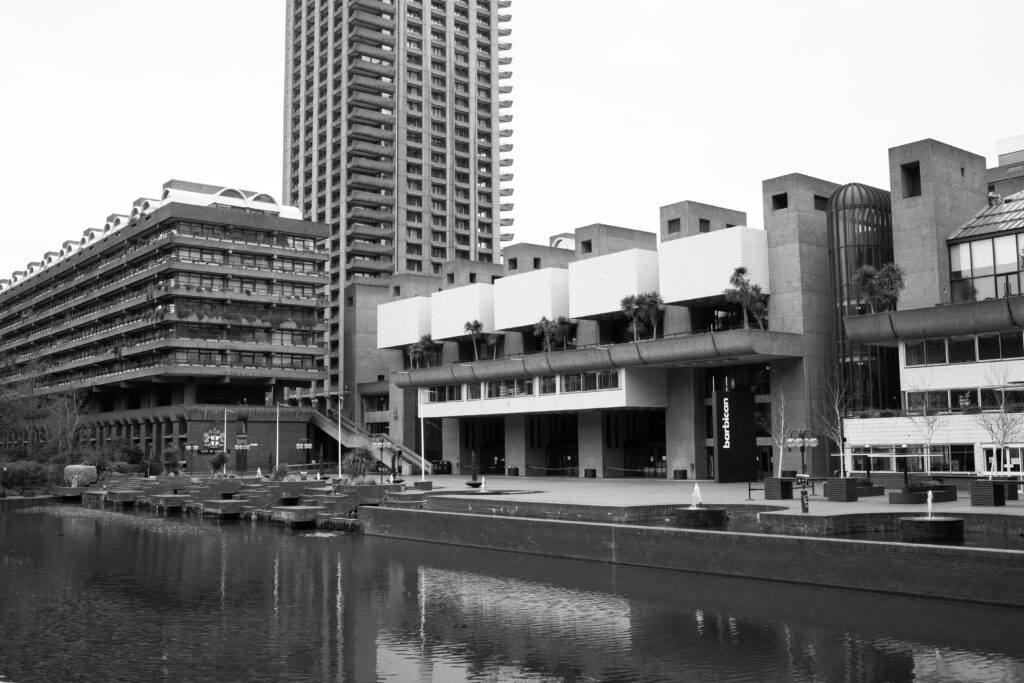
    The neighbouring Barbican with its closed theatre and eerily muted walkways with Wyndham-esque pods somehow manages to retain a sense of warmth. Although deserted, save for the odd body at a desk in an adjacent block, it keeps the interest of the observer. It is a hard development surrounded by equally gritty high rises but in its textured and rough industrial concrete balconies there remains, even with everyone tucked away and hidden, a consoling sense of presence, even warmth.  

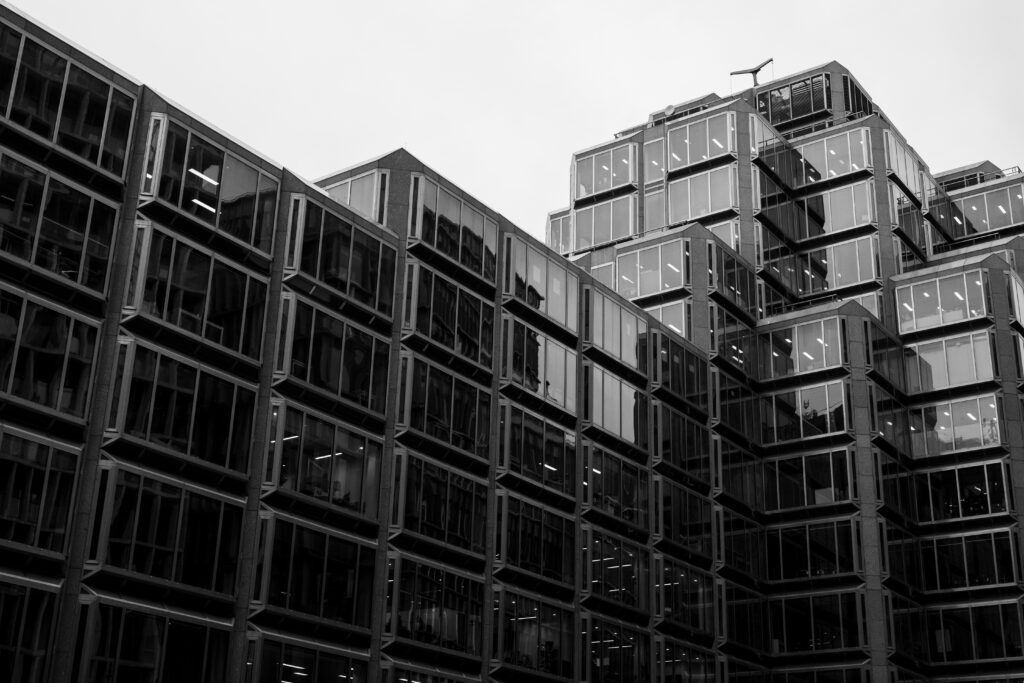
    South of the river, the National Theatre with its Brutalist layered concrete feels more than ever cold and alone. In sunlight, filled with people and life it can really soar, but during the winter of our pandemic it can appear an inexplicable relic. It is not alone, but just like the office blocks that surround Victoria Station, and which are usually lit up and full, the glass panels lie in darkness reflecting the world outside its walls.  

    In contrast, as habits change, people work from home and exercise and socialise near to where they live. Residences that sit in the middle of the action come to the fore. The suburbs are no longer the exclusive realm of the terraced house. High-rise flats demand attention on the horizon. Floor to ceiling bedroom windows overlooking community parks  look like fixtures of the future.  

    Deprived of so many people, London becomes a myriad of lines and angles. With the softening sounds of chatter, footsteps temporarily suspended, and with the constant noise of the cars, buses and aeroplanes also reduced, it is an opportune time to explore the silent shadows of the city’s architecture and search out the little pockets of hope and colour that still exist across the boroughs waiting for the return of laughter and light switches. 

    A New Build in SW London shows that the direction of travel is most definitely up when it comes to finding space in an already overcrowded city. 
    London – all angles and shapes and static boats.
    The timeless Barbican, empty and imperious at once from both the past and the future. 
    125 Victoria Street
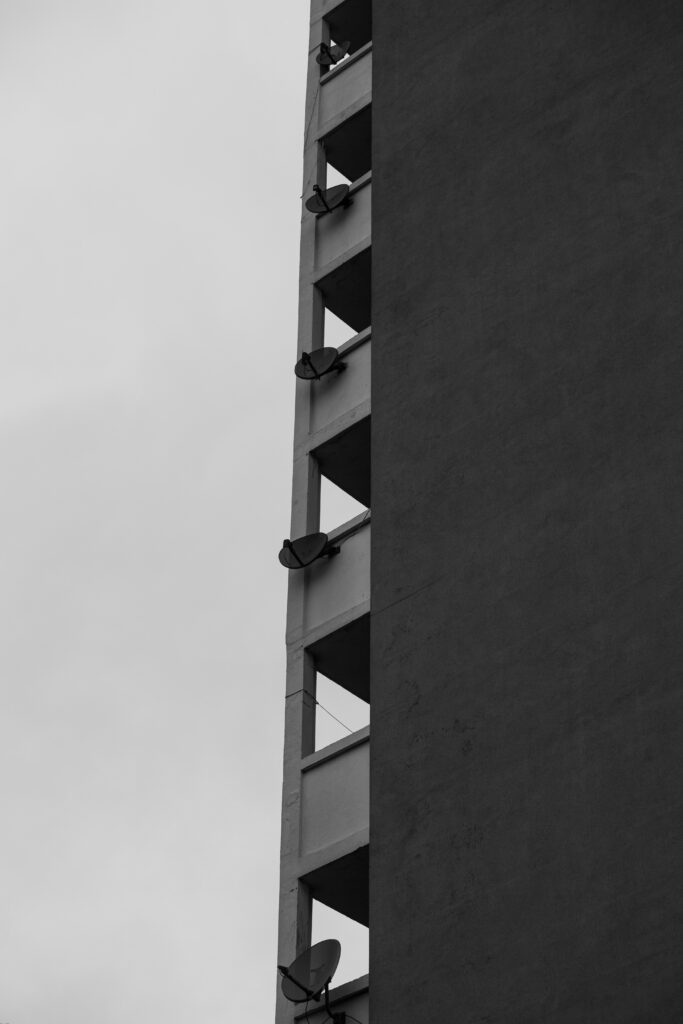
    Satelite dishes adorn a tower block in Loughborough Junction in SW London in a visual nod to the Netflix and other providers of TV that we have been at home devouring over the last year. 


  • Dinesh Dhamija on India’s Investment Allure

    Dinesh Dhamija


    As the world polarises further into warring blocs, with Russia, China and Iran on one side and the US and Europe on the other fighting proxy battles in Ukraine and Gaza, India is forging for itself an ‘honest broker’ role.

    Pacifist by nature, India has studiously avoided siding with extremist ideologies or states. During the Cold War, the country kept an open mind to Communism: it was widely tolerated in the south of India, without threatening to dominate.

    In the current climate, Prime Minister Narendra Modi has pulled off the seemingly impossible trick of staying friends with Russia while being courted by US President Joe Biden, British Prime Minister Rishi Sunak and Australia’s Anthony Albanese.

    For the nation’s economy and its future as an investment destination, these are very positive traits. Such is the fear of intensified disruption in the Middle East and Central Asia, with recent mini conflicts breaking out in Azerbaijan, Kazakhstan and Belarus, that a safe space for emerging market investment is at a premium.

    As the Financial Times reported recently, India today is “powerfully appealing” to investors. “Over the past 30, 20, 10 and five years, the Sensex has performed as well or better than the S&P 500, leaving other big markets far behind,” it pointed out the other day. India is now more efficient, thanks to infrastructure development in roads, ports, railways and airports; electrification has reached 90 per cent of households, up from 67 per cent a decade ago. And its huge working age population is expected to rise for years to come, just as most developed economies begin to age.

    Much as we in the West might wish that India put its weight behind us on Ukraine or in the Middle East, its purposeful neutrality may serve it better than any hasty favouritism.

    And as democracy comes under attack in the United States from the increasingly rabid Republican party, or even in Europe with the rise of extremists such as Viktor Orban of Hungary, the world’s largest democracy gains yet more allure.

    As the FT says: “The desire to allocate a meaningful slice of portfolios to the emerging world, as a source of both diversification and growth, remains.”

    India has represented the best destination for this slice for a few years now. The latest eruption of conflict in the Middle East only adds to the logic of investing in the relatively stable, democratic, fast-modernising Indian economy.

    Dinesh Dhamija founded, built and sold online travel agency ebookers, before serving as a Member of the European Parliament. His latest book, The Indian Century, will be published in the Autumn.

  • Bellamy’s Restaurant Review: A Regal Dining Experience in Mayfair

    Bellamy’s Restaurant Review, Ronel Lehmann

    Hidden off Berkeley Square down Bruton Place is one of the late Queen Elizabeth II’s favourite French restaurants, Bellamy’s in Mayfair. I had never dined there and was delighted when one of my senior colleagues decided to treat me to dinner. There she was sat resplendent at the bar holding fort with a cocktail when I arrived.

    I was immediately relieved of my coat and umbrella whilst the receptionist welcomed me and took a phone call at the same time. I thought about my busy day and how deft I was at multitasking, but she was on another level. Luigi Burgio, Bellamy’s Manager, greeted me as a regular customer which helped set the scene for a special dining experience and ushered us to a corner table.

    Normally I am the host, but my colleague insisted that I behave as a good guest, so I sat regally on the banquet. The first thing that I noticed was the upholstery. It was firm and very supportive of the back, and for once I didn’t need a pillow or be seated on a chair. The waiter was very attentive and sparkling mineral water was chosen.

    Bellamy’s restaurant is a calm oasis, tables are positioned to afford privacy and the walls were full of interesting art and prints. The mirrors positioned beside us allowed you a real time reflection of guest’s arrival and departure without having to look away.

    Gavin Rankin, the owner then arrived and extended us a warm welcome. He stopped by all the tables. I liked his style and genuine care for diners. I learned that his nonagenarian mother still makes the chocolate pudding for the restaurant, and I was salivating at the prospect.

    The menus arrived. It was very comprehensive, and I noted some favourites including, Apple, Endive and Walnut gratin; Salad of Artichoke Heart & Haricot Verts; Ravioles de Royans; Smoked Eel Mousse; and Entrecôte frites. For a moment, it reminded me of my student days in France, when ordering Steak frites. I only discovered after enjoying the meal, that it was in fact horse meat. It was therefore reassuring to read that the Entrecôte was Baynards Park Beef and not from one of the Royal fillies.

    We both elected for the Table D’Hôte, which translates as Table of the Host. Three courses were priced at £35 which struck me as extremely good value.

    We both decided to select the Soupe Paysanne, it was a cold night, the hearty bowl was hot, filling and delicious. After a short break Chicken Breast a l’estragon with mashed potato arrived. It was exceptional and very tender. The potato soaked up the delicious tarragon infused sauce on my plate. When I had run out of potato, I helped myself to my hosts chips. The chips were some of the best I have tasted in London. I continued eating chips. The chopped salad du jour was a perfect accompaniment to our main courses. The sommelier suggested a pairing of red and white wines and my lips still found time to enjoy the lingering after taste of tarragon.

    You cannot ignore the pudding menu and we both went off piste ignoring Crème Catalane. My host chose salted caramel ice cream which was served soft in a frosted glass. I elected to go for the Ile Flottante, so that I could return to the chocolate pudding another time. Yes, I did try the ice cream and it was sensational. My host had enjoyed Ile Flottante before, so by the time I had tried to stop eating her ice cream, I was ready to go to floating heaven. The Ile Flottante was sensational, better than in France. This famous dessert consists of meringue floating on crème anglaise. It was so light and airy.

    We declined coffee, tea and digestives and then a bowl of smooth milk chocolates arrived. Being a gentleman, I did offer to the pay the bill before being chastised and beginning my lonely walk of shame back to transport home. I was sure that I heard a Rossignol (a French Nightingale) sing in Berkeley Square.