Author: admin

  • Paul Joyce: A Dr Who Dinosaur Speaks

    Photographer, artist and erstwhile Dr Who director, Paul Joyce, offers an insight into the making of the Time Lord…

    One can almost hear the sigh of relief breathed by Idris Elba when at last the young cub was painfully torn from David Tennant’s side in an awkward and over-extended CGI sequence. A nod maybe to the book of Genesis but no mention of additional ribs or, thanks be, even a glance towards the other candidate for Eve’s existence, the baculum. Rather we are presented with an athletic looking young black actor of undoubted Achillean appeal and bizarrely sporting only bone-white underpants for the remainder of the show. For my money quite a lot of fuss over barely spilt milk. Welcome to the world of “Bi-Regeneration” (as opposed to simply ‘bi’) which will allow Tennant whose Hamlet and no doubt Macbeth and Lear will all be overshadowed at least in legacy terms, by his stuttering appearances as The Time Lord. As one horrified fan just wrote: “what the f*** so what now we get 2 doctors flying about ????” It is clear our David will not leave the show lying down.

    In a hagiographic follow-up documentary aired immediately after the show’s first airing, an uncomfortable looking presenter, wielding an exaggerated Welsh accent (to remind us of the show’s Celtic credentials,) wandered around the set to demonstrate just how good the CGI is in the transmitted version. His first choice of interviewees included the 2nd assistant director, a Runner and a puppeteer. Oh yes, plus one of the producers who appeared briefly as did the show’s grandmaster, Russell T. Davies. Any documentary worth its salt covering filming of really any kind would usually figure the director at some point as being at least nominally a captain on the ship. But not here, not now, which symbolises for me the vacuum at the heart of Dr Who in its ongoing form since my brief tenure there 40 years ago. The director nowadays can be anyone more or less: in my time that might be a promoted first assistant director or junior producer eager to lap up the BBC philosophy of absolute loyalty to the crown (or in other words TV Centre). For me that view has not shifted much in the last four decades at least.

    My quite genuine admiration for the show’s initial 20 minutes or so rested, now I consider my reaction more carefully, on mainly technical excellence; these included stunning views of cities with beautiful futuristic buildings running alongside believable recreations of Soho streets 100 years ago. British TV is attempting and succeeding in matching the mighty Hollywood dollar, aided by our indigenous and unequalled Special Effects facilities. The bolted-on documentary also showed what seemed like an army of Steadicam operators flying hither and thither about the set apparently filming anything that moved. I came from an era where budgets were tiny, special effects barely obtainable, and working conditions today would be truncated overnight by a number of trade unions and government acts.

    Paul Joyce second from left with Tom Baker


    In my day I had to beg, borrow and finally steal the first truly portable camera to enter the BBC’s hallowed walls, called, as I barely can remember, an Ikigami. Added to which I faced a hostile management at the BBC eager to have me fired, and with key elements of my crew resentful of my very presence on set. In retrospect my reputation was probably firmly set on its course towards oblivion long before I took up the reins on “Warriors Gate”.

    It is important to mention that there is one crucial difference concerning a director’s authority between my time, and pre-production conditions today, and that is that he or she has no official control over casting, a major contribution to the success of any series. I like to think that my four episodes of “Warriors Gate” where I was totally responsible for casting (Clifford Rose; Kenneth Cope; David Weston, etc.), survives as well as many in those middle years, because of the strength and diversity of the talent I chose to work with. This was aided by basically a stroke of fate which left myself and the script editor, Chris Bidmead, with unworkable scripts which we had to re-write over the course of a week, thus losing valuable rehearsal time which I was not able to recover. Having altered the characterisations in our additions, this meant I had an intimate knowledge of what made my characters tick. So it was important to let my two Laurel and Hardy actors ( Freddie Earle and Harry Waters ) know that their roots had been laid down in the work of many authors such as Samuel Beckett and Tom Stoppard. A middle ranking BBC executive thrust into the role of casting director would have no notion of these, hopefully subtle, nods to familiar characters which can be traced right back to the Bard himself (aka.Rosencrantz and Gildernstern). So one crucial element of constructing a coherent show is cut away at a stroke, like nadgers from a bullock. This change from my days was not a spur of the moment management decision, but one made incrementally over time; one leading to a gradual erosion of the director’s authority, further buttressing those twin pillars of the BBC Establishment, the producer and the writer.

    A friend of mine, a well-known presenter and actor, also well informed on the history of Dr Who, said that one director had told him that British TV deliberately places an executive layer in place in order “to protect the audience from the director”. I found this a very intriguing notion and it is certainly true that the BBC keeps directors as blank as the outline posted on eBay or Instagram before you fill in your personal details. Ghostly interchangeable presences flitting from drama to drama, obedient boys and girls wedded to the great corporation and fully plugged-in to its necessary support systems. It was certainly my experience both on “Warriors Gate” and a Play for Today that I wrote and directed in Pebble Mill, that one is expected to work to a rigorous schedule which takes no account of creative differences, matters of interpretation, second thoughts or even the weather. And going over a studio session by a single minute means the plug is literally pulled. Now this practice might have changed by now, and I really hope it has, but the driving force behind BBC programming is to produce saleable product first and foremost. In the past the BBC nurtured towering talents, the likes of Ken Russell, Peter Watkins, Ken Loach and Tony Garnett, but those days are long gone, lost like traces of special-effects gunpowder on the fields of Culloden. All of the above mentioned fled from TV into the alternative minefield of film-making where the stakes are even higher but success comes to those with persistence and talent, finally rewarded by the enviable credit, “A Film by…”

     

    A scouting shot by Paul Joyce for Dr Who at Powys Castle

    The recent strike by film and TV writers in the US has reached an uneasy compromise but the threat of AI hangs over all of us. Mozart is already composing his 42nd symphony. But if actors are frightened of being cloned and resurrected from the dead, what about directors? Could we make one like Sam Peckinpah whenever we want a great shoot-out? Or a Spielberg for any Si-fi or underwater picture? Seriously now, I can see a time when a robot could not only organise a script, but create a workable storyboard, issue instructions to actors based on pre-ordained movements (computer checked beforehand) then supervise an individual shot; a robotic decision could then be based on a) if everything in frame was in focus, b) actors delivered their lines without hesitation or repetition c) any special effect proceeded according to plan. Voila! Direction by numbers, but aren’t we almost there already? The days of “Sorry sir, there is a hair in the gate” are well behind us now.

    There have undoubtably been fine directors on the series during its unprecedented 60 year run, but for me the problem remains, now as it actually did just as well then, how few have gone on to become true originators and in creative terms, real auteurs. In America’s golden age of live TV, mighty talents like Sidney Lumet and John Frankenheimer, Michael Mann and Robert Altman emerged and then went on to become kings in the kingdom of Hollywood films. It is difficult to come up with a complementary list here in the UK.

    I can see why more or less anyone competently trained in state-of-the-art technical capacities, particularly computer graphics and CGI generated images, could command a set of this kind today, and bow to the will of the writer’s vision. In this sense nothing has changed since “Warriors Gate” where I tried to bring at least a hint of the director as auteur to the proceedings. But I was cut off at the knees by the establishment’s twin-peaks, namely the producer and the writer. This has barely changed from the era of the show’s founding producer, Verity Lambert up to and including Russell T. Davies today. So a homogeneous product is born to satisfy the needs of voracious salesmen promoting BBC Worldwide, and where a show is judged by its longevity rather than on its individual and intrinsic merits. Who amongst us older directors can forget that the first episode of the Peter Falk TV series Columbo was directed by a teenage Steven Spielberg?

    So here we have it, an all-new, no-expense spared Russell T. Davies extravaganza with bells and whistles (literally), flying galleon ships (straight out of Pirates of the Caribbean) and a baby hungry monster Goblin (or was it Gremlin) looking like a giant overfed cowpat. What more could a child want, I asked myself, settling down on the sofa to watch with my soon-to-be teenaged granddaughter, Zsofia? She took the precaution of supplying us with large fluffy cushions to hide behind during the scary bits. Scary bits? Well, that’s another story…

    Of course, we are all watching out for the hugely talented Ncuti Gatwa to don a pair of real trousers after flouncing around in boxer shorts for his prequel introduction. And he gave us that smile as well, countless times, showing a set of teeth well capable of blinding half the audience as well as severing the appendages of any alien previous seen on the series. Looks, charisma, athleticism and even I suspect a good singing voice. What more can one ask for, except perhaps a new companion to bounce off? “Say no more”, mouths Russell T. and with a sweep of his pen, lo and behold, a companion appears as blond as he is black and as straight as he is gay. The whole world in his arms!

    So where is the problem? At the very root, I’m afraid, with the very bedrock of the programme, the script itself. Part religious analogy (baby in a manger) part time-travel with missing baby (black or white, both are there, but which is which) and a chorus of singing Gremlins (or maybe they are meant to be Goblins?). It all seemed to hinge on some kind of time warp (but unfortunately not as funny as Rocky Horror) where Ncuti rescues one of the babies who apparently develops rapidly into his next companion, a blond goddess called Ruby (Millie Gibson). All well and good but what about the story line in an episode which must have cost, in my calculation at least, the BBC about 6289 licence fees? Just one word covers that I fear, simply “cobblers”.

    After the first 40 minutes or so, when a nest of Goblins/Gremlins formed a chorus line and prepared to belt out something sounding like “Hello Dolly”. I turned to dumb-struck Zsofia and asked if she could make head nor tail of what was going on? She shook her head sadly, cushion still rooted firmly in her lap. “What’s that for then” I asked her. “Oh” she replied, “I was watching an old Matt Smith episode of some dolls in a cupboard. Really scary!” “What about this one, do you think”, I enquired gently. After a momentary pause came back the unequivocal: “Not scary enough!”


  • Finito Candidate Phil Verney Looks Ahead to 2024

    Phil Verney


    Us humans are interesting creatures, aren’t we? On the face of it, one could argue that the changing of a year is merely a second changing on a clock. Yet, for many humans, it signals the opportunity for reflection and change, especially when thinking about our careers.

    On New Year’s Eve, I was lucky enough to have a guest pass to photograph London’s ever-impressive firework’s display. Standing opposite this world-renowned landmark, listening to revellers discussing their plans for 2024 and seeing technicians rehearse the countdown, I found myself reflecting on my own achievements, lessons learned, and plans for the future.

    Embarking upon a career change can feel a daunting one. Technological leaps, such as AI and a post-Covid work dynamic have resulted in a rapidly changing job landscape. Through Finito’s career change mentoring program, I have gained vital knowledge, skills and insights. For me, their attention to detail, structure and step-by-step approach has been incredibly helpful in preparing me for the next steps. I have also noticed improvements in my personal life too which was an unexpected, but most welcome benefit.

    Now, as the festive lights, trees and echoes of Auld Lang Syne disappear and 2024 gets into full swing, my own excitement is building once again to find my next role.

    I’ve been really fortunate to have had a number of incredible experiences throughout my career, notably during my time at Google, so I know the importance of a job not feeling like a chore. I very much subscribe to what Mark Twain said; “Find a job you enjoy doing, and you will never have to work a day in your life.” I remember distinctly when working on an exciting role within the Google Earth team that I couldn’t really tell much difference between a Wednesday morning and a Saturday afternoon, because of how much I was enjoying the work. This notion is what I always strive for because it’s a win-win scenario for myself and a company’s progression.

    I became aware of Finito through a previous role and had met with Ronel on a couple of occasions. I was really taken by the work of Finito and so when I decided that it was time to undertake the next steps in my career, I knew there was only one place to start.

    As mentioned, I found Finito’s step by step approach incredibly beneficial. Time keeps us all marching to a quick step, and having access to the team of experts that Ronel put together really supported me in organising all the pieces of the jigsaw required to begin a career change.

    Our starter for ten begins with me meeting Finito mentor, Claire Coe to put together my credentials and design them as a powerful, but succinct summary of my skills and experience. Everybody to whom I have shown this CV has been impressed and commented how much it stands out.

    The next stage was to meet up with Finito’s resident photographer, Sam Pearce to have some headshots taken. I had never had headshots done before, so I was a little apprehensive about this. I needn’t have been worried though as Sam did a wonderful job of putting me at ease.

    A strong LinkedIn profile is an integral part for anyone looking to network and seek opportunities, and for this part, I met a few times with Amanda Brown, whose insights and attention to detail really helped me to spruce up my LinkedIn profile, and most importantly, make it useful for others.

    Working with Finito’s presentation and body language expert, Merrill Powell was an absolutely fascinating journey for me. Whilst I had never found interviews particularly intimidating, I knew there were areas on which I wanted to improve. Merrill’s ability to offer constructive criticism was incredibly helpful and I feel as though I learned so much about myself as a whole.


    Establishing a really strong connection with a primary mentor is a key aspect of Finito’s approach, which I have found incredibly useful. I meet regularly with Robin Rose to explore strategy, contacts and how best to position myself. The wealth of insights that Robin has been able to impart really has been priceless.

    I met briefly with Angelina Giovani and Mike Donoghue too as Ronel felt that their insights would be beneficial.

    This multi-pronged approach has also been an excellent reminder for my own self of how much I have to offer an employer. I’ve always found that combining a career path with a long held passion is key for me. I would love to find a role where there’s a strong visual component, such as the space industry, photography or lighting/art shows.

    My plan would be to find a role that had a business development “let’s get stuck in, there’s much to do” theme to it, where I can position myself as someone to really help an organisation achieve and further its goals, and become a leader within that company. I know I’m in a good position to do all this now, thanks to the Finito programme.

  • Raphael Holt: I found 6 ways to make money in my teens

    By Raphael Holt


    From the age of 15, I have been focused on finding work. As a student in North London, I wanted financial freedom and to gain experiences that could benefit me in the future. From turning my passions into businesses, to finding work that builds up experience for my future, the joy these experiences have brought me and the lessons they have taught me have been a pivotal part of my upbringing.

    1.   Custom Fidget Spinners

    Even before I hit my teens, I started an online enterprise. At the age of 12, fidget spinners (a small toy based around three arms that spin from a central ball bearing) became a huge sensation among young people. I too became entirely consumed, so consumed I began to design and sell my own under the name Custom Fidget Spinners. I had spotted a gap in the market for innovative design and colourways. I would bulk buy 30 or so plain spinners, strip them of their ball bearing and dip the outer body into a bath of water and spray paint, a process called hydro-dipping that often resulted in a mesmerising mix of patterns and colours. I sold to school friends, family and even shipped abroad. This also solidified my position as the cool kid for a brief two months.


    One of my hyrdo-dipped fidget spinners


    2.   Landscape gardening

    Possibly my favourite of them all – working outside, earning well… what’s not to like?

    Again, this all started from a passion as opposed to financial desperation, and for me that is key to enjoyment and success in any work. I developed an interest in landscaping and (mostly) pond-scaping. I went into my back garden, dug a hole, lined it with plastic and I had made my first pond at fourteen. To my horror, two weeks after I had perfected it (with a running waterfall) one of my mates careered into it during his first experience in the world of beer, instantly disabling my precious water feature. Nonetheless, I cracked on with my landscaping and went on to help many of my neighbours, eventually working under a local landscaper. This is an excellent opportunity if you’re partial to a bit of manual labour in exchange for £150 a day. I distinctly remember fuelling my summer travels after a three-day landscaping stint at Corum’s Fields Nursery.


    Building my first pond at the age of 14


    3.    Selling second-hand clothes

    Covid struck the world, many worked from home, but hospitality-working teens were left with uncertain finances. I had to find a way. Depop, Vinted and Ebay are all well-known to the vast majority of young people. However, what I found is that the price of an item can be seriously increased by the photography and presentation of your online store. Combine clean aesthetic with car-boot sale prices and your profit margins will lengthen. I would rise early to haggle over the finest worms with the Nag’s Head sellers. Return home with a bumper crop to upload to the shop. This is easy and accessible for teens of all ages. The real trick is to brand scout in the hopes that a seller is slightly removed from the fashion world and is willing to let go of some Carhartt jeans for a quid.


    Selling car boot sale jeans on Depop


    4.   Working as a photographer’s assistant for Next

    Year 11 work experience day. I found myself in Acton on what I assumed was a visitors pass to a fashion shoot. I was taken aback by the grandeur of the whole operation, and slightly stumped by some of the dopey, Chelsea boot-wearing staff. However, I tried to seem like I knew what I was on about, cracked a couple of droll jokes with the Chealsea booters – presumably about Hackney and IPA. One week later they called me up and asked me to work on a two-day shoot as a photographer’s assistant. I said yes without hesitation. After the two days I finally dared to ask if I was being paid at all. They said, ‘yes of course, £200 a day is a minimum for this work.’


    On shoot for next at Rida Studios, London


    5.   Bar and waiting shifts for a catering agency


    Why would you want to work in a pub and be stuck on a weekend-destroying rota, when you can join a staffing agency and pick your own hours and venue? You do not need substantial experience to join these agencies, so have a look in your local area if you live in or around London – try Host, High Society, Rocket or Splendid. These all regularly staff large events. The pay starts at £13ph and can go up to around £15. Not only will you never have to sacrifice your social life, but you have the chance of working a rage of cool events. I did the BAFTAS as well as King Charles’s Coronation Concert last year, during which I had the opportunity to subtly serve Austin Butler with my best Elvis accent.


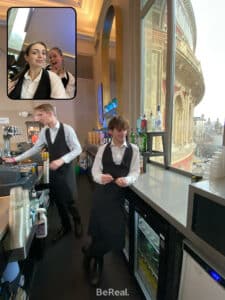
    Posing at the Royal Albert Hall during a bar shift


    6.   Tutoring English as part of the National Tutoring Programme

    Set up by the government due to the poor post-COVID literacy rates, the National Tutoring Programme sees tutors being employed across UK secondary schools, and sees my bank balance into the friendly figures. Jokes aside, this is an incredibly important role and extremely valuable experience. Not only to the students make me laugh (by asking me how many children I have) but they make me happy when I see them doing well or growing in confidence. So, if you are looking for a job, have a specialist subject you would like to teach, and extraordinarily long and slow burning fuse – this is the one for you.


    In conclusion…


    Aside from the individual job titles and intricacies of working within each industry, what I really believe is that every teenager should get involved with work. In most circumstances teens will be living at home with no rent to pay and some spare time. This is the greatest opportunity, perhaps of your lifetime, to make money, and every penny you earn is yours to spend. Virtually no tax, no subscriptions, no debt. You can work one shift a week during Sixth Form and before you know it you are booking a holiday.


    To see examples of Raphael Holt’s work visit http://freelancejournalist.com or Raphaelholtphotos on Instagram.


  • Stuart Thomson on the importance of personalising your job role

    Stuart Thomson


    Applying for a job can often be a case of matching your abilities against a prescribed job specification. But to excel in any role means moving beyond that and shaping a job in your own image.

    Job specification documents often hold totemic status. Some use them as a crutch to ‘prove’ themselves; others use them to avoid doing more than they must do. A job specification should instead be used as a starting point. The launching pad for developing the role and a career in your own image.

    The more that a role can be personalised, the better. The role will be more satisfying and, come annual reviews, it will be easier to demonstrate the added value you bring. That can mean promotions and additional money. Working to a job specification rule can be dull and repetitive.

    What would be the steps towards following a more personalised approach?

    1)    Self-assessment – consider what you do well and other areas that might need to be addressed. Being able to do the job is not enough. Pushing the boundaries need self-reflection. Set goals so that you can continuously challenge yourself.

    2)    Role-assessment – consider what the job specification does and not cover once you have been in the role for at least a few months. Actively look for gaps and consider what is possible, impossible and what could be described as aspirational. In essence, you are thinking about where the gaps are that you can push and make a difference at.

    3)    Training and development – once the self-assessment has been undertaken, think about what support might be needed. This could be training, mentoring, a period of study or other support. Some organisations will provide it but others may need to finance it themselves. Whatever the situation is, there should always a business case made.

    4)    Be creative – especially in a commercial setting, or one where you are focused on service delivery, any successful and growth-focused organisation want to be challenged. There is nothing that tops not just good ideas but a plan for delivery as well. The two should go hand-in-hand.

    5)    Find an internal friend – especially in the early days, it is always useful to know how to navigate potential internal discussions and potentially even battles. The more you can discuss this with others, the better. It should be hoped that one such person could be a line manager but some consider themselves first and others later, however disappointing that attitude is.

    6)    Have a plan of action – bring all this together in one place and be prepared to update it regularly as you develop, receive feedback and learn from the experience of others. Networking always helps as you bring the thoughts and views of others into your plan updates. Keeping good records of training, discussions and achievements should not be underestimated either. It is too easy forget all the hard work and good ideas that you develop.

    Personalisation should be about pushing the boundaries rather than waiting for them to be imposed upon you. It is about helping an employer but helping yourself as well. A more personalised role is a more enjoyable role and is ultimately empowering.

  • India’s 10-year reckoning

    Dinesh Dhamija

    Since his election as Indian Prime Minister in 2013, Narendra Modi set out a vision for his country to become a fully developed economy by 2047, the centenary of its foundation.

    Could India finally cast off its colonial burdens and achieve its undoubted potential?

    We are now a third of the way through the journey from Modi’s arrival until 2047 and the Indian population is about to cast its votes in a General Election.

    Here’s how the main economic indicators have shifted during the first decade of his tenure:

    From 2014 to 2022, India’s GDP grew by an average of 5.6 per cent in compound annual growth (CAGR) terms, compared with a CAGR of 3.8 per cent on average for 14 other large developing economies such as Brazil and Mexico.

    The percentage of Indians living in extreme poverty (earning less than $2.15 per day) has fallen from 18.7 per cent in 2015 to 12 per cent in 2021, across both urban and rural populations. Economic analysts attribute this to welfare schemes and the Aadhaar digital ID system, which has helped to target payments to the needy and cut out middlemen.

    Indians now make digital transactions worth Rs3,355 trillion per year, a 70 per cent increase on the Rs1,962 trillion in 2017-2018, much of it conducted via locally made smartphones, which 60 per cent of the population own. India’s digital transformation has helped it become the ‘back office to the world’, particularly centred on the cities of Bengaluru and Hyderabad.

    India’s middle class – defined as households with an annual income between
    $6,700 and $40,000 – has risen from 300 million in 2014 to 520 million today, while those classed as wealthy, earning above $40,000 pa, now number 90 million, up from 30 million in 2014. These changes have opened up markets for a huge diversity of consumer goods, for national and international travel, for investment and business development. They are an extremely positive sign for the future of the country.

    Infrastructure development is another big success story: more than 10,000km of roads have been constructed each year since 2018 and 1.7 per cent of GDP is devoted to transport investment, compared with 0.4 per cent of GDP in 2014. Of course, not everything is perfect. India’s unemployment figures are concerning: they exceeded 10 per cent in October 2023 and are worryingly high among young people and women. Despite government encouragement, the female labour force participation rate fell between 2014 and 2022 from 25 per cent to 24 per cent, lower than Bangladesh, Sri Lanka or Pakistan.

    Nevertheless, if the next 20 years see as much progress and economic growth as the past 10, there is every chance that Modi’s vision for the country will be realised.


    Dinesh Dhamija founded, built and sold online travel agency ebookers, before serving as a Member of the European Parliament. His latest book, The Indian Century, will be out soon.


  • Paul Joyce on Mr Bates v The Post Office

    With over 50 years as a director of stage and screen, our Media, TV and Film Correspondent, Paul Joyce, casts his director’s gaze over ITV’s recent drama, Mr Bates vs The Post Office, and ponders on television’s ability to influence public opinion…

    I have taken a personal interest in Toby Jones’ career since we met, only the once and an occasion he will certainly not recall as he was only nine months old and fast asleep for the duration of my visit. His father, the legendary character actor Freddie Jones, had invited me to his London flat to discuss appearing in my first ever film, a totally illegal and unauthorised adaptation of a short theatre piece by Samuel Beckett (Act Without Words). For reasons which still escape me, Freddie had agreed to star in the film, which we were about to shoot on a rubbish tip in Rainham, Essex. After our meeting, which we in the profession would call a ‘script conference,’ even though there was to be no dialogue in the film, he beckoned me into the bedroom to inspect the young Toby, a chubby-faced baby looking much like he does now (with about the same amount of hair). Since then I have watched his career flower from the male equivalent of a young ingenue to his current crop of youthful old men.

    The recent acclaimed ITV Production of Mr Bates vs The Post Office in which Toby plays the eponymous lead, led me to speculate on the power of television and film to concentrate public opinion on real events which for many diverse reasons may have been ignored, or as in this case, swept under the carpet. Over three nights the writer took us across a total of eight cases involving death, dishonour, and most frighteningly, disbelief. Within 48 hours of the final part being transmitted, questions were asked in the House of Commons, prompting a rapid statement from our Prime Minister which indicated he agreed that the CBE given and firmly accepted by the ex-Post Office head, Paula Vennell, should be summarily torn from her grasp (she has now relinquished it).

    I have seen Toby portray, in varying shades of genius, Alfred Hitchcock, Truman Capote, Claudius Templesmith in The Hunger Games, and most impressive of all (for me at least) the lead of Gilderoy in Berberian Sound Studio, the latter being an idiosyncratic masterpiece. On TV he inhabited his role in the magnificent Detectorists with depths of feeling and emotion well beyond the ken of most sitcoms. But here, in Mr Bates he was asked to take on perhaps the most challenging role of all, to play an entirely ordinary, and frankly, one hundred percent boring man.

    And there to prove my point in countless interview was the real Mr Bates, economical of wordage, apparently unmoved by twenty-three years or so of battling variegated authorities, lawyers, committees, corporations, the Post Office and the manufacturer of the flawed software at the very heart of the story, Fujitsu themselves. And all without a trace of what Toby can bring to the table in spades: humour. So even though I have worked with and directed many great actors after Freddie Jones (Paul Scofield, Dirk Bogarde, Max Wall, John Hurt, David Warner, Prunella Scales, etc) I am left frankly bemused by his performance. Was he here at the peak of his powers, or just walking though it? Watching the real Mr Bates himself walking his way through countless interviews, answering the same questions again and again, it finally dawned on me that Toby’s performance had me truly fooled; for there in front of me in all his well-deserved glory, stood a man of honour, and as plain and boring as the day is long. In my opinion a BAFTA winning portrayal, without a doubt.

    For me, at least, television came of age as a serious medium in 1966 with the ground-breaking documentary-drama Cathy Come Home, marking Ken Loach’s entry into the path of directorial greats. Focusing on a young couple, the film pursues a trajectory where the outcome is indeed tragic, but the results of the film’s transmission on national TV was nothing short of sensational. The film follows Cathy and Reg as they seek to establish both a working relationship, and then a family in the face of indifference, hostility and finally, gut-wrenching cruelty on the part of the state. Unable to find or afford accommodation, they become basically stateless, abandoned by an indifferent establishment, despite the fact that not so long before a British Prime Minister had declared, “You have never had it so good!” A public outcry followed the initial screening and the quickly-scheduled repeat. Just months afterwards, the charity Crisis was established, bringing hope, compassion and practical help to thousands of people who, like Cathy, had lost friends, family and their children as a result of having no real place to go. Suddenly, television was not just a black and white box in the corner spewing out Match of the Day and Coronation Street. It had truly thrust itself into the modern age.

    At the same time the BBC were trying to deal with the ramifications of Cathy, they were presented with another problem, again entirely of their own making. One of their legendary staffers was a commissioning editor named Huw Wheldon who had virtually single-handedly brought the BBC into today’s world in terms of contemporary coverage of all the arts. He also had a great ability to find new and talented directors, such as Ken Russell, and especially the hero of this next tale, Peter Watkins. Watkins then was a no-holds-barred basically unstoppable TV auteur (before that phrase had even been invented) who seemed not to need sleep or even food in the pursuit of a filmic vision which time and lack of resources did not in any respect dim. He had just made an astonishing drama-documentary called Colloden, dealing with the flight of Bonnie Prince Charlie and the subsequent bloody battle, followed by his five-month scramble to keep ahead of the English forces before legging it to France. It should have been clear to the BBC, given Watkin’s portrayal of the British Establishment and especially the army, that here was a pure Republican by nature and once let loose in the BBC would undoubtedly wreak havoc in all departments.

    And this is precisely what happened. His depiction of the results of a nuclear attack in Britain was instantly impounded and banned by the BBC. This despite the fact that the Campaign for Nuclear Disarmament had only recently been formed and was already a powerful lobby, even within the Establishment itself (the philosopher Bertrand Russell was a founder member). The difficulty of even obtaining pirate versions raised the film immediately to legendary status, and although the BFI were reluctantly allowed a single screening some years later, it was over 20 years before the BBC relented and permitted its transmission. I think it would be fair to say that this film changed the nature and direction of the nuclear disarmament movement forever. Without even realising it, the BBC had taken one more step towards maturity and now, in all practical terms, had earned the keys to the front door. But to whom should they hand them?

    No ideas? Well, I have. One David Rose, a BBC stalwart who went on to found ‘Film on 4’ at Channel 4 and subsequently commission 150 films of international renown, including work from such directors as Andrei Tarkovsky and Wim Wenders. When the opening for Controller of British Regional Television presented itself to him, he grabbed it with both hands and set up his offices at Pebble Mill, Birmingham, which was to become a byword for innovative TV dramas. His earlier time at the BBC giving birth to, amongst others, Z Cars, gave him the currency to directly commission hard-hitting contemporary dramas, which he did almost immediately, establishing ‘The Mill’ as THE place to work and, at the famous bar, to be seen. There he nurtured such talents as David Hare (Licking Hitler) and Mike Leigh (Abigail’s Party) and was reprimanded for commissioning Ian McEwen’s Solid Geometry in which a pickled penis, once unstoppered, became the focus of a philosophical debate (production cancelled). In the meantime, a Play for Today slipped through almost unnoticed by a newish writer, Alan Bleasdale. Not much attention was wasted on a tale of half a dozen northern unemployables who slapped down tarmac road coatings with little thought about the longevity of their work. However, Rose saw the potential in developing the film into a five-part series, one episode concentrating on each character, which he duly commissioned and the ‘Yosser’ episode went, as they say today, viral.

    Boys from the Blackstuff came at a time when there was still a Royale Family type sense of occasion (frequently nightly) of communal TV watching, which now might be referred to as ‘binging.’ Almost immediately, Josser’s catchphrases, “Gizza’ job!” (translation: “give us a job”) and “I can do that!” became bywords and are now bedded into our contemporary English language. In 1982 on its first transmission, it was immediately re-scheduled for a repeat only nine weeks later, and in 2000 was placed seventh in the best TV programmes of the 20th Century. By concentrating on one character in each episode, Bleasdale was able to fully explore the themes of emotional and mental insecurity in an uncaring and acquisitive society where unemployment and deprivation were watchwords for most of those living north of Watford.

    The writer Dennis Potter once referred to television as the means a nation talks to itself, but here it was a single programme which did so, and which many saw as a critique of Margaret Thatcher, whereas in fact the scripts were mostly written before she became PM. In the decade before its transmission in 1982, 80,000 people had lost their jobs in the story’s setting, Liverpool, and redundancy there had reached 25%. In an economic climate which the then Chancellor, Geoffrey Howe, described as a “managed decline,” i.e the wrecking of trade unions and vandalising the public purse, Thatcher’s great ally, Norman Tebbit, described the films as “defeatist.” Well, it was not to be long before the Tory’s themselves were defeated, heralding an unprecedented time for Labour to remain in office. Thus, these are some of the destinations reached when a nation engages in a dialogue with itself.

    Before leaving this somewhat sketchy survey of key moments in TV drama history, I feel The Crown cannot go unmentioned. A series which well outlasted the very Queen who figured in most episodes, it has finally announced its imminent closure with many royal threads still wafting about in the breeze. Harry, Megan, Andrew? A great series which started as compulsive viewing and then (for me at least) morphed into a box of Quality Street into which one could occasionally dip a restless hand, or even eye. But I would not be without these decades old reminders that one’s ordinary life is really not that bad at all; at least when compared with the ex-owner of Harrods or the prince who inhabits a rabbit hutch on his brother’s estate. If you really want to understand levelling up, just press the button, and don’t forget to record and wipe interruptions, or simply pay more and cancel the ads.

    Mr Bates vs The Post Office is available to stream on ITVX. 

    The author, Paul Joyce, is a director, photographer and artist, with over 50 years in film and television. For more information, visit his website.

  • Dinesh Dhamija: Storm in a Beauty Spot

    Dinesh Dhamija

    It was hardly the worst provocation in the world: Indian Prime Minister Narendra Modi sitting in a chair on a sandy beach, saying how much he enjoyed his morning stroll. Yet within moments, it had sparked an international incident recalling the Bay of Pigs.

    To summarise: some Maldivian politicians took exception to Modi’s tourist snap and made rude comments about him and about Indians in general. The Maldives’ recently elected president, Mohamed Muizzu, suspended them. Indian celebrities pledged to boycott the Maldives and one major travel agent stopped booking trips to the archipelago. The chances are that the spat will blow over as quickly as a mid-afternoon tropical shower, but it illustrates a few interesting trends.

    The first is that Indian Ocean countries feel they need to push back against the country’s growing regional influence. For the Maldives, this means playing India off against China, with new president Muizzu openly campaigning on an anti-India ticket and agitating for greater independence from its huge northern neighbour. At the same time, since 25 per cent of the Maldives’ economy ($3 billion) relies upon tourism, and since Indians make up the largest part of that, he can’t afford to alienate their visitors. Hence slapping down his own party members.

    Modi, for his part, is an unashamed nationalist and will always promote Indian assets, including tourism destinations, whenever possible. And why not? The fact that the Lakshadweep islands receive just 10,000 visitors a year compared with 1.7 million to the Maldives makes the debate symbolic rather than economic. The overall Indian tourism industry is forecast to exceed $23 billion in 2024 and reach almost $35 billion within five years. With this level of growth, the Maldives can look forward to boom times for years to come, whether or not the Lakshadweep islands throw up a few five-star resorts. Indians venturing overseas enjoy Mauritius, Thailand and Dubai, but the Maldives is closer, more relaxing and the food is typically fantastic.

    The geopolitical trend is more serious and concerning, since China has become more belligerent, in the South China Sea and elsewhere, challenging India on its own borders and in relation to Pakistan. If President Muizzu were to invite the Chinese military into the Maldives, that could change the whole diplomatic balance of the Indian Ocean. Visitors to the Maldives are struck by the tranquillity and beauty of the islands, by the fabulous marine life which swirls beneath resort verandas and the gentle, welcoming nature of the local population. Somehow, these paradise-like islands also manage to harbour simmering tensions which occasionally erupt into violence, thanks to high unemployment and a widespread drugs culture. Hindu-Muslim divisions have widened in recent years, giving some Maldivians a reason to oppose Indian influence.


    Portraits of Dinesh Dhamija for Finito. 7.6.2023 Photographer Sam Pearce

    Dinesh Dhamija founded, built and sold online travel agency ebookers, before serving as a Member of the European Parliament. His latest book, The Indian Century, will be out soon.


  • Modi’s election momentum

    Dinesh Dhamija


    Almost a decade has passed since Narendra Modi became Indian Prime Minister in 2014, yet he is still setting records for electoral popularity. Barring a catastrophe, he appears certain to win next year’s general election for a third five-year term.

    Just a few days ago, his Bharatiya Janata Party (BJP) won three out of four contested state elections, taking both Rajasthan and Chhattisgarh in the north of India from Congress and maintaining hold of Madhya Pradesh for an unprecedented fifth term. Only the recently formed southern state of Telangala voted for Congress.

    The arithmetic of Modi’s dominance is striking. Prior to the recent votes, the BJP and its allies-controlled states representing 45 per cent of the Indian population. Now they control 16 out of 29 states, equal to 60 per cent of the population. No Congress chief minister has been re-elected since 2014.

    Although state and national votes are fought on different criteria, Modi enjoys such widespread support – and the BJP campaigned this time explicitly on his record – that he should sail through the ballot next May.

    What explains this lengthy run? One factor is Modi’s appeal to women. They turn out in huge numbers to vote for the BJP, thanks to policies such as the Swachh Bharat (‘clean India’) mission to improve sanitation. This has improved not only standards of hygiene across India but security for women and girls. A welfare system that delivers benefits directly to women, rather than via their husbands, is equally valued.

    These days, an increasing number of women vote for the BJP even when their husbands vote for Congress – a novel sign of independence.

    In the recent elections, Modi doubled down on policies designed to win the female vote, promising 5kg of free grain per month to 800 million people. Having boosted India’s economy, projected the country’s power overseas, his personal modesty and devotion to Hinduism is a potent asset for the BJP to which Congress appears to have no answer.

    Modi’s argument that a vote for BJP would give them a ‘double engine’ of local and national representation has persuaded many former Congress supporters to switch sides. When they see the bounties disbursed to Modi’s home city of Ahmadabad in Gujarat or his constituency in Varanasi, they want a piece of the same pie.

    Congress is at a loss to know where to go next. The latest results were “deeply shocking,” said a spokeswoman. The old aura of the Gandhi-Nehru dynasty has worn thin, after decades of economic under-performance.

    There remain plenty of challenges, not least chronic unemployment, and under-investment in India’s manufacturing sector. But on the basis of his record so far, I think Modi richly deserves to win another term.

    As I write in my latest book The Indian Century, thanks to Modi: “In international affairs, India is no longer shy or cowed by other nations. It speaks with confidence and authority and acts with the country’s own interests at heart.”

    Dinesh Dhamija founded, built and sold online travel agency ebookers, before serving as a Member of the European Parliament. His latest book, The Indian Century, will be out soon.


  • The Flaws in the UK’s January 31st Tax Deadline: a Call for Reform

    Finito World

    The United Kingdom’s tax system is a complex web of regulations and deadlines, with one date looming large on the calendar for millions of taxpayers: January 31st. Every year millions of households finish their Christmas lunch with the dark suspicion that the expenditure they just made on Christmas was perhaps a little optimistic. Then January rolls round, and the true nature of the situation reveals itself.

    Tax obligations are, of course, an essential part of maintaining a functioning society: nothing is certain in this life but death and taxes, as Benjamin Franklin put it, though he never had to be on hold to HMRC and so had sufficient restraint about the matter to utter a pithy maxim.

    Every January, one finds oneself wondering about the insistence on a single deadline for self-assessment tax returns. It raises serious questions about practicality and fairness. Is a more nuanced and taxpayer-friendly approach not possible, one wonders, as one logs on to one’s self-assessment page, realises that one has forgotten one’s password.

    The problems of the system are clear. In the first place, it causes unnecessary stress on taxpayers, especially those who may have complex financial situations. With the pressure of the holiday season just behind us, expecting individuals to meticulously gather and report financial information during what is traditionally a festive time seems impractical. This timing adds unnecessary stress to an already hectic period. Furthermore, it means that December – the month of maximum household expenditure – is followed by financial stress. in an age where mental health is a buzzword it is rather out of keeping with current priorities.

    Secondly, the strain of the deadline means people rush to report and therefore often report inaccurately. Taxpayers may be tempted to hastily compile their financial data, potentially leading to errors, omissions, or oversights. A more reasonable deadline spread across the year could encourage individuals to take the time needed for thorough and accurate reporting.

    Thirdly, January is also the time when people’s health is usually at its most precarious. Life is unpredictable, and circumstances such as illness, family emergencies, or unexpected events can disrupt even the best-laid plans. The inflexibility of the January 31st deadline offers little room for those facing unforeseen challenges. A more flexible deadline system, perhaps with staggered dates, would better accommodate individual needs and challenges.

    Fourthly, if you have any sort of problem, then try getting hold of HMRC.The concentration of tax returns around the January deadline puts a strain on HM Revenue & Customs (HMRC) resources. The influx of returns in a short period creates a bottleneck, potentially leading to delays, errors in processing, and increased stress on both taxpayers and tax authorities. A staggered deadline system could distribute the workload more evenly throughout the year.

    Finally, the current system limits taxpayers’ ability to engage in effective tax planning. With the tax year ending in April, individuals have only a few months to assess their financial situation and make adjustments. A more dynamic approach to deadlines could allow for periodic assessments, enabling better-informed decisions and potentially reducing tax liabilities.

    It’s time to reconsider the current system and work towards a more taxpayer-friendly and fair approach to meeting our fiscal obligations.

  • India’s Prospects for 2024

    Dinesh Dhamija

    We’re almost a quarter through the 21st century and the predictions of Jeff Bezos and others that this would be “India’s Century” are well on their way to fruition.

    What should we be looking out for in 2024, as the country exerts its ever more powerful economic and political muscles? Here are my top seven predictions:

    Major announcements from global corporates

    We’ve seen global manufacturers like Apple increase their operations in India over recent years. I predict there will be an acceleration of these deals: Apple itself wants to make 25 per cent of its iPhones in India by 2025, so watch out for multi-billion-dollar investments.


    India takes diplomatic centre stage

    Russia’s invasion of Ukraine, the stand-off between China and the United States, conflict in the Middle East… these are all disputes between polarised adversaries which a calm, neutral moderator can help to resolve. India is increasingly seen as a trusted mediator in global affairs and will accentuate this role in 2024 I believe.


    New Indian sporting heroes

    As the Indian population gains more leisure time, we’ll see more examples of world-class sporting performance. For example, 17-year-old Dommaraju Gukesh from Chennai became the second-youngest chess Grandmaster when he was 12 years old and has already defeated world number one Magnus Carlson. I predict that India will win more medals at the Paris Olympics this summer than ever before.


    India will host the 2036 Olympics

    There have been years of behind-the-scenes lobbying for India to host the 2036 Olympics, probably in Delhi. I predict that there will be an announcement in 2024 as Narendra Modi brings the greatest festival of international sport to the country for the first time, just as China won the 2008 games in recognition of its rising global status.


    UPI will gain international acceptance

    The Unified Payments Interface (UPI) which has helped to transform the Indian economy, reducing payment costs and corruption, will reach broad international acceptance in 2024, helping to bring ever more populations out of poverty and strengthen global cooperation. It is another great example of Indian leadership in technology and development.


    Political continuity

    As far as there is a sure thing in politics, Narendra Modi is sure to regain the Prime Ministership in this year’s Indian General Election, reassuring the markets and investors that they can plan for the future with confidence. I expect to see an upsurge in economic activity following the election as people make their bets on the next five years.


    India’s GDP could overtake Germany’s

    On current projections, India’s GDP will reach $4 trillion sometime in 2024 and could pass that of Germany (currently $4.4 trillion) and Japan ($4.2 trillion) by the end of the year to attain third spot globally. This would have profound implications for the world economy and encourage yet more investment into the country.


    Happy New Year!


    Dinesh Dhamija founded, built and sold online travel agency ebookers, before serving as a Member of the European Parliament. His latest book, The Indian Century, will be out soon.