Author: admin

  • Dinesh Dhamija: Watch Out for a Moroccan HUV

    Dinesh Dhamija


    Not sure what a Moroccan HUV is? Let me explain.

    An HUV is a hydrogen utility vehicle – like an SUV but powered by hydrogen. There aren’t many around right now – some in China, plus a few thousand Toyota Mirai models – but soon there could be tens of thousands on our roads.

    Morocco? That’s the unlikely manufacturing location for one of the most promising HUV companies. For a deposit of €1,000, you can pre-order a NamX HUV: either the 300 horsepower GT model costing €75,000 or the 500-horsepower GTH costing €95,000, made in Morocco for delivery by the end of 2026.

    NamX stands for New Automotive and Mobility Exploration, says its founder, Moroccan entrepreneur Foauzi Annajah, who has French business partners. He hired legendary Italian car designers Pininfarina to create the look.

    The project fits well with the EU’s ReFuel programme, which aims to make green hydrogen the cornerstone of Europe’s decarbonisation drive. Morocco, meanwhile, has become a surprise winner in African automotive manufacturing, turning out almost half a million cars per year. Besides NamX, there are plans for Africa’s first EV battery gigafactory in the country, with investment from Chinese-German company Gotion High-Tech.

    NamX originally wanted to use fuel cells, like most electric vehicles. But in 2023 it went instead for internal combustion engines, powered by hydrogen.

    It blamed the volatility of rare earth metals needed in fuel cells, whereas the “proven and time-tested technology [of combustion engines] has benefited from decades of investment and continuous enhancements,” said the company.

    On the other hand, as motoring journalist Leigh Collins pointed out, combustion engines use just 20-40 per cent of the energy in their fuel, compared with 40-60 per cent in fuel cells. So NamX drivers will need to buy more hydrogen per km than those in fuel cell models. That could be a dealbreaker for some. The price of hydrogen has jumped in recent months, meaning that some H2-powered vehicles cost 10 times more to run than a Tesla.

    Where NamX has an edge is range and refuelling. Its cars can travel for 800km. Then their hydrogen capsules are slipped out and replaced in seconds. Customers will get new capsules delivered to their homes. It is also super quick (0-60 in four seconds) and a stunningly beautiful design, which you might expect from Pininfarina, the creative team behind So if you want to drive far and fast in a zero-carbon car with the looks of a supermodel, this could be the Moroccan HUV for you.


    Dinesh Dhamija founded, built and sold online travel agency ebookers.com, before serving as a Member of the European Parliament.  Since then, he has created the largest solar PV and hydrogen businesses in Romania. Dinesh’s latest book is The Indian Century – buy it from Amazon at https://www.amazon.co.uk/dp/1738441407


  • Lumos Education CEO Johanna Mitchell on the women changing the face of conservation

    Johanna Mitchell

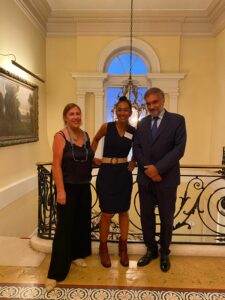
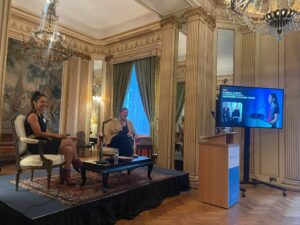
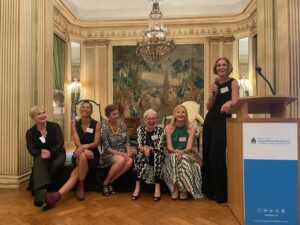
    Lumos Education was delighted to be invited to sponsor Women Powering Smart Energy’s conversation event at the Argentine Ambassador’s Residence. The evening, co-ordinated by Steve Gladman of Women Powering Smart Energy, highlighted the relationship between gender and conservation.

    The Dalai Lama has said that the western woman will save the world.  The women changemakers who spoke at the Ambassador’s Residence in September embody his prediction.  Their dynamism and steadfast commitment to preserving the environment and wildlife makes them a true beacon of hope in the sphere of conservation.


    Only a Child


    The Ambassador for Argentina in the UK, his Excellency Javier Esteban Figueroa, launched the evening.  I introduced the film, Only a Child, which was produced by Simone Giampaolo and narrated by the then 12 year old girl, Severn Cullis-Suzuki in 1992. The message, from this young child’s perspective, is that governments and communities need to act now to affect lasting change. Her compelling young voice states eloquently that ‘northern countries will not share with the needy, even when we have more than enough, we are afraid to share, we are afraid to let go of some of our wealth.’  Severn declares: ‘you grown- ups say you love us, but, I challenge you, make your actions reflect your words.’  At the end of the film, Severn, now a Canada- based environmental activist, is pictured, over 30 years after her words, as an adult with her own children. The time that has elapsed between Severn’s childhood and her growing into adulthood and raising her own family, demonstrates powerfully how much-needed changes to halt the environmental breakdown have been slow to manifest.


    Dr Micaela Camino


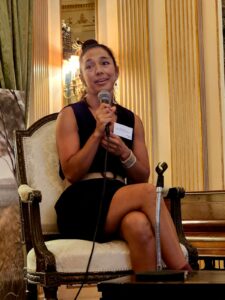
    The audience enjoyed the rich conversation between award-winning conservationist, Dr Mica Camino and the Cultural Attaché to the Argentine Embassy in London, Minister Alessandra Viaggiero.  Their discussion focused on the importance of engaging with indigenous communities, who live close to nature and depend on the local food, structure and wildlife for their own survival.  And for the continued survival of their children.  Mica spoke about the importance of understanding that, in conservation, the environment and people can’t be separated.  The two are inextricably linked.

    Dr Micaela Camino


    Mica is a committed conservationist on a mission to empower communities, defend their human rights and to preserve the fragile ecosystem of Argentina’s Dry Chaco.  Nestled in Northern Argentina, this expansive forest teams with both indigenous communities and critically endangered species, notably the Chacoan peccary.  However, the relentless advance of agricultural development threatens not only the habitat but also the very livelihoods and cultural heritage of the local people.  Mica is the recipient of the Whitley Fund for Nature (Green Oscar) 2022 for her research work to defend the Dry Chaco forest.  As a Researcher of the National Scientific and Technical Research Council of Argentina at the Conservation Biology Laboratory of Centre for Applied Ecology of the Coast and Founder and Director of Proyecto Quimilero, Mica juggles her career with mothering her young son.  Her tireless efforts exemplify the power of grassroots action and the potential for positive change even in the face of daunting challenges.


    Mary Rice 


    Following Mica’s incredible achievements, the audience listened to Mary Rice’s equally impressive contribution to the environment.  In conversation with Aisling Ryan, herself a committed conservationist, Mary described her role in bringing about the global ivory ban.  She spoke about her negotiations with governments and key players to enforce action or legislative change, often in extremely demanding political and social circumstances.  Mary and Aisling reminisced about their attendance at Kenya’s historic ivory burn in Nairobi.  Both thinking that they would stay in an hotel but, in reality, Mary camping knee-deep in mud wearing a pair of child’s pink wellies, whilst grappling with streaming the ivory burn live to the international community.

    Mary Rice


    As Executive Director of the Environmental Investigation Agency (EIA), Mary Rice’s accomplishments are simply colossal.   In addition to directing the EIA’s work on the illegal ivory trade and attending major international meetings related to the subject, Mary acts as a spokesperson and presents on the issue. Working with investigative and analytical teams to obtain the data and evidence required to support and facilitate enforcement action or legislative change, she liaises closely with stakeholders worldwide to ensure an innovative and strategic approach to what is a dynamic and global problem.

    Trained as a journalist, Mary spent 15 years working in Asia before moving to London.  She is also a  published author and photographer. “Heat, Dust and Dreams”(Struik), an exploration of people and environment in Namibia’s Kaokoland and Damaraland, was the result of three years of research and photography in what is now known as the Kunene region, home to the last viable population of black rhino outside a protected area. And one of the world’s last great wildernesses.

    Aisling Ryan


    Leading Conservationist, Climate and Sustainability Leader, Aisling, led the campaign to stop the ivory trade alongside Mary Rice. This campaign resulted in four UN resolutions and bans in China, Hong Kong, the UK, US, Canada and France   She has collaborated with the Kenyan government, EIA, WildAid, ZSL and other key NGOs. She also negotiated a pro-bono partnership with WPP to create a mass lobby campaign and with Kantar to deliver pivotal research to prove public support to ban the ivory trade. She has worked with Conservation South Luangwa (CSL) in Zambia since 2014 and continues to serve as Non-Executive Director and Trustee.

    Recognised for her contribution to sustainability and ESG, Aisling is a recipient of many awards, including the UN SDG Impact Award, Gold Cannes Lions, D&AD Pencils, the Grand Prix at The Marketing Society Effectiveness and the Campaign Big Awards. She was also acknowledged for her valued contribution to DE&I on the 2019 and 2021 HERoes INvolve Women Role Model Awards Global 100 List of Senior Executives.  Aisling pioneered the People’s Seat for the United Nations. She also drove negotiation and partnership between Sir David Attenborough, UNHQ, UNFCCC and Poland and wrote his speech for COP24.


    Millie Kerr


    Following Aisling’s discussion with Mary, Millie Kerr, US lawyer turned conservationist, author and wildlife photographer, spoke with Aisling Ryan about her distinguished career, marked by a resolute dedication to the cause of environmental preservation.

    In conversation with Aisling, Millie explained how her grandparents’ ranch had been a key influence in her childhood and served to cultivate an early love of wildlife and devotion to conservation.  Weekends and holidays were spent with the animals on their property, which included scimitar-horned oryx, rheas, zebras and other foreign species which they began introducing in the 1970s.

    Millie Kerr

    After working for a prominent London international law firm, her career trajectory took an unexpected turn during a sabbatical to Namibia, where she undertook a role at a wildlife conservancy. This experience kindled her passion for documenting and advocating for wildlife and nature conservation. On returning to the United States, a brief stint at the Federal Communications Commission preceded her relocation to New York City, where she continued to write while employed by the Wildlife Conservation Society/Bronx Zoo.

    Asked by Aisling how she would advise Londoners looking to make a difference, she suggested a rewilding a small garden, emphasising that even with the shortages of outdoor space in London, this is perfectly possible and incredibly rewarding.

    Based in London, Millie is a freelance multimedia journalist. Her writing on travel and wildlife conservation has been featured National Geographic Traveller, The New York Times, and The Wall Street Journal.  Millie’s debut nonfiction book, “Wilder: How Rewilding is Transforming Conservation and Changing the World,” published by Bloomsbury in August 2022, enjoys acclaim and endorsement from celebrated conservationist Jane Goodall. This volume, characterised as a fusion of popular science and memoir, surveys rewilding projects worldwide, highlighting the individuals defining the evolution of conservation.

    Professor Genoveva Esteban

    Distinguished academic, Professor Genoveva Esteban (Bournemouth University, UK), specialises in microorganisms in fresh water and marine environments.  Having completed her PhD in Spain, Genoveva came to the UK as a postdoctoral student and has worked here even since.   She has juggled her research and conservation work, with her family commitments.   During her career, Genoveva has pioneered ground-breaking research into the diversity of free-living microorganisms to help us to better understand ecosystems.  She explains how, as some microorganisms eat bacteria, they benefit the environment.  And as foundations of the food chain, microorganisms help to conserve the environment, essentially safeguarding bigger animals by protecting the little ones.

    Dr Genoveva Esteban


    Genoveva agrees that there is a gender imbalance in the way that men seem to be seen as more credible, in the world of conservation, but she says things are starting to change.  She is currently looking to develop a project, with fellow academics in the UK and on mainland Europe, to see how the different freshwater environments and habitats can be connected.  This project is about habitat connectivity in a fragmented world.

    Genoveva has infused the younger generation with her passion and knowledge.  Her students around the globe, including in Poland the US and Spain, are continuing Genoveva’s work in their own labs.  She says that, in her experience, the younger generation want to use science to help conserve the environment because they know that the planet is under threat.  They are interested in understanding how science works and how to use the scientific knowledge they have gleaned encourage conservation.  As well as working with students at her university, Genoveva also works with children in her local community to promote STEM subjects.  She runs science family days at her local museum to promote science and the importance of cherishing the environment.

    As well as encouraging and inspiring the next generation, Genoveva’s has built and nurtured deep and lasting partnerships with colleagues from Government departments, research centres and wildlife trusts.  She sends 15 students every year on a work experience placement to work with researchers in those institutions.

    The depth and richness of the contribution that these women have made to the environment and conservation is simply extraordinary.   In a world that, with the pace of environmental damage, and inability of governments to take urgent action, often seems hopeless, these women offered hope.  I know I, and all of my Lumos Education colleagues and partners who attended, poured out into the London evening feeling inspired, humbled and hopeful.

    Ronel Lehmann, of Finito Education, recently told me that a many of his young university leavers are keen to follow careers in the fields of conservation and the environment.

    Micaela Camino, Mary Rice, Millie Kerr, Aisling Ryan and Genoveva Estaban are blazing a trail for young women- and men- to follow.


    Johanna Mitchell is the Founder and Director at Lumos Education

  • The Poet at Work I: Tishani Doshi

    The Poet at Work I: Tishani Doshi

    As the government seemingly reduces the importance of poetry on the national curriculum, by making its study optional at the GCSE level, Finito World is introducing this regular series aimed at illustrating the utility of poetry, and examining the relationship between literature and the workplace. Poets are asked to produce a poem which speaks to what our first featured poet, Tishani Doshi, calls ‘ideas of work, leisure, community, labour, decoration, and poetry and the space we create for it all. ‘ After we produce the poem, we then give the reader a Q & A touching on the life of the poet and their relationship with work.


    Tishani Doshi is a poet and novelist born in what was then Madras in 1975. She has built an international reputation on the back of her poetry and novels – for which she has won many awards, including the Eric Gregory Award and the Forward Prize for Best First Collection. Her novels have also been critically acclaimed. Her most recent Small Days and Nights has been shortlisted for the Tata Best Fiction Award 2019 and the RSL Ondaatje Prize 2020.


    In ‘Postcard from Work’ readers will immediately be relieved by the exotic colours – ‘the yellow trumpet flowers’ and the ‘sunbirds…diving in and out of this den of gold.’ It is a poem which begins in a blaze of light. It is a piece ostensibly about work, but where little work is done – except the perhaps more vital work of paying tribute to the natural world, and mulling our place in it. Sometimes the best we have to offer our masters is to take a mental holiday from the tasks they have set us to do.


    Doshi knows that we were not born only to consider ‘the price of milk’ but to find ways of being which let death know we mean to ‘hold on.’ Work has to be done – and someone has to do it, and that will mean taking a break from dreaming. Doshi zooms out to show us what tasks lie unfinished around the narrator: we might be in a seamstress’ (‘someone else will tend the hem’) or even at a vet (‘someone else will pry open the dog’s jaw’). All our leisure, the moments we snatch, must be supported by drudgery elsewhere. Doshi also makes her living as a dancer, and her poems always have something of dance about them – they are miracles of rhythm and movement, and full of a joy which does what poetry should do: her poems are the antidote we didn’t know we needed until they came our way.


    Postcard from Work 


    Forgive me, I have been busy 

    with the yellow trumpet flowers.

    They dance uselessly, slivers

    of rapture. I know the dishes

    need washing but the sunbirds

    are diving in and out of this den

    of gold. Their dark purple wings

    are soft nets, intimate with the leaves.

    Beaks poised to receive nectar. There are 

    days I neglect my beard. I grow tired 

    of digging. I imagine someone else

    will tend the hem, the torn sleeve.

    Someone else will pry open 

    the dog’s jaw for his evening pill. 

    Our throats are in constant need

    of shelter.


    I’ve sublet a room   

    to a poet who does not know 

    the price of milk but is ready 

    to lay down her spear and surgical

    instruments, to worship the roots

    of this labyrinth. If there is rain

    and soil, onions will grow. After 

    a day in the field, the poet and I 

    sit around a fire to sing. It is a way 

    of letting death know we mean to hold

    on. The threshold stays warm. We flick

    at night with a fly-brush, cheat insects

    of their audience with a chorus 

    resurrected from silence. Think 

    of the performance of this lament

    as our hunger, of the armchair

    in the corner, our repose. 

    Underneath, is a footstool 

    that hides.


    What is the interplay in your life between dance and poetry? Is it an entirely fruitful one or can it be said to be in any way antagonistic?


    Poetry came first, but in a way, poetry only came into being once I had dance. They’ve never been antagonistic, unless you count yearning for one, while you’re engaged in the other? But that feels such a natural way of being in the world. Both require a kind of vulnerability and strength – the making of your own vocabulary. When I’m in a lazy mode, which is my most natural way of being, I wonder at both the worlds of poetry and dance, the capabilities we don’t imagine for ourselves. 


    How do you find the business side of your writing life? Many writers I know struggle with invoices/tax/the admin of it all? But then I think that can also be a cliché and many writers be surprisingly scrappy and hard-headed?


    I studied business administration and communications before ditching it for poetry, so I can get around economics and accountancy alright, but that’s not to say I thrill in it. I move in waves. Sometimes I’m terribly productive about everything – to-do lists and all. Other times I want to be left alone to watch the flowers. 


    The UK government has recently said that poetry should be optional at the GCSE level – a significant demotion in its importance on the curriculum. What is your view on that and what do you feel the impact will be?


    One of my first jobs was to teach an introduction to poetry and fiction class to students at Johns Hopkins University. It was a required class, most of my students were pre-med or engineering. I like to think as a result that in future dentist waiting rooms, there may be a volume of Elizabeth Bishop lying around, or that someone designing a bridge might dip into the poems of Imtiaz Dharker for inspiration. I don’t know what the UK government’s motivations for demoting poetry are, but I hope usefulness was not a factor. Everything is connected. I can’t imagine any kind of life that doesn’t need the intuition and imagination of poetry.


    What sort of role does poetry have in India – does the government encourage it sufficiently or is there tension in your country also on that score?


    Well, our current prime minister unfortunately published a volume of poems, called A Journey.  Historically, tyrants have had a thing for poetry (see Mao, Nero, Stalin, Mussolini Bin Laden), which gives poetry a bad rep. Poetry as I remember it in school was rather fossilized and distant. I think at the college level, there have been serious efforts to rejuvenate and decolonize the syllabus. In schools, I fear they may still be standing up in front of classrooms with hands clasped, reciting “charge of the light brigade.”  


    Was there a particular teacher when you were younger who turned you onto poetry?


    Yes. Her name was Cathy Smith Bowers. I took one of her classes as an undergraduate in college, and it changed my life. 


    What’s your favourite poem about the workplace?


    I read this as a work poem, because I love my work, and my work is poetry.


    Love is a Place by EE Cummings 


    love is a place
    & through this place of
    love move
    (with brightness of peace)
    all places

    yes is a world
    & in this world of
    yes live
    (skilfully curled)
    all worlds

  • Meredith Taylor reviews E.1027 – Eileen Gray and the House by the Sea

    Meredith Taylor

    Eileen Gray (1878-1976) was a creative genius and the first woman to conquer the world of architecture at a time when men controlled it all. This new film reflects on Gray’s impressive career and her stunning modernist house on the Cote d’Azur and will appeal to cineastes and lovers of art and design alike.

    Unfolding as a stylish hybrid documentary E.1027 is a filmic journey into the emotional world of Eileen Gray, who was born into a large family in County Wexford, Ireland before moving to London where, after being presented as a debutante, she studied Fine Arts at the Slade and was later drawn to furniture design and architecture although her career languished in the shadows at a time when the profession was dominated by men.

    In the 1920s women architects found themselves confined to designing interiors and Gray broke the mould by moving to the South of France where she found a plot of land on the water’s edge in Roquebrune – Cap Martin and fulfilled her dream of having a modernist house on the Riviera.  A self-confessed bi-sexual she lived there with her younger lover, the editor-in-chief of the journal ‘Architecture Vivante’ Jean Badovici. The two crossed paths with fellow architect Le Corbusier who comes off the worse for wear in Swiss filmmaker Beatrice Minger’s take of events. He is seen an arrogant and rather self-regarding character who muscles into Gray’s world by decorating E.1027 with his own murals.

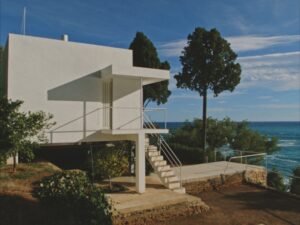
    Eileen Grey – the house at Roquebrune – Cap St Martin

    Minger’s film takes us into Gray’s inner circle, a tightly knit coterie of designers that included Fernand Lager, Corbusier and his wife Yvonne. Early on Gray in the film counteracts Corbusier’s theory that a house is ‘a machine for living’  considering it more spiritual than that: ‘A place you surrender to, that swallows you up. A place you belong to”.

    Gray and Jean Badovici dedicated themselves to building the E.1027 in the Roquebrune-Cap-Martin location between Monaco and Menton in 1925. Due to its rocky, cliff-hanging location, wheelbarrows had to be used to transport materials on site. Gray named the house: E for Eileen 10 for John Badovici but their idyll came to a close two years later when Gray sensed the winds of change: “I like doing things but I don’t like possessing them”. She had already bought another plot of land inland and her attention moved on to design a place in this  even more remote location.

    The film then broadens its focus onto ‘Bado’ and Corbusier’s relationship, with the French architect claiming Gray’s scheme for the house was copied from his own pen design. Marking the territory he built his own wooden Cabanon alongside a little bistro near to E.1027. But the Second World War put an end to the rivalry when the German Nazi soldiers occupied the Roquebrune house riddling the walls with bullets.

    In the title role Natalie Radmall-Quirke smokes her way through this intimate portrait of the artist who appears both a victim of her deep emotions and the driving  force behind her lover Badovici – in one scene a graceful dance is testament to their feelings for each other. After leaving the house Gray was forced to contend with Corbusier’s arrogance, although he appears to redeem himself by trying to find a buyer for the Roquebrune house, eventually it was sold to Swiss artist Marie Louise Shelbert who misguidedly thought Corbusier was the architect. Gray organised a funeral for Badovici but no one came.

    Family money and her strong work ethic clearly allowed Gray to remain financially independent all through her life although there is never any mention of commissions outside her own designs: many of her schemes never left the drawing board until later recognition, and although her furniture now sells for astronomical prices: her chrome Adjustable Table. E.1027 is one of the flagships of modern classics in furniture history (www.smow.fr/eileen-gray/adjustable-table-e-1027.html )The famous house had a less illustrious ending. In a final interview Gray finally appears in her nineties, emerging as an appealingly decent woman without a shred of ego.


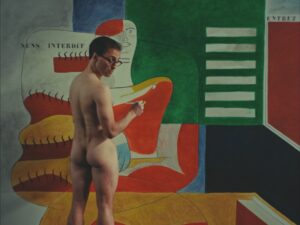
    E1027 – Murals by Corbusier


    EILEEN GRAY AND THE HOUSE BY THE SEA which will celebrate its world premiere at CPH:DOX 2024 (March 13-24, 2024) in Copenhagen as part of the INTERNATIONAL COMPETITION programme.


  • Ronel Lehmann on 2Veneti: “right up there with the best”

    Ronel Lehmann on 2Veneti


    As I was making my way to join a senior colleague in this Wigmore Street restaurant, my thoughts abruptly turned to a breaking news alert on my mobile phone that a new satellite is now able to detect emissions of methane, an invisible yet potent gas that is dangerously heating the planet.

    It reminded me that the day before I had succumbed to a Jerusalem Artichoke Velouté at Coq d’Argent, a French restaurant perched high up in the heart of the city. The significant side effects of dietary inulin fibre apparently is a contributory factor and the cause of flatulence.

    To my abject horror, I noticed that my host had one of her two wrists in plaster. The greeting at 2Veneti is “Magna e Tasi, Bevi e godi” which translates to “Eat and shush, drink and enjoy.” Although I was immediately made to feel at home, I was concerned about whether I would be required to cut up her food as clearly operating with one hand in 2Veneti was going to be challenging. There was real trattoria décor and character in the restaurant which filled up quickly with the lunch service.

    Although we were supposed to be working afterwards, the owner charged our two glasses of wine to accompany our meal. My colleague enjoyed a glass of Lugana di Sirmione. Avanzi. 2022 Veneto, Turbiana grape, which she remarked was rounded with a pleasant generous velvety taste. From lake Garda I myself enjoyed the Bardolino Chiaretto. Cavalchina 2022 Veneto which was a Light pink Bardolino, Provence in style, smooth and elegant.

    A bread basket of focaccia was served and it was light, airy and Moorish. My colleague began by ordering Carpaccio di Manzo con maionese al Parmigiano e tartufo nero, beef carpaccio with parmesan mayonnaise and black truffle whereas I chose the vitello tonnato, thinly sliced veal with tuna, capers, mayonnaise and pickled onion. Both starters were delicious and beautifully presented.

    As the plates were cleared, I noticed that my colleague was managing to eat the food very respectfully. I asked the owner about the name 2Veneti. He responded that there were two original partners from Venice, hence 2Veneti. A simple and plausible explanation which made perfect sense.

    The ravioli del plin con fonduta di formaggi arrived. This was baby ravioli filled with beef and cheese fondue. I decided not to have the black truffle sauce and was encouraging the waitress to provide additional aged Parmigiano-Reggiano which she readily obliged.

    My colleague enjoyed a plate of gnocchi di patate fatti in casa con radicchio e formaggio Monte Veronese, a wonderful homemade potato gnocchi with radicchio and Monte Veronese cheese.

    No Italian meal is without a resplendent bowl of zucchini, and we shared a giant helping together. The pudding menus arrived, and we decided to share a pistachio and vanilla ice cream.

    When you think of the great Italian restaurants in London, you might be minded to mention The River Café, Sartoria and Santini. 2Veneti is right up there with the best. The service is welcoming, friendly and efficient. Regulars in Marylebone and Mayfair will tell you it is a best kept secret. I cannot wait to try the other dishes when I return. Hopefully the satellite picked up the heat of our smiling faces as we returned to the office.

  • Friday poem: ‘Plan of Attack’ by Jude A. Jung

    Plan of Attack


    Best in these short days, where silence is,

    and darkness lasts, to create little beginnings,

    like the rustle of the mouse in the hedges.

    Winter requires circumspection: small songs

    can give immense colour to what has none.

    Your masterpiece, that might be for spring:

    to sketch it now is better than a fast intention

    begun bleakly, which will reek of your rushing,

    and have a sort of odour of winter’s despair,

    a too rapid response to the exhaustion

    which happens when the light isn’t here.

    An auspicious day is coming soon.

    Patience, then. Stretch the canvas, don’t mark it.

    Be alert. This is the world about to undarken.

  • Roger Bootle on AI interviews – and why he prefers interviewing in person

    Roger Bootle


    The whole question of AI interviews is a bit like warfare really. Every technological advance on the side of offence is met by technological advance on the side of defence. Similarly, there are now algorithms that prepare candidates how to approach AI interviews.

    I suppose in the early stages of the interview process there is something to be said for going down this route, although I must say it is completely against my own instinct. When I was actively running Capital Economics a lot of my time was taken up interviewing people which was one of the most important jobs that a CEO like me could do in a small firm to make sure that the people were really good. In those days, I was aware that what I was looking for wasn’t necessarily straightforward so I would have loathed giving up that initial sifting to AI. For a start you get a bunch of paper CVs in and I could tell very quickly whether a person was plausible or not.  I could sift very quickly. When you come to the next stage, and you have got rid of all the implausible applications, you certainly wouldn’t want an AI algorithm at that stage.

    Really it goes back to this whole question of being human: although a lot of people will resist this, particularly in small organisations, hirers will be very motivated by whether they think they can get on with this or that person. This is especially important in a small outfit, though I accept things might be different for a bigger company. If you are working at close quarters in a small company and you really don’t like a person, that’s an important negative. How is your algorithm going to pick that up?

    It’s quite possible therefore that AI interviews will never really take hold for smaller companies. Whereas with those big companies, where there are hundreds if not thousands of applicants, that basic stage could be very time-consuming so employers might find it efficient to get AI to tackle that. You might miss the occasional good person and let through the occasional duffer but you can sort that out later. In a small company, this sort of thing matters so much more.

    For reasons I won’t go into, I happen to own a pet shop and dog grooming salon. It’s a niche business, and so it’s very difficult to recruit staff. We happened to need a new manager,  and we advertised for the role. The manager is critical – a good manager will take the burden off me and make the business thrive. It was 2020, and I happened to be in France and I conducted the interview by Zoom. I rejected the candidate who everybody else thought was the best of the bunch, and hired someone over Zoom who turned out to be a disaster. Zoom obviously isn’t AI, but it is similar in that I didn’t have the sort of human contact that I would normally have in an interview process of meeting someone in person.

    In a similar vein, there is also a fair amount in my book The AI Economy about education. Some AI enthusiasts say that there aren’t going to be any teachers any more because people can learn remotely from various programmes and so forth. I strongly reject this idea. I would recommend Sir Anthony Seldon’s book The Fourth Education Revolution. According to Seldon, there is scope to use AI a lot in the education process, but the system of the teacher standing up in front of a class of sometimes hundreds of people and the students taking notes is ludicrously antiquated.

    Instead, I suspect education will proceed along the lines of the tutorial system whereby we will have more one-on-one sessions which are about discussion and interaction, in addition to seminars where you have got a small number of students discussing and interacting. Under that system the ratio of teachers to pupils or students in aggregate may not change that much but the ratio in individual teaching sessions will change dramatically.

    AI won’t change our lives anything like as much as the enthusiasts claim because we’re human beings and we will always crave some degree of human contact across every area of our lives.


    The AI Economy by Roger Bootle is published by Hachette UK and priced £20


  • Father Ted creator Graham Linehan: “The button has been reset and I’m back to being incredibly frightened”

    George Achebe interviews the sitcom writer and comedian about life on the frontlines of the culture wars

    Graham Linehan is tall enough to be unmissable as he walks into Berners Tavern, a place of almost unbearable trendiness in the London Editions hotel, just off Oxford Street. Having chosen the restaurant, I realise that I have caused him to walk in and around Soho – not necessarily a place likely to be friendly to him given that it’s a wokeness heartland and Linehan, in another lifetime the popular creator of sitcoms such as Father Ted, Black Books and Motherland, has carved out a place in our culture as a critic of wokeness in general and the transgender movement in particular. I have brought him to the lion’s den – but at least he gets to eat a meal by Jason Atherton.

    To put it mildly, Linehan is under fire. Really, he has found himself – partly by volition but with a large measure of accident – at the front lines of the so-called culture wars. “It’s been tough,” he says, looking like he needs a hug.

    How did he get here? For Linehan, it all began when JK Rowling published a blog on her website which seemed to most people relatively anodyne, but which in our current predicament as a polarised society, caused a pantomimic storm on what was then Twitter. It cannot be gone into in serious depth here, except to say that Rowling explained her position as a feminist accused of being a TERF (trans exclusionary radical feminist) at some length and with measured thought. It is probably false to say that she had chosen to oppose the transgender movement; really she had reserved her right to question it.

    Among her five reasons for doing so was this: “I’m concerned about the huge explosion in young women wishing to transition and also about the increasing numbers who seem to be detransitioning (returning to their original sex), because they regret taking steps that have, in some cases, altered their bodies irrevocably, and taken away their fertility.”

    Linehan – who has a daughter – sought to organise support, and circulated a letter which was signed by the likes of Sir Tom Stoppard, Lionel Shriver, and Ian McEwan. “Stoppard was great. He signed the JK Rowling letter. He has never really weighed in on the issue; he has never really spoken about the effect of removing single sex spaces.” So why has Stoppard, as an example, not been singled out? “The better informed you are about the transgender the more trouble you get into,” he says with a sigh. “He’s probably not that well-known among the young and he is quite cerebral. But who wouldn’t sign that letter?”

    I can see that Linehan is vulnerable; his body language is passive and dejected. He has reason to be. In a sense, he has no regrets, but he also, he says, radically underestimated what the reaction would be to a letter he viewed, and still views, as non-controversial. You can see straightaway that, unlike other anti-wokeness campaigners – Dave Chappelle, Ricky Gervais, Rowling herself – Linehan doesn’t quite have the personality for a protracted fight. He is also, of course, much less wealthy than they are, and without the assured income streams that devolve from the Harry Potter franchise, The Office, or Chapelle’s Netflix specials.

    “I am really worried about my security,” says Linehan. “I am very vulnerable financially and desperately hoping the book does well enough to dig me out of a hole.”

    The book he’s referring to is Tough Crowd: How I Made and Lost a Career in Comedy, recently published by Eye Books. It’s an excellent read, beautifully written and extremely affecting. It is a sort of diptych, its first half recalling with charming nostalgia his early career as a rock journalist and then as a writer of beloved sitcoms. It is a book which proclaims the importance of comedy as an art form, and will be of value to anyone considering a career as a TV writer. At one point he imagines himself being hounded by trans activists like ‘an evil Beatles’ and when I quote the line back at him approvingly, he smiles. I can see that he’s pleased. The original intention of his career was to make people laugh, and it’s this really which still animates him. This detour into the culture wars must feel very gravid to someone who cares so much about the mechanics of laughter.

    Tough Crowd is a funny book – but especially, it’s wise about being funny, which is a different thing. So how has he found publishing the book? “I’ve found it unbelievably hard. I am finding it really upsetting. Writing it was very much a release; it was great to get all the stuff down on paper. As I was going along, I weaned myself off the anti-anxiety medication I was on because getting it all down on paper was helping.” However this positive period has ceded to the experience of publication, with Linehan under fire again. “I just feel that the button has been reset and I am back to being incredibly frightened and shell-shocked by the whole thing.”

    The trouble Linehan faces is that while 95 per cent of the country may agree with him, or at least have some sympathy with his views, it’s the five per cent who don’t with whom he needs to work in order to secure an income. He is especially upset that his Father Ted musical, which he regarded as his pension, has been put on hold by Hat Trick Productions, for reasons which seem to be spiteful.

    Linehan explains: “That five per cent is united as casting me as either obsessive or abusive or whatever it happens to be and that five per cent is also hiding my books in bookshops. I have heard multiple reports of that since we snuck onto The Sunday Times Top 10.”

    This is shocking – and obviously upsetting to him. I decide it might be my role to cheer him up and improve his mood, and seek to turn the conversation round to comedy. So how does the writing process work for Linehan? “I just sit down and start typing – but rewriting is my favourite part in sitcoms and in books too. It’s such a pleasure just going over and over something. I heard someone say a writer is a sculptor who makes his own clay – the clay being the first draft. That’s a very good way of looking at it. I used to think of first drafts as if they worked great but if they didn’t that was fine too because it was like an arrow pointing the way, and once I knew what way we should go, everything became much simpler.”

    When he is thinking about these things, you can see what good company he is – how much he has to impart, and that his career has been earned as a result of an enormous amount of hard work. The trouble is the culture wars keep exerting a sort of gravitational pull on him, and we’re continually drawn back to the enormity of what’s happening. At one point, Linehan mentions Christopher Hitchens, and I ask him what he would have thought about the wokeness movement. “It wouldn’t have got as far – I don’t think it would have got as far.” This seems to place a lot of power at Hitchens’ elbow – but it’s plausible.

    The Internet has a particular fascination for Linehan, who tweeted happily under the @Glinner handle – but Twitter eventually came for him and he had his account banned in the pre-Musk era. “I remember in the early days I was such an evangelist for Twitter: everything’s going to be great,” he recalls. “We could connect and we could all share information and ideas. I now realise what an incredible organising tool it is for frightening people.. People have this idea that Jimmy Savile was some sort of creature that could be killed: he’s not. He is still around. He is everywhere. What he did was to make the best of his much more limited opportunities by becoming a DJ by having access to kids charity work all that sort of stuff – but now you don’t need to be a high achiever like Savile to get access to kids. You can just change your pronouns and wander in behind someone in the toilet.”

    I ask him if the gender critical movement could be more united. How often for instance does he talk with JK Rowling? I am surprised by the response: “She has never said a single word to me.” How does he feel about that? “I didn’t do it to get thanks from her. I did it because I think it is right. She is on her own track and is doing great work and I am on mine.”

    Shouldn’t his side of the argument join up more? Linehan sighs: “The whole thing is so fractious. One of the things I remind people sometimes is that I am not a feminist. I am someone who is fighting for my career, fighting for my daughter’s rights. I am not really a feminist. I’m not part of that world and the thing about feminism is it’s incredibly territorial and there are so many wars going on at any one time. The gender critical movement has done really well in staying as united as it has despite all these tensions but it’s tough sometimes.  I try and stay out of it.   I say I’m not part of these discussions. One of the nice things about radical feminism is they say that you cannot be a man and be a feminist. I think that’s a brilliant rule: it means that we can help, and offer observations – but in the end we’re men.”

    Linehan detours into particular example: “At the moment I am defending this lesbian who has been running speed dating nights and recently decided to admit no more trans-identified men: the trans activists went for her. Now when she puts on these nights, they infiltrate them. Now, she is under fire from our own side and being accused of fraud. It’s incredible this vitriol she is being subjected to and it’s based on nothing but on pure rumour.  What happens every so often is this feeding frenzy that goes around aimed at people who are brave enough to stick their head above the parapet.”

    When I speak to a prominent gender critical activist, who asks to go by the pseudonym Jessica Freeman, I find her broadly supportive. “I really appreciate everything Graham’s done.” However, she also draws attention to the differences between Rowling and Linehan. “Rowling is very judicious about who she supports and what she says publicly. I hate to say it but I do understand why she’s not said anything to him or about him as some of the things he’s said on Twitter have been rather rash and extreme. But it may simply be that the opportunity has not arisen yet. She does tend to keep her head down for months on end and then makes a surprise appearance with a few carefully worded tweets. We shall see. I do hope Graham is ok though. It must be hard.”

    I ask what tweets Freeman would single out as having been problematic. “He can be overly aggressive, very defensive (understandably) and I know that calling people ‘groomers’ [this is a putdown Linehan has used on Twitter when dealing with his critics] hasn’t gone down well with some women. And there was an incident a while ago where one of his online pals – Arty Morty – was particularly sexist and Graham defended him. I genuinely think it was an inadvertent slip but lots of women at the time were saying: ‘Oh you’re just another man defending sexist men’. He can’t win.”

    He does seem alone. I ask him briefly if he’s seen Coogan’s superb performance as Savile – he hasn’t – and I then wonder aloud where the people he’s worked with – Coogan and Armando Iannucci – are when he’s being attacked. “It’s partly my fault,” replies Linehan. “I was never very good at tending relationships. I was never particularly close to these people at the best of times – and now these are the worst of times. I just figured they have got their own lives and didn’t need to hear from me. What I find kind of strange is how these extremely political people like Steve, like Iannucci, are just completely ignoring this issue.”

    This is very diplomatic, but Freeman is prepared to be frank. “They’re nowhere to be seen. Did you see the abuse thrown Richard Ayoade’s way for simply endorsing Graham’s book on the front of the cover? Left-wing comedians and writers are too afraid that they will be treated like Graham so they don’t say a word. They’ll say something when it’s not dangerous anymore and everyone agrees that children are being harmed.”

    When I put this viewpoint to Linehan, he says: “I just feel like it wouldn’t take too many voices saying ‘Hang on’. They won’t be able to cancel Armando Iannucci. They won’t be able to cancel Steve Coogan.”

    One star Linehan singles out is the trans comedian and actor Eddie Izzard. “He has been incredibly arrogant and I have never seen such out-of-control ego in a star. I met him a few times, the first time while he was becoming well-known as a cross-dresser and I remember wondering why he kept bringing it up. That is part of his fetish – to put it in your face all the time.”

    Given that Linehan is under considerable pressure, how does he cope? “The way I sometimes reassure myself is to remind myself that this is a historical moment. Sometimes ordinary people get chewed up in it – which is what is happening. All my friends have been cancelled, lost their livelihoods, lost their businesses. It’s just history chewing them up.”

    Still, it probably doesn’t feel great to be chewed up – especially, for his marriage to have fallen apart. I don’t ask him about this – it feels too awful to contemplate and moreover is none of my business. Instead, I ask him about possible revenue streams to tide him over? The income from his sitcoms, he says, has reduced over time, since payments were structured around a tapering fee arrangement. A column in The Mail or The Telegraph? “I’ve been thinking about that. I would like to.” Speaking engagements with businesses? “I haven’t really looked into that. Part of my problem at the moment is that I am really exhausted, and I am kind of on edge at the moment because of the publicity.” Does his standup make any money? “I can’t at the moment. I could possibly do OK if I could get a venue to put me on regularly.”

    All of which feels fairly bleak, but when we return again to a discussion of comedy, and the architecture of a laugh, then things revert. Linehan is also a great anecdotalist. “I have a great story about John Cleese during The Fish Called Wanda phase. Dawn French got a phone call saying: ‘John Cleese wants to meet you for lunch’. And everyone knew at that time that the film was casting so she is beside herself with excitement. The big day comes and she meets him probably somewhere like this and he says: “Let me tell why I’ve got you here today. I have a problem in that I really despise younger comedians and my therapist has told me that I should meet them and tell them how I feel.”  Dawn French goes back home to Lenny Henry who also has a meeting with him coming up. She says: ‘You might not want to take that meeting. He is just going to tell you how much he hates you!’”

    But Linehan is at pains to point at out that as a young journalist he interviewed Cleese and recalls: “He was lovely. I was only 19 years’ old and he answered all my questions and was forgiving when I asked stupid ones.”

    Another positive is Jonathan Ross, who, like Ayoade, has braved opprobrium and endorsed the book. “Jonathan was probably one of the only heroes involved in my story.  He is the only one that reassured me that I was right and he was the only one that tried to help when my marriage was breaking down. He let us use a place of his to stay in for a little holiday: he’s a very kind man. But then he was an early victim of cancellation: I think he saw it coming before anyone else did.”

    All in all, Linehan’s is a fight which keeps opening up onto the absurd. “There is no authority here unless you count Judith Butler,” he says, referring to the waffly academic high priest of gender studies. “Judith Butler is the Charles Darwin of things that don’t exist.”

    Yet for all his anxiety and complexity, I feel a sense of protectiveness towards Linehan. He has strong views of course, but he has hurt nobody, and been terribly abused in return: such people are always on the right side of history. In the end, in the part of us that matters, we all want each other to be okay. For us to function as a society that has to extend to those with whom we have disagreements. Right or wrong or somewhere in between, we’re all vulnerable. To meet Linehan is to think, is to know, that we’ve got to do better than this.

    https://www.eye-books.com/books/tough-crowd

  • Friday poem: Omar Sabbagh’s ‘The Ghost’

    The Ghost


    In the corner of the room

    a cheap white frame; the picture inside

    shows an aged man, minted there

    with a brimming sense of achievement, calmed

    by a certain slow and quiet pride.

    My daughter kisses the picture

    now and then, scurrying to that small corner

    whenever trouble threatens.


    The man there has seen it all before,

    how each one of us holds his own white sky,

    letting it fold upwards into each one of his own dark eyes;

    how each one of us elides the fateful missive sent

    him, an opened secret from above or below;

    how each one of us living speaks

    in stillness to himself as though he were a ghost

    already, a spirit seeking to prick the fabric

    of the world he’s left behind,

    hoping to needle the place it was that long ago

    he’d signed with departure.


    And between the two,

    this framed wiseacre and my daughter,

    I see my life past each day’s silent slaughter

    turn in style between white and grey,

    framed by the two known sides of love.


    Omar Sabbagh


  • Claire German: A Tour of Design Centre Chelsea Harbour in 8 Objects

    Claire German


    Design Centre, Chelsea Harbour is a worldclass example of placemaking, its famous glass domes synonymous with design and decoration. The international design destination in London helps people discover great design and supports those doing it best: from big name brands to emerging makers, as well as highlights the skills they use to make pieces of lasting value. The mission is to champion creativity, entrepreneurship and business, representing the very best that design can offer. Today, the mix of luxury flagships, independent companies and some 600 international brands can be found, all at one address. Now the next chapter of the story is being written and more global names are moving in. Change and growth are a vital part of what the Design Centre stands for – fostering talent, and continually building on its thriving community, are part of its heart and soul.

    The Design Centre hosts two flagship events each year to celebrate the new collections from the showrooms. London Design Week takes place every March to showcase spring summer whilst Focus is held every September to unveil the autumn winter showstoppers from the Design Centre’s roster of international brands. Alongside the new collections, the industry and design enthusiasts alike also look to these shows to understand what the design directions for the seasons ahead will be. Following weeks of investigation and sneak peeks at the new fabric, wallpaper and furniture collections, the Design Centre’s creative director Arabella McNie and wider team identify common threads such as new textures in weaving, new patterns and motifs, and colour palettes, ultimately using these directions to form the creative shoot, the branding and the graphics for the next show.

    The design directions give us a fantastic opportunity to showcase some truly standout collections and products and the stories behind them, which adds another layer of appreciation for the incredible talent and craftsmanship present at the Design Centre. Below, Design Centre, Chelsea Harbour have outlined the directional styles for spring summer 2024, telling the story of each one through a specific wallcovering, fabric, product or objet that really epitomises the look and feel of that trend.

    To see these pieces in person, visit London Design Week 2024 between Monday 11 – Friday 15 March where all interior design aficionados are welcome.


    1.     The Palette of the Season



    ‘Mughal Painting’ rug at Wendy Morrison

    This spring summer, design houses are showcasing decorative and dreamlike fabrics and wallcoverings that are curated for those with the sweetest palettes. From pistachio and sage to lemon to lavender and lilac, these colours set the backdrop to a whimsical season ahead.

    A new launch that we must highlight in line with this pastel moment, is the new ‘Mughal’ Painting Rug from Wendy Morrison, whose brand features maximalist rugs, textiles and wall coverings. Wendy Morrison will be moving to a larger showroom at Design Centre, Chelsea Harbour in the coming months.

    The ‘Mughal’ rug is a wool and silk hand-knotted heritage rug, which celebrates Mughal art and the tradition and joy of visual storytelling.  Inspired by the Mughal miniature paintings of the 16th century, Wendy Morrison was drawn to the bright, pure colour, level of detail, links to the natural world, and storytelling, at the heart of this ancient art.

    One of the most significant colours in the rug – lilac – is the shade associated with the Crown Chakra, the energy centre with a connection to spirituality and enlightenment. This lilac hue is certainly a dominant colour across spring summer 2024 collections and therefore inspired the Design Centre team in choosing the branding for London Design Week 2024 which features both lilac and aqua tones.


    2.     ‘Bloomsbury’ design direction



    ‘Pheasant’ lamp by Bunny Williams x Paolo Moschino at Paolo Moschino


    A key design direction to highlight for SS/24 is ‘Bloomsbury’ which pays homage to the Bloomsbury creatives who lived and worked during the early 20th century. The group believed in creativity, innovation and beauty but it is their sense of fun and freedom that Design Centre showrooms are really celebrating for spring summer 2024.

    Lighthearted rather than studied, there is always a sense that there has been enjoyment in putting a Bloomsbury look together.

    Much like the interior in Charleston Farmhouse itself or the inspiration behind Kit Kemp’s Charlotte Street hotel, this design direction is layered, eclectic and thoroughly charming. It’s about filling your home with beautiful things, seeing furniture as art and painting every available surface!

    Perfectly epitomising this direction, we must mention the ‘Pheasant’ lamp from the new collaboration between Bunny Williams and Paolo Moschino which sees two design titans come together to celebrate their unparalleled expertise in design sophistication.

    Known for balancing refined beauty, welcoming liveable appeal, and attention to detail in their interiors, the evolving collection from Paolo Moschino and Bunny Williams includes furniture, artwork, and accessories geared towards outdoor living and crafted from materials like wicker, teak, metal, and stone.

    See Bunny Williams and Paolo Moschino in conversation with Hatta Byng, the editor of House & Garden, on the mainstage as part of the London Design Week 2024 talks programme.


    3.     ‘Enchanted Isle’ design direction
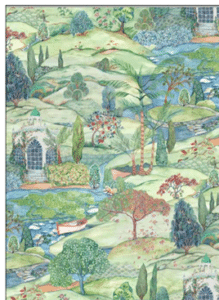
     

    ‘Lodhi’ fabric, Byzance collection at Osborne + Little

    It is no surprise that a connection with nature has been a recurring theme in interior design, however, this season, there is a charming twist.  The ‘Enchanted Isle’ design direction takes the eye on a journey to imaginary places.

    Here, we must give special mention to the Byzance collection from Osborne & Little (the ‘Lodhi’ fabric from the collection is pictured above) which feels as if it is setting the scene for a fairytale. Printed and embroidered fabrics in this collection draw inspiration from the decorative cultural arts. Each fabric tells a distinctive story, from ornate patterns reminiscent of Indian artistry to playful motifs capturing the essence of nature.

    A giant in the decorating world, Osborne + Little opened their Design Centre showroom doors at the in the summer of 2023 bringing their classic with a contemporary interpretation design philosophy to the Design Centre.


    4.     ‘Abstraction’ design direction’
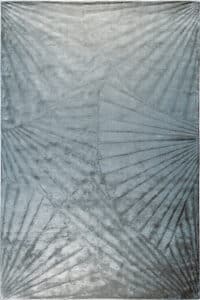


    ‘Ori Lake’ by The Rug Company


    The ‘Abstraction’ Design Direction is all about taking the essence of something and really distilling it down to abstract forms. In many instances, with a painterly brush stroke effect.

    A natural extension to the focus that has been on Bahaus design in recent seasons, this design direction celebrates mixing ovals, circles and abstract lines. Much of the furniture in this direction nods to angular edges whilst the wallcoverings and fabrics feature an arbituary arrangement of abstract shapes in a largely neutral and earthy palette, with joyous accents in warm shades – hot yellows, rust and moments of sage, petrol and pale blue.

    The Rug Company’s ‘Ori Lake’ rug, pictured, embodies this design direction with its abstract shapes. Crafted entirely in silk, the ‘Ori Lake’ rug features fan-like forms that showcase traditional hand carving techniques.

    Founded in 1997 with the belief that luxury is determined through respect for craftsmanship, community and innovative design, The Rug Company is one of several exciting new showroom openings at Design Centre, Chelsea Harbour in 2024. With three stacks of rugs showcasing core collections, the new showroom will also be home to a new project studio dedicated to creating bespoke designs.

    5.     ‘Palm Beach’ design direction
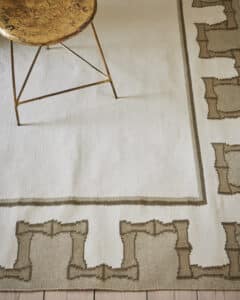


    ‘Greek Cane’ rug, mustard, by Salvesen Graham x Jennifer Manners at Jennifer Manners

    Renowned US designer Mark D Sikes describes the Palm Beach aesthetic as ‘classic but with a bit of drama’ and looking ahead to spring summer 2024 and the offering from the Design Centre showrooms, there is an abundance of this style.

    Perhaps best summed up as ‘Old World Charm with a Tropical feel’, think sumptuous interiors with an airy twist – the homes of Estée Lauder and Gloria Guinness spring to mind.

    Playful and fresh, there’s lattice, fretwork, rattan and a sense of indoor/outdoor that suits the glamorous lifestyle of Palm Beach socialites as they entertain on their lawns. This is perfectly embodied in the upcoming Salvesen Graham x Jennifer Manners rug collection, the second collaboration between interior design duo Salvesen Graham and Design Centre showroom Jennifer Manners, following their hugely successful scalloped rug collection in 2018.

    They say ‘great minds think alike’, and the Design Centre certainly has seen a flurry of collaborations in recent years – from fashion houses to interior design stalwarts working alongside established names to create new products. There are plenty of star-powered licensed collections making a splash, but there is also evidence of exciting micro collaborations and one-offs too. London Design Week 2024 will showcase an array of Design Centre showrooms partnering with international tastemakers such Paolo Moschino with Bunny Williams, Arteriors with Laura Kirar, GP & J Baker with Kit Kemp and Sanderson Design Group with Giles Deacon.


    6.     ‘Tesselate’ Design Direction



    ‘Step’ fabric, Kirkby Design at Romo

    This design direction is titled Tessellate and, as the name suggests, it is all about repeated patterns. There is a particular abundance of diamond and triangle shapes. From micromosaic designs to grand scales found in villas and cathedrals, this design direction plays with scale and takes inspiration from all forms of tile inspired motifs.

    Pictured is the ‘Step’ fabric which is from the Kirkby Design brand at Romo which very much plays into geometric, repeating patterns of the direction.

    Situated in one of the Design Centre’s largest showroom spaces, Romo is a British family-run business in its fifth generation. The company has grown to become an international market leader in designer fabrics, wallcoverings and accessories. The Romo Group now has six in-house brands – Romo, Black Edition, Kirkby Design, Mark Alexander, Villa Nova and Zinc Textile – and is renowned for the highest quality of product and design.


    7.     ‘Spice Route’ Design Direction


    The Design Centre have titled the next design direction ‘Spice Route’ as it creates the sense of journeying from east to west to some exciting vistas and far off lands. The palette for this direction ranges from caramel to nutmeg to olive shades.

    ‘Spice Route’ is for the well- travelled individual who has a home that is full of nomadic weaves and treasures they have collected along the way. The ‘Camel Table Lamp’ by Porta Romana is the perfect example of a London Design Week launch that is brimming with character.

    Porta Romana recently celebrated their 25th anniversary and marked the occasion by reissuing some of its most loved designs. With a flagship showroom at Design Centre, Chelsea Harbour, Porta Romana has collaborated with a roster of starry design names over the years, from Kit Kemp, to plaster artist Viola Lanari and Martin Brudnizk.


    8.     Hot Tropics



    ‘Mar Centrepiece’ Arteriors x Laura Kirar at Arteriors

    Much like a crackling fire, the Hot Tropics design direction is bursting with sizzling design and a warm palette. Elaborate and intricate, many of the designs within this direction are reminiscent of basket weaving techniques. This is perfectly embodied in the Laura Kirar x Arteriors collection which features a Mar chandelier, floor lamp, tray and the pictured centrepiece.


    An internationally renowned interior & product designer as well as a sculptor, Kirar joined forces with Arteriors to create a collection that reflects late summers on the mediterranean coast. The collection will be launched at London Design Week 2024 where Kirar will be present to host a special event at Arteriors’ recently expanded and revamped showroom in Design Centre East.


    Free to register, secure your place at London Design Week 2024 and see the new collections in-person alongside a packed calendar of workshops, masterclasses and talks:

    LDW24 Registration